Do weight-loss shots extend your life?
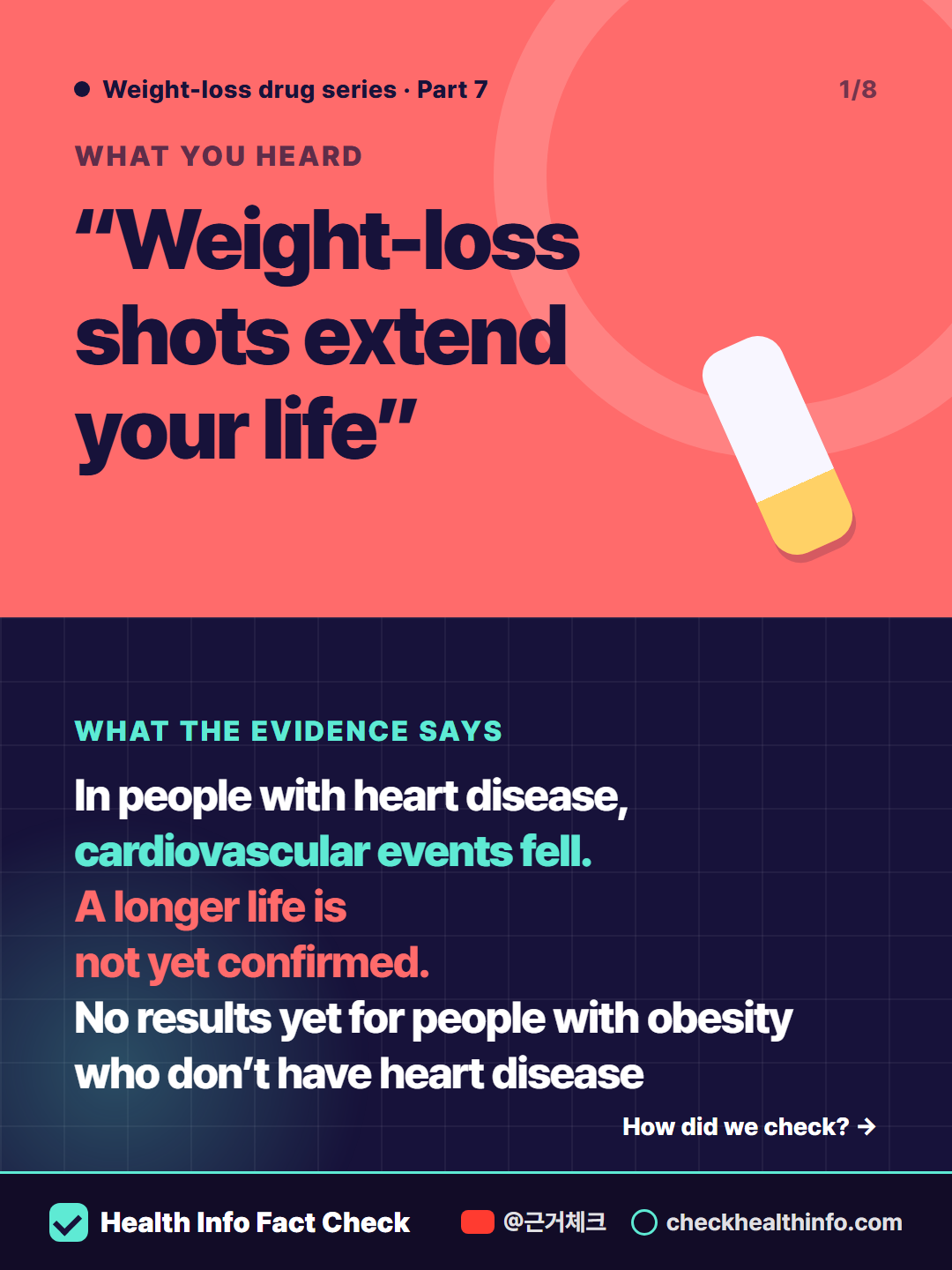
Do weight-loss shots (such as Wegovy) help you live longer?

We checked this verdict against 12 sources, such as published studies and clinical guidelines. · How checked: Operator-approved
Verdicts at a glance
| Claim | Verdict |
|---|---|
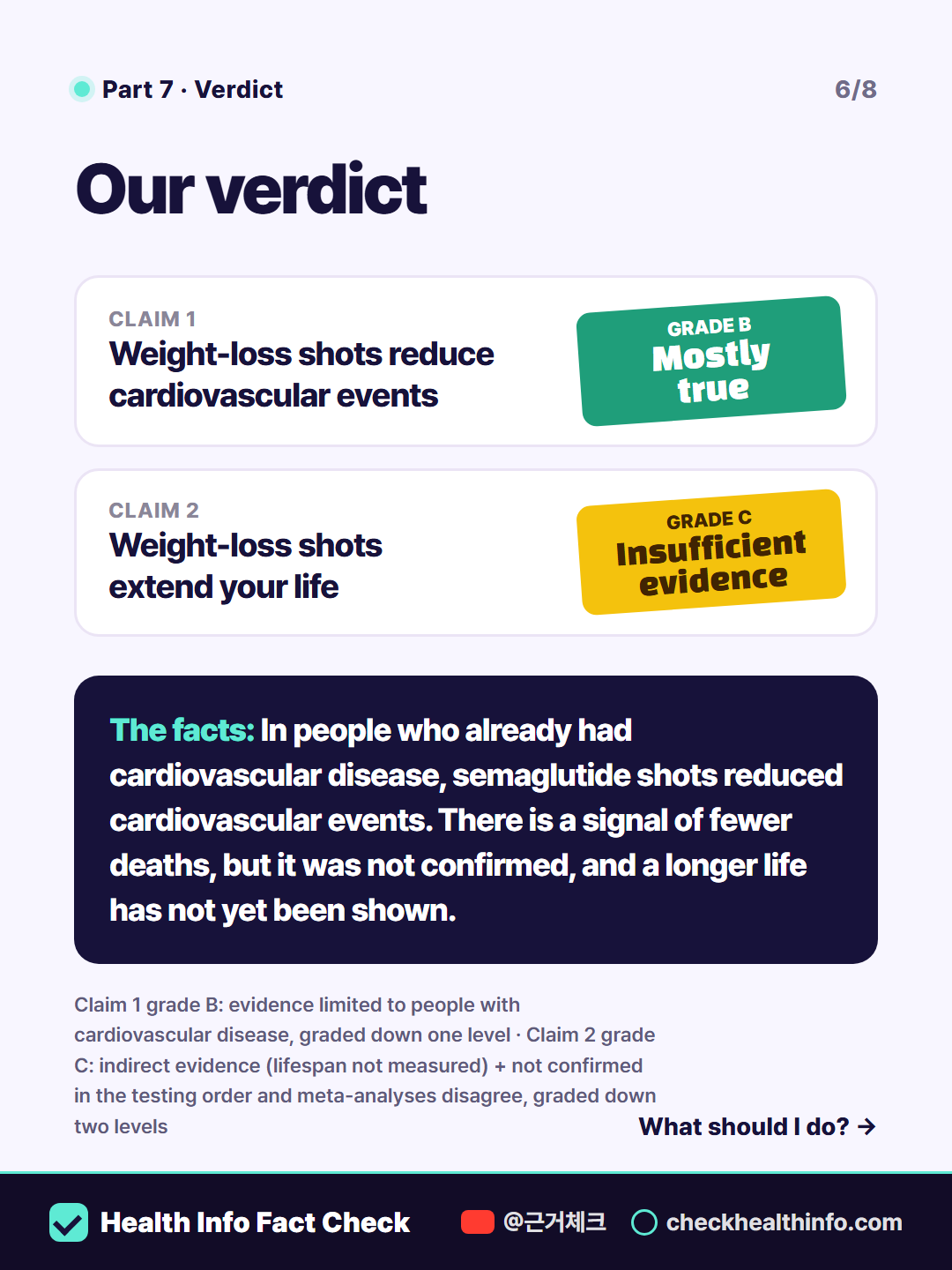
| Weight-loss shots (semaglutide, the ingredient in Wegovy) reduce cardiovascular events such as heart attack and stroke | Mostly true · Evidence grade B |
| Weight-loss shots extend your life | Insufficient evidence · Evidence grade C |
Bottom line — Semaglutide shots (2.4 mg; the ingredient in Wegovy) reduced major cardiovascular events — cardiovascular death, heart attack and stroke combined — in adults with overweight or obesity who already had cardiovascular disease (Mostly true, B). In the same trial, fewer people died from any cause, but this was not confirmed under the trial’s prespecified testing order, and no trial has directly measured how many more years people live. So the claim that weight-loss shots “extend your life” is still rated Insufficient evidence (C — this does not mean it is wrong). There are no such trial results yet for people with obesity who do not have heart disease. Talk to your doctor before starting or stopping the shots, and before changing any heart medicines you already take.
Major cardiovascular events (often called MACE, “major adverse cardiovascular events”) — A combined outcome of cardiovascular death, nonfatal heart attack and nonfatal stroke. A person counts as having an “event” when the first of the three happens.
Hazard ratio — A comparison of the risk of an event during follow-up between two groups. A value below 1 means the risk was lower in the group that got the drug.
Relative risk — The risk in one group divided by the risk in another. A value below 1 means a lower risk.
Odds ratio — A comparison of the odds of an event between two groups. A value below 1 means the odds were lower in the group that got the drug.
95% confidence interval — The range in which the true value likely lies. If it includes 1, we cannot conclude that there is a difference.
Prespecified testing order — When a trial looks at several outcomes, it sets an order before it starts, and a later outcome can be confirmed only if the earlier one is. This keeps chance findings from being reported as real effects.
Drug names — Semaglutide is the active ingredient in Wegovy and Ozempic; tirzepatide is the ingredient in Mounjaro. We name products only so you can tell which ingredient they contain; we do not recommend any specific product.
Claim 1. “Weight-loss shots (semaglutide, the ingredient in Wegovy) reduce cardiovascular events such as heart attack and stroke”
Mostly true · Evidence grade B
In plain terms Among people with obesity who already had heart or blood vessel disease, those who got semaglutide shots had fewer events (heart attack, stroke and cardiovascular death combined). But we have not yet found trial results showing fewer cardiovascular events in people with obesity who do not have heart disease (SURMOUNT-MMO, which also includes people who only have risk factors, is still under way).
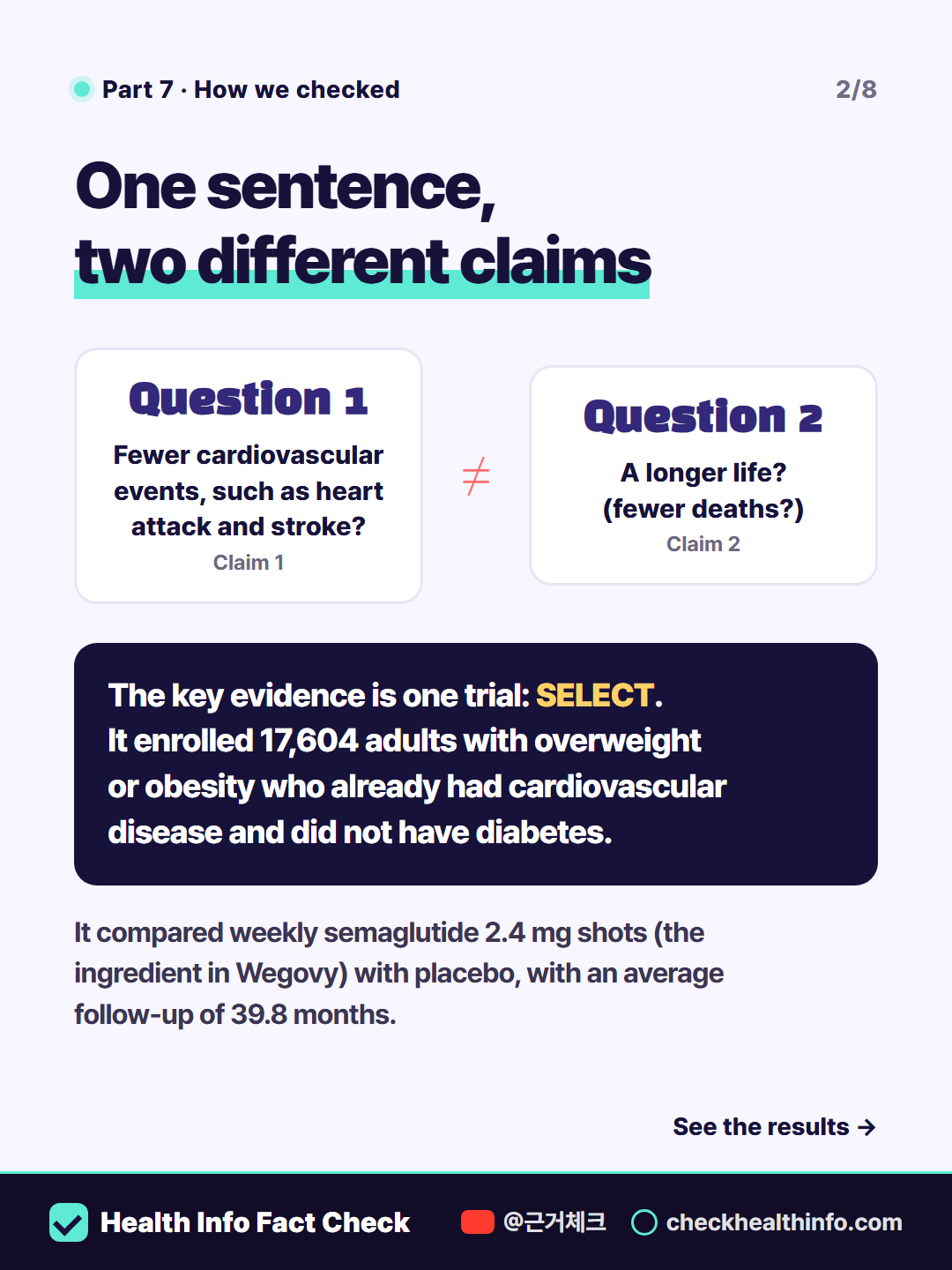
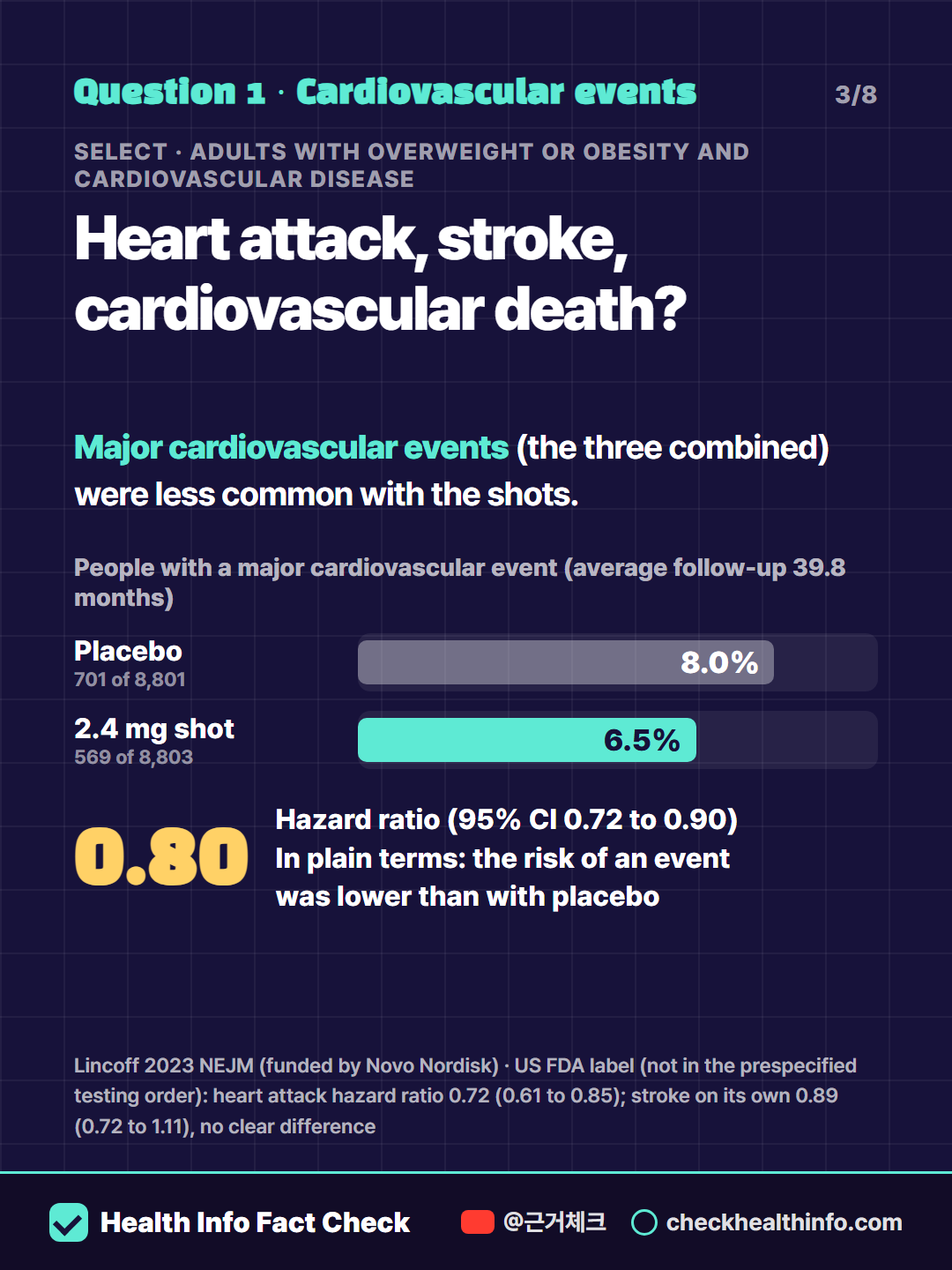
- The SELECT trial assigned 17,604 people aged 45 or older with a body mass index of 27 or higher, existing cardiovascular disease and no diabetes to weekly semaglutide 2.4 mg shots or placebo and followed them for an average of 39.8 months. Major cardiovascular events occurred in 6.5% of the semaglutide group (569 of 8,803) and 8.0% of the placebo group (701 of 8,801) (hazard ratio 0.80, 95% confidence interval 0.72 to 0.90). Permanently stopping the drug because of side effects happened in 16.6% of the semaglutide group versus 8.2% of the placebo group. The trial was funded by the manufacturer (Novo Nordisk). [1]
- In the detailed results from the same trial shown in the US FDA label, fatal or nonfatal heart attack occurred in 3.8% of the placebo group and 2.8% of the semaglutide group (hazard ratio 0.72, 0.61 to 0.85). Stroke on its own, at 2% versus 1.8% (hazard ratio 0.89, 0.72 to 1.11), showed no clear difference. These two outcomes were not part of the prespecified testing order. [8]
- In a network meta-analysis of 262 randomized trials of weight-loss drugs, semaglutide shots were associated with fewer heart attacks (relative risk 0.72, 95% confidence interval 0.61 to 0.85). But the authors noted that this estimate came mainly from cardiovascular outcome trials in high-risk people, so it should not be read as separate confirmation of the SELECT results. The authors also wrote that most weight-loss drugs did not show cardiovascular benefits. [2]
- Major cardiovascular events were also reduced in participants with a history of heart failure (24.3%) (hazard ratio 0.72, 95% confidence interval 0.60 to 0.87). [3]
- A meta-analysis of 22 tirzepatide (the ingredient in Mounjaro) trials reported an odds ratio for major cardiovascular events of 0.87 (95% confidence interval 0.79 to 0.94), but it mixed in trials of people with type 2 diabetes. The results of the tirzepatide outcome trial in people with obesity (SURMOUNT-MMO) are not yet in PubMed. [4] [7]
- The US FDA and Korea’s Ministry of Food and Drug Safety (MFDS) have also approved Wegovy shots to reduce the risk of major cardiovascular events in adults with overweight or obesity who have established cardiovascular disease. [8] [9] The European Medicines Agency (EMA) product page lists weight management as the use and refers readers to section 5.1 of the product information for the cardiovascular risk-reduction trial results [10].
The evidence supports the claim, but the people studied (those who already had cardiovascular disease) and the drug (semaglutide 2.4 mg shots) are narrower than the claim. That fits “Mostly true” under section 2 of our rating method. The grade starts at A because there are systematic reviews and a network meta-analysis. But those estimates came mainly from trials in high-risk people, and SELECT is the only trial in people with obesity that directly showed fewer major cardiovascular events, so the evidence is indirect for “everyone with obesity,” as the claim says. Under section 1 of our rating method (reason 1: indirect evidence), we graded it down one level to B.
Claim 2. “Weight-loss shots extend your life”
Insufficient evidence · Evidence grade C
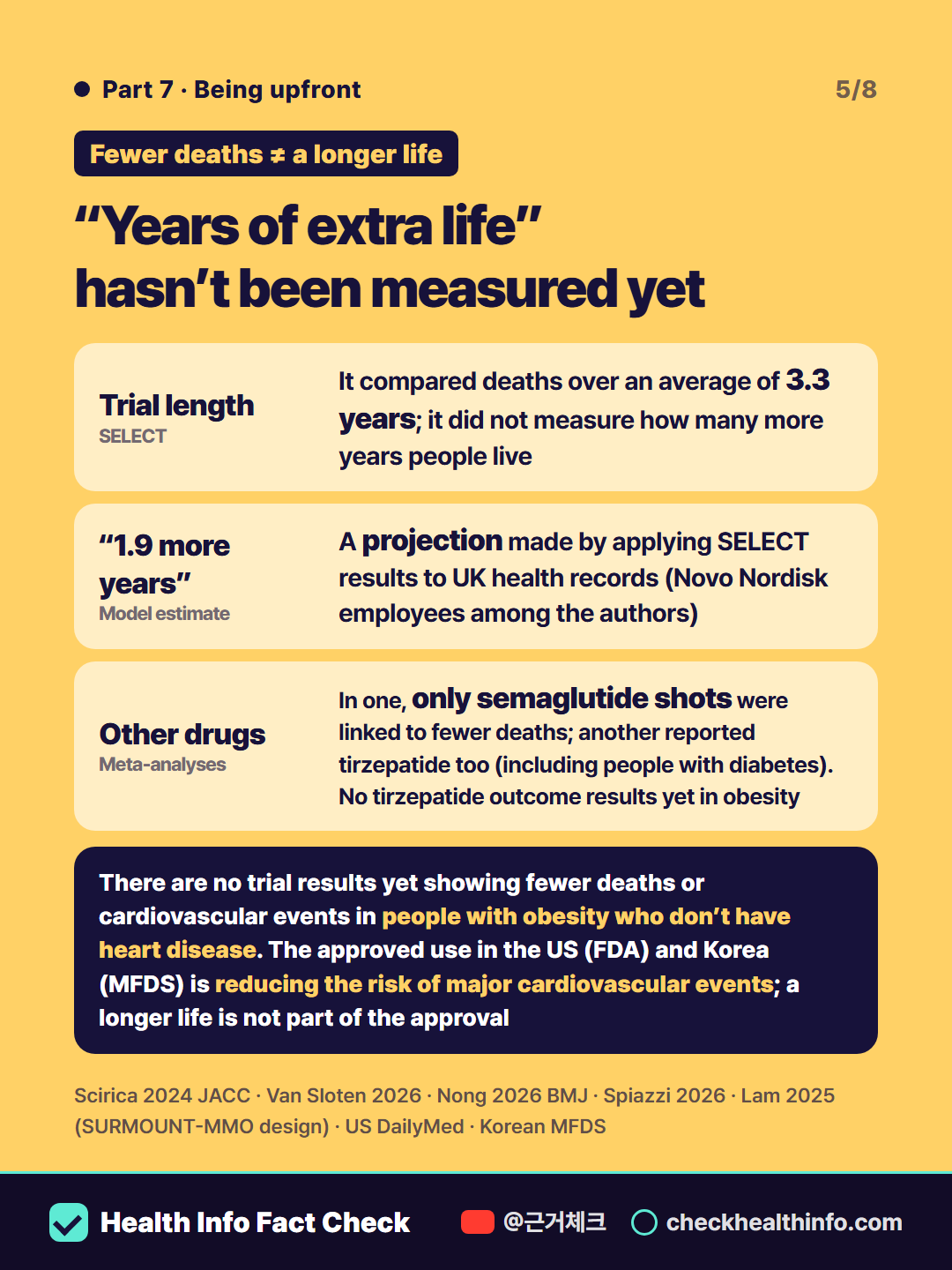
In plain terms In the same trial, fewer people died over about 3 years in the semaglutide group. But this was not confirmed in the way the trial had set out in advance, and no one has directly measured “how many more years” people live. A small drop in deaths is not the same thing as a longer life.
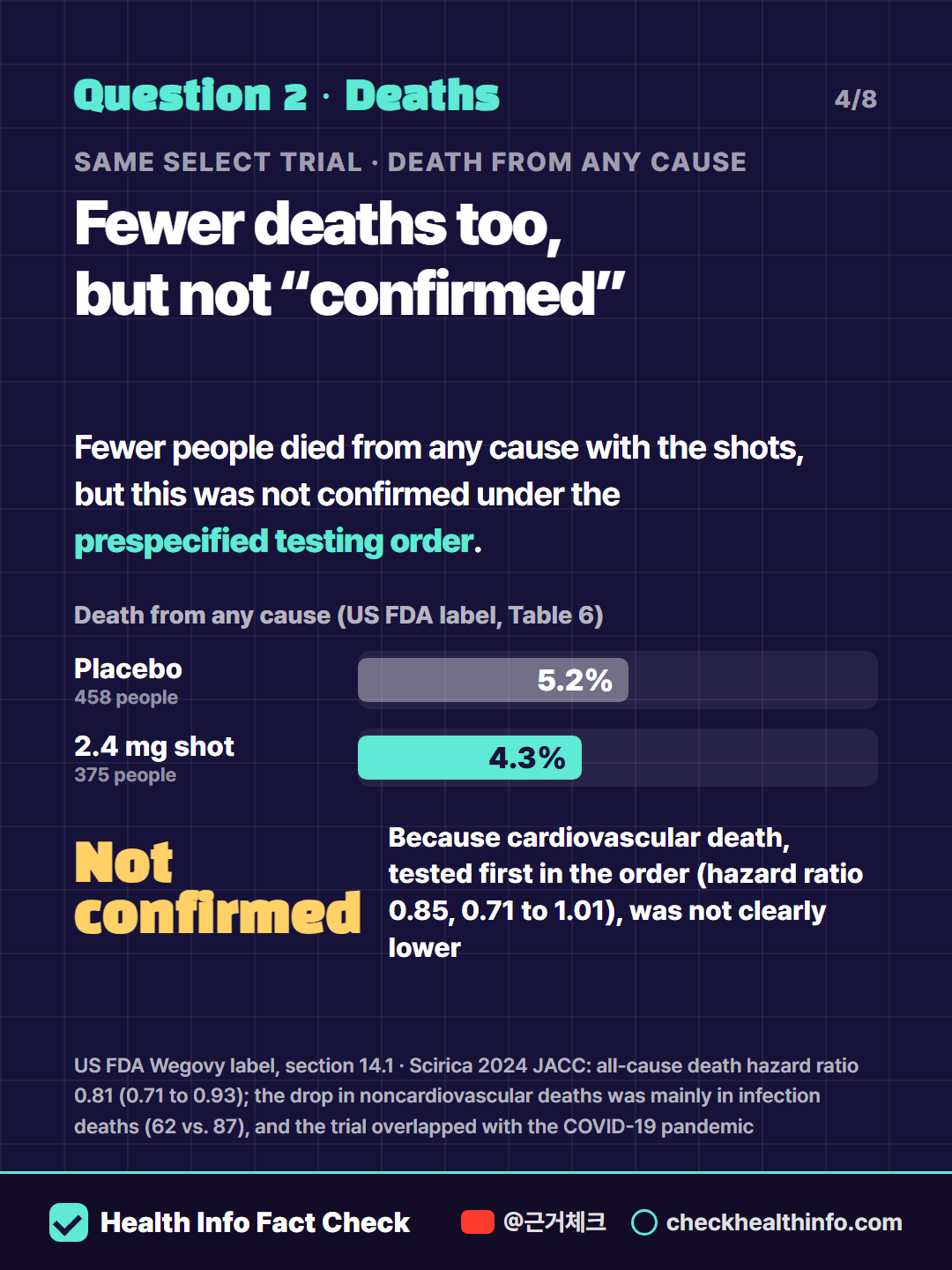
- Of the 833 deaths in the SELECT trial (average 3.3 years), 485 were cardiovascular and 348 were noncardiovascular. The hazard ratio was 0.81 (95% confidence interval 0.71 to 0.93) for death from any cause, 0.85 (0.71 to 1.01) for cardiovascular death, and 0.77 (0.62 to 0.95) for noncardiovascular death. [5]
- In the US FDA label, death from any cause occurred in 5.2% of the placebo group (458 people) and 4.3% of the semaglutide group (375 people). But cardiovascular death, the first outcome in the prespecified testing order, did not show superiority, so death from any cause was also treated as “not statistically significant.” In other words, this result was not confirmed by the trial’s formal statistical testing. [11]
- The most common cause of noncardiovascular death was infection, and there were fewer such deaths with semaglutide (62 versus 87, hazard ratio 0.71, 0.51 to 0.98). Deaths from COVID-19 were 43 versus 65. The authors wrote that the trial overlapped with the COVID-19 pandemic, a time when many infection deaths occurred. They also wrote that because more people in the placebo group died of infection, fewer of them remained at risk of cardiovascular death. Employees of the manufacturer were among the authors of this analysis. [5]
- In a network meta-analysis of 262 randomized trials, semaglutide shots were the only weight-loss drug associated with fewer deaths from any cause (relative risk 0.81, 95% confidence interval 0.72 to 0.93), and this estimate also came mainly from cardiovascular outcome trials in high-risk people. [2]
- A tirzepatide meta-analysis reported an odds ratio for death from any cause of 0.84 (95% confidence interval 0.75 to 0.93), but it analyzed people with diabetes and people with obesity together. [4] The SURMOUNT-MMO trial, which plans to include about 15,000 people with obesity, is looking at outcomes that include death from any cause, but it has no results yet (authors include employees of the manufacturer, Eli Lilly). [7]
- The figure of “1.9 more years of life expectancy” is a projection calculated by applying SELECT results to a cohort of 19,117 people from UK health records using life tables. It is not a measured lifespan, and Novo Nordisk employees were among the authors. [6]
- The approved use in the US (FDA) and Korea (MFDS) is reducing the risk of major cardiovascular events; reducing deaths or extending life is not part of the approval. [11] [12]
There is a signal that fewer people died, but there is not yet evidence confirming that the shots “extend your life” (this does not mean the claim is wrong). The grade starts at A because there are systematic reviews and meta-analyses. ① The claim is that the shots “extend your life,” but the evidence shows fewer deaths over about 3 years in people who already had cardiovascular disease, and no trial has directly measured how many more years people live. There are also no death results for people with obesity who do not have heart disease (indirect evidence). ③ That death result is an unconfirmed secondary outcome from a single trial (it was not confirmed under the prespecified testing order), a large part of the reduction came from fewer infection deaths during the COVID-19 pandemic, and meta-analyses disagree (in one network meta-analysis, only semaglutide shots were associated with fewer deaths, while a tirzepatide meta-analysis that included people with diabetes reported that tirzepatide was associated as well). These are two of the reasons for grading down in section 1 of our rating method (reason 1, indirect evidence, and reason 3, uncertain or conflicting results), so we graded it down one level for each, to C.
Scope: This verdict covers only cardiovascular events, death and lifespan. Weight loss, side effects and cost are covered in other parts of the series. The SELECT trial and its analyses cited here were funded by the manufacturer (Novo Nordisk) or had manufacturer employees among the authors, and Eli Lilly employees took part in the SURMOUNT-MMO design paper.
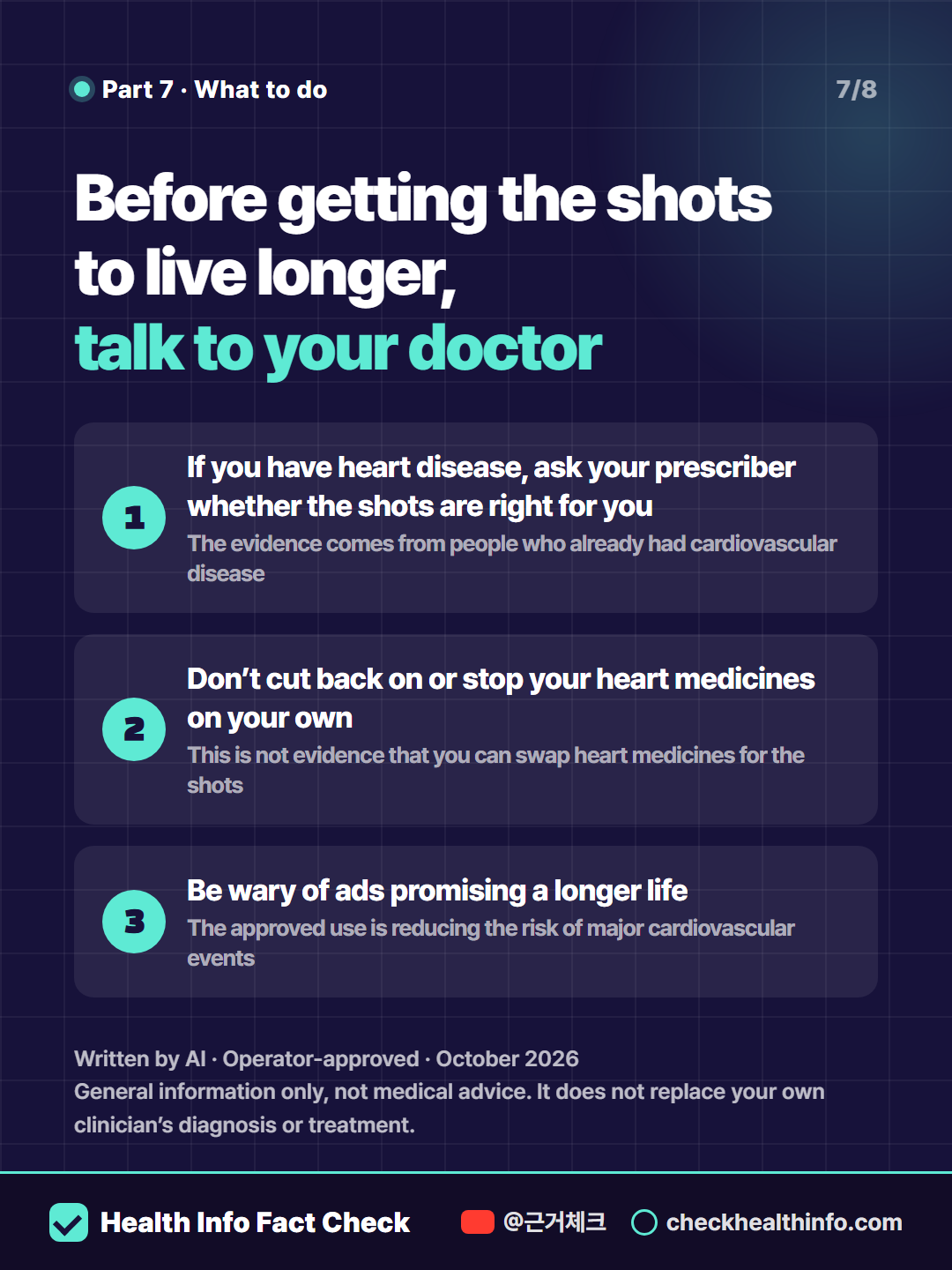
The evidence comes from people who already had cardiovascular disease. If you have heart disease, ask your prescriber whether these shots are right for you. These results are not evidence that you can stop existing heart medicines, such as cholesterol or blood pressure medicines, and switch to the shots. If you see an ad saying the shots “extend your life,” remember that the approved use is reducing the risk of major cardiovascular events, not extending life.
Limits of this verdict
- The key evidence is a single trial, SELECT, in adults with overweight or obesity who already had cardiovascular disease and did not have diabetes (average age 61.6).
- For the tirzepatide outcome trial in people with obesity (SURMOUNT-MMO), we found only the design paper in PubMed (searched 2026-10-16), not its results.
- We could not directly check the text of section 5.1 of the EMA product information or the Korean Society for the Study of Obesity guidelines this time, so we did not cite them.
- The US Centers for Disease Control and Prevention (CDC) does not issue recommendations on using obesity medicines. If you see weight-loss drug information presented as a “CDC recommendation,” check the source again.
- The grades follow section 1 of our rating method. When new studies come out (for example, SURMOUNT-MMO results), we check them in our monthly PubMed review, and if a verdict changes, we record it in our corrections log (in Korean).
Card news
Video (in Korean)
References
- Lincoff AM, Brown-Frandsen K, Colhoun HM, et al. Semaglutide and Cardiovascular Outcomes in Obesity without Diabetes. N Engl J Med 2023;389(24):2221-2232. PMID 37952131. PubMed abstract · Full article
- Nong K, Shi Q, Xie X, et al. Comparative effects of drugs for adults with overweight or obesity: systematic review and network meta-analysis. BMJ 2026;394:e372161. PMID 42419792. PubMed abstract · Full article
- Deanfield J, Verma S, Scirica BM, et al. Semaglutide and cardiovascular outcomes in patients with obesity and prevalent heart failure: a prespecified analysis of the SELECT trial. Lancet 2024;404(10454):773-786. PMID 39181597. PubMed abstract · Full article
- Spiazzi BF, Zingano CP, Colpani V, et al. Tirzepatide, cardiovascular outcomes and mortality in obesity and diabetes: a systematic review and meta-analysis. Diabetes Res Clin Pract 2026;239:113431. PMID 42442557. PubMed abstract · Full article
- Scirica BM, Lincoff AM, Lingvay I, et al. The Effect of Semaglutide on Mortality and COVID-19-Related Deaths: An Analysis From the SELECT Trial. J Am Coll Cardiol 2024;84(17):1632-1642. PMID 39217559. PubMed abstract · Full article
- Van Sloten T, Hageman SHJ, Westerink J, et al. Projected life-year gains with semaglutide in individuals with cardiovascular disease without type 2 diabetes in the UK. Endocr Connect 2026;15(3). PMID 41800807. PubMed abstract · Full article · Free full text
- Lam CSP, Rodriguez A, Aminian A, et al. Tirzepatide for reduction of morbidity and mortality in adults with obesity: rationale and design of the SURMOUNT-MMO trial. Obesity (Silver Spring) 2025;33(9):1645-1656. PMID 40545827. PubMed abstract · Full article
- US DailyMed — Wegovy (semaglutide) injection and tablets prescribing information (accessed 2026-10-16). Source
- Korean MFDS drug database — Wegovy prefilled pen 2.4 mg (semaglutide) labeling (accessed 2026-10-16). Source
- European Medicines Agency (EMA) — Wegovy product page (EPAR) (accessed 2026-10-16). Source
- US DailyMed — Wegovy (semaglutide) injection and tablets prescribing information (accessed 2026-10-16). Source
- Korean MFDS drug database — Wegovy prefilled pen 2.4 mg (semaglutide) labeling (accessed 2026-10-16). Source
General information only, not medical advice. Do not start, change or stop these medicines without talking to your prescriber, and do not cut back on or stop the heart medicines you already take on your own.