Wegovy, Ozempic, Mounjaro, Saxenda, efpeglenatide: are they the same drug?
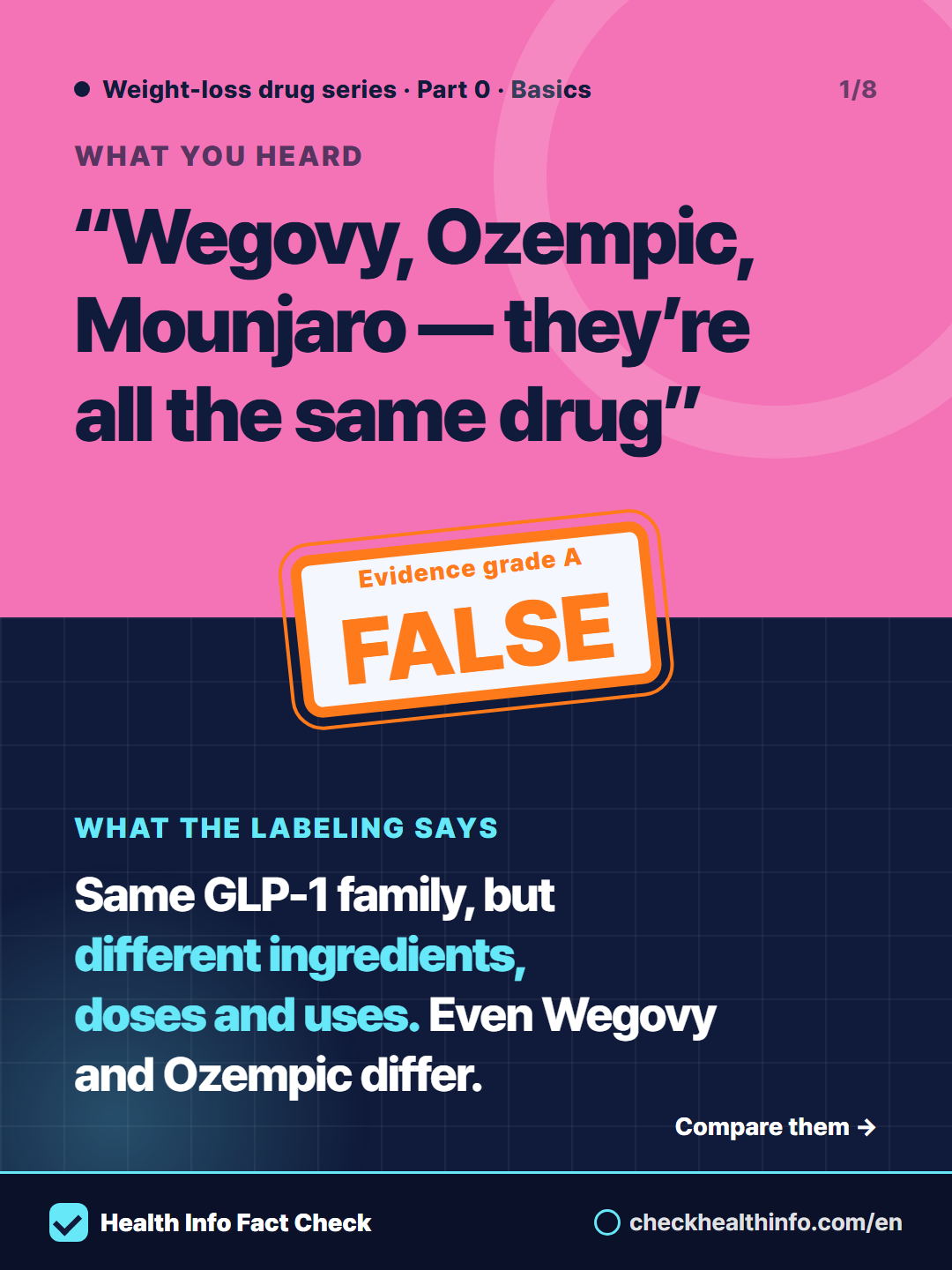
Are Wegovy, Ozempic and Mounjaro (and Saxenda and efpeglenatide) all the same drug?

We checked this verdict against 16 sources, such as published studies and clinical guidelines. · How checked: Operator-approved
Verdicts at a glance
| Claim | Verdict |
|---|---|
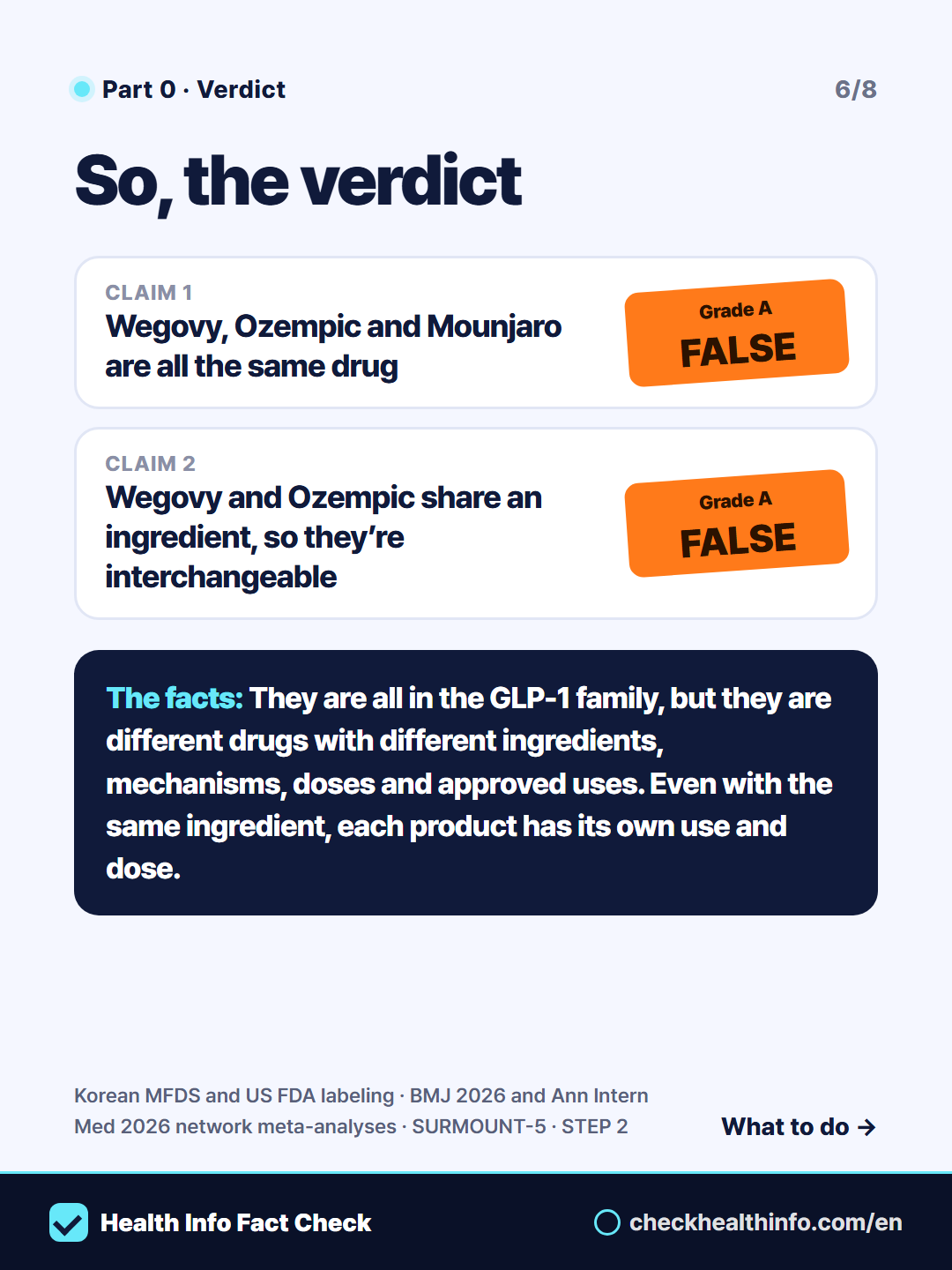
| Wegovy, Ozempic and Mounjaro are all the same drug | False · Evidence grade A |
| Wegovy and Ozempic have the same ingredient, so they are the same product and can be used interchangeably | False · Evidence grade A |
Bottom line — Wegovy, Ozempic and Mounjaro are often lumped together as “GLP-1 drugs,” but they are not the same drug. Wegovy and Ozempic share the same active ingredient (semaglutide). Mounjaro has a different active ingredient (tirzepatide) and works in a different way. Even Wegovy and Ozempic, despite sharing an ingredient, are separate products with different approved uses and doses, so do not switch between them or use them together on your own.
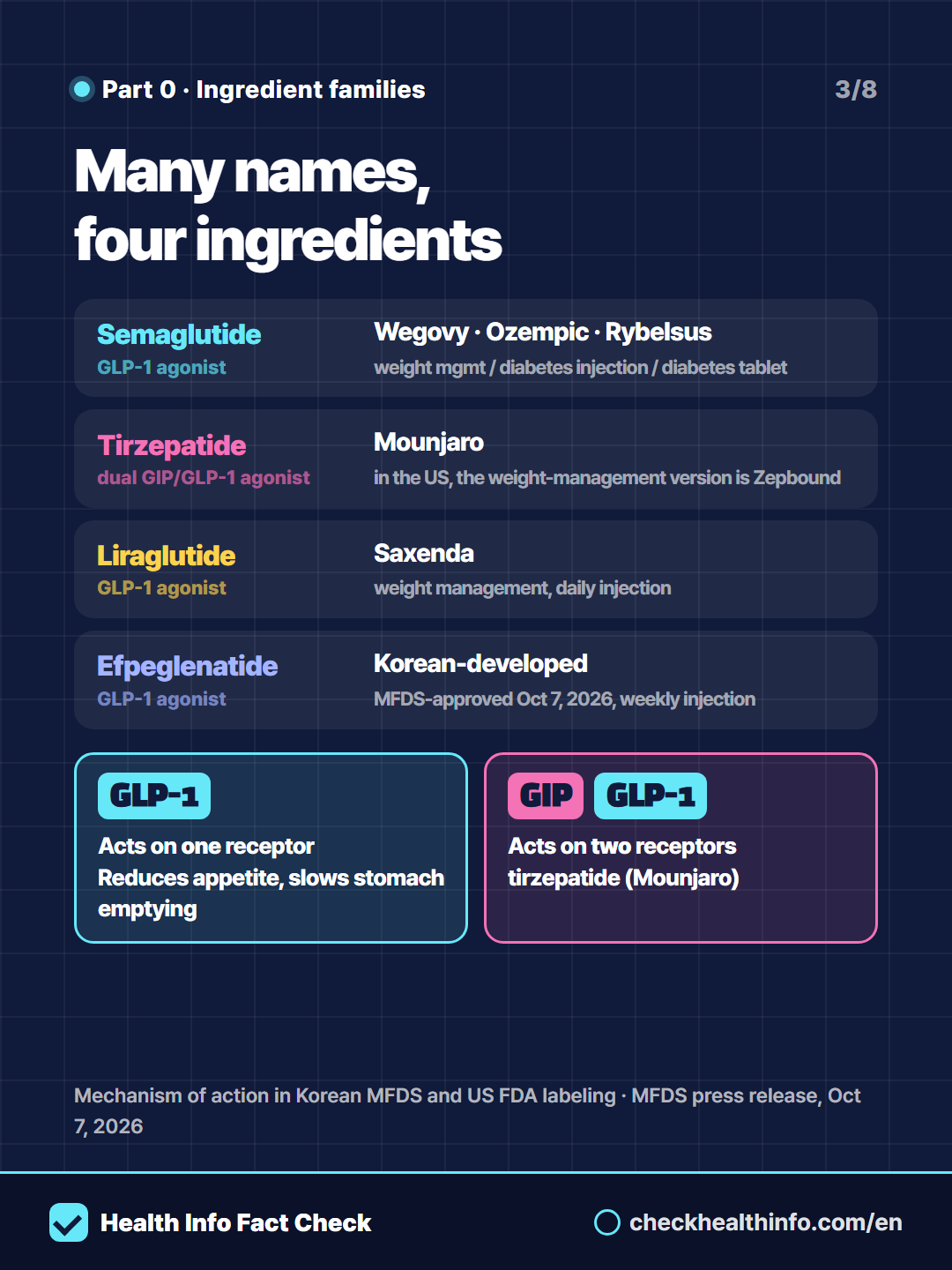
GLP-1 receptor agonist — A drug that acts on the GLP-1 receptor to reduce appetite and slow how fast food leaves the stomach. Semaglutide, liraglutide and efpeglenatide belong to this group.
Dual GIP/GLP-1 receptor agonist — A drug that acts on two receptors at once, the GLP-1 receptor and the GIP receptor. Tirzepatide belongs to this group.
Approved use (indication) — The disease or purpose a regulator has approved a product for. Products with the same ingredient can have different approved uses.
Drug names — We name products only so you can tell which ingredient they contain. We do not recommend any specific product.
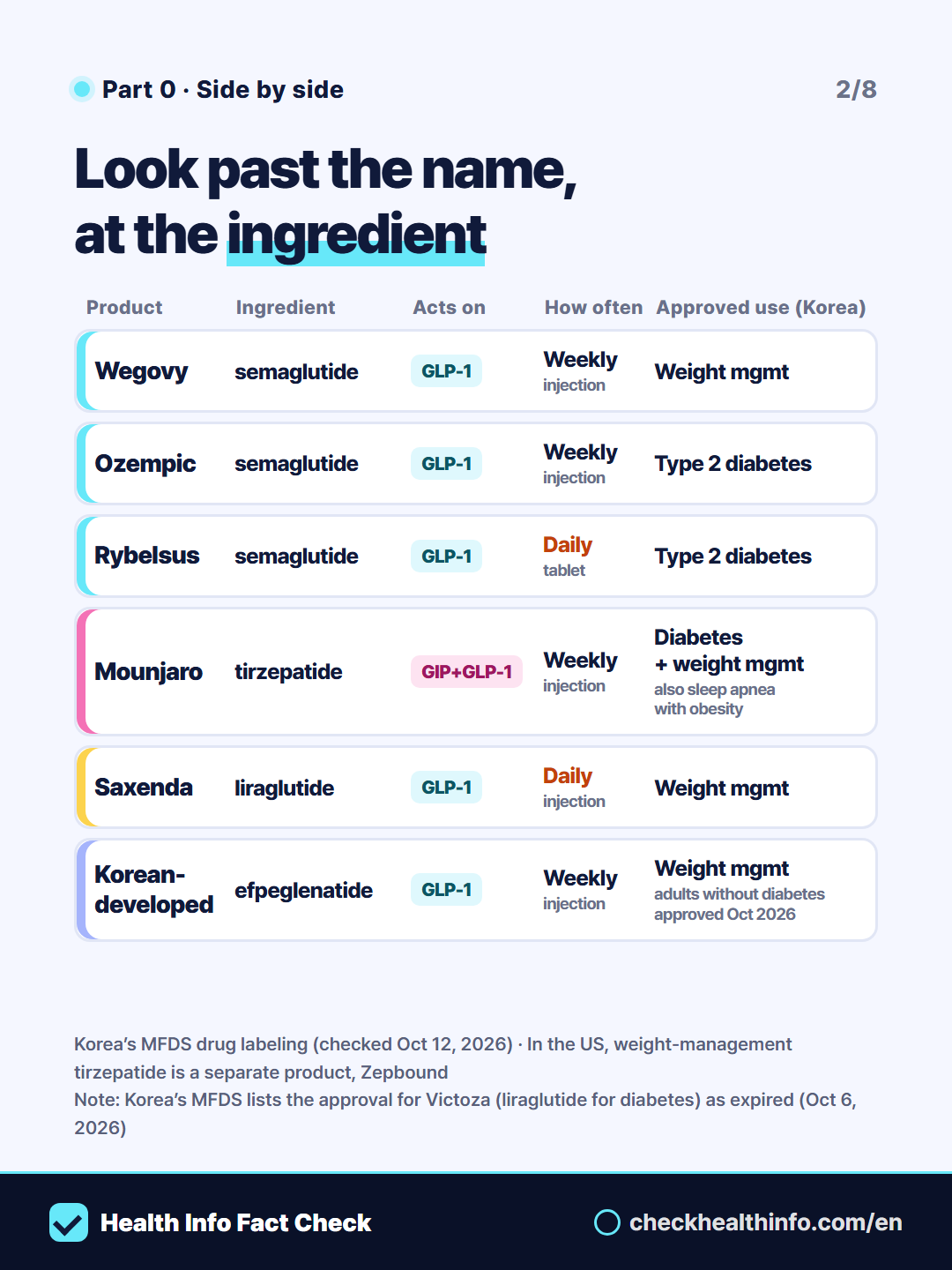
Side-by-side comparison (based on drug labeling from Korea’s Ministry of Food and Drug Safety [MFDS], checked October 12, 2026)
| Product | Active ingredient | Acts on | How it is given | Approved use in Korea |
|---|---|---|---|---|
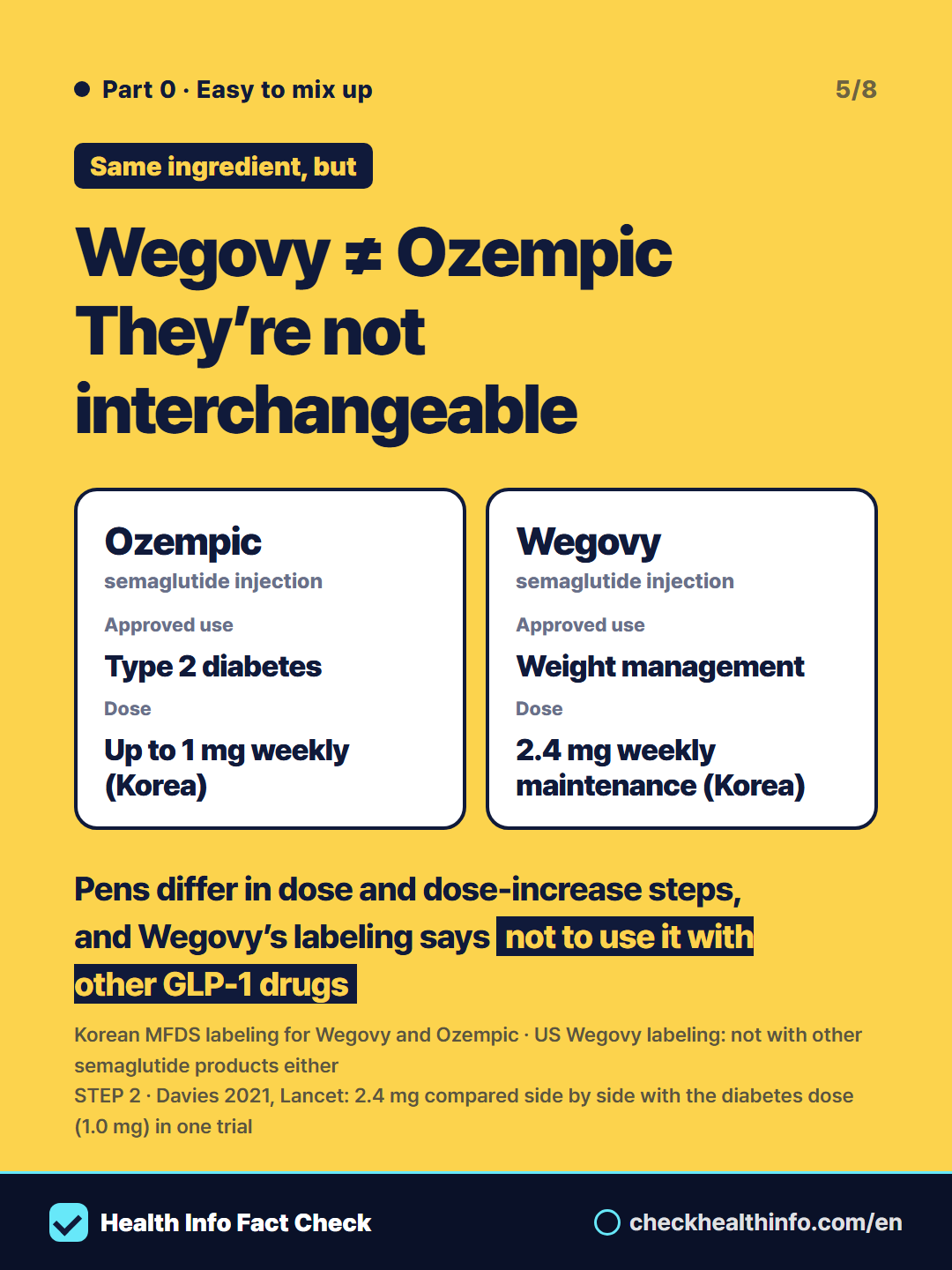
| Wegovy | Semaglutide | GLP-1 | Injection once a week (maintenance dose 2.4 mg) | Weight management [5] |
| Ozempic | Semaglutide | GLP-1 | Injection once a week (up to 1 mg) | Type 2 diabetes [6] |
| Rybelsus | Semaglutide | GLP-1 | Tablet once a day (up to 14 mg) | Type 2 diabetes [7] |
| Mounjaro | Tirzepatide | GIP + GLP-1 | Injection once a week (up to 15 mg) | Type 2 diabetes; chronic weight management; obstructive sleep apnea in adults with obesity [8] |
| Saxenda | Liraglutide | GLP-1 | Injection once a day (maintenance dose 3.0 mg) | Weight management [9] |
| Efpeglenatide (Korean-developed) | Efpeglenatide | GLP-1 | Injection once a week (maintenance dose 10 mg) | Chronic weight management in adults without diabetes (approved October 7, 2026) [11][12] |
In the United States, tirzepatide is sold as two different products: Mounjaro for diabetes and Zepbound for weight management [13][14]. Product lineups and approved uses differ from country to country. (Note: In Korea’s MFDS drug database, the approval for Victoza, the liraglutide product for diabetes, is marked “expired” as of October 6, 2026 [10].)
Claim 1. “Wegovy, Ozempic and Mounjaro are all the same drug”
False · Evidence grade A
In plain terms All three belong to the same “GLP-1 family,” but they contain two different ingredients that act on different receptors. On average, they also led to different amounts of weight loss.
- Wegovy and Ozempic contain semaglutide, which acts on one receptor, the GLP-1 receptor [5][6]. Mounjaro contains tirzepatide, a dual agonist that acts on two receptors at once, the GIP receptor and the GLP-1 receptor [8][13].
- Saxenda, often mentioned alongside them, contains liraglutide (GLP-1, injected once a day) [9]. On October 7, 2026, Korea’s Ministry of Food and Drug Safety (MFDS) approved efpeglenatide (GLP-1, injected once a week) as Korea’s 45th domestically developed new drug. It is approved for chronic weight management in adults with obesity or overweight who do not have diabetes [11][12]. We could not yet confirm efpeglenatide’s weight-loss results in a phase 3 trial published in PubMed, so we do not give numbers for it here.
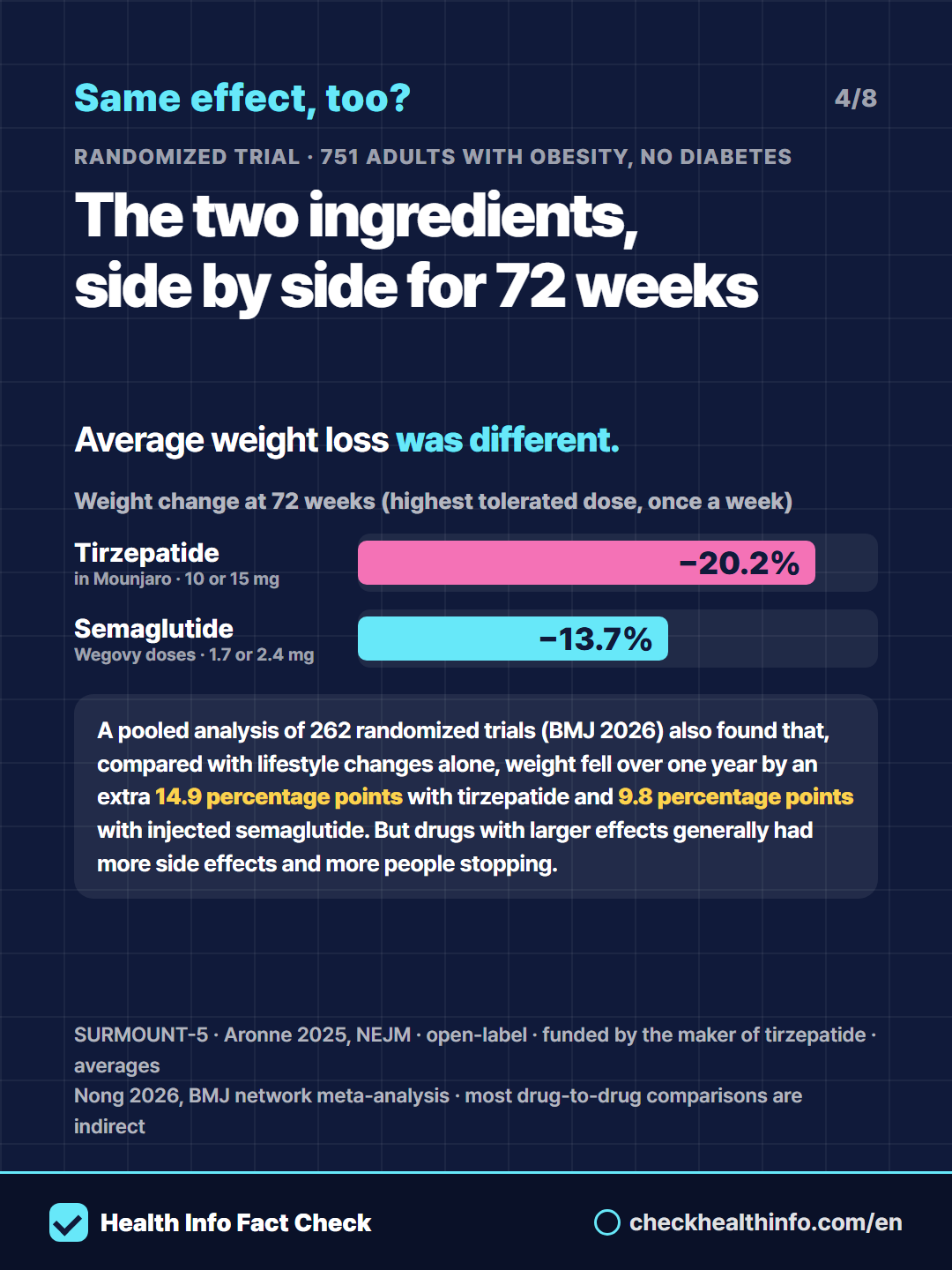
- In a network meta-analysis of 262 randomized trials covering 19 drugs (BMJ 2026), compared with lifestyle changes alone, weight fell over one year by an additional 14.9 percentage points with tirzepatide (95% confidence interval 13.9–16.0), 9.8 percentage points with injected semaglutide (9.1–10.6), and 10.9 percentage points with oral semaglutide (moderate to high certainty of evidence). The share of people who stopped because of side effects also differed by drug, and drugs with larger weight loss generally had more side effects and more people stopping. [1]
- A living systematic review commissioned by the American College of Physicians (69 randomized trials) also found the largest weight loss with semaglutide and tirzepatide. However, few trials compared the drugs directly with each other. [2]
- In a head-to-head trial (SURMOUNT-5), 751 adults with obesity and without type 2 diabetes were randomly assigned to one of the two drugs. Each took the highest dose they could tolerate (tirzepatide 10 or 15 mg; semaglutide 1.7 or 2.4 mg, the Wegovy doses) once a week for 72 weeks. Weight changed by −20.2% with tirzepatide (95% confidence interval −21.4 to −19.1) and −13.7% with semaglutide (−14.9 to −12.6). Gastrointestinal side effects were the most common in both groups. [3]
If you look only at Wegovy and Ozempic, “same ingredient” is correct. But the claim is that all three products are “the same drug,” and Mounjaro has a different ingredient altogether. So under our rating method, we rated it “False.” The differences in effect are averages. Which drug suits a given person is decided with the prescribing doctor, weighing other health conditions, side effects and cost. This verdict is not a recommendation that one drug is better than another.
Claim 2. “Wegovy and Ozempic have the same ingredient, so they are the same product and can be used interchangeably”
False · Evidence grade A
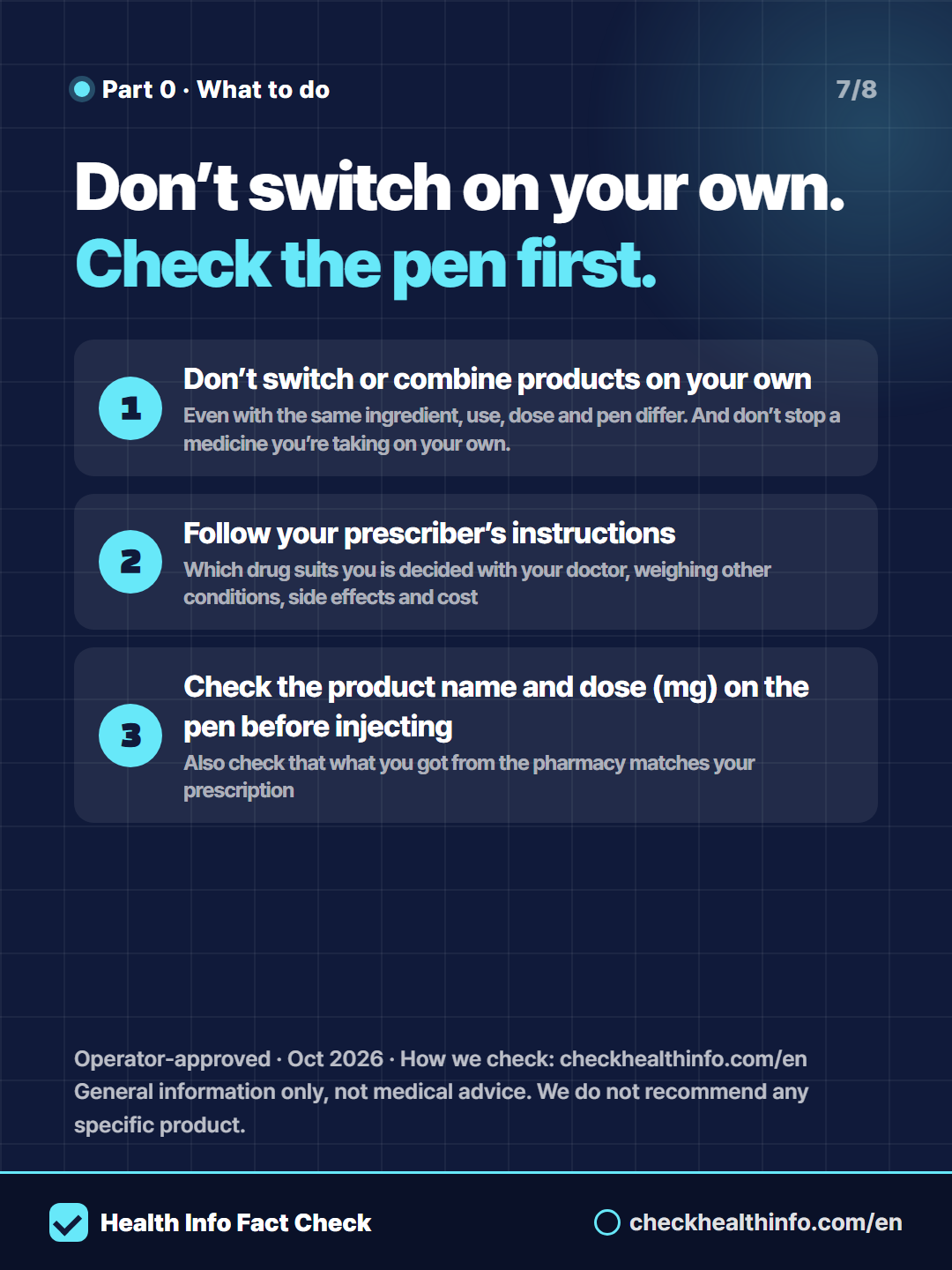
In plain terms They share an ingredient, but they are separate products with different approved uses and doses. Do not switch between them or use them together on your own.
- Under Korea’s MFDS labeling, Ozempic is for blood sugar control in type 2 diabetes. It starts at 0.25 mg once a week, up to a maximum of 1 mg once a week (doses above 1 mg are not recommended) [6]. Wegovy is for weight management. The dose is increased step by step over 16 weeks to a maintenance dose of 2.4 mg once a week (doses above 2.4 mg are not recommended) [5].
- Rybelsus, which has the same ingredient, is a once-a-day tablet for diabetes [7].
- In one randomized trial (STEP 2: 1,210 adults with overweight or obesity and type 2 diabetes), the 2.4 mg weight-management dose was compared side by side with the approved diabetes dose (1.0 mg) and with placebo. Weight changed over 68 weeks by −9.6% with 2.4 mg and −3.4% with placebo (difference −6.2 percentage points, 95% confidence interval −7.3 to −5.2). Gastrointestinal side effects occurred in 63.5% (2.4 mg), 57.5% (1.0 mg) and 34.3% (placebo). [4]
- Wegovy’s Korean labeling says it should not be used with other GLP-1 receptor agonists [5]. The US prescribing information states that using it with other semaglutide-containing products is not recommended either [15]. In the United States, Ozempic is not approved for weight management [16].
- Likewise, in the United States, tirzepatide comes as separate products for diabetes (Mounjaro) and weight management (Zepbound), and Zepbound’s prescribing information says using it with other tirzepatide-containing products or GLP-1 receptor agonists is not recommended [13][14].
Your prescribing doctor decides which product to use and at what dose. Pens differ in how much they deliver per dose and in their dose-increase steps, so check the product name and dose (mg) on the pen before each injection. Also check that what you got from the pharmacy matches your prescription. And do not stop a medicine you are taking on your own.
Limitations of this verdict
- Ingredients, how the drugs work, doses and approved uses are based on Korean MFDS and US FDA labeling checked on October 12, 2026. Labeling can change. We did not review the European Medicines Agency (EMA) assessment reports this time.
- Among the studies comparing effects, SURMOUNT-5 was an open-label trial (participants knew which drug they were taking) and was funded by the maker of tirzepatide. STEP 2 was funded by the maker of semaglutide. Most comparisons between drugs in the network meta-analyses are indirect comparisons through a shared comparison group. SURMOUNT-5 included only adults with obesity and without diabetes, so it cannot tell us whether the same difference applies to people with diabetes or to people who meet Korea’s definition of obesity (BMI 25 or higher).
- The STEP 2 abstract does not report weight change in the 1.0 mg group, so we do not give a number for the weight difference between the two doses.
- We could not find efpeglenatide’s clinical trial results in PubMed abstracts or in the labeling summary, so we give no numbers for it. We will review it again when results are published.
- Grades follow section 1 of our rating method. Claim 1 is graded A because there are network meta-analyses of randomized trials. Claim 2 is about a product’s approved use and dose, so under section 1 we used Korean MFDS and US FDA labeling (official regulatory documents) as direct evidence, giving grade A. The randomized trial (STEP 2) is supporting evidence.
- We check for new studies and labeling changes in our monthly review. If a verdict changes, we will update this page and note the change.
Card news
References
- Nong K, Shi Q, Xie X, et al. Comparative effects of drugs for adults with overweight or obesity: systematic review and network meta-analysis. BMJ 2026;394:e372161. PMID 42419792. PubMed abstract · Full article
- Damen JAA, Idema DL, Vernooij RWM, et al. Benefits and Harms of Pharmacologic Treatments in Adults With Overweight or Obesity: A Living Systematic Review and Network Meta-analysis for the American College of Physicians. Ann Intern Med 2026;179(8):1140-1155. PMID 42296503. PubMed abstract · Full article
- Aronne LJ, Horn DB, le Roux CW, et al. Tirzepatide as Compared with Semaglutide for the Treatment of Obesity. N Engl J Med 2025;393(1):26-36. PMID 40353578. PubMed abstract · Full article
- Davies M, Færch L, Jeppesen OK, et al. Semaglutide 2·4 mg once a week in adults with overweight or obesity, and type 2 diabetes (STEP 2): a randomised, double-blind, double-dummy, placebo-controlled, phase 3 trial. Lancet 2021;397(10278):971-984. PMID 33667417. PubMed abstract · Full article
- Korea MFDS drug database — Wegovy 2.4 mg prefilled pen (semaglutide) labeling (accessed 2026-10-12). Source
- Korea MFDS drug database — Ozempic prefilled pen (semaglutide) labeling (accessed 2026-10-12). Source
- Korea MFDS drug database — Rybelsus tablets (semaglutide) labeling (accessed 2026-10-12). Source
- Korea MFDS drug database — Mounjaro KwikPen (tirzepatide) labeling (accessed 2026-10-12). Source
- Korea MFDS drug database — Saxenda pen 6 mg/mL (liraglutide) labeling (accessed 2026-10-12). Source
- Korea MFDS drug database — Victoza pen 6 mg/mL (liraglutide) labeling (accessed 2026-10-12). Source
- Korea MFDS drug database — efpeglenatide 10 mg autoinjector labeling (accessed 2026-10-12). Source
- Korea MFDS press release — approval of the first Korean-developed GLP-1 obesity drug (October 7, 2026) (accessed 2026-10-12). Source
- US DailyMed — Zepbound (tirzepatide) prescribing information (accessed 2026-10-12). Source
- US DailyMed — Mounjaro (tirzepatide) prescribing information (accessed 2026-10-12). Source
- US DailyMed — Wegovy (semaglutide) prescribing information (accessed 2026-10-12). Source
- US DailyMed — Ozempic (semaglutide injection) prescribing information (accessed 2026-10-12). Source
General information only, not medical advice. Do not start, stop, switch or combine these medicines without talking to your doctor.