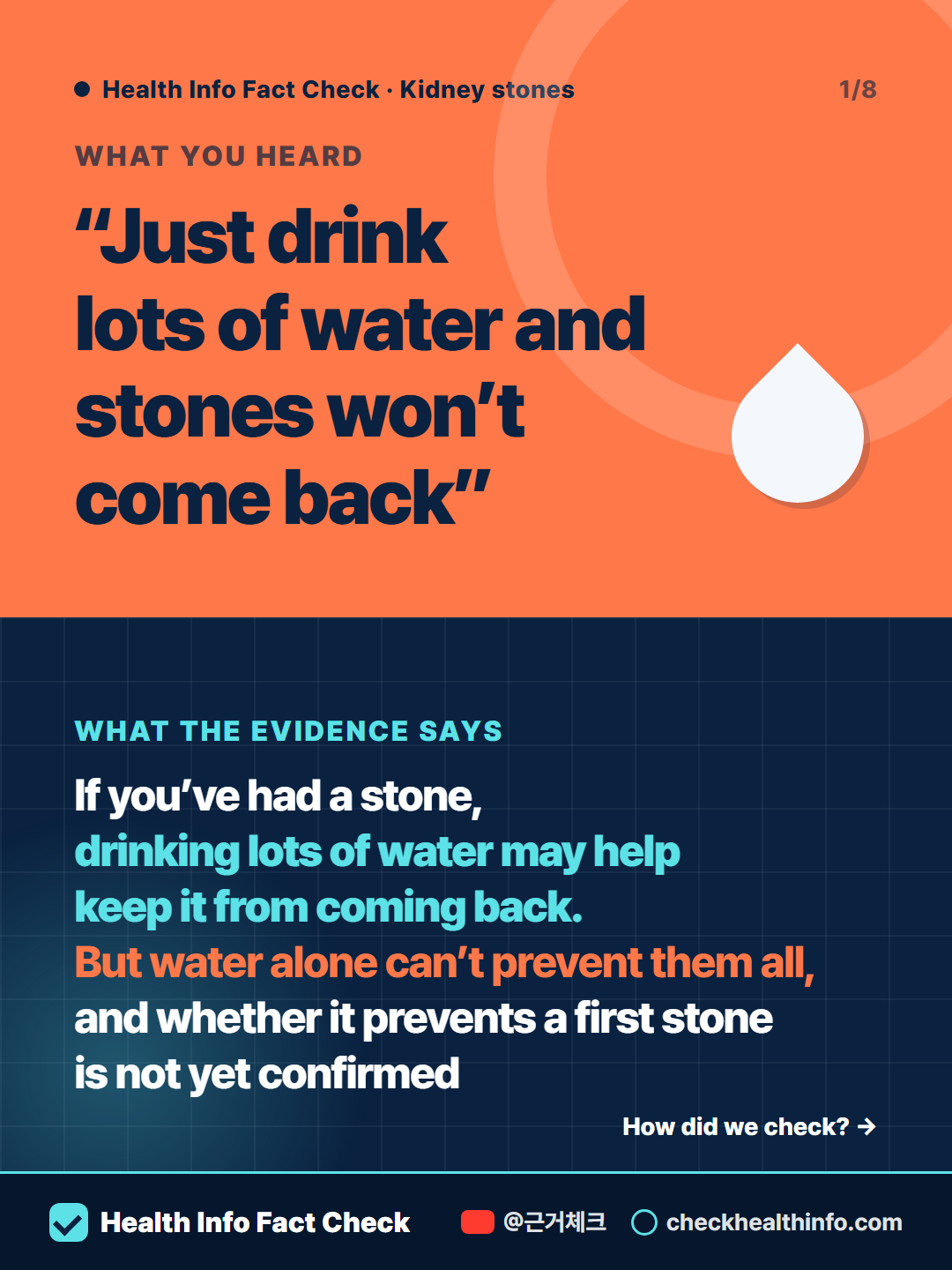
Had a kidney stone? Can just drinking lots of water keep it from coming back?
Can drinking lots of water prevent kidney stones from forming or coming back?

We checked this verdict against 12 sources, such as published studies and clinical guidelines. · How checked: AI-drafted · automated evidence checks
Verdicts at a glance
| Claim | Verdict |
|---|---|
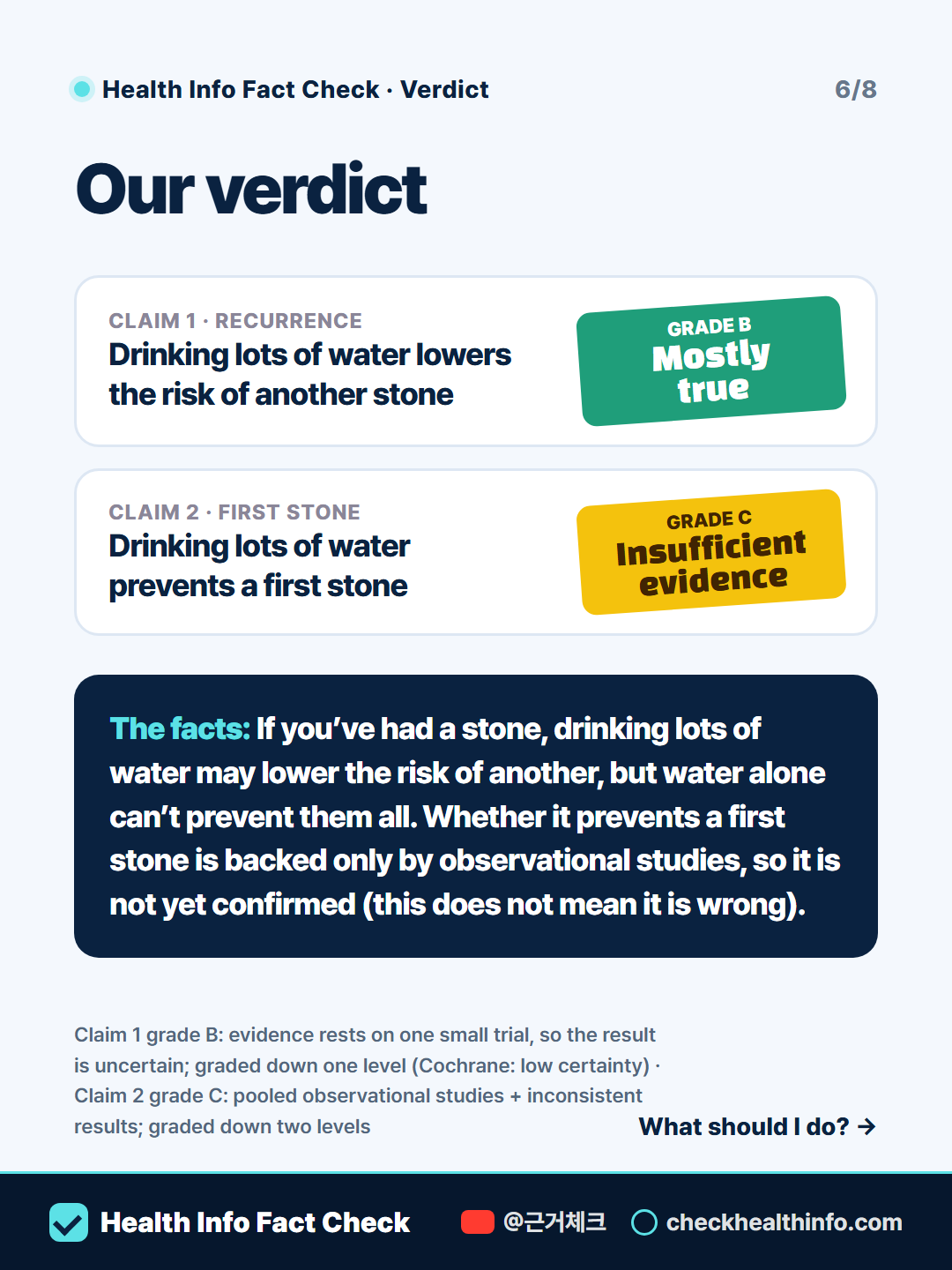
| If you have had a kidney stone, drinking lots of water can lower the risk of getting another one | Mostly true · Evidence grade B |
| If you have never had a kidney stone, drinking lots of water can prevent a first one | Insufficient evidence · Evidence grade C |
Bottom line — If you have had a kidney stone, drinking lots of water may lower the chance that another one forms. But water alone cannot prevent them all, and adding a program to help people drink more on top of advice to drink plenty of water did not clearly lower recurrence further. Whether drinking lots of water prevents a first stone in people who have never had one is supported only by observational studies, so it is not yet confirmed (this does not mean it is wrong). If you limit fluids because of kidney disease, heart failure or a similar condition, talk to your doctor before drinking more.
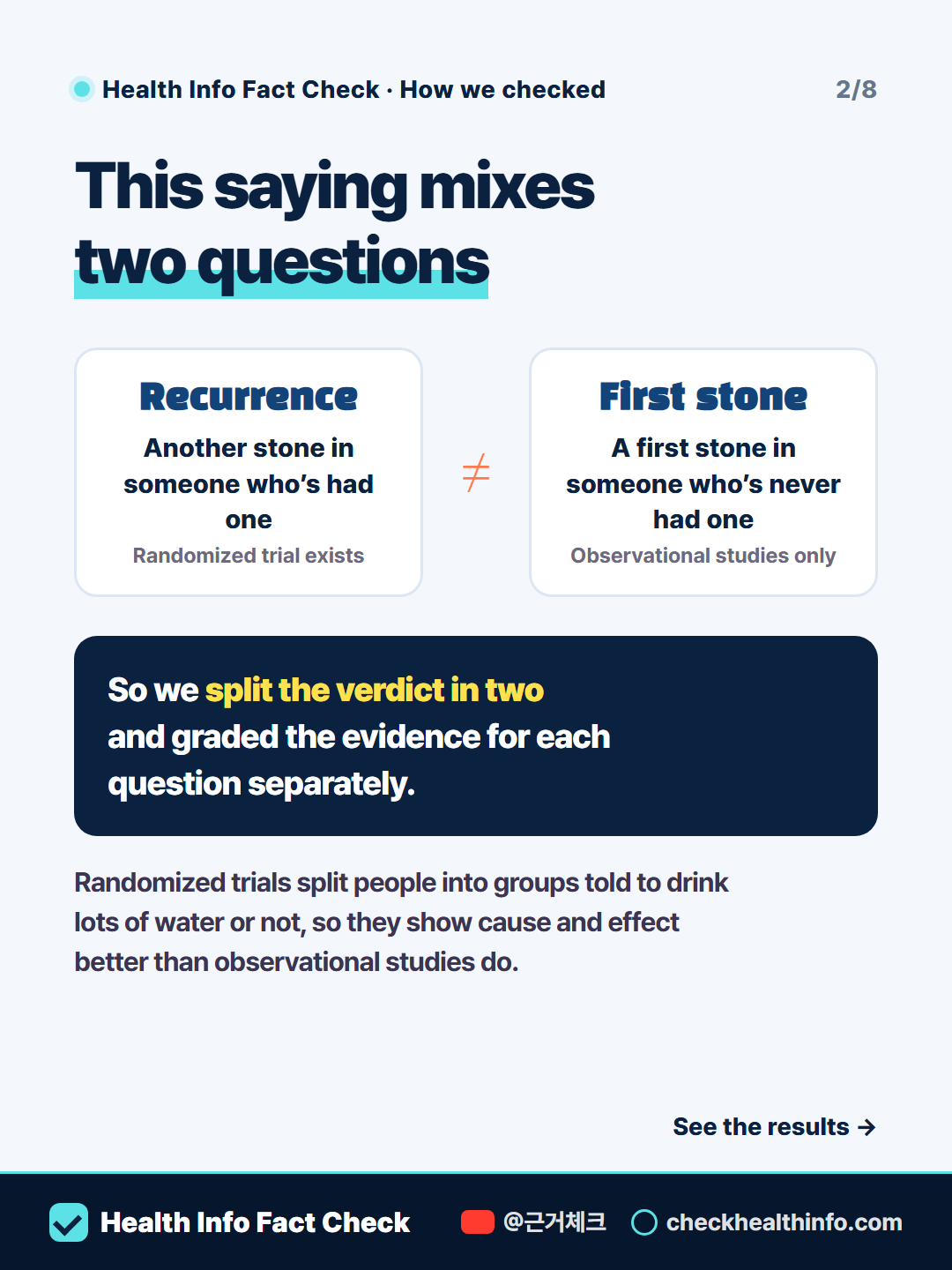
Preventing recurrence / preventing a first stone — Preventing another stone in someone who has already had one, versus preventing a first stone in someone who has never had one. The evidence for each is different, so we split the verdict in two.
Relative risk — The risk in one group divided by the risk in another. A value below 1 means a lower risk (0.45 means less than half).
Hazard ratio — A comparison of how fast events happen over time in two groups. A value close to 1 means no difference.
95% confidence interval — The range in which the true value likely lies. If it includes 1, we cannot conclude that there is a difference.
Observational study (cohort) — A study that records how much people already drink and follows them over time. It shows that things occur together, but it is less certain than a randomized trial about cause and effect.
Claim 1. “If you have had a kidney stone, drinking lots of water can lower the risk of getting another one”
Mostly true · Evidence grade B
In plain terms People who have had a stone may be less likely to get another one if they drink lots of water. But some people still got another stone even when they drank lots of water, and in a recent large trial, adding a program to help people drink more did not clearly lower recurrence further.
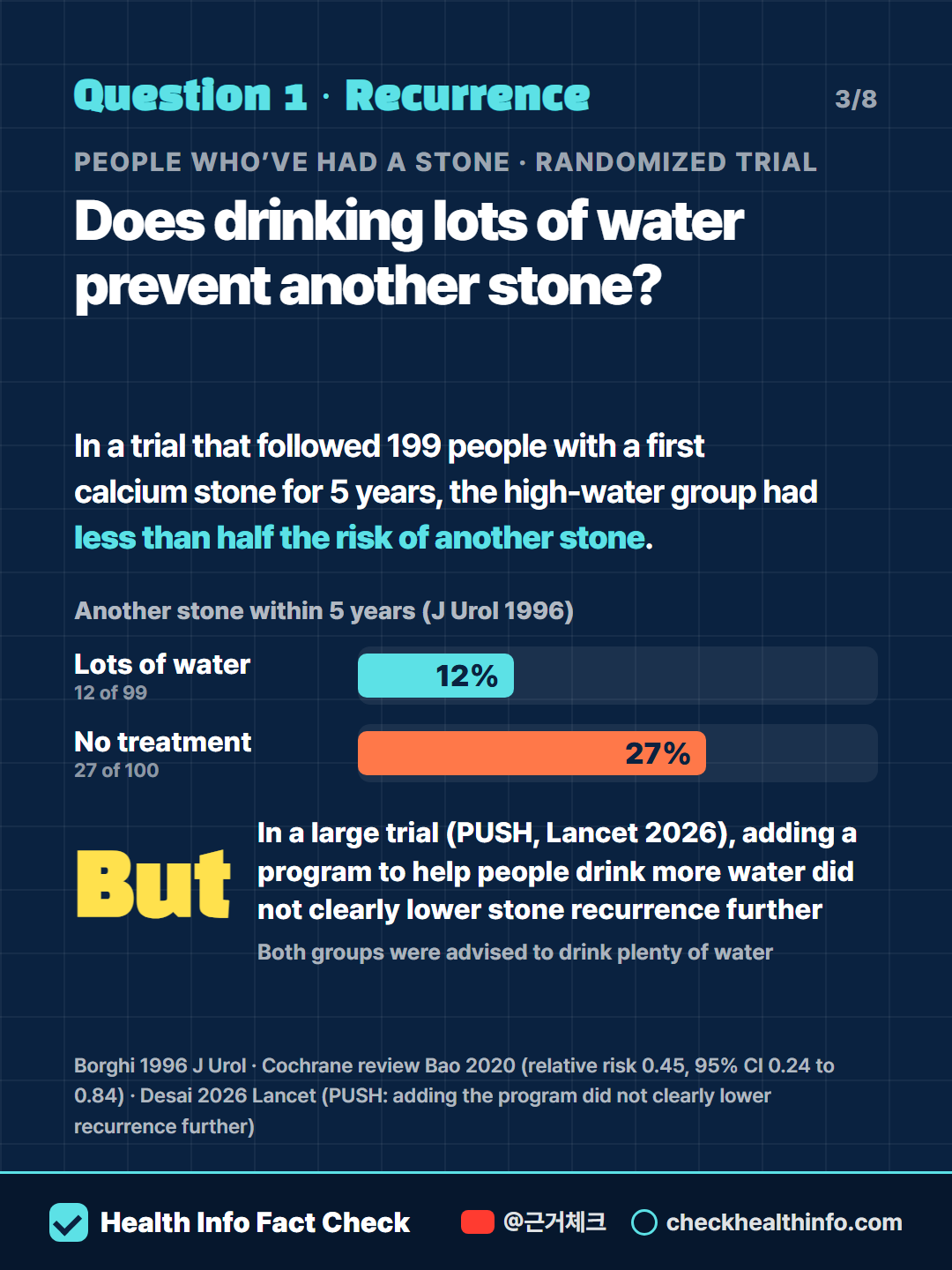
- In a trial that randomly assigned 199 people with a first calcium stone and followed them for 5 years, 12 of 99 people told to drink lots of water (with no change in diet) had another stone, compared with 27 of 100 people who received no treatment. The time until another stone was also longer, an average of 38.7 versus 25.1 months. [3]
- A Cochrane systematic review that included this trial (2020 update) summarized it as a relative risk of recurrence of 0.45 (95% confidence interval 0.24 to 0.84), or 149 fewer recurrences per 1,000 people. In plain terms, the risk of another stone was less than half. But the evidence came from this one trial, and the review rated its certainty as “low” because of risk of bias and imprecision. [2]
- A meta-analysis (6 randomized trials, 2 of them on fluids) also found that fluid intake reduced recurrence of calcium stones (relative risk 0.39, 95% confidence interval 0.19 to 0.80). [4] A systematic review of 18 randomized trials that changed how much water people drank summarized that drinking more water led to 15 fewer stones per 100 people over 5 years [6]. Most of the fluid results in these reviews also come from the one trial above.
- A systematic review of 31 studies (26 of them randomized trials) published through December 2025 concluded that drinking more fluids may reduce recurrence in adults who have had calcium oxalate or calcium phosphate stones. The strength of evidence was “low.” A low-salt diet, normal to high calcium intake, a low-protein diet and several medicines may also reduce recurrence, with similarly low strength of evidence. [1]
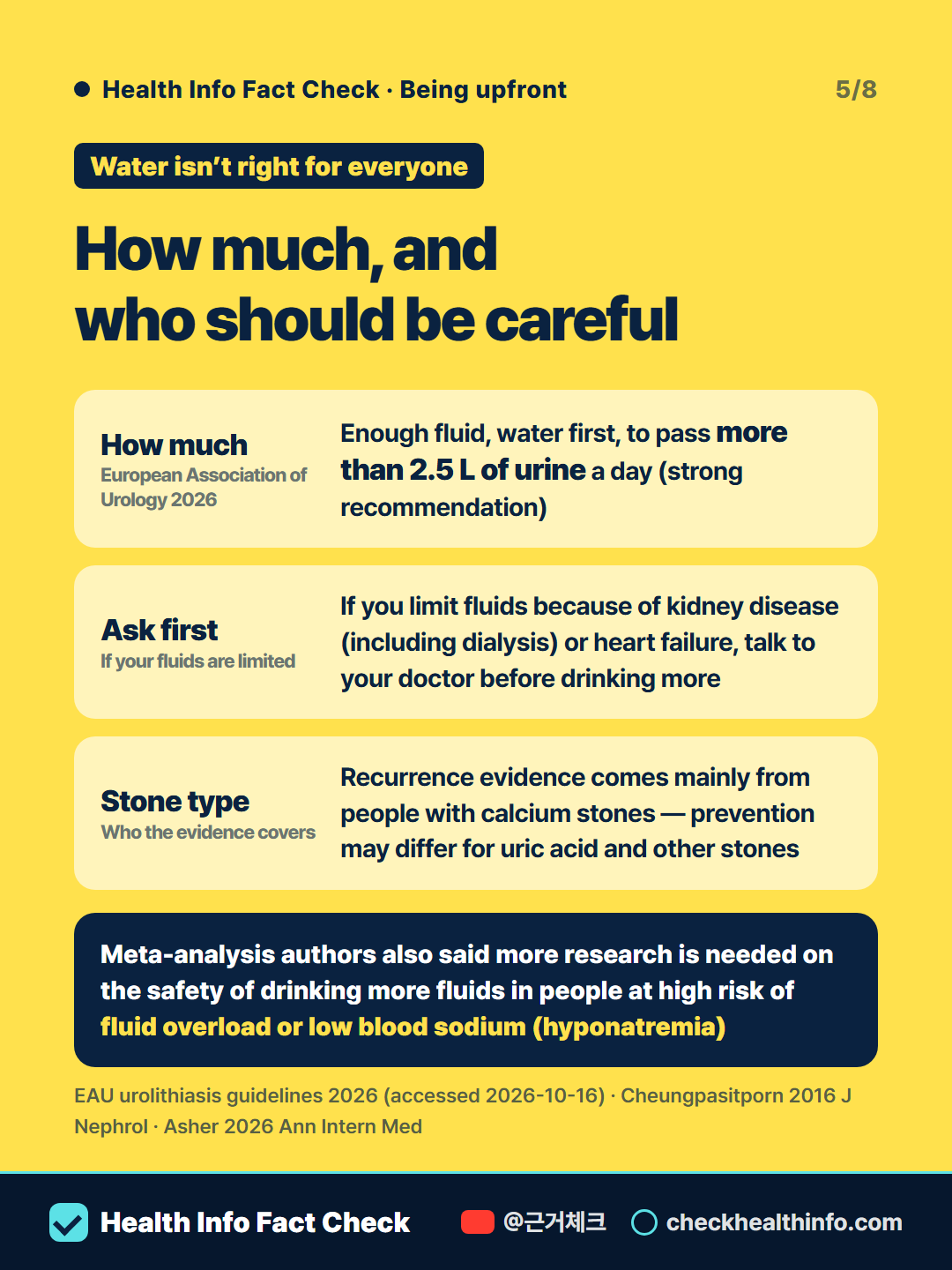
- The European Association of Urology guidelines (2026) strongly recommend drinking enough fluid, with water first, to pass more than 2.5 L of urine in 24 hours. Their general prevention advice lists fluid intake of 2.5–3.0 L a day and urine output of 2.0–2.5 L a day. [12]
- By contrast, in a recent large randomized trial (PUSH) of people who had had stones and passed little urine, adding a program to help people drink more — a prescribed amount to drink, financial rewards, health coaching and text-message reminders — did not clearly lower symptomatic stone recurrence compared with guideline-based usual care. A correction notice has been published for this paper, but we could not check what it corrects, so we report only its conclusion here, not its numbers. This trial did not compare drinking water with not drinking water, so it does not rule out an effect of water itself. In plain terms, adding a program on top of advice to drink plenty of water, as the guidelines recommend, did not clearly lower recurrence further. [5]
The grade starts at A because there are systematic reviews and a guideline. But the evidence on recurrence that compares lots of water with no treatment is essentially one trial of 199 people, and several reviews all rely on that one trial, so the result is uncertain. That a recent large trial (PUSH) found no clear further drop in recurrence when a program to help people drink more was added also adds to this uncertainty. So under section 1 ③ of our rating method, we graded it down one level to B. The 2020 Cochrane systematic review rated this evidence as “low certainty,” and a 2026 systematic review supported by the US Agency for Healthcare Research and Quality (AHRQ) and the Patient-Centered Outcomes Research Institute (PCORI) rated it as “low strength of evidence.” Cochrane graded it down for two reasons: limitations of the trial (risk of bias) and a wide confidence interval. Our rating method grades down one level for each of these reasons: ① indirect evidence, ② pooled observational studies, and ③ inconsistent or uncertain results. It does not treat a trial’s risk of bias as a separate reason for grading down. So only the wide confidence interval (③) applies, which gives B. This B does not mean the evidence is stronger than those two reviews found; the grades come from different rules. The evidence supports a lower risk of another stone, but it comes mainly from people with calcium stones, and water alone cannot prevent them all, so the claim is “Mostly true.”
Claim 2. “If you have never had a kidney stone, drinking lots of water can prevent a first one”
Insufficient evidence · Evidence grade C
In plain terms Observational studies consistently find that people who drink more fluids get fewer stones. But no trial has asked people who have never had a stone to drink more water and checked whether fewer first stones form, so we cannot confirm that water “prevents” them. This does not mean water is useless.
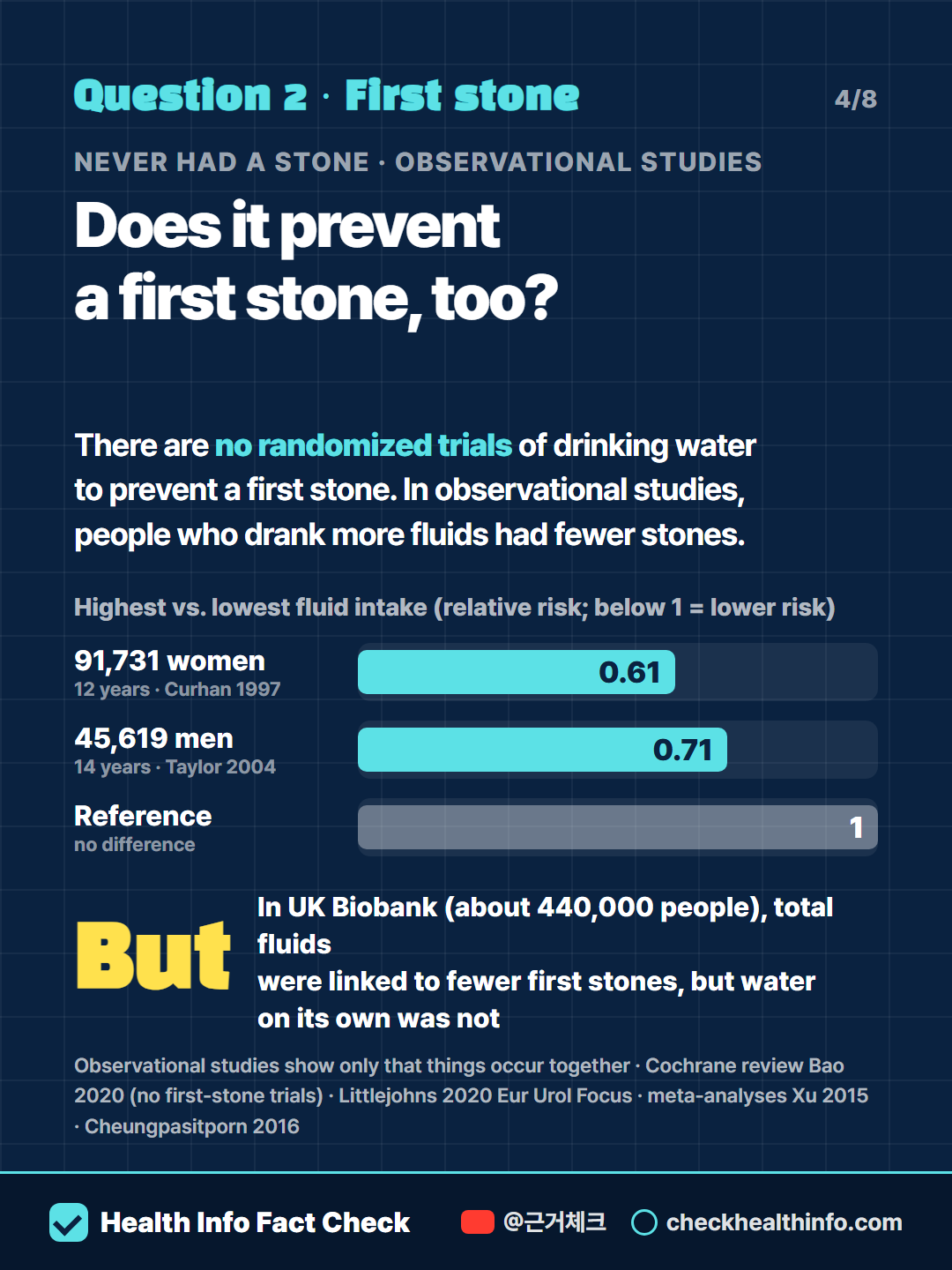
- In the Cochrane systematic review, no randomized trial of preventing a first stone met its inclusion criteria. [2]
- In a cohort of 91,731 women with no history of stones followed for 12 years, the relative risk for the highest fluid intake group, compared with the lowest, was 0.61 (95% confidence interval 0.48 to 0.78). [10] In a cohort of 45,619 men with no history of stones followed for 14 years, it was 0.71 (95% confidence interval 0.59 to 0.85). [11]
- In a meta-analysis of 15 observational studies (351,081 people), each additional 500 mL of water intake was linked to a relative risk of stones of 0.93 (95% confidence interval 0.87 to 0.98). [8] In a meta-analysis of 7 observational studies (273,685 people), the pooled relative risk was 0.49 (95% confidence interval 0.34 to 0.71). [7]
- But in the UK Biobank cohort (439,072 people followed for an average of 6.1 years), each additional glass (200 mL) of total fluids a day was linked to a 13% lower risk of hospital admission for a first stone (hazard ratio 0.87, 95% confidence interval 0.85 to 0.89), while water intake on its own was not linked to stone risk. [9]
The grade starts at A because there are meta-analyses. But ② all the evidence on a first stone comes from pooled observational studies, so we graded it down one level, and ③ the results are inconsistent — for example, in a large cohort, water on its own was not linked to stone risk — so we graded it down one more level. Under section 1 of our rating method, each of these two reasons (② and ③) lowers the grade by one level, giving C. Observational studies cannot fully account for other lifestyle differences in people who drink a lot of water, so a cause-and-effect link — that water “prevents” a first stone — has not yet been confirmed.
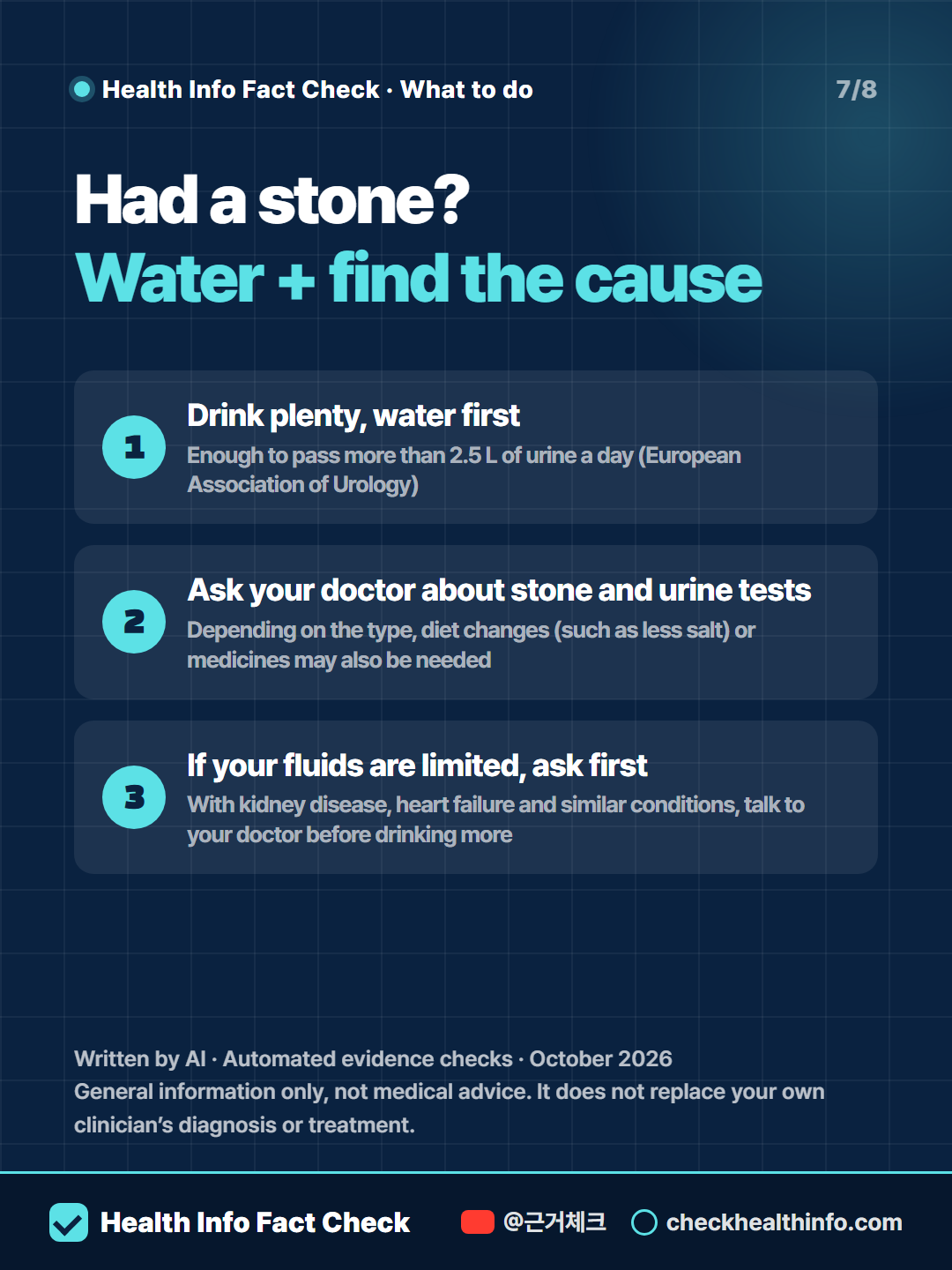
If you limit fluids because of kidney disease (including dialysis), heart failure, cirrhosis or a similar condition, or if you have had low blood sodium (hyponatremia), be sure to talk to your doctor before drinking more. The authors of a meta-analysis also said that more research is needed on safety in people at high risk of fluid overload or hyponatremia [7].
If you have had a stone
- Drink plenty, water first — The European Association of Urology recommends drinking enough to pass more than 2.5 L of urine a day [12]. The guideline recommends water first among drinks.
- Find the cause — If you get stones often or are at high risk, ask your doctor about stone analysis and urine tests to find the cause [12]. Diet changes such as less salt, enough calcium and not too much protein, as well as some medicines, may also reduce recurrence of calcium stones (low strength of evidence) [1][12].
- Stone type — The evidence on recurrence comes mainly from people with calcium stones. Uric acid, cystine, infection-related and other stones may have different causes and ways to prevent them.
Scope: This verdict covers only whether drinking water and other fluids lowers the risk of another stone or a first stone. Treatments to remove existing stones and prevention with medicines are outside its scope.
Limits of this verdict
- The recurrence evidence comparing lots of water with no treatment is essentially one trial (199 people) published in 1996, in people with calcium stones.
- The PUSH trial compared a program to help people drink more water — not water itself — with guideline-based usual care. The comparison group was also advised to drink plenty of water. A correction notice (Lancet 2026) has been published for this paper, but it is available only to subscribers and we could not check what it corrects, so we cite only the trial’s conclusion and not its numbers.
- We could not directly check the full text of the American Urological Association (AUA) 2026 guideline, so we did not cite its fluid recommendations. We also could not directly check Korean guidelines, such as those of the Korean Urological Association, this time.
- Most of the evidence comes from studies of adults in Western countries.
- The grades follow section 1 of our rating method. When new studies come out, we check them in our monthly PubMed review, and if a verdict changes, we record it in our corrections log (in Korean).
Card news
Video (in Korean)
References
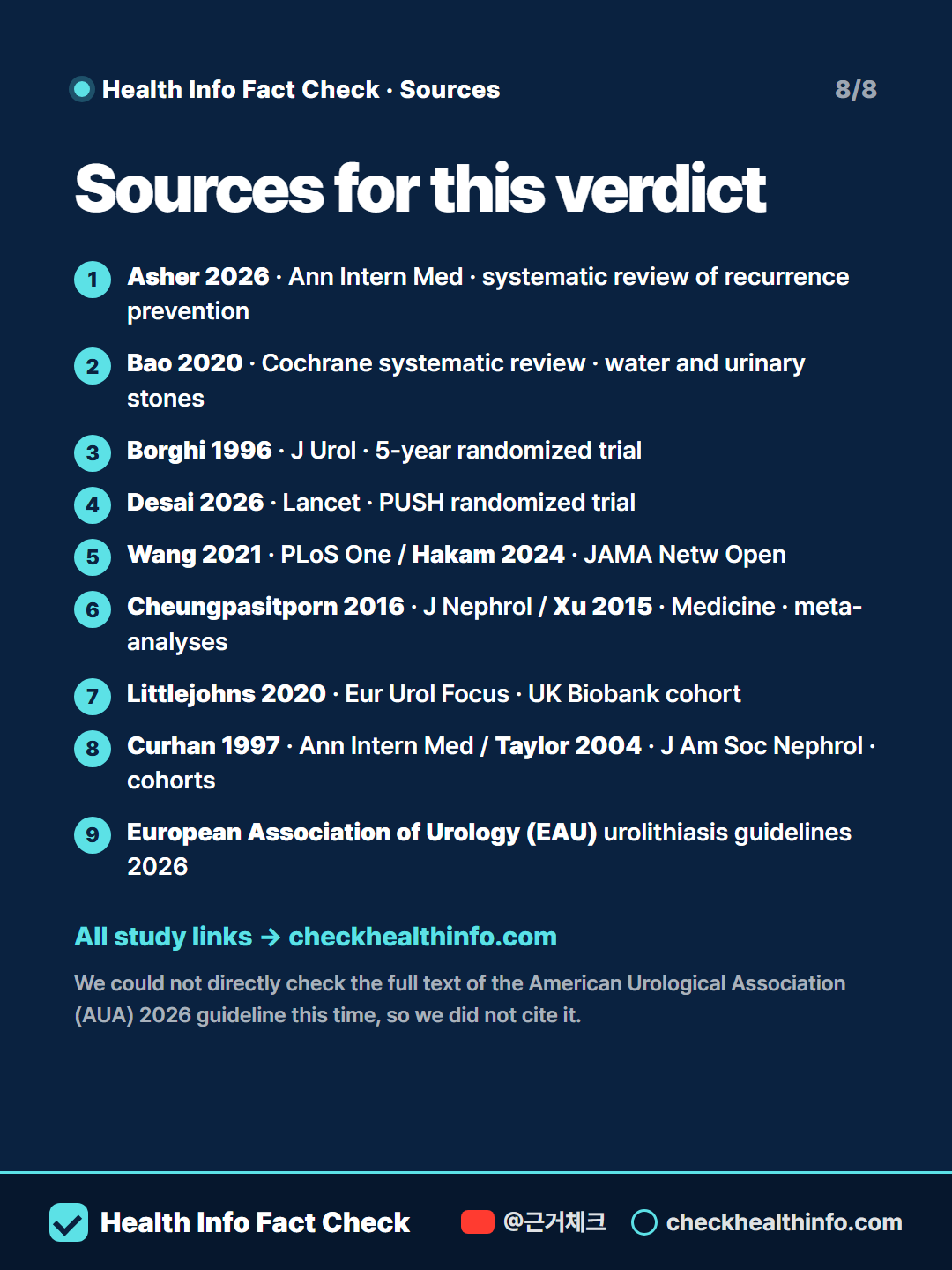
- Asher GN, Viprakasit DP, Aymes SE, et al. Prevention of Recurrent Nephrolithiasis in Adults and Children : A Systematic Review. Ann Intern Med 2026;179(5):696-707. PMID 41871357. PubMed abstract · Full article
- Bao Y, Tu X, Wei Q. Water for preventing urinary stones. Cochrane Database Syst Rev 2020;2(2):CD004292. PMID 32045491. PubMed abstract · Full article · Free full text
- Borghi L, Meschi T, Amato F, et al. Urinary volume, water and recurrences in idiopathic calcium nephrolithiasis: a 5-year randomized prospective study. J Urol 1996;155(3):839-43. PMID 8583588. PubMed abstract
- Wang Z, Zhang Y, Wei W. Effect of dietary treatment and fluid intake on the prevention of recurrent calcium stones and changes in urine composition: A meta-analysis and systematic review. PLoS One 2021;16(4):e0250257. PMID 33872340. PubMed abstract · Full article · Free full text
- Desai AC, Maalouf NM, Harper JD, et al. Prevention of urinary stones with hydration: a randomised clinical trial of an adherence intervention. Lancet 2026;407(10534):1171-1181. PMID 41864748. PubMed abstract · Full article · Free full text
- Hakam N, Guzman Fuentes JL, Nabavizadeh B, et al. Outcomes in Randomized Clinical Trials Testing Changes in Daily Water Intake: A Systematic Review. JAMA Netw Open 2024;7(11):e2447621. PMID 39585691. PubMed abstract · Full article · Free full text
- Cheungpasitporn W, Rossetti S, Friend K, et al. Treatment effect, adherence, and safety of high fluid intake for the prevention of incident and recurrent kidney stones: a systematic review and meta-analysis. J Nephrol 2016;29(2):211-219. PMID 26022722. PubMed abstract · Full article · Free full text
- Xu C, Zhang C, Wang XL, et al. Self-Fluid Management in Prevention of Kidney Stones: A PRISMA-Compliant Systematic Review and Dose-Response Meta-Analysis of Observational Studies. Medicine (Baltimore) 2015;94(27):e1042. PMID 26166074. PubMed abstract · Full article · Free full text
- Littlejohns TJ, Neal NL, Bradbury KE, et al. Fluid Intake and Dietary Factors and the Risk of Incident Kidney Stones in UK Biobank: A Population-based Prospective Cohort Study. Eur Urol Focus 2020;6(4):752-761. PMID 31085062. PubMed abstract · Full article
- Curhan GC, Willett WC, Speizer FE, et al. Comparison of dietary calcium with supplemental calcium and other nutrients as factors affecting the risk for kidney stones in women. Ann Intern Med 1997;126(7):497-504. PMID 9092314. PubMed abstract · Full article
- Taylor EN, Stampfer MJ, Curhan GC. Dietary factors and the risk of incident kidney stones in men: new insights after 14 years of follow-up. J Am Soc Nephrol 2004;15(12):3225-32. PMID 15579526. PubMed abstract · Full article
- European Association of Urology (EAU) Guidelines on Urolithiasis 2026 — 4.2 Metabolic evaluation and recurrence prevention (accessed 2026-10-16). Source
General information only, not medical advice. It does not replace your own clinician's diagnosis or treatment. If you limit fluids because of kidney disease (including dialysis), heart failure or a similar condition, talk to your doctor before drinking more.