Magnesium supplements: do they help leg cramps and sleep, and is it OK to take them every day?
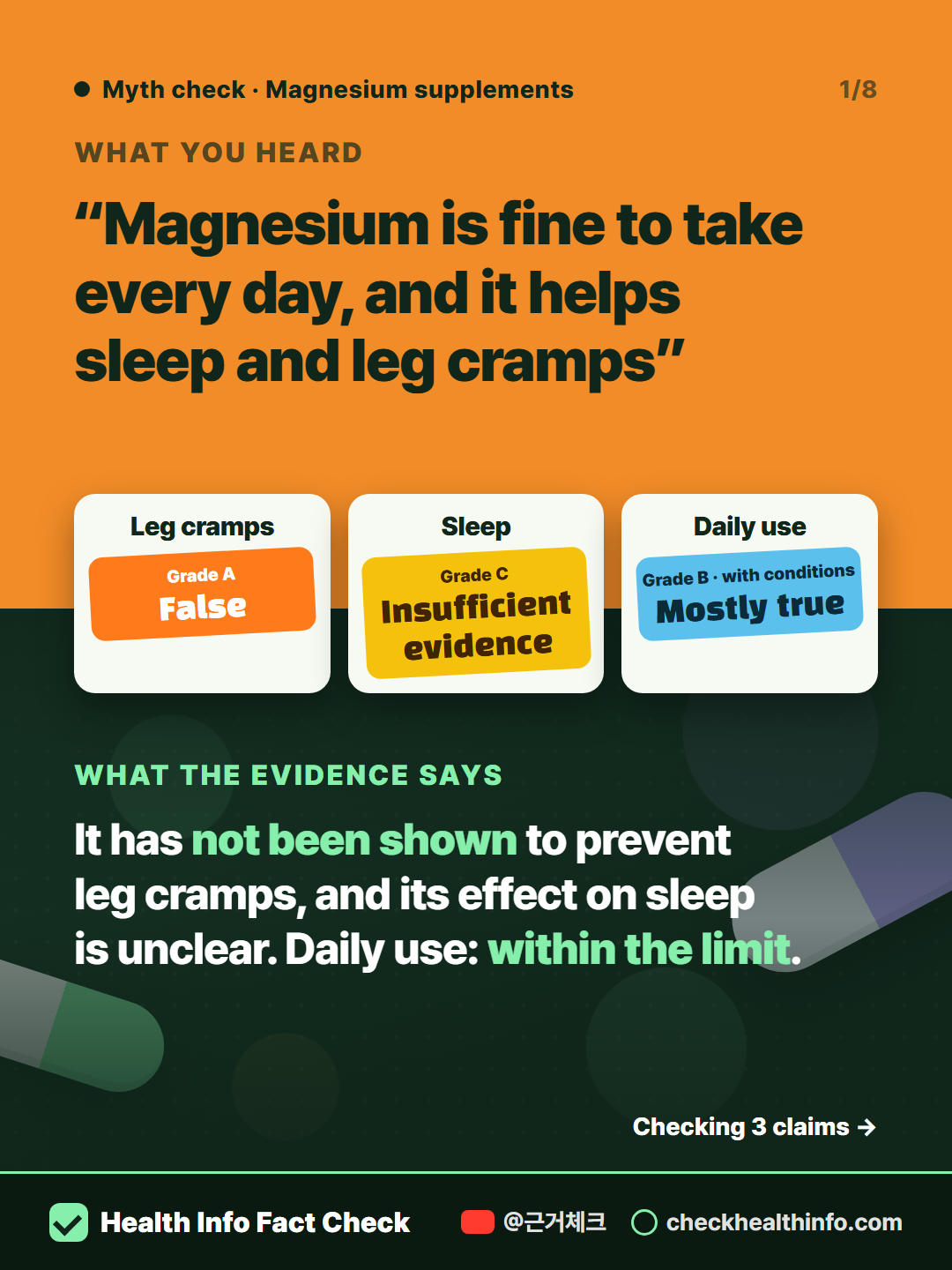
Do magnesium supplements help leg cramps and sleep, and is it fine to take them every day?

We checked this verdict against 8 sources, such as published studies and clinical guidelines. · How checked: Operator-approved
Verdicts at a glance
| Claim | Verdict |
|---|---|
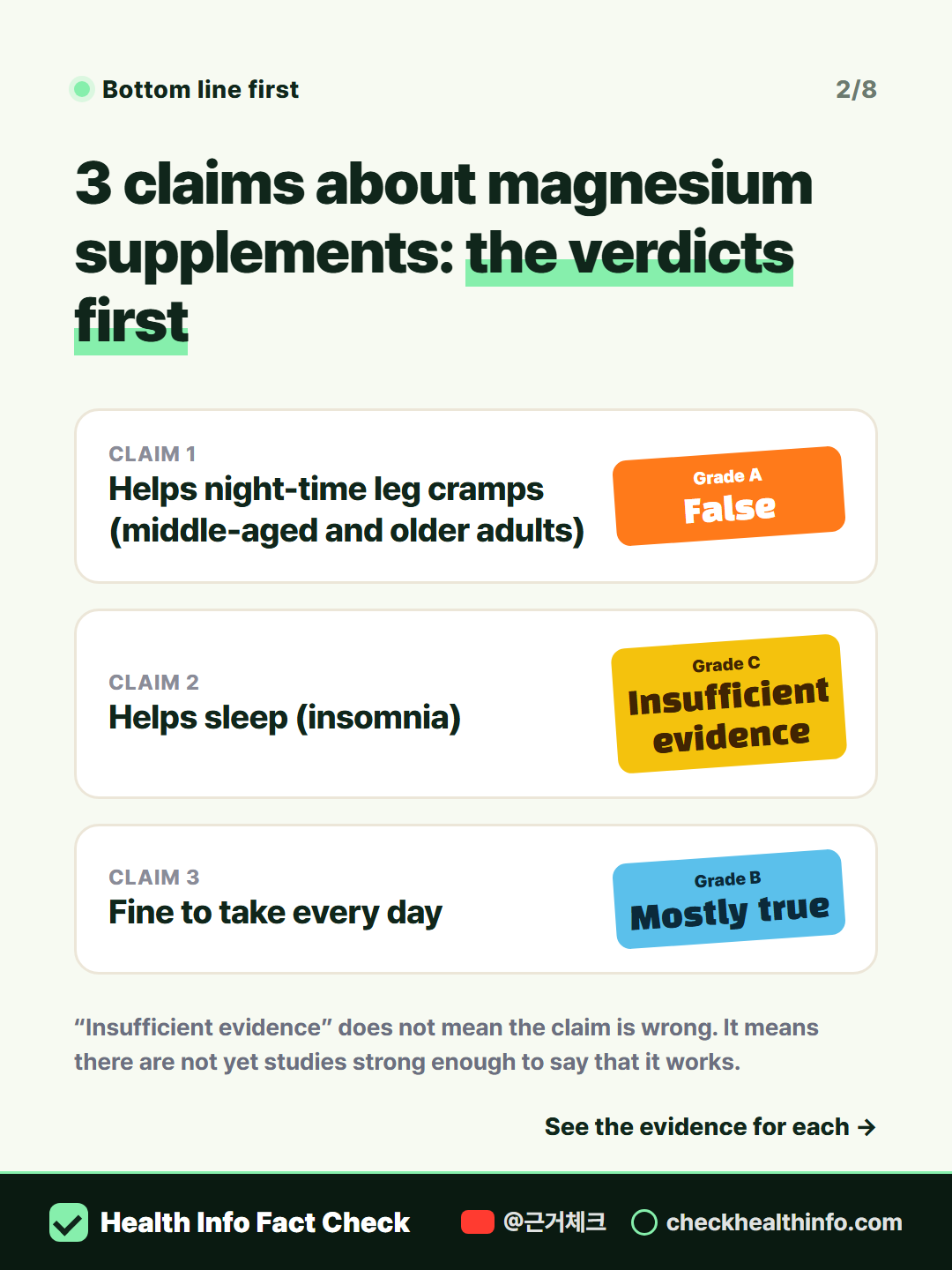
| Magnesium supplements reduce night-time leg cramps (with no clear cause, mostly in middle-aged and older adults) | False · Evidence grade A |
| Magnesium supplements help with sleep (insomnia) | Insufficient evidence · Evidence grade C |
| It is fine to take magnesium supplements every day | Mostly true · Evidence grade B |
Bottom line — In a review of randomized trials, magnesium did not reduce night-time leg cramps in middle-aged and older adults, and its effect on sleep is not yet clear either. For healthy adults, taking up to 350 mg a day from supplements is mostly fine, but it can cause diarrhea, and people with reduced kidney function need to be careful.
Mean difference — The average in one group minus the average in the other. Zero means no difference.
Relative risk — The proportion of people in one group who had an outcome divided by the proportion in the other group. A value of 1 means no difference; above 1 means the outcome was more common in the group being compared (for example, the magnesium group).
Odds ratio — Like relative risk, a way to compare two groups. A value of 1 means no difference; above 1 means the outcome was more common in people with that factor.
95% confidence interval — The range in which the true value likely lies. If it includes 0 (for a mean difference) or 1 (for a relative risk or odds ratio), we say there is no statistically clear difference.
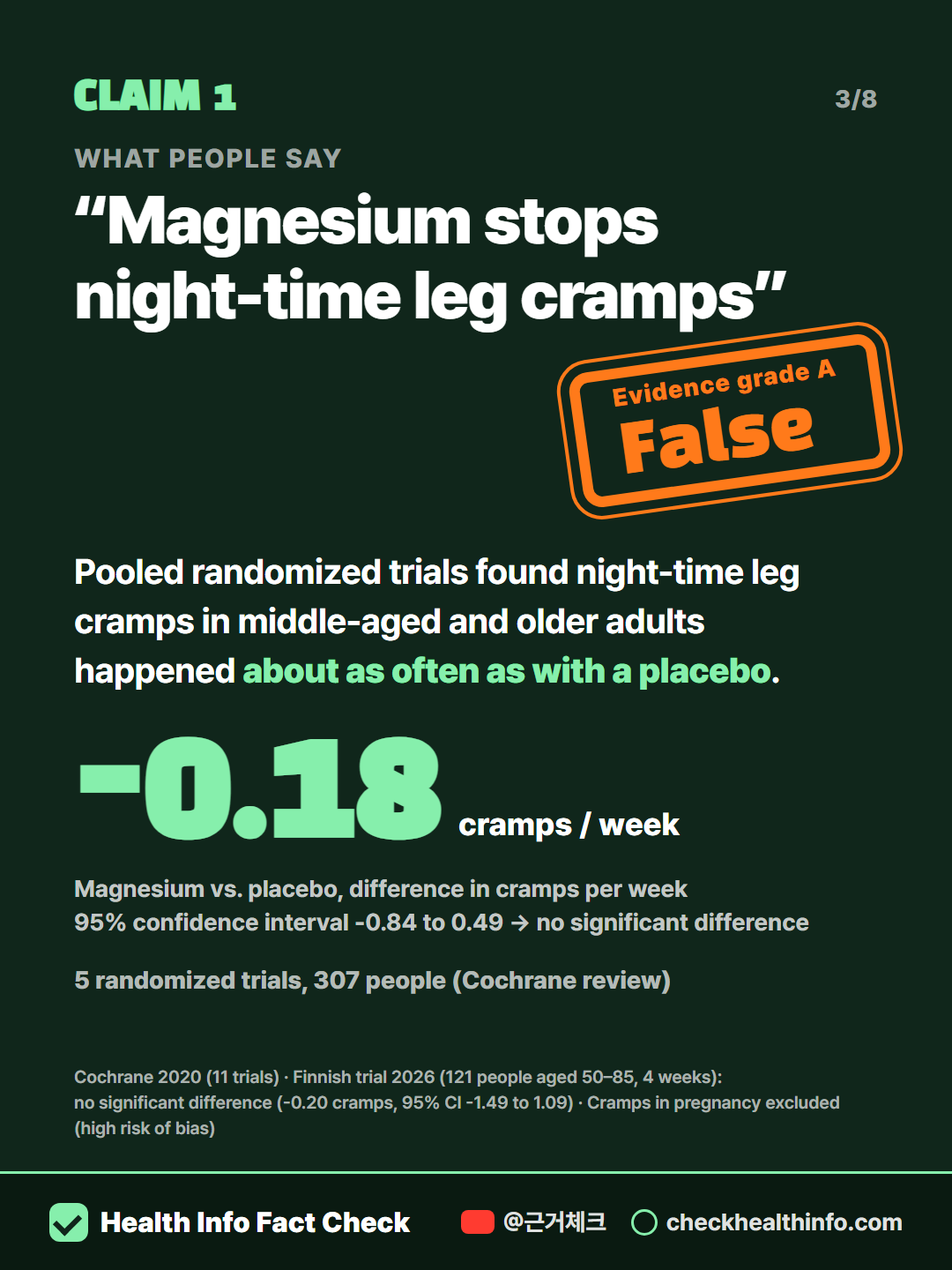
Claim 1. “Magnesium supplements reduce night-time leg cramps (with no clear cause, mostly in middle-aged and older adults)”
False · Evidence grade A
In plain words When randomized trials were pooled, night-time leg cramps in middle-aged and older adults happened about as often with magnesium as with a placebo (dummy pill).
- In a Cochrane systematic review (11 randomized trials, 735 people), taking magnesium for 4 weeks for cramps with no clear cause, mostly night-time leg cramps in older adults, left the number of cramps per week almost the same as with placebo (mean difference -0.18 cramps, 95% confidence interval -0.84 to 0.49). The proportion of people whose cramps dropped by 25% or more did not differ either (relative risk 1.04, 95% confidence interval 0.84 to 1.29; high-certainty evidence). The authors concluded that magnesium is unlikely to provide clinically meaningful cramp prevention in older adults. [1]
- A later trial in Finland randomly assigned 121 people aged 50 to 85 who had cramps at least twice a week to compression stockings, magnesium or placebo for 4 weeks. The number of cramps per week did not differ significantly between the magnesium and placebo groups (adjusted mean difference -0.20, 95% confidence interval -1.49 to 1.09). In the same trial, only the group wearing below-knee compression stockings had fewer cramps (-1.43, 95% confidence interval -2.36 to -0.50). [2]
The Cochrane review found that results from trials in pregnant women were conflicting [1]. A meta-analysis of four randomized trials in pregnant women (332 women) found no reduction in how often cramps occurred (mean difference -0.47, 95% confidence interval -1.14 to 0.20) [3]. However, the Cochrane review rated all of the trials in pregnant women as being at high risk of bias, so we did not use these results in the verdict [1]. If you are pregnant, talk to your prenatal care provider before taking any supplement.
Scope: This verdict is about muscle cramps with no clear cause (mostly night-time leg cramps in middle-aged and older adults). We did not rate cramps during exercise because there are no randomized trials, and the verdict does not apply when tests have confirmed a magnesium deficiency.
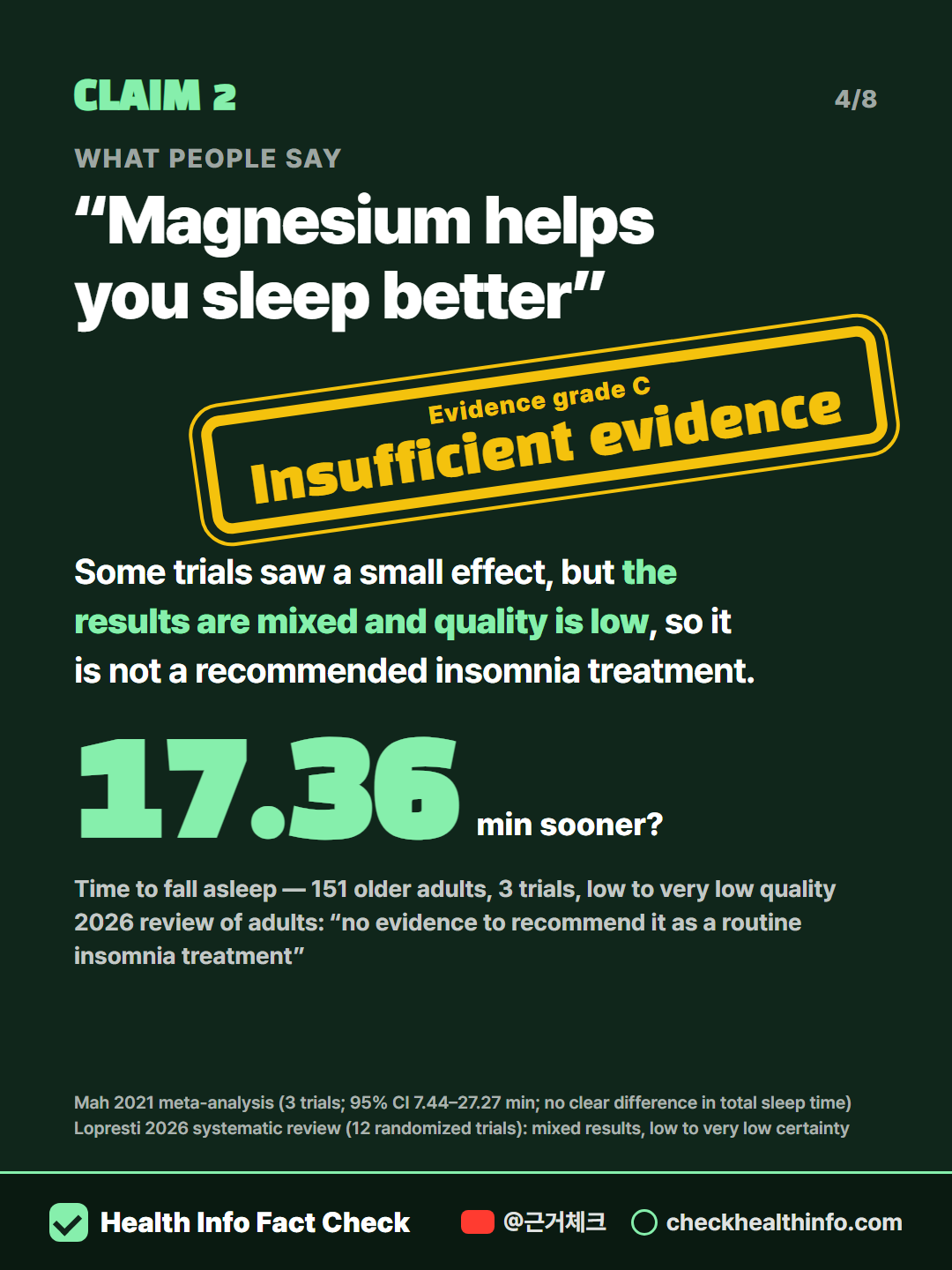
Claim 2. “Magnesium supplements help with sleep (insomnia)”
Insufficient evidence · Evidence grade C
In plain words Some trials found a small benefit, but the results are mixed and the studies are of low quality, so there is not yet enough evidence to say magnesium helps sleep. It has not been shown that it does not work, either.
- The most recent systematic review (2026), which included only randomized trials in adults, found that results for self-rated sleep, brain-wave recordings (EEG) and wrist activity monitors were mixed and that the certainty of the evidence was low or very low. It concluded that there is no evidence to recommend magnesium as a routine treatment for insomnia, though some adults may see small improvements in self-rated measures. [4]
- A meta-analysis of 3 randomized trials in 151 older adults with insomnia found that falling asleep took 17.36 minutes less than with placebo (95% confidence interval 7.44 to 27.27 minutes). Total sleep time increased by 16.06 minutes, but this difference was not statistically clear. All of the trials had a moderate to high risk of bias, and the quality of the evidence was low to very low. [5]
- In a randomized trial of 155 adults aged 18 to 65 who reported poor sleep, insomnia severity scores fell over 4 weeks by 3.9 points in the group taking 250 mg of elemental magnesium a day and by 2.3 points in the placebo group, a difference that was only just statistically significant (p=0.049). The effect size was small (Cohen's d 0.2). One of the trial's authors heads a clinical research organization that receives research funding from supplement companies and is also the first author of the 2026 review above. [6]
There is a systematic review of randomized trials, but the results differ depending on how sleep was measured and the trials are few and small, so under our rating method we graded the evidence down two levels. This does not mean magnesium has been shown not to work; it means there are not yet studies strong enough to say that it does. If insomnia goes on for a long time, see a doctor before turning to supplements.
Claim 3. “It is fine to take magnesium supplements every day”
Mostly true · Evidence grade B
In plain words For healthy adults, taking magnesium within the upper limit (350 mg a day from supplements and medicines) is mostly fine. But it can cause diarrhea, and people with reduced kidney function or who take certain medicines should check with their doctor or pharmacist first.
- The NIH Office of Dietary Supplements (US National Institutes of Health) sets the upper limit for magnesium that adults get from supplements and medicines at 350 mg a day. This limit does not include magnesium from food. In healthy people, the kidneys remove extra magnesium from food in the urine, but large amounts from supplements or medicines often cause diarrhea, which can come with nausea and abdominal cramps, and the risk of magnesium toxicity rises when kidney function is reduced. [7]
- In the randomized trials in the Cochrane review, serious adverse events did not differ: 2 of 72 people taking magnesium and 3 of 68 taking placebo. Adverse effects of oral magnesium were mostly gastrointestinal, such as diarrhea, reported by 11% to 37% of the magnesium groups and 10% to 14% of the control groups across trials (relative risk for minor adverse events 1.51, 95% confidence interval 0.98 to 2.33; low-certainty evidence). [1]
- A retrospective cohort study at a university hospital in Japan looked back at 320 inpatients prescribed magnesium oxide (a medicine used as a laxative and antacid) and found that 23% developed high blood magnesium (hypermagnesemia; mostly mild grade 1 at 19%, grade 3 at 4%). Risk factors included an estimated glomerular filtration rate, a measure of kidney function, of 55.4 mL/min or less (odds ratio 3.105) and taking 1650 mg or more of magnesium oxide a day by tablet weight (odds ratio 1.914). The 1650 mg figure is the total weight of the medicine, so it cannot be compared directly with the elemental magnesium listed on a supplement label or with the 350 mg upper limit. These data come from inpatients taking a prescription medicine, not a supplement, but they show that magnesium can build up when kidney function is reduced. [8]
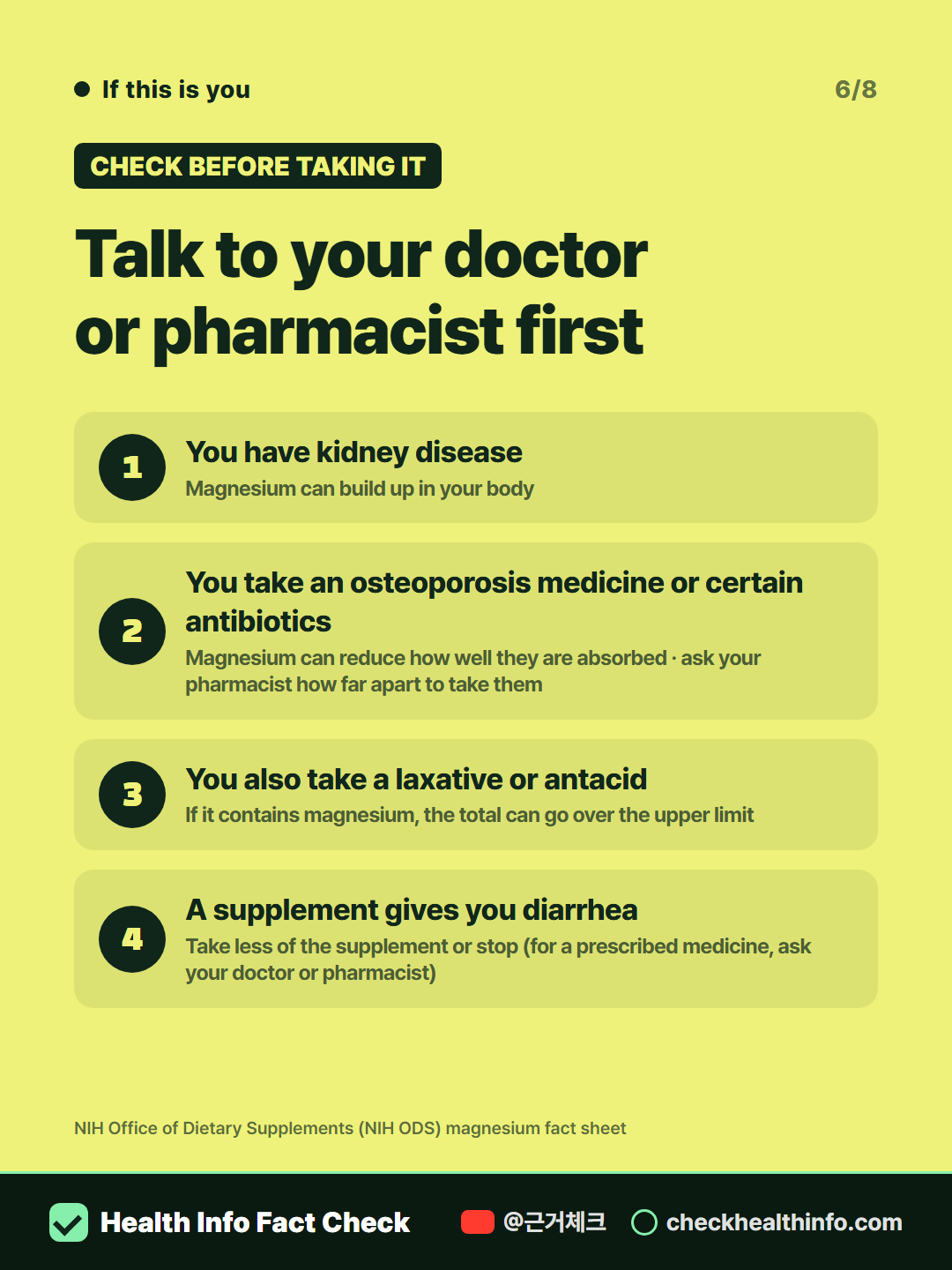
· have kidney disease
· take an osteoporosis medicine (a bisphosphonate) or a tetracycline or quinolone antibiotic — magnesium can reduce how well these medicines are absorbed, so the doses need to be spaced apart. Ask your pharmacist how far apart to take them. [7]
· also take a laxative or antacid that contains magnesium — together they can go over the upper limit
· get diarrhea from a magnesium supplement — take less of the supplement (for a prescribed medicine, ask your doctor or pharmacist).
Scope: The figures on stomach and bowel side effects come from trials that gave magnesium for a few weeks to people with cramps, so they do not directly show what happens when someone takes it every day for years. That is why we graded the evidence down one level to B.
Limitations of this verdict
- Magnesium products vary in form (oxide, glycinate, threonate and others) and dose, and each trial used a different product. We did not conclude that any particular form works better.
- Most of the evidence comes from studies outside Korea. The supplement upper limit is cited from the NIH Office of Dietary Supplements fact sheet (accessed October 2026).
- Grades follow section 1 of our rating method. Claim 1 is A because there is a systematic review; claim 2 is C, graded down two levels because the results are mixed and the trials are small; claim 3 is B, graded down one level because the side-effect data are indirect evidence from short-term trials.
- We check for new studies in our monthly PubMed review, and if a verdict changes we record it in our corrections log (in Korean).
Card news



Video (in Korean)
References
- Garrison SR, Korownyk CS, Kolber MR, et al. Magnesium for skeletal muscle cramps. Cochrane Database Syst Rev 2020;9(9):CD009402. PMID 32956536. PubMed abstract · Full article · Free full text
- Kuusipalo A, Laitila J, Lehtonen E, et al. Secondary prevention of leg cramps using compression stockings or magnesium supplements: a three-arm randomized clinical trial. Trials 2026;27(1). PMID 41680812. PubMed abstract · Full article · Free full text
- Liu J, Song G, Zhao G, et al. Effect of oral magnesium supplementation for relieving leg cramps during pregnancy: A meta-analysis of randomized controlled trials. Taiwan J Obstet Gynecol 2021;60(4):609-614. PMID 34247796. PubMed abstract · Full article
- Lopresti AL, Smith SJ, Drummond PD. Magnesium Supplementation for Sleep in Adults: A Systematic Review of Randomized Controlled Trials. J Diet Suppl 2026;23(5):553-581. PMID 42661485. PubMed abstract · Full article
- Mah J, Pitre T. Oral magnesium supplementation for insomnia in older adults: a Systematic Review & Meta-Analysis. BMC Complement Med Ther 2021;21(1):125. PMID 33865376. PubMed abstract · Full article · Free full text
- Schuster J, Cycelskij I, Lopresti A, et al. Magnesium Bisglycinate Supplementation in Healthy Adults Reporting Poor Sleep: A Randomized, Placebo-Controlled Trial. Nat Sci Sleep 2025;17:2027-2040. PMID 40918053. PubMed abstract · Full article · Free full text
- NIH Office of Dietary Supplements (ODS) — Magnesium Fact Sheet for Health Professionals (updated 2026-01-06) (accessed 2026-10-12). Source
- Wakai E, Ikemura K, Sugimoto H, et al. Risk factors for the development of hypermagnesemia in patients prescribed magnesium oxide: a retrospective cohort study. J Pharm Health Care Sci 2019;5:4. PMID 30805197. PubMed abstract · Full article · Free full text
General information only, not medical advice. It does not replace your own clinician's diagnosis or treatment. If you have kidney disease or take other medicines (such as osteoporosis medicines or certain antibiotics), talk to your doctor or pharmacist before taking a magnesium supplement.