Didn’t reach 10,000 steps? Does walking still do you any good?
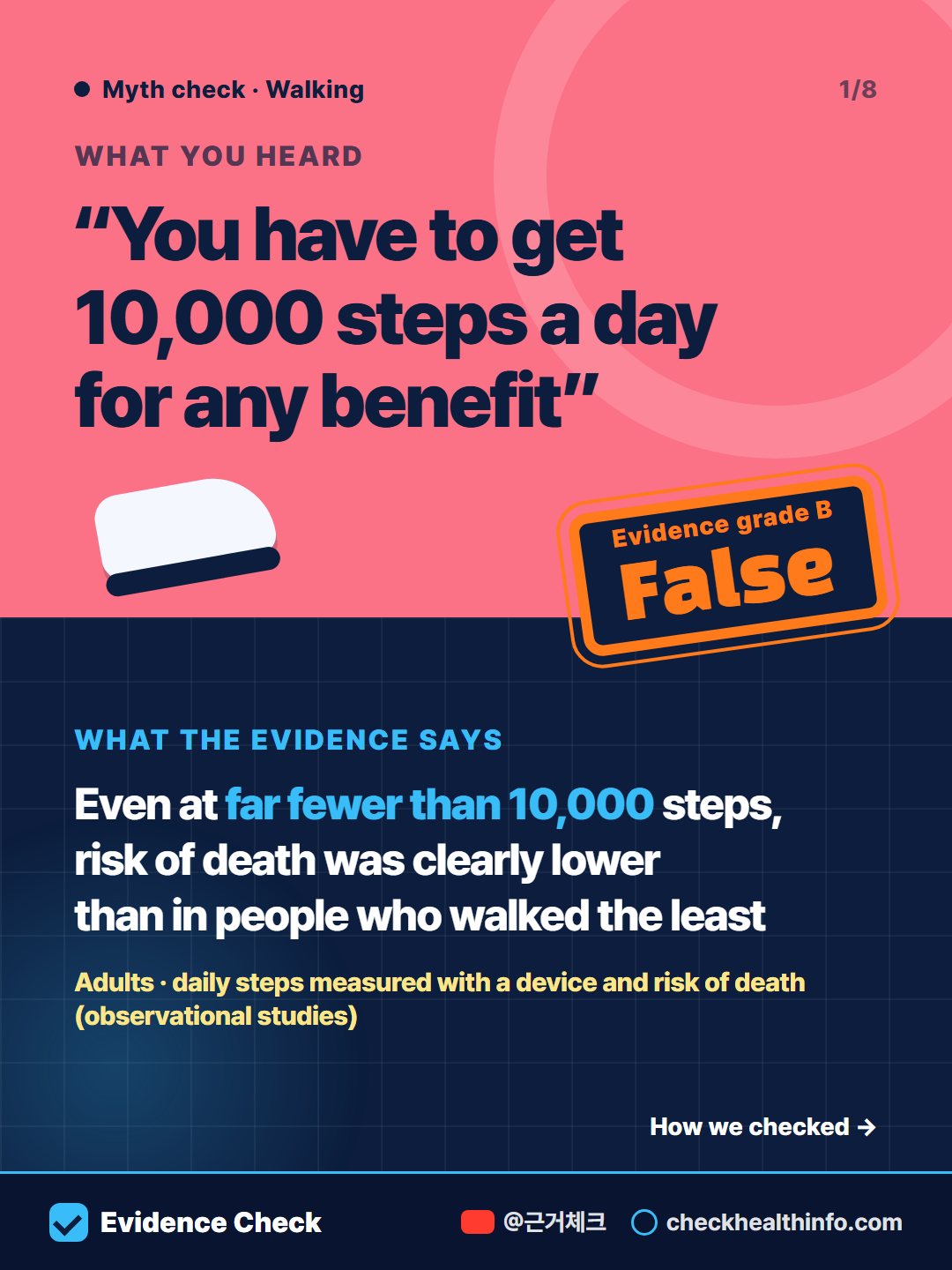
To get health benefits (a lower risk of death), do you have to get 10,000 steps a day?

We checked this verdict against 6 sources, such as published studies and clinical guidelines. · How checked: AI-drafted · automated evidence checks
Verdicts at a glance
| Claim | Verdict |
|---|---|
| To get health benefits (a lower risk of death), you have to get 10,000 steps a day | False · Evidence grade B |
Bottom line — Across studies that measured people’s daily steps with a device and followed them for years, the risk of death was clearly lower at step counts far below 10,000. So the claim that “you have to get 10,000 steps a day to see any health benefit” is false. In fact, people who walked just a few thousand more steps a day than the least active people had a lower risk of death (with large drops up to about 7,000 steps), and people who walked more tended to have a slightly lower risk still (observational studies). If you have knee, heart or lung problems, or have not exercised in a long time, talk with your health care team before you increase your steps.
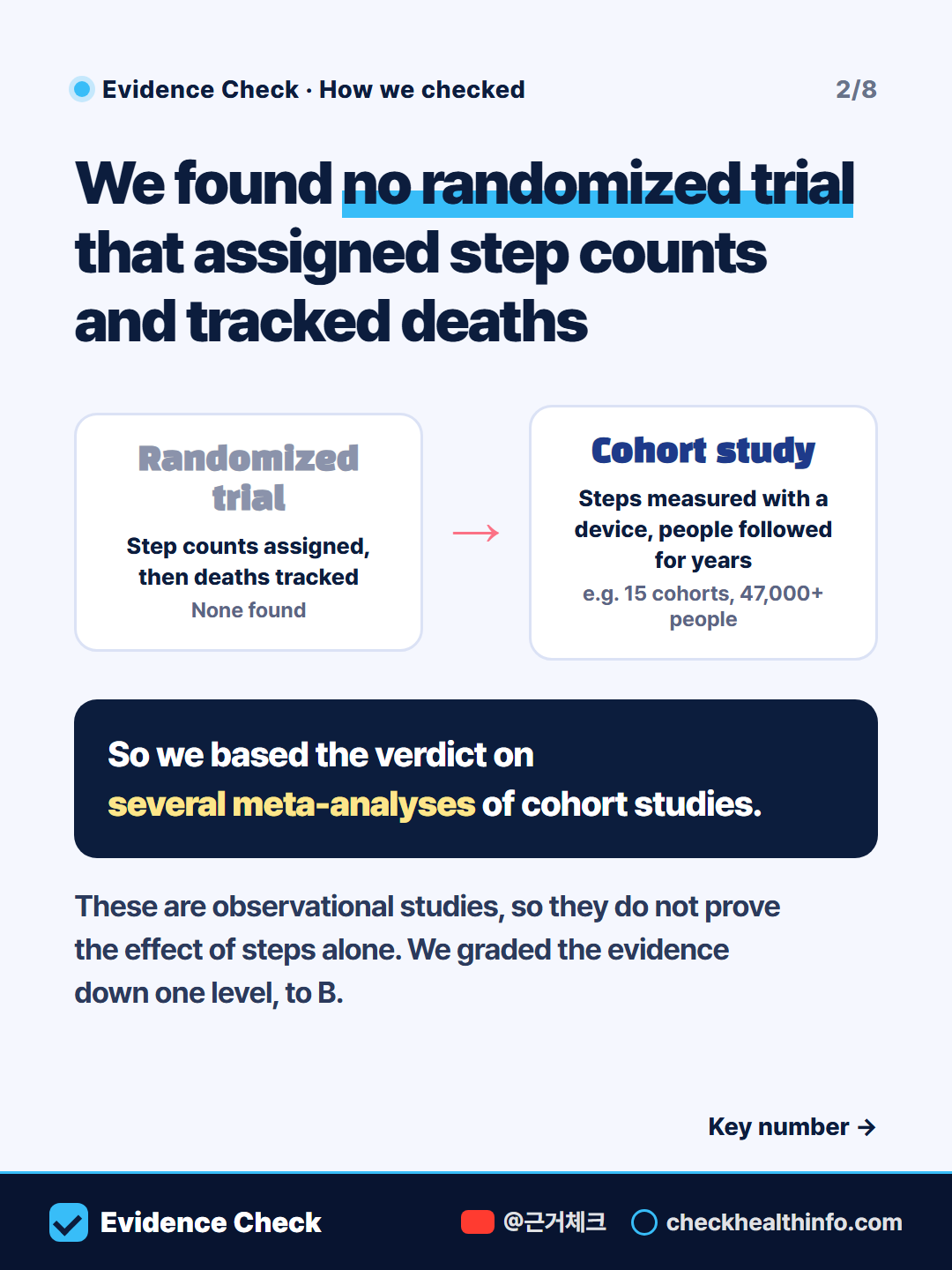
Cohort study — An observational study that measures many people’s habits (here, their step counts) and follows them over a long time. It shows that two things go together, but it is less certain than a randomized trial about cause and effect.
Meta-analysis — An analysis that pools the results of several studies into a single estimate.
Hazard ratio — A comparison of how fast an event (here, death) happens over time in two groups. A value of 1 means no difference; less than 1 means lower risk.
95% confidence interval — The range in which the true value is likely to fall. If the range includes 1, we cannot say for sure that there is a difference.
Quartiles — Four equal groups made by lining up participants by step count and splitting them into quarters.
Claim. “To get health benefits (a lower risk of death), you have to get 10,000 steps a day”
False · Evidence grade B
In plain words 10,000 steps is not a minimum. People who walked just a few thousand more steps a day than the least active people had a lower risk of death (with large drops up to about 7,000 steps), and people who walked more tended to have a slightly lower risk still (observational studies).
- We found no trial that randomly assigned people to step counts and followed them for death, so we based the verdict on meta-analyses of cohort studies that measured steps with a device and followed people for years.
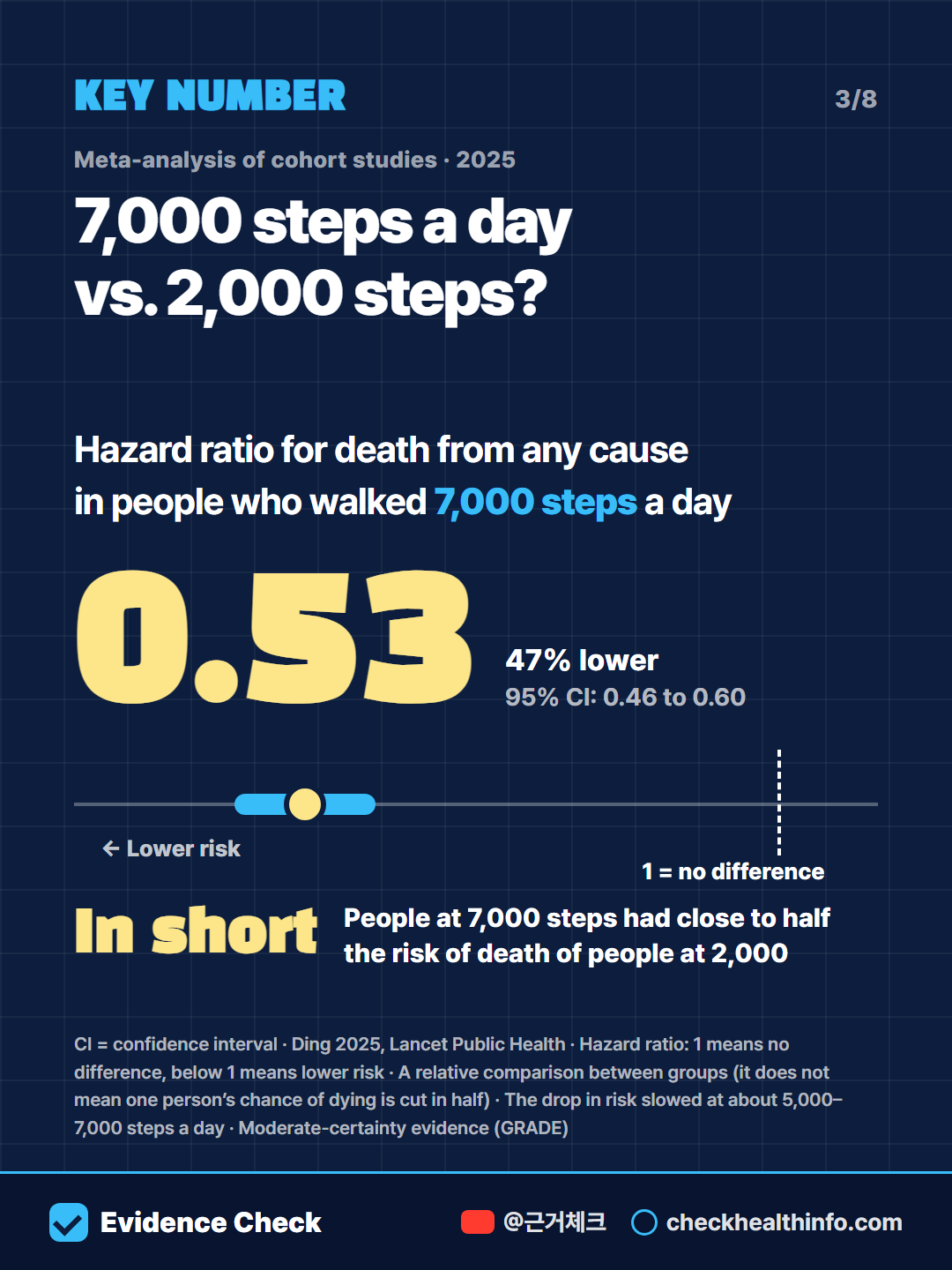
- In a meta-analysis of studies published through 2025, people who walked 7,000 steps a day had a 47% lower risk of death from any cause than people who walked 2,000 steps (hazard ratio 0.53, 95% confidence interval 0.46 to 0.60). Risk fell steeply up to about 5,000–7,000 steps a day and then kept falling, but more slowly. The study rated the certainty of this evidence as “moderate” using GRADE. In other words, people who walked 7,000 steps had close to half the risk of death of people who walked 2,000 steps. A hazard ratio is a relative comparison between two groups; it does not mean that any one person’s actual chance of dying is cut in half. [1]
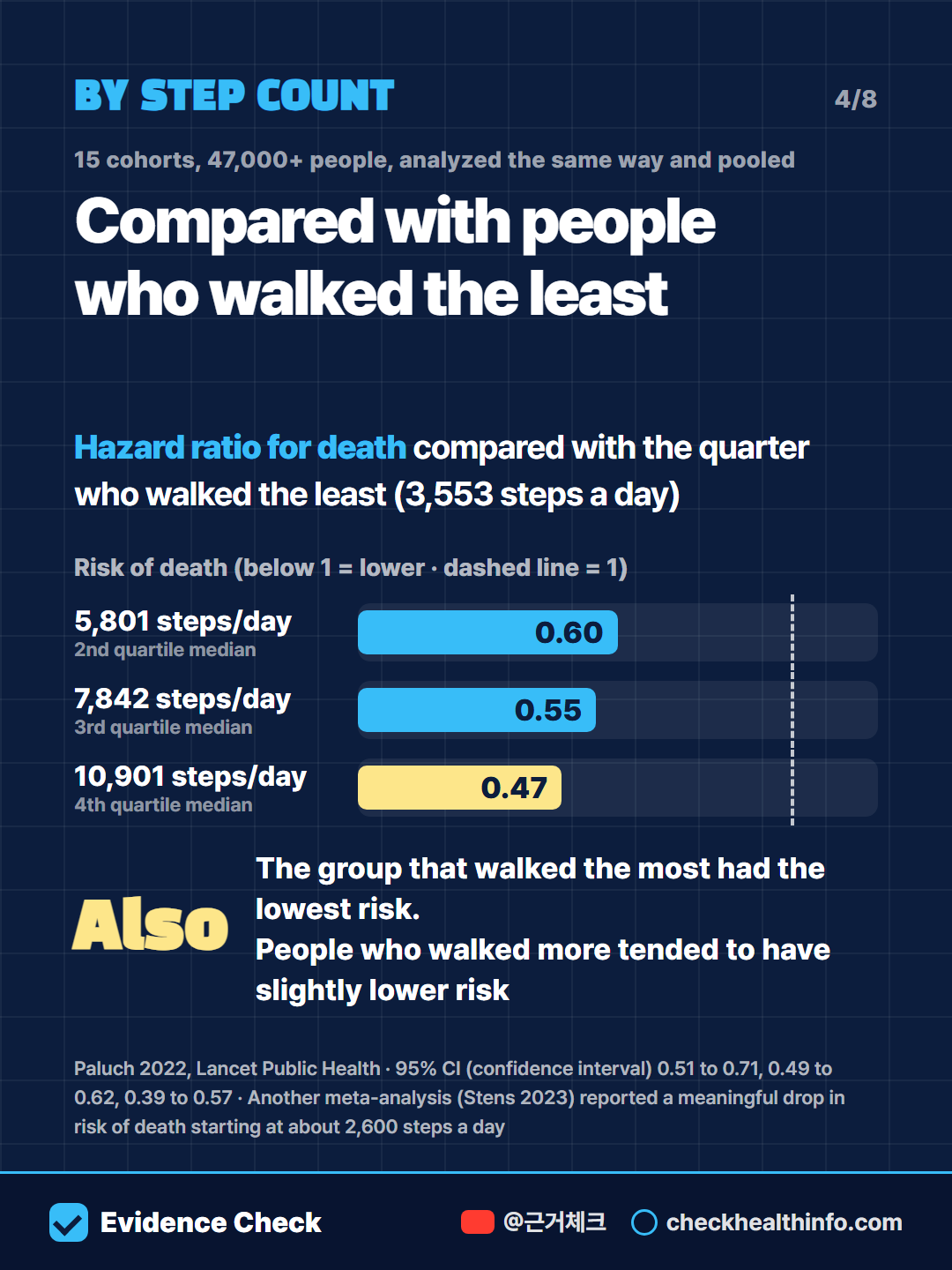
- In a study that analyzed 15 cohorts with more than 47,000 people in the same way and pooled the results (each research team analyzed its own data using the same protocol, and the results were then combined), the hazard ratios for death compared with the quarter who walked the least (median 3,553 steps a day) were 0.60 for the group at 5,801 steps a day (95% confidence interval 0.51 to 0.71), 0.55 at 7,842 steps (0.49 to 0.62) and 0.47 at 10,901 steps (0.39 to 0.57). In other words, even people who walked about 6,000 steps a day had a clearly lower risk than the least active people, and the group that walked the most had the lowest risk. [2]
- Another meta-analysis reported that, compared with 2,000 steps a day, a meaningful drop in the risk of death started at about 2,600 steps (hazard ratio 0.92 at 2,517 steps, 95% confidence interval 0.84 to 0.999) and that risk kept falling up to about 8,800 steps. In other words, a difference showed up even between people who walked 2,000 steps a day and those who walked just over 2,500. [3]
- In yet another meta-analysis of 17 cohort studies, each additional 1,000 steps a day was linked to a 15% lower risk of death from any cause (hazard ratio 0.85, 95% confidence interval 0.81 to 0.91). In other words, the more people walked, the lower their risk tended to be. [4]
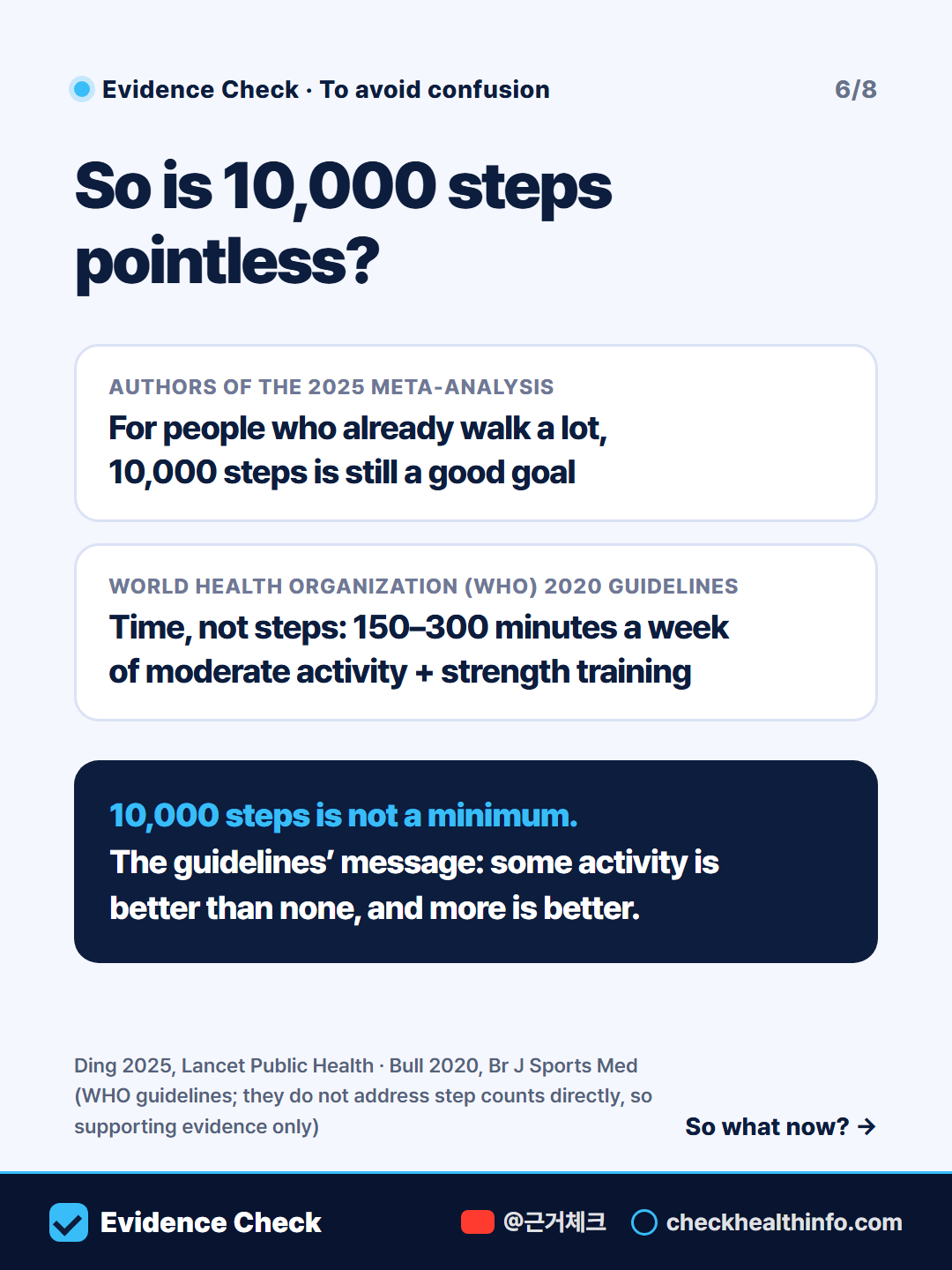
- The World Health Organization (WHO) 2020 physical activity guidelines give their advice in minutes of activity, not steps: for all adults, 150–300 minutes a week of moderate-intensity (or 75–150 minutes of vigorous-intensity) aerobic activity, plus regular muscle-strengthening activity. They sum it up as: some activity is better than none, and more is better. These guidelines do not address the number 10,000 directly, so we use them only as supporting evidence. [6]
The highest level of evidence is systematic reviews and meta-analyses of prospective cohort studies, so we started at A. But these are meta-analyses of observational studies, not randomized trials, so under section 1 of our rating method (reason 2: pooled observational studies) we graded down one level, to B. The studies looked directly at daily steps and risk of death, so we did not grade down for indirectness (reason 1). The step count at which risk starts to drop meaningfully differs between studies (from about 2,600 steps up to the point where the drop slowed, at about 5,000–7,000 steps), but they all point the same way: risk was lower at step counts far below 10,000. So we did not grade down for inconsistency (reason 3). Reliable studies (grade B) show the opposite of the claim that “you only get a benefit if you reach 10,000 steps,” so it is rated “False” (section 2 of our rating method). The part that says “walking more is better” does fit the evidence.
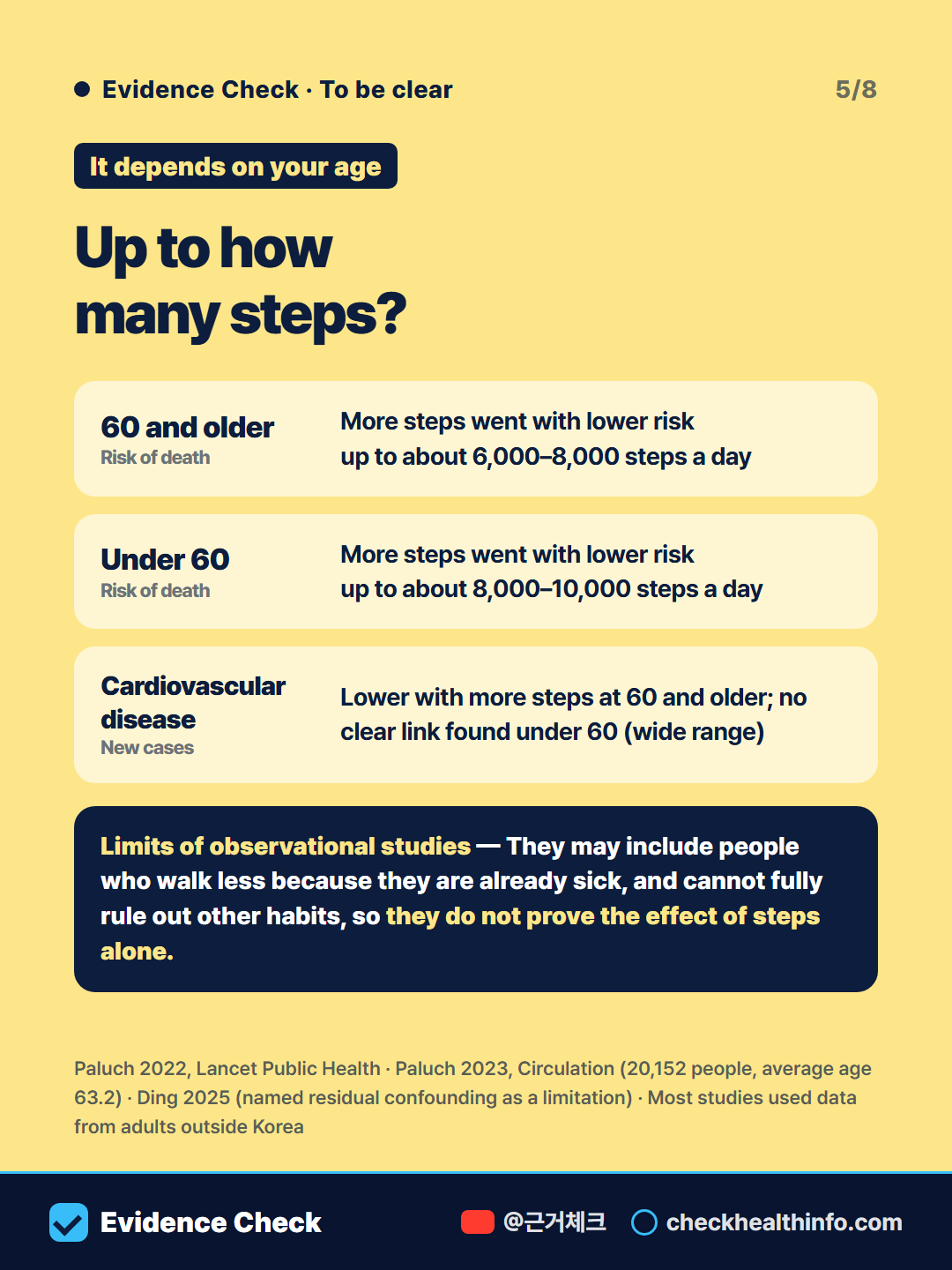
Risk of death — In people 60 and older, more steps were linked to lower risk up to about 6,000–8,000 steps a day; in people younger than 60, up to about 8,000–10,000 steps a day. In other words, the step count where risk stopped falling much was lower for people 60 and older and higher for people under 60. [2]
New cardiovascular disease — In an analysis of more than 20,000 people (average age 63.2), more steps were linked to lower cardiovascular disease risk in people 60 and older (hazard ratio 0.51 for the quartile that walked the most, 95% confidence interval 0.41 to 0.63). In people younger than 60, no clear link was found (0.95, 95% confidence interval 0.61 to 1.48; the range is wide, so we cannot say for sure). [5]
No. The authors of the 2025 meta-analysis said that 10,000 steps is still a good goal for people who already walk a lot, and that 7,000 steps is also linked to meaningful improvements and may be a more realistic goal [1]. This does not mean that 10,000 steps is harmful. It means that not reaching 10,000 steps does not make your walking worthless.
How to start walking more
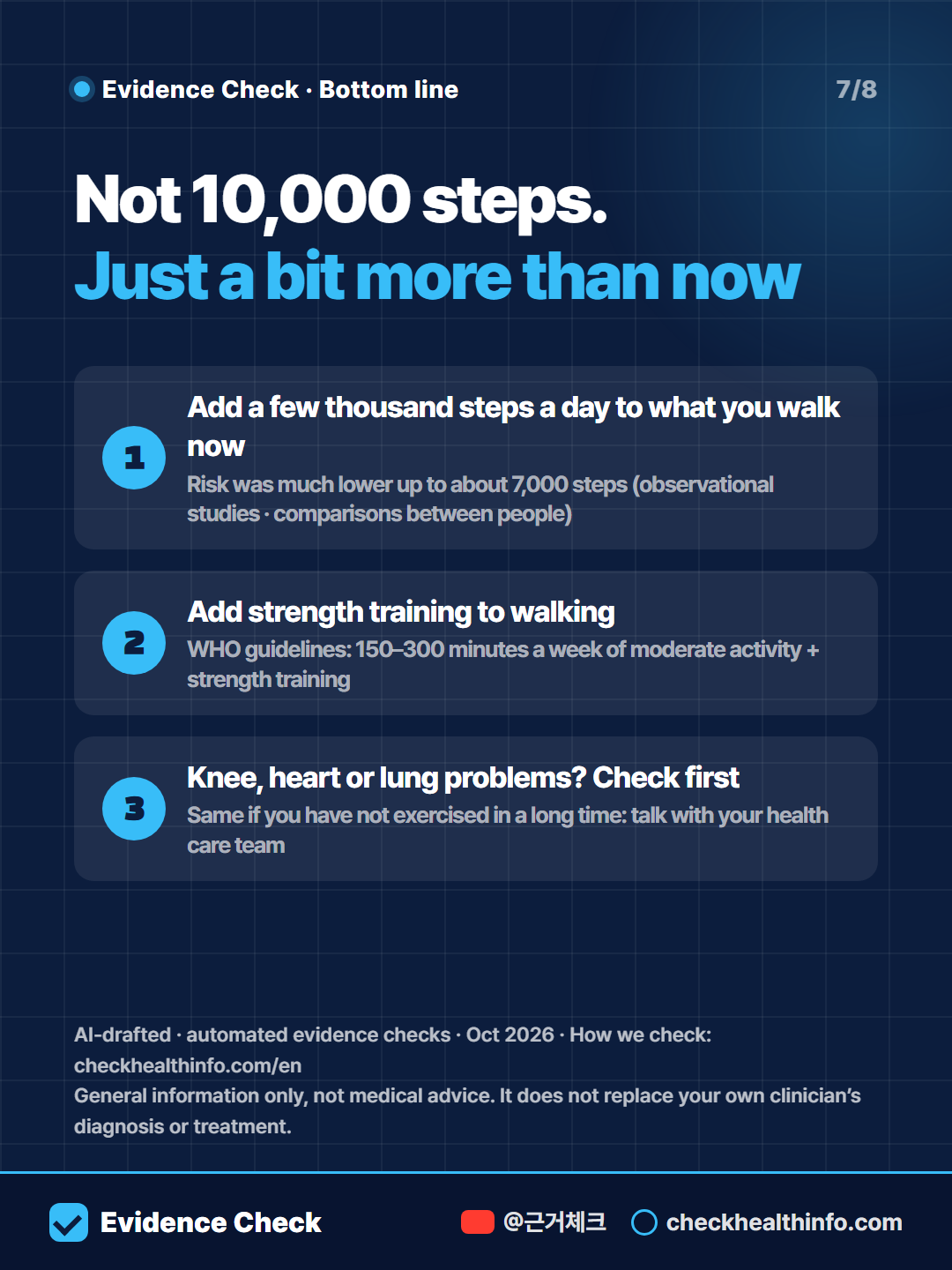
- A little more than now — Try adding a few thousand steps a day to what you walk now. In the studies, risk was much lower with more steps, up to about 7,000 a day (observational studies; comparisons between people).
- Add strength training — The WHO guidelines recommend regular muscle-strengthening activity for all ages, on top of aerobic activity such as walking (150–300 minutes a week of moderate intensity) [6].
- Check first — If you have knee, heart or lung problems, or have not exercised in a long time, talk with your health care team before suddenly increasing your steps.
Scope: This verdict covers only the link between adults’ daily step counts (measured with a device) and risk of death, and whether 10,000 steps is a minimum. It does not cover walking speed, exercise plans for specific conditions or where the number 10,000 came from.
Limits of this verdict
- All of these are observational studies, so they do not prove the effect of steps themselves. They cannot fully rule out that people who are already sick walk less, or the effects of other lifestyle habits (the 2025 meta-analysis also named residual confounding as a limitation).
- The step count at which risk starts to drop or levels off differs by study, measuring device and age. Most of the studies used data from adults outside Korea.
- Correction notices are attached to two of the meta-analyses we cited (Ding 2025 and Banach 2023). The numbers we cite match the current PubMed abstracts, but we could not check the text of the corrections directly.
- We could not directly check the step-count advice from the US CDC or Korean guidelines this time, so we did not cite them.
- We set the grade under section 1 of our rating method. We check for new studies in our monthly PubMed review, and if a verdict changes, we record it in our corrections log (in Korean).
Card news
Video (in Korean)
References
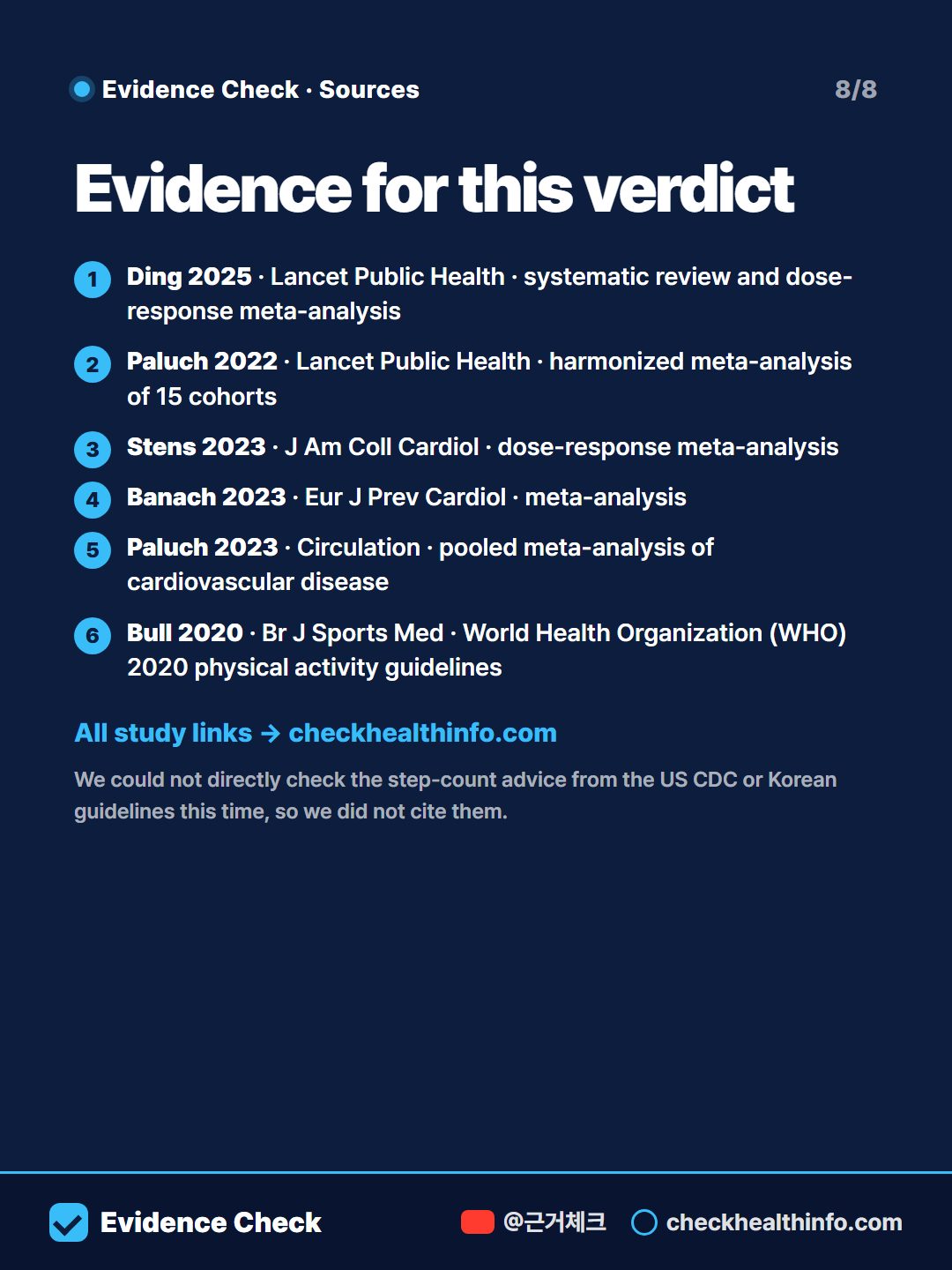
- Ding D, Nguyen B, Nau T, et al. Daily steps and health outcomes in adults: a systematic review and dose-response meta-analysis. Lancet Public Health 2025;10(8):e668-e681. PMID 40713949. PubMed abstract · Full article
- Paluch AE, Bajpai S, Bassett DR, et al. Daily steps and all-cause mortality: a meta-analysis of 15 international cohorts. Lancet Public Health 2022;7(3):e219-e228. PMID 35247352. PubMed abstract · Full article
- Stens NA, Bakker EA, Mañas A, et al. Relationship of Daily Step Counts to All-Cause Mortality and Cardiovascular Events. J Am Coll Cardiol 2023;82(15):1483-1494. PMID 37676198. PubMed abstract · Full article
- Banach M, Lewek J, Surma S, et al. The association between daily step count and all-cause and cardiovascular mortality: a meta-analysis. Eur J Prev Cardiol 2023;30(18):1975-1985. PMID 37555441. PubMed abstract · Full article
- Paluch AE, Bajpai S, Ballin M, et al. Prospective Association of Daily Steps With Cardiovascular Disease: A Harmonized Meta-Analysis. Circulation 2023;147(2):122-131. PMID 36537288. PubMed abstract · Full article
- Bull FC, Al-Ansari SS, Biddle S, et al. World Health Organization 2020 guidelines on physical activity and sedentary behaviour. Br J Sports Med 2020;54(24):1451-1462. PMID 33239350. PubMed abstract · Full article
General information only, not medical advice. It does not replace your own clinician’s diagnosis or treatment. If you have knee, heart or lung problems, or have not exercised in a long time, talk with your health care team before increasing your steps.