Sudden face, arm or speech changes: is it a stroke? BE-FAST vs FAST
When spotting the warning signs of stroke, does BE-FAST, which adds balance and eyes, pick up more strokes than FAST (face, arm, speech, time)?

We checked this verdict against 8 sources, such as published studies and clinical guidelines. · How checked: Operator-approved
Verdicts at a glance
| Claim | Verdict |
|---|---|
| BE-FAST (adding balance and eyes) picks up more strokes than FAST | Mostly true · Evidence grade C |
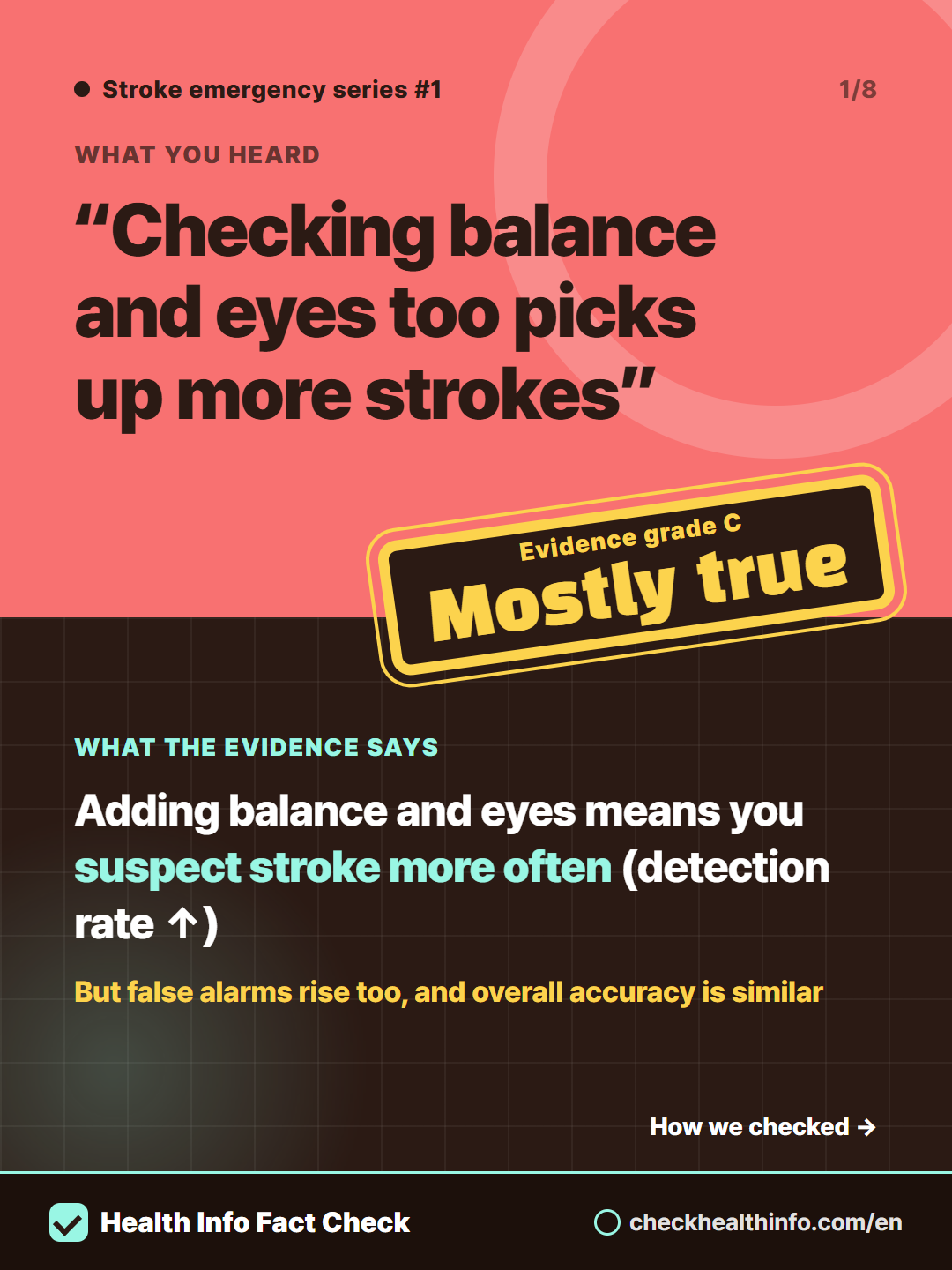
Bottom line — BE-FAST adds Balance and Eyes to the face, arm and speech signs of FAST. In studies that applied both checks to the same patients, BE-FAST flagged more strokes (it had higher sensitivity). Read in this narrower sense, the claim that “BE-FAST picks up more strokes than FAST” is mostly true. But it also flags more people who turn out not to be having a stroke (false alarms), and a study of emergency medical services (EMS) found that overall accuracy was similar and concluded that adding balance and eyes did not improve stroke detection. There are few studies and their results conflict, so the evidence grade is C. What is clear is that a stroke is possible even when the face, arms and speech seem normal, if someone suddenly feels dizzy or unsteady or has trouble seeing (early warning signs of stroke from the Korea Disease Control and Prevention Agency, KDCA). Do not try to judge this yourself; call 119 right away (911 in the US).
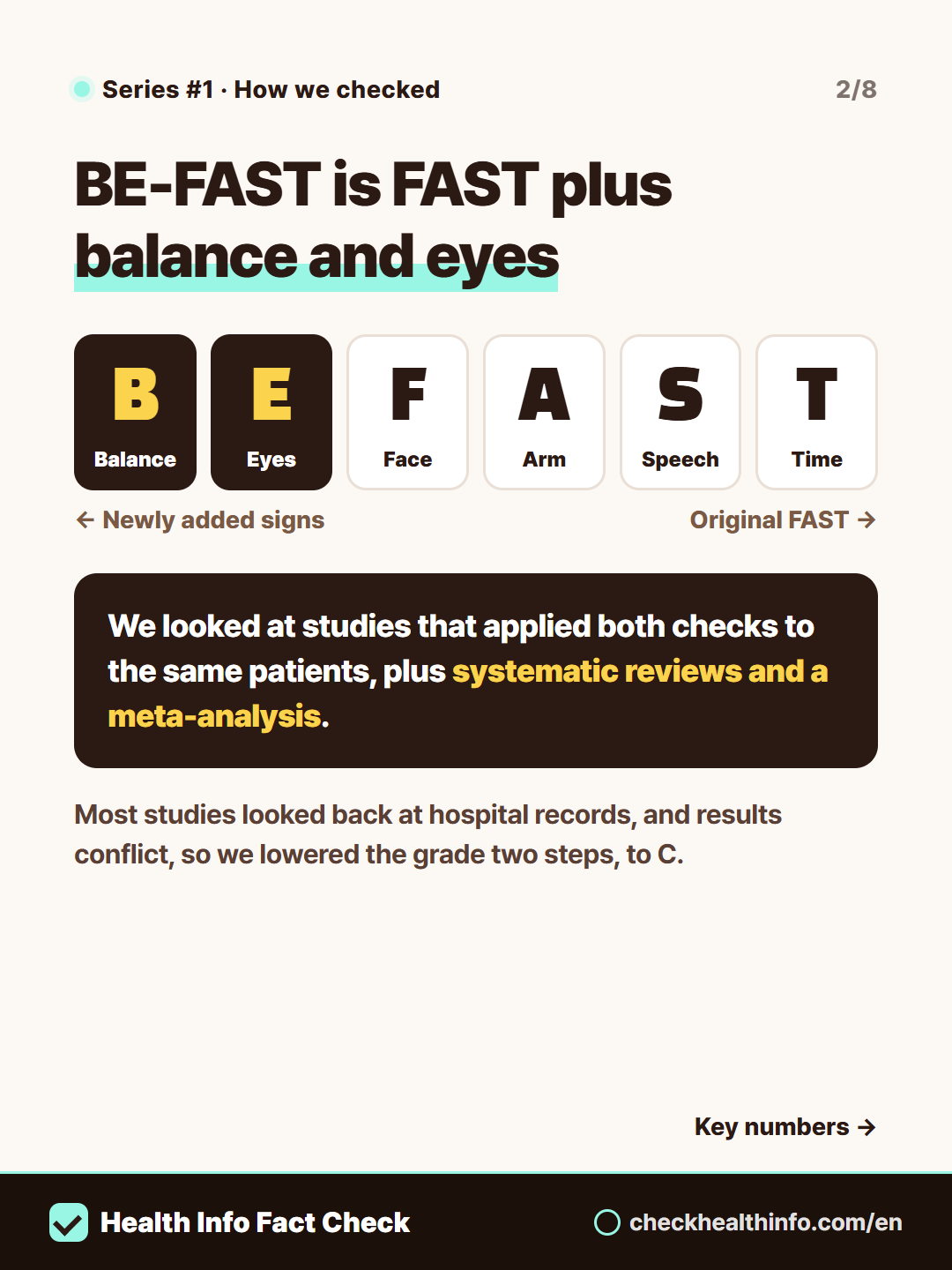
FAST · BE-FAST — Memory aids for the warning signs of stroke. FAST stands for Face, Arm, Speech and Time; BE-FAST adds Balance and Eyes.
Sensitivity — Of the people who really are having a stroke, the share that the check flags as “possible stroke.” The higher it is, the fewer strokes are missed.
Specificity — Of the people who are not having a stroke, the share that the check correctly rules out. The lower it is, the more false alarms there are.
Posterior circulation stroke — A stroke caused by a blockage in the blood vessels that supply the back of the brain (such as the brainstem and cerebellum). It often shows up as dizziness, balance problems or vision problems.
Retrospective study — A study that looks back at existing hospital records.
95% confidence interval — The range that is likely to contain the true value. The wider the range, the less certain the result.
Claim. “BE-FAST (adding balance and eyes) picks up more strokes than FAST”
Mostly true · Evidence grade C
In plain words Checking balance and eye symptoms as well makes you suspect stroke more often. But it also flags more people who are not having a stroke, so it is too early to say it is more accurate overall.
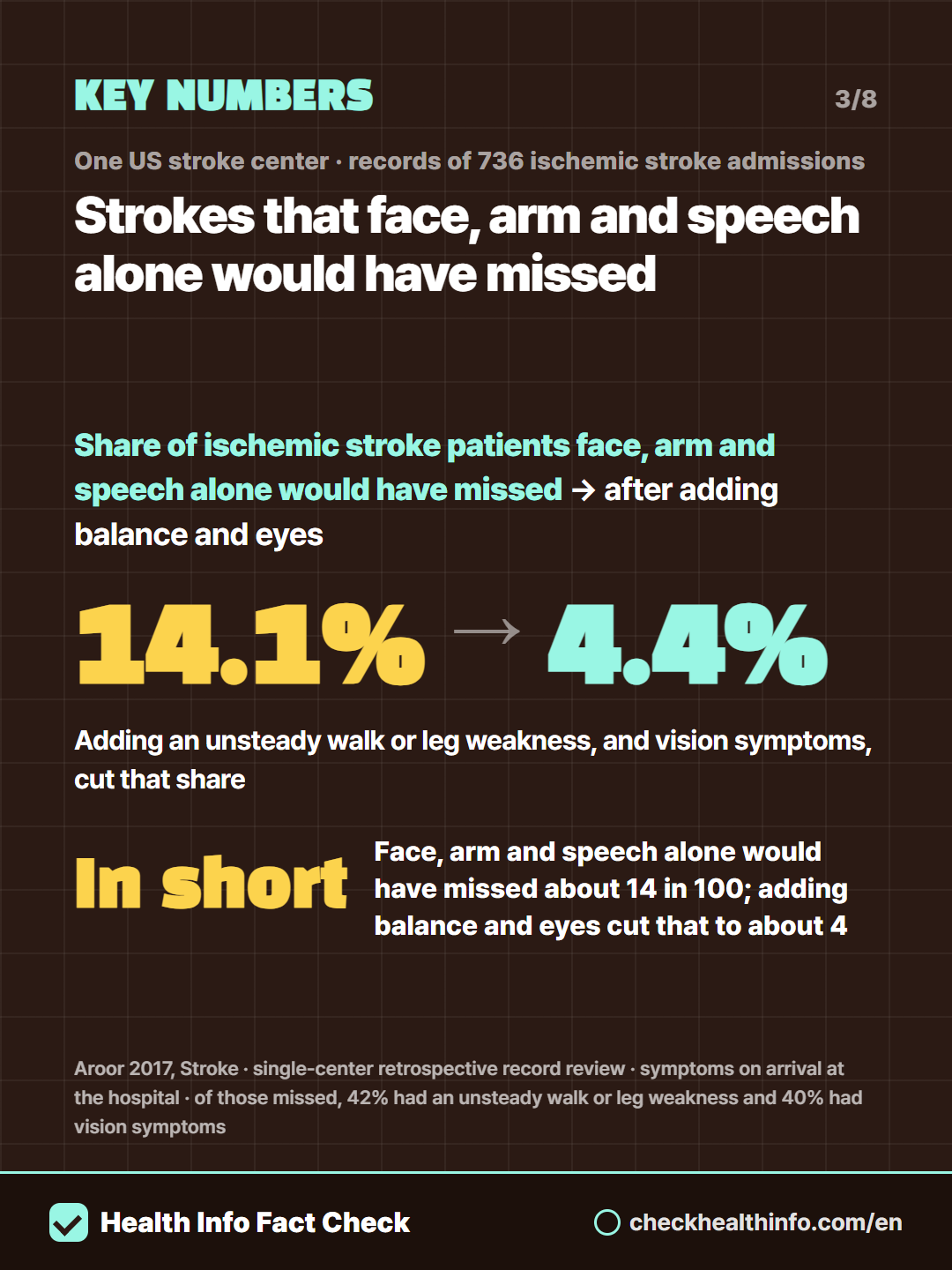
- In the records of 736 people admitted with ischemic stroke (stroke caused by a blocked artery) at one US stroke center, 14.1% had none of the face, arm or speech symptoms when they arrived at the hospital. Of these patients, 42% had an unsteady walk or leg weakness and 40% had vision symptoms; adding these two signs reduced the share who would have been missed to 4.4%. In other words, face, arm and speech alone would have missed about 14 of every 100 people with ischemic stroke, and adding balance and eyes cut that to about 4. [3]
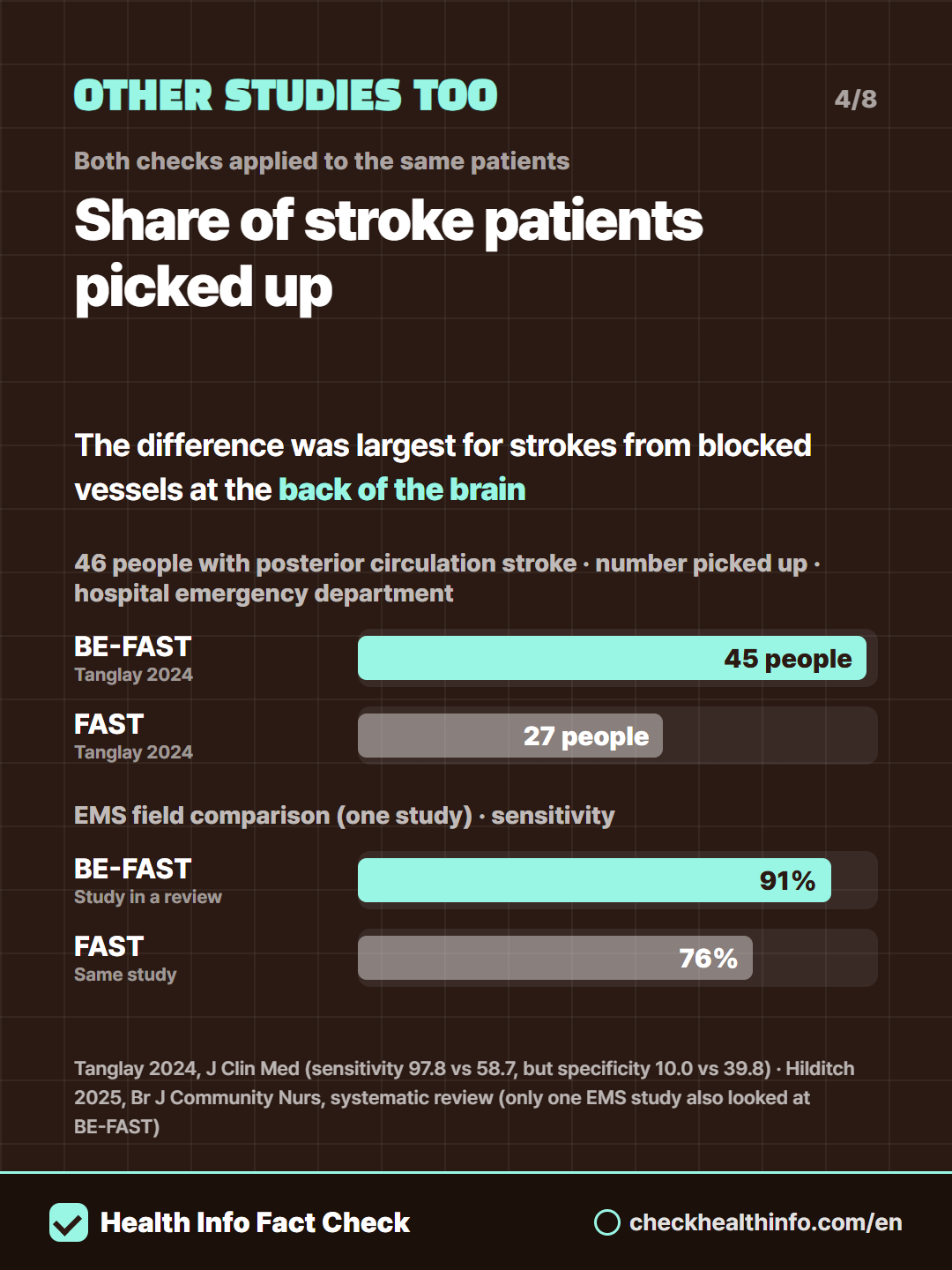
- Among 46 people with posterior circulation stroke (a blockage in the vessels at the back of the brain), FAST flagged 27 and BE-FAST flagged 45. In other words, the difference was large for strokes that show up as dizziness, balance problems or eye symptoms. [4]
- A systematic review found only one study that compared both checks in the field by EMS crews. In that study, sensitivity (the share of strokes picked up) was 91% for BE-FAST and 76% for FAST. In other words, BE-FAST flagged more strokes in the field as well. [1]
- BE-FAST includes every item in FAST, so when both are used on the same patients, it will always flag at least as many people as FAST does, by design. What matters is how many more false alarms that brings (see below).
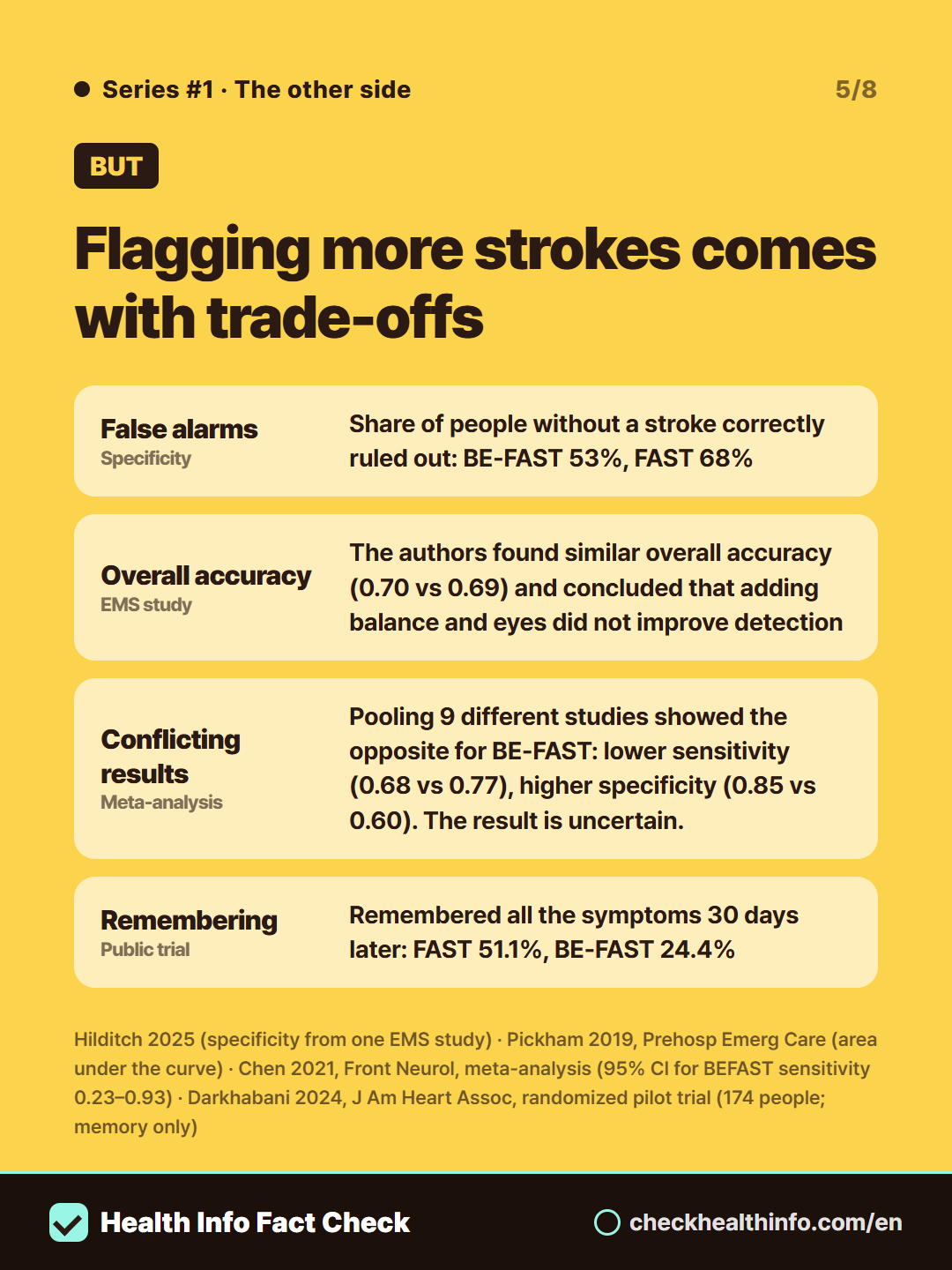
False alarms — In the same EMS study (the only study in the systematic review that also tested BE-FAST), the share of people without a stroke who were correctly ruled out (specificity) was 53% for BE-FAST and 68% for FAST [1]. In the posterior circulation stroke study, specificity was 10.0% for BE-FAST and 39.8% for FAST [4]. In other words, more people who are not having a stroke get flagged.
Similar overall accuracy — In a prospective study of 359 patients seen by US EMS crews, the overall accuracy of the two checks (area under the curve) was similar, 0.70 vs 0.69, and the only items that independently predicted stroke were facial droop and arm weakness. The authors concluded that adding balance and eyes did not improve stroke detection by EMS crews [8]. In other words, flagging more strokes also brings more false alarms, so it is too early to say BE-FAST is more accurate overall.
Conflicting results — A meta-analysis pooling 9 different studies (6,151 people) found the opposite: BE-FAST (written “BEFAST” in that study) had lower pooled sensitivity (0.68 vs 0.77; 95% confidence interval for BE-FAST 0.23–0.93) and higher specificity (0.85 vs 0.60), the opposite direction from the same-patient comparison studies. The studies differed in who was studied and where, so the pooled estimates are inconsistent and the result is uncertain [2]. The systematic review also said BE-FAST may be more sensitive but that there is not enough evidence to draw a conclusion [1].
Remembering — In a pilot trial that randomly assigned 174 members of the public to be taught one check or the other, the share who remembered all the symptoms 30 days later was 51.1% for FAST and 24.4% for BE-FAST (written “BE FAST” in that study). This suggests that more items to memorize can mean less is remembered. The trial looked only at memory; it did not look at whether people actually recognized a stroke sooner [7].
We judged the claim in the narrower sense of “picks up a higher share of strokes (higher sensitivity).” Every study that applied both checks to the same patients found that BE-FAST picked up more strokes, so in this sense the evidence agrees with the claim. But false alarms increase; a prospective EMS study found similar overall accuracy and concluded that adding balance and eyes did not improve stroke detection; and a meta-analysis pointed the opposite way. That is why the rating is “Mostly true” rather than “True” (section 2 of our rating method), and it does not mean BE-FAST is more accurate overall. The evidence starts at grade A because it includes a systematic review and a meta-analysis. We lowered it one grade under reason (2) in section 1 of our rating method because the pooled studies are observational (mostly studies that looked back at hospital records), and one more grade under reason (3) because the results conflict and are uncertain, which gives C.
What to do
- Face, arm, speech — If one side of the face suddenly droops, an arm suddenly becomes weak, or speech suddenly becomes slurred, suspect a stroke.
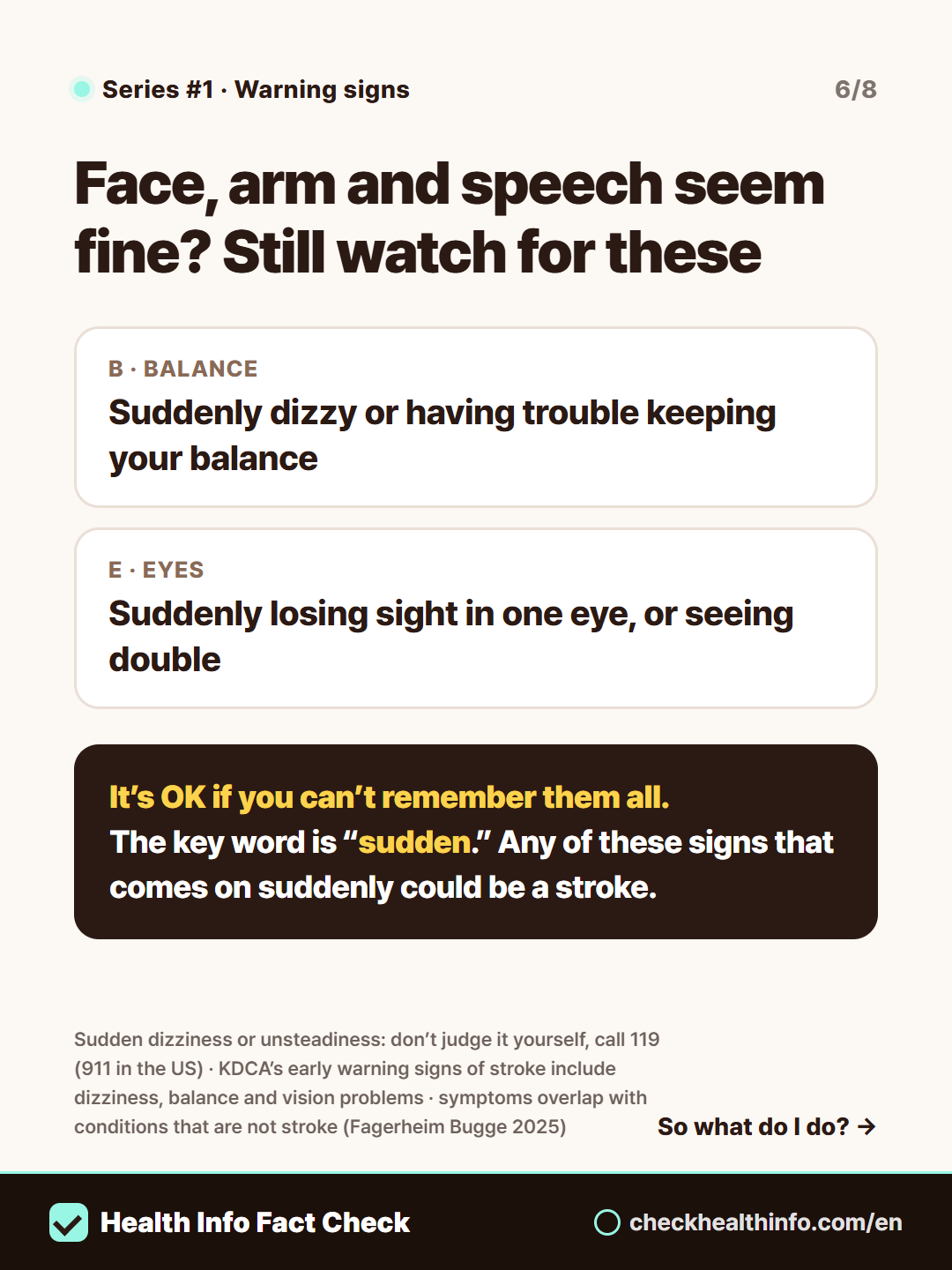
- Balance and eyes, too — Even if the face, arms and speech seem normal, a stroke is possible if someone suddenly becomes dizzy or has trouble keeping their balance, or suddenly loses sight in one eye, loses half of their field of vision, or sees double. These are also among the early warning signs of stroke listed by KDCA [3][4].
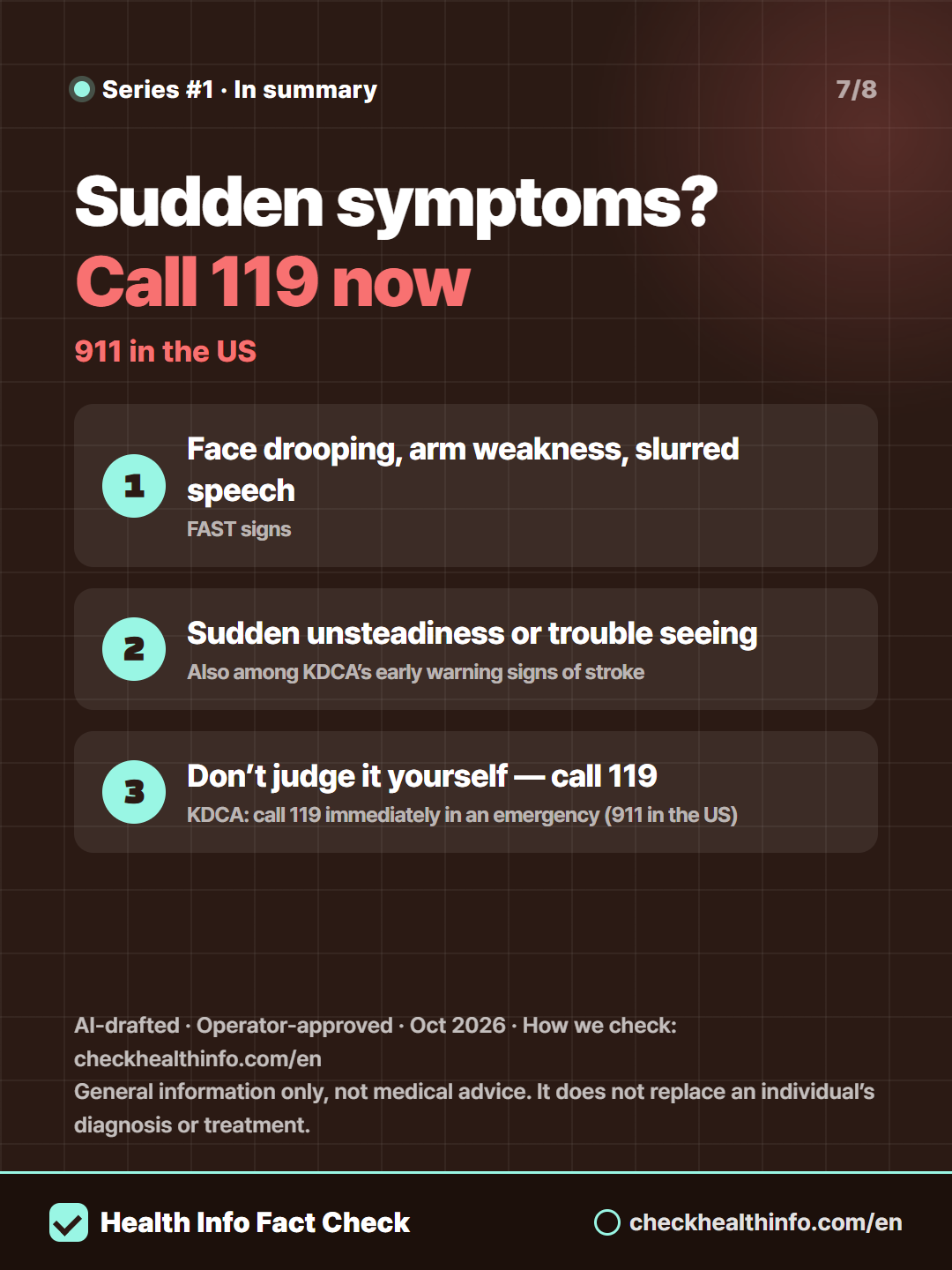
- If you can’t remember them all — The key word is “sudden.” Sudden dizziness or unsteadiness overlaps with symptoms of conditions that are not stroke, so it is hard to tell them apart at home [6]. Do not try to judge this yourself; call 119 right away (911 in the US). KDCA also advises calling 119 immediately in an emergency (9 lifestyle rules for preventing cardiovascular and cerebrovascular disease, in Korean, accessed October 26, 2026).
- Even if it goes away quickly — Call 119 (911 in the US) even if the symptoms go away within a few minutes. We cover this separately in part 6 of this series.
Scope: This verdict covers only how well the stroke warning-sign checks (FAST and BE-FAST) pick up people having a stroke. It does not cover treatment effects or any one person’s diagnosis. The studies looked at EMS crews and hospital staff using the checks, which is different from a member of the public spotting a stroke at home. Among people with a suspected minor stroke, those who had a stroke more often had speech problems, facial weakness and limb weakness, while those who did not more often had dizziness, headache and nausea, but the symptoms overlapped [6]. Leave the judgment to 119 (911 in the US) and the hospital.
Limits of this verdict
- Most of the studies are retrospective, looking back at one hospital’s records, and few studies compared the two checks in the field by EMS crews. A prospective EMS study reported similar overall accuracy.
- In the meta-analysis, BE-FAST had lower pooled sensitivity and higher specificity, with a very wide confidence interval, so the results conflict.
- The trial in members of the public looked only at memory; it did not look at actual recognition of stroke or at treatment outcomes.
- We did not cite the 2026 American Heart Association/American Stroke Association guideline for acute stroke because its abstract does not compare FAST and BE-FAST. We were not able to check materials from the Korean Stroke Society this time.
- We set the grade under section 1 of our rating method. We check for new studies in our monthly PubMed review, and if a verdict changes, we record it in our corrections log (in Korean).
Card news
Video (in Korean)
References
- Hilditch M, Brand C, Devlin S, et al. BE-FAST vs FAST in prehospital stroke recognition: a systematic review. Br J Community Nurs 2025;30(9):439-447. PMID 40862575. PubMed abstract · Full article
- Chen X, Zhao X, Xu F, et al. A Systematic Review and Meta-Analysis Comparing FAST and BEFAST in Acute Stroke Patients. Front Neurol 2021;12:765069. PMID 35153975. PubMed abstract · Full article
- Aroor S, Singh R, Goldstein LB. BE-FAST (Balance, Eyes, Face, Arm, Speech, Time): Reducing the Proportion of Strokes Missed Using the FAST Mnemonic. Stroke 2017;48(2):479-481. PMID 28082668. PubMed abstract · Full article
- Tanglay O, Cappelen-Smith C, Parsons MW, et al. Enhancing Stroke Recognition: A Comparative Analysis of Balance and Eyes-Face, Arms, Speech, Time (BE-FAST) and Face, Arms, Speech, Time (FAST) in Identifying Posterior Circulation Strokes. J Clin Med 2024;13(19). PMID 39407971. PubMed abstract · Full article · Free full text
- El Ammar F, Ardelt A, Del Brutto VJ, et al. BE-FAST: A Sensitive Screening Tool to Identify In-Hospital Acute Ischemic Stroke. J Stroke Cerebrovasc Dis 2020;29(7):104821. PMID 32312632. PubMed abstract · Full article
- Fagerheim Bugge H, Guterud M, Larsen K, et al. Presenting symptoms and diagnostic accuracy of prehospital stroke scales for patients with suspected mild minor stroke. Eur Stroke J 2025:23969873251360592. PMID 40785620. PubMed abstract · Full article
- Darkhabani MZ, Homa-Bonell JK, Thoreson L, et al. BE FAST Versus FAST: A Randomized Pilot Trial Comparing Retention of Stroke Symptoms Between 2 Mnemonics. J Am Heart Assoc 2024;13(19):e035696. PMID 39291473. PubMed abstract · Full article
- Pickham D, Valdez A, Demeestere J, et al. Prognostic Value of BEFAST vs. FAST to Identify Stroke in a Prehospital Setting. Prehosp Emerg Care 2019;23(2):195-200. PMID 30118372. PubMed abstract · Full article
General information only, not medical advice; it does not replace an individual’s diagnosis or treatment. If you or someone near you suddenly has face drooping, arm weakness, slurred speech, dizziness, unsteadiness or trouble seeing, call 119 (911 in the US) right away, even if the symptoms go away.