Can brain training keep dementia away?
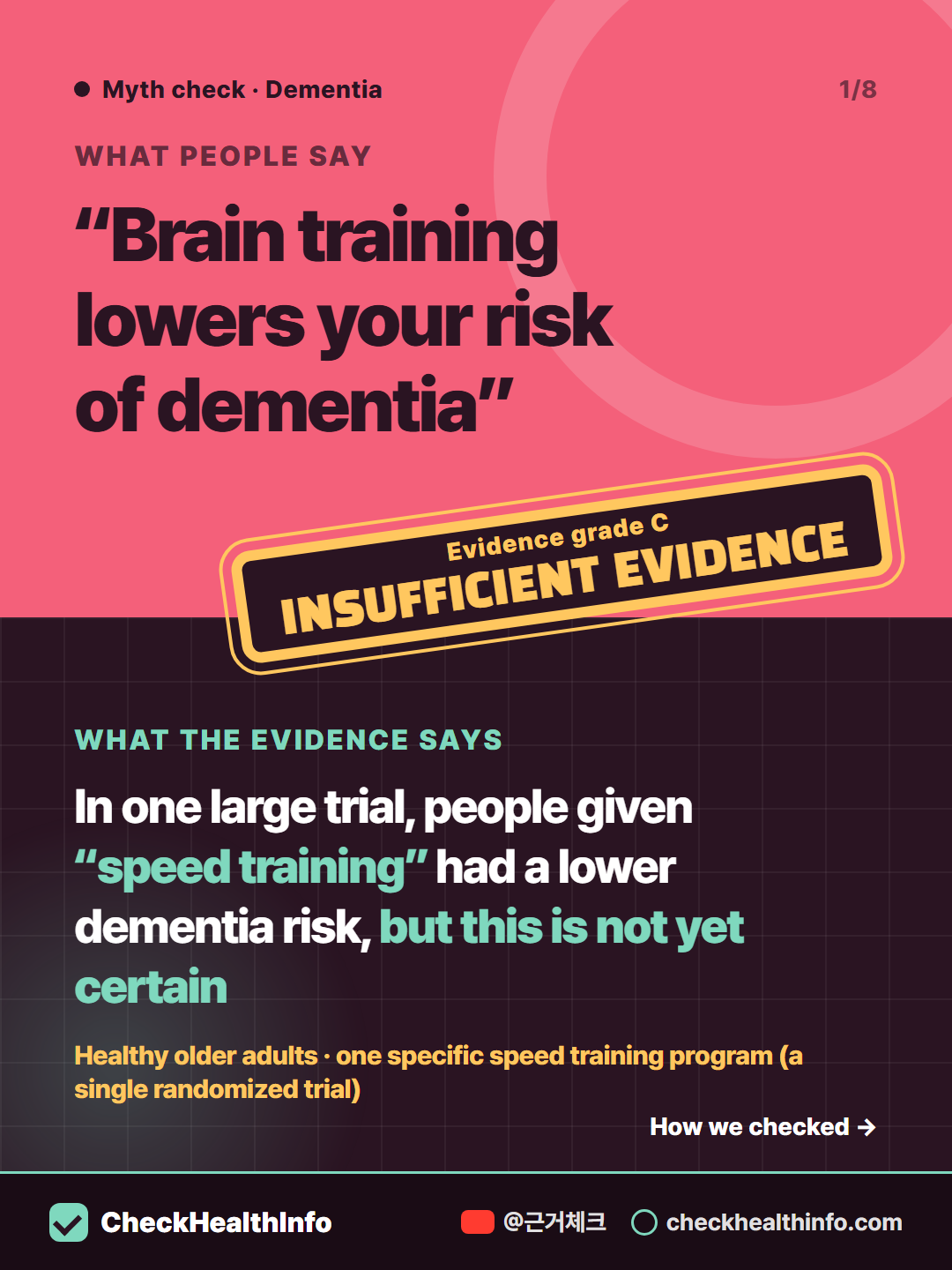
Does brain training (especially speed training) really lower the risk of dementia?

We checked this verdict against 6 sources, such as published studies and clinical guidelines. · How checked: AI-drafted · automated evidence checks
Verdicts at a glance
| Claim | Verdict |
|---|---|
| Brain training (speed training) lowers your risk of dementia | Insufficient evidence · Evidence grade C |
Bottom line — Essentially only one randomized trial, the US ACTIVE trial, has looked directly at dementia, and its result was statistically borderline. So the claim that “brain training (speed training) lowers your risk of dementia” is rated “Insufficient evidence.” Here is what the evidence shows: in this trial, older adults given “speed training” had a lower dementia risk after 10 years, but at 20 years there was no clear difference for the speed training group as a whole, and systematic reviews found the evidence on preventing dementia insufficient. Training does improve scores on the tasks you practice. “Insufficient evidence” does not mean the claim is false; it means it has not been shown yet.
Randomized trial — A study that assigns people to groups by chance, like drawing lots, and compares them. It is the best way to show cause and effect.
Systematic review and meta-analysis — A review that finds and appraises all relevant studies using set methods, and may pool their results.
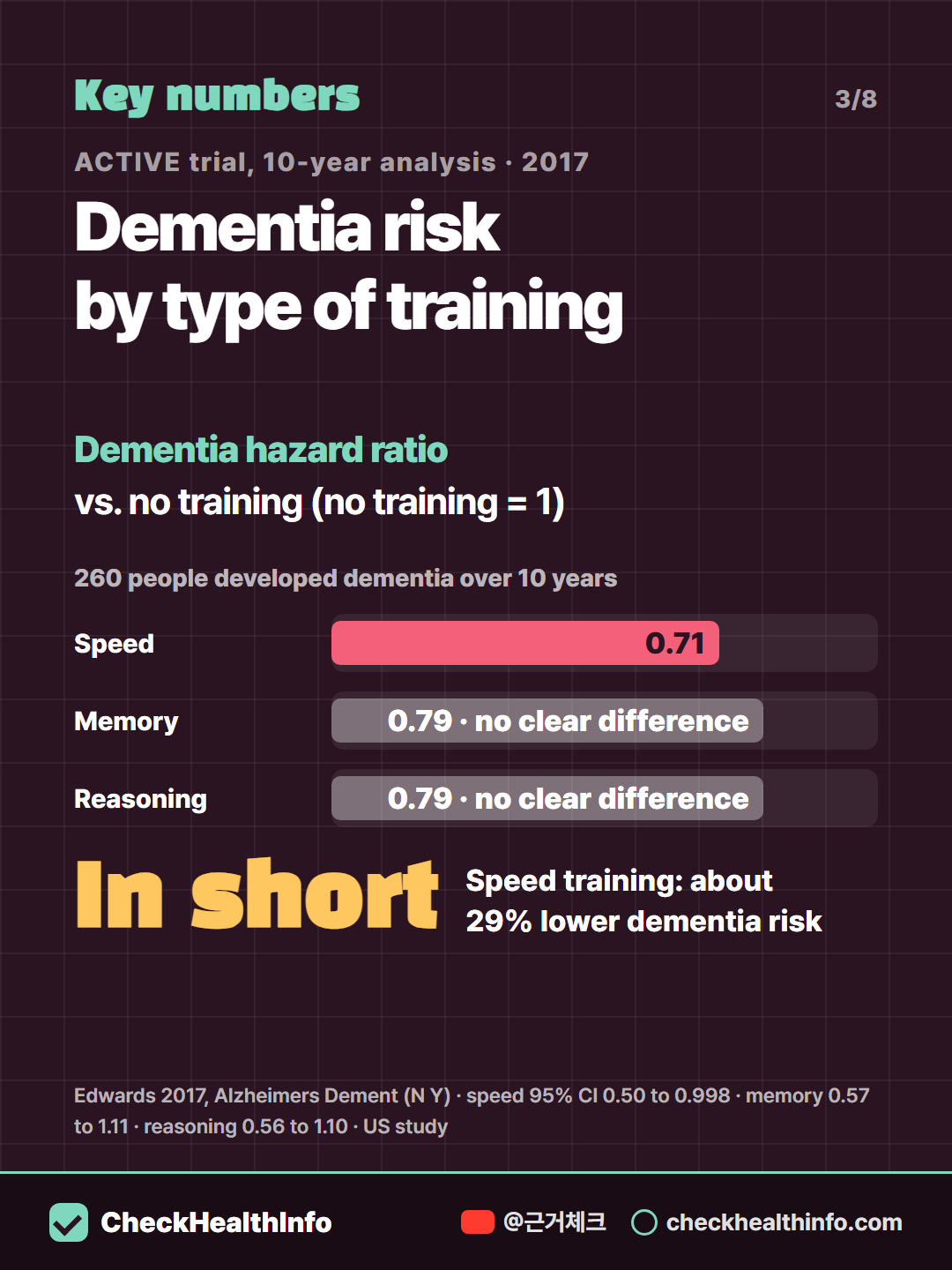
Hazard ratio — Compares how fast events happen in one group with another. A value of 1 means no difference; less than 1 means lower risk.
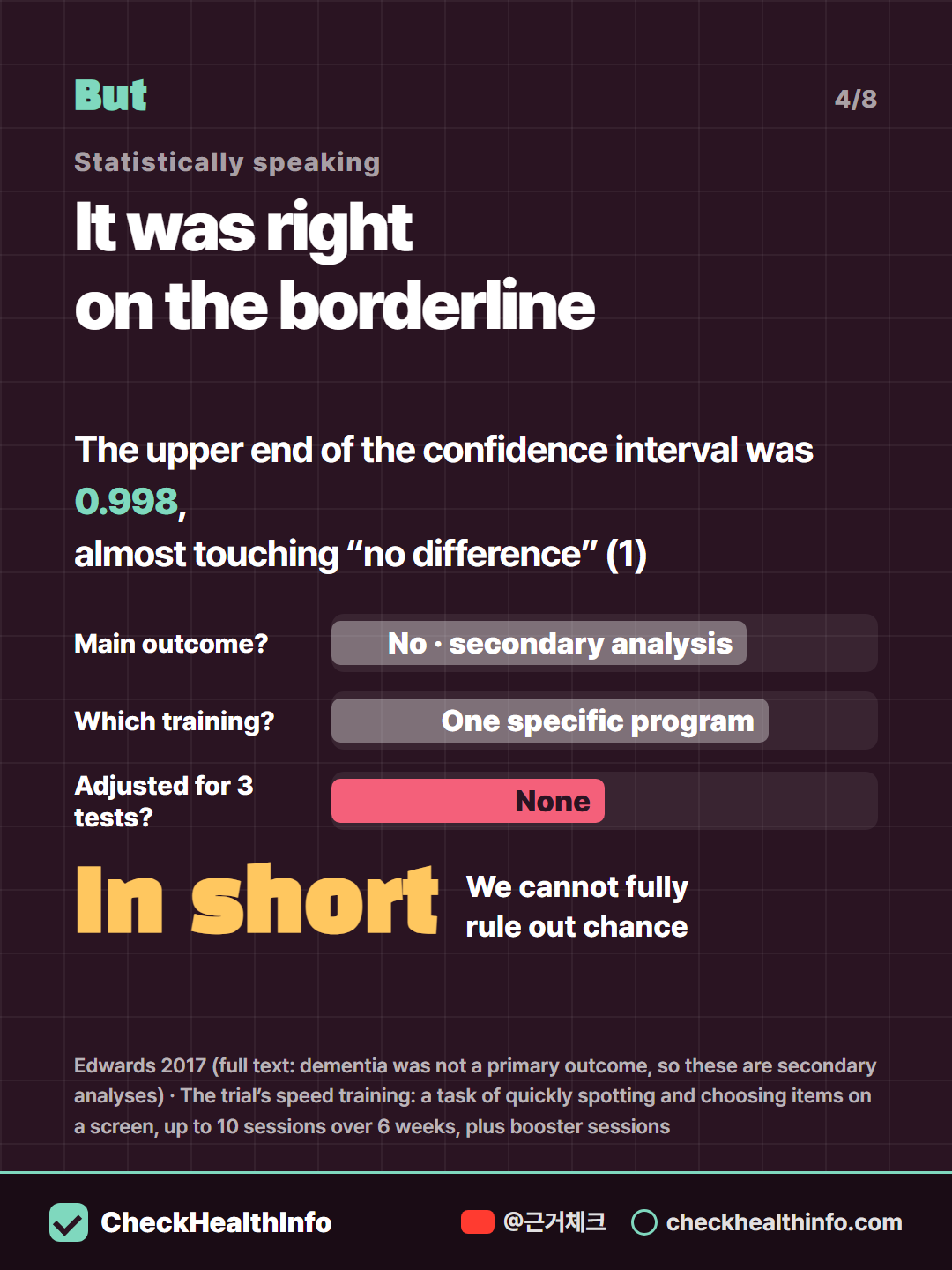
95% confidence interval — The range in which the true value is likely to fall. If it includes 1, or almost touches 1, we cannot say for sure that there is a difference.
Claim. “Brain training (speed training) lowers your risk of dementia”
Insufficient evidence · Evidence grade C
In plain words In one large trial, older adults who did “speed training” (quickly spotting and choosing items on a screen) developed dementia less often. But the result was borderline and comes from a single trial, so it is too early to say brain training prevents dementia.
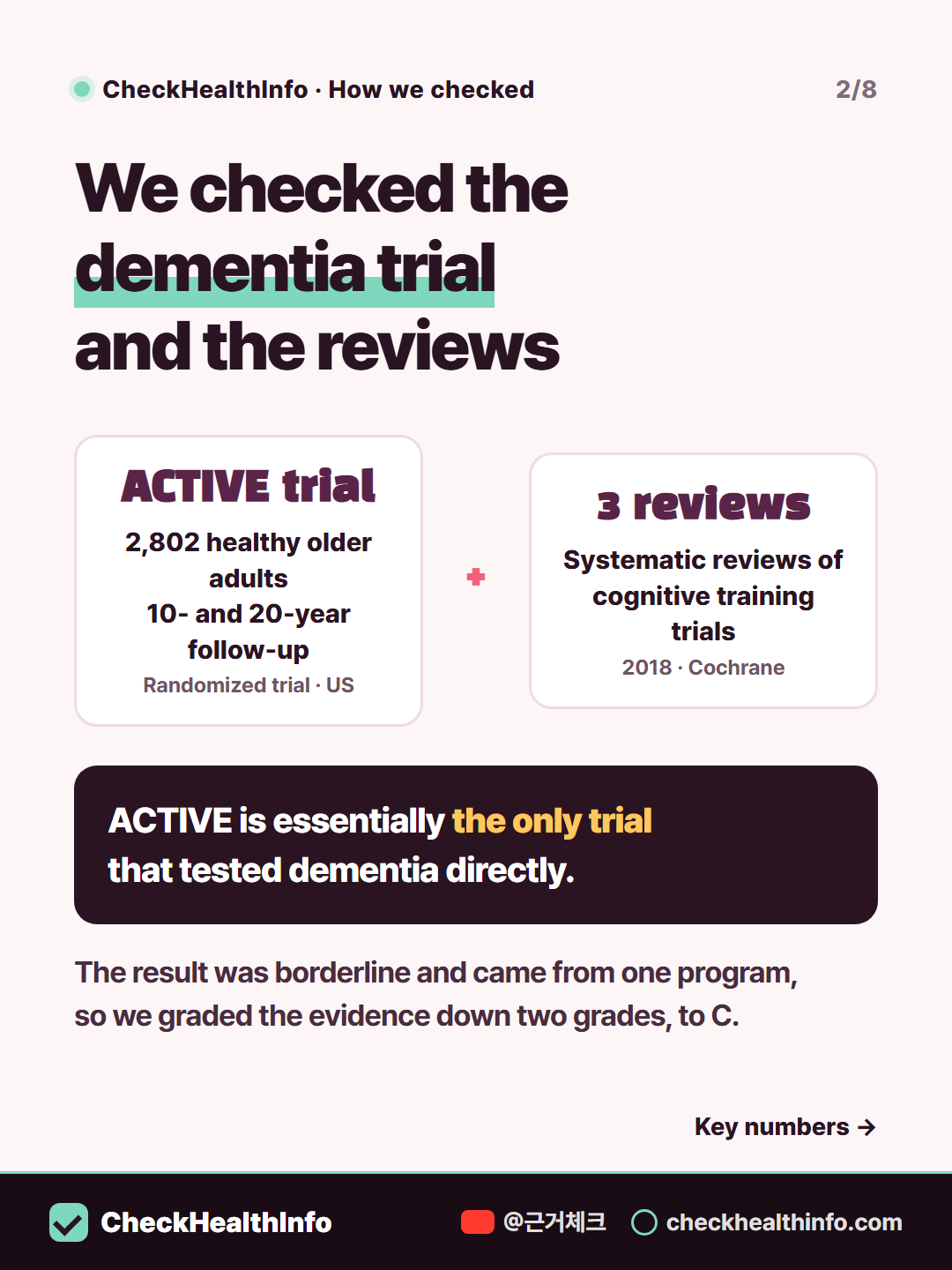
- The US ACTIVE trial randomly assigned 2,802 healthy older adults to memory, reasoning or speed (processing speed) training, or to a control group with no training. In a 10-year follow-up analysis, 260 people developed dementia. The hazard ratio for dementia was 0.71 in the speed training group (95% confidence interval 0.50 to 0.998); memory training (0.79, 0.57 to 1.11) and reasoning training (0.79, 0.56 to 1.10) showed no clear difference. In plain words, the speed training group’s risk of developing dementia was about 29% lower, but the confidence interval almost touched 1, so chance cannot be fully ruled out. [1]
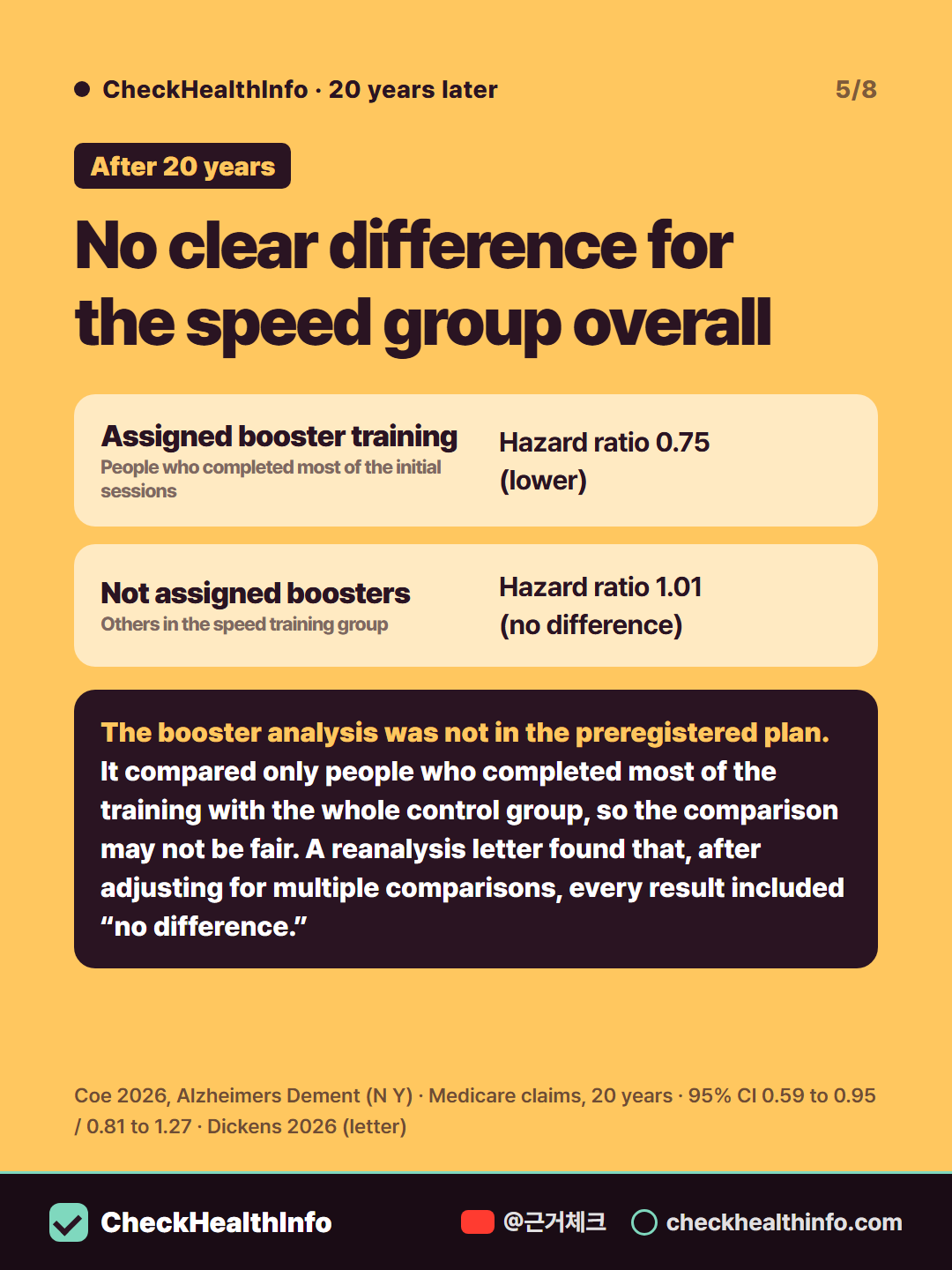
- A 20-year analysis that linked the same trial to Medicare claims (people enrolled in traditional Medicare) found no statistically clear difference between the speed training group as a whole and the control group, when compared as originally randomized (from a table in the full paper). The risk of a dementia diagnosis was lower in only one subgroup: people who completed most of the initial sessions and were then randomly assigned to booster training (hazard ratio 0.75, 95% confidence interval 0.59 to 0.95). People in the speed training group who were not assigned boosters showed no difference (1.01, 0.81 to 1.27). Memory and reasoning training showed no clear effect. In plain words, after 20 years, people who got speed training, taken as a whole, did not clearly differ from the control group. [2]
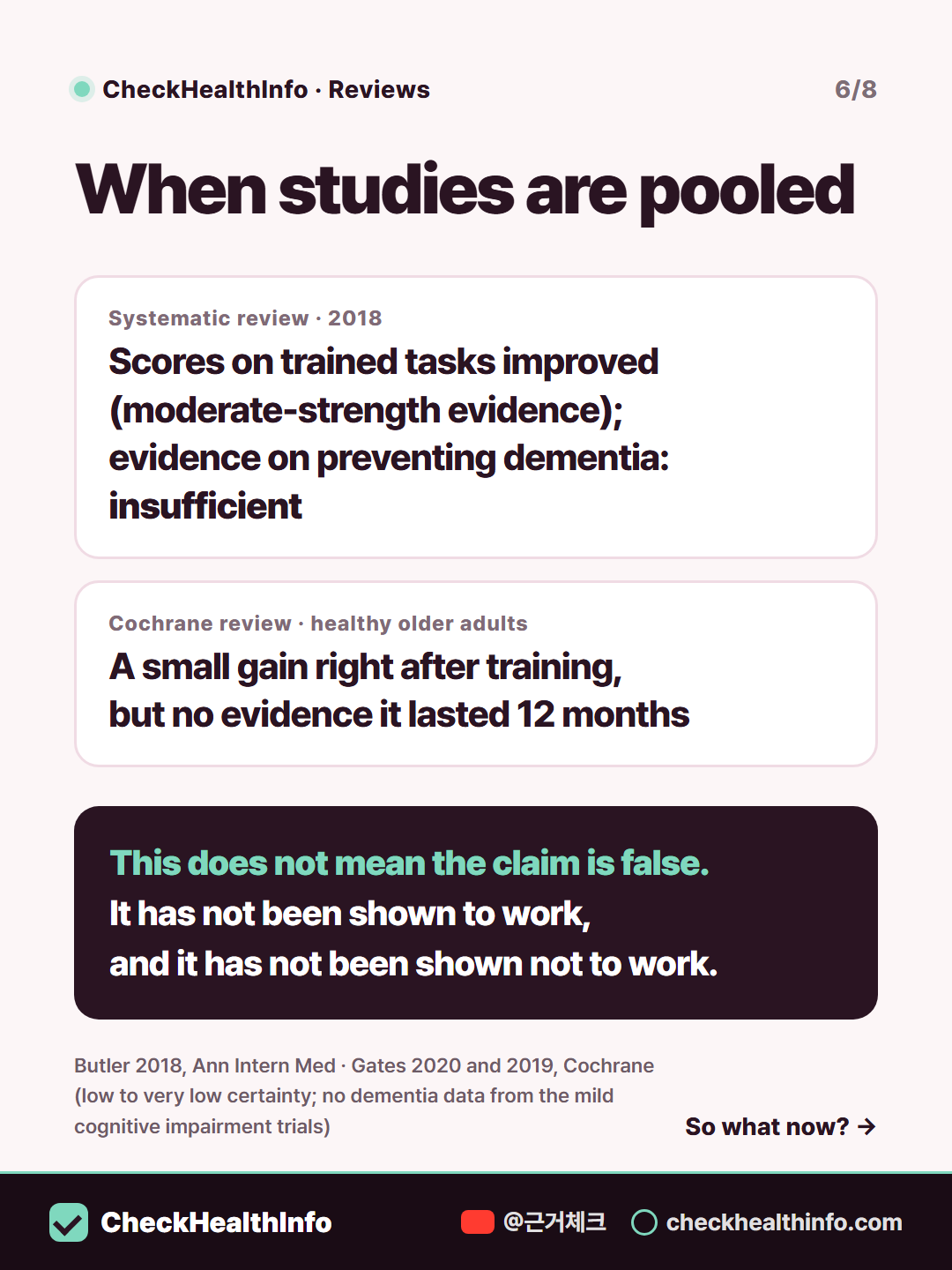
- A systematic review of cognitive training trials concluded that, in healthy older adults, training improves test performance in the area trained (moderate-strength evidence) but not in other areas, and that evidence on preventing cognitive decline or dementia is insufficient. [4] A Cochrane review found that computerized cognitive training in healthy older adults slightly improved overall cognitive function right after training, but there was no evidence the effect lasted 12 months, and the evidence was of low or very low certainty. [5] No trial in people with mild cognitive impairment reported data on new cases of dementia. [6]
The highest level of evidence is systematic reviews, so we started at A. But essentially only one randomized trial looked directly at dementia; the 10-year confidence interval almost touched 1; and at 20 years there was no clear difference for the speed training group as a whole. The results are uncertain (reason (3) in section 1 of our rating method; down one grade). The evidence also comes from one specific speed training program given to US older adults around 1998; dementia was not the trial’s prespecified primary outcome; and the trial does not directly cover brain games and apps in general, so the evidence is indirect (reason (1); down one more grade). That gives C. The reviews did not directly pool this trial’s dementia results; starting instead from the trial itself (a randomized trial, B) and grading down for reason (3) also gives C. The claim has been neither shown to be false nor consistently shown to be true, so it is rated “Insufficient evidence” (section 2 of our rating method).
Dementia was a secondary analysis — The ACTIVE trial did not set dementia as a primary outcome, so the dementia results come from secondary analyses (Edwards 2017 full text). [1]
Number of sessions — In the 10-year analysis, more speed training sessions went with lower dementia risk (hazard ratio 0.90 per additional session, 95% confidence interval 0.85 to 0.95, unadjusted). But people chose how many sessions to attend, so healthier people may simply have attended more. [1]
The booster analysis — The “assigned booster” group that showed a difference at 20 years included only people who had completed most of the initial training, compared with the whole control group, so the comparison may not be fair. The booster analysis was also missing from the preregistered plan (full text). One co-author is an advisor to, and shareholder in, the company that sells this speed training program (conflict-of-interest disclosure in the paper). [2]
A reanalysis letter — A reanalysis letter found that, after adjusting the 20-year results for multiple comparisons, every confidence interval included 1. But the same letter also argued that the overall pattern of results may point to a shared protective effect of all three types of training, concentrated in the youngest age group. So the letter itself points in two directions (it is a reanalysis published as a letter in a journal). [3]
How to think about brain training
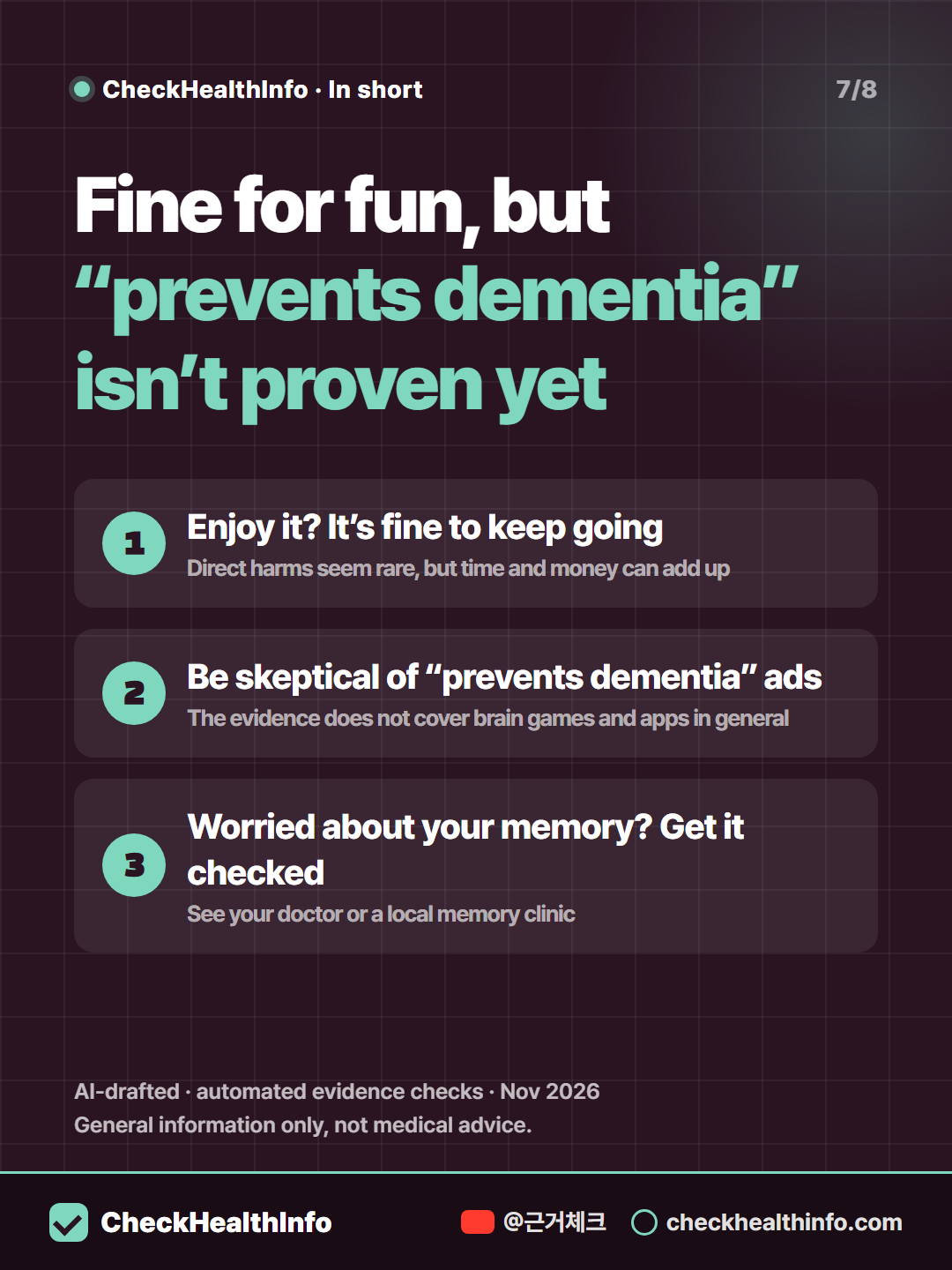
- If you enjoy it, it’s fine to keep doing it — Direct harms from brain training seem rare, but the time and sometimes the money involved can be a real burden. [6]
- Be skeptical of “prevents dementia” ads — What was studied was one specific speed training program. It is not evidence that brain games and apps in general have the same effect.
- Worried about your memory? Get it checked — Don’t try to judge it on your own. Talk to your doctor or a local memory clinic.
Scope: This verdict covers only whether brain training (especially speed training) lowers the risk of dementia in adults (mostly older adults) with normal cognition. It does not cover cognitive rehabilitation for people who already have dementia, or other lifestyle factors such as exercise or diet.
Limitations of this verdict
- The evidence relies heavily on a single trial in US older adults, so it may not apply directly to older adults in other countries, such as Korea, or to other types of training.
- In the 10-year analysis, dementia was defined from interviews and test scores; in the 20-year analysis, from diagnosis codes in claims data. Either may differ from a diagnosis made directly by a clinician.
- Points we confirmed in the full text of the papers (secondary analysis, the comparison for the whole speed group, preregistration, conflict of interest) are described without numbers.
- We set the grade according to section 1 of our rating method. We check for new studies in our monthly PubMed review, and if the verdict changes, we record it in our corrections log.
Card news
Video (in Korean)
Easy version (in Korean)
Full evidence (in Korean)
References
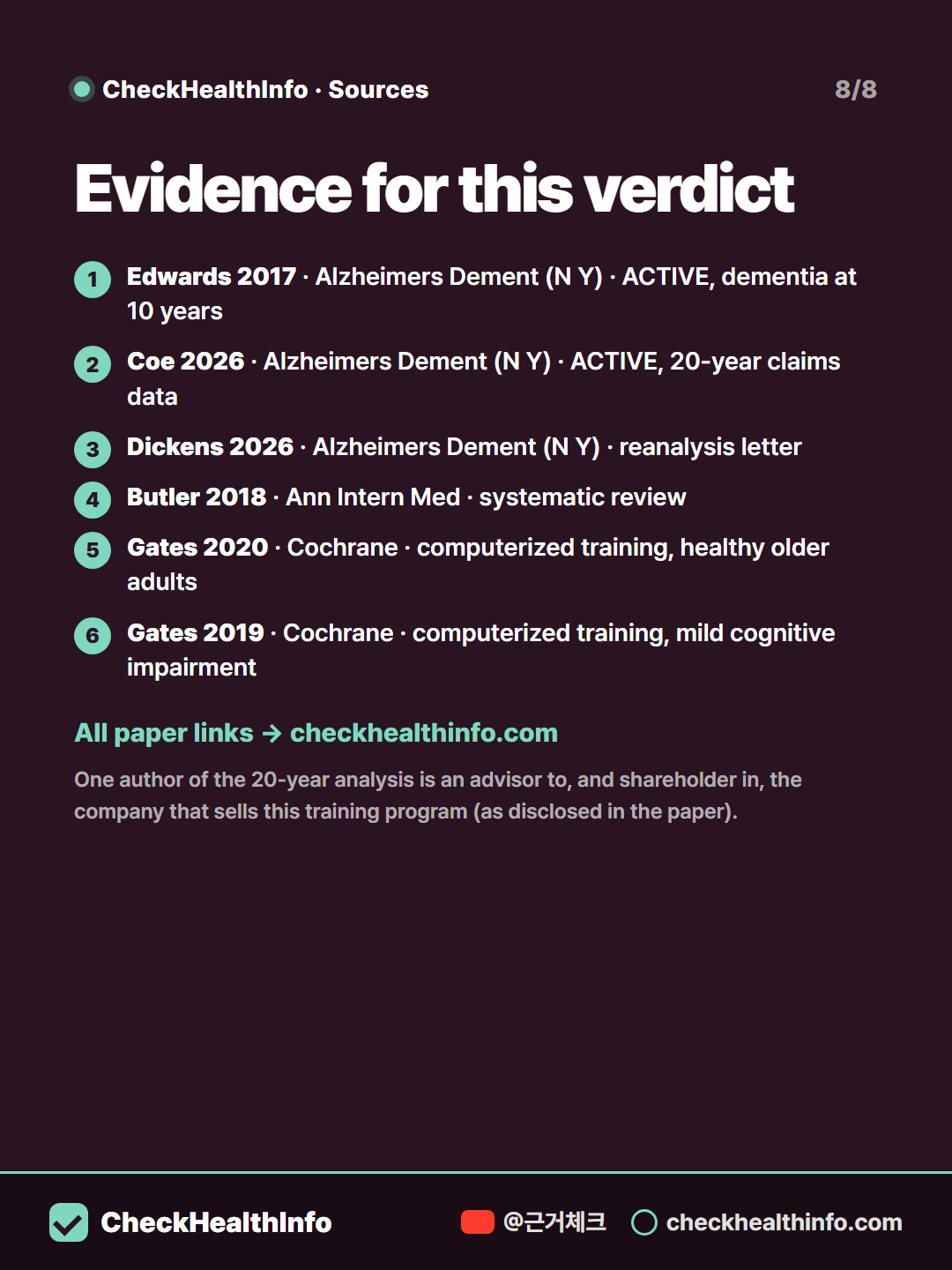
- Edwards JD, Xu H, Clark DO, et al. Speed of processing training results in lower risk of dementia. Alzheimers Dement (N Y) 2017;3(4):603-611. PMID 29201994. PubMed abstract · Full article · Free full text
- Coe NB, Miller KEM, Sun C, et al. Impact of cognitive training on claims-based diagnosed dementia over 20 years: evidence from the ACTIVE study. Alzheimers Dement (N Y) 2026;12(1):e70197. PMID 41669119. PubMed abstract · Full article · Free full text
- Dickens WT. Reanalyzing the impact of cognitive training over 20 years in the ACTIVE study: Losing the forest in the trees. Alzheimers Dement (N Y) 2026;12(2):e70280. PMID 42339399. PubMed abstract · Full article · Free full text
- Butler M, McCreedy E, Nelson VA, et al. Does Cognitive Training Prevent Cognitive Decline?: A Systematic Review. Ann Intern Med 2018;168(1):63-68. PMID 29255842. PubMed abstract · Full article
- Gates NJ, Rutjes AW, Di Nisio M, et al. Computerised cognitive training for 12 or more weeks for maintaining cognitive function in cognitively healthy people in late life. Cochrane Database Syst Rev 2020;2(2):CD012277. PMID 32104914. PubMed abstract · Full article · Free full text
- Gates NJ, Vernooij RW, Di Nisio M, et al. Computerised cognitive training for preventing dementia in people with mild cognitive impairment. Cochrane Database Syst Rev 2019;3(3):CD012279. PMID 30864747. PubMed abstract · Full article · Free full text
This is general information, not medical advice, and it does not replace diagnosis or treatment by your own clinician. If you are worried about your memory, talk to your doctor or a local memory clinic.