If you drink cold water, will you lose weight?
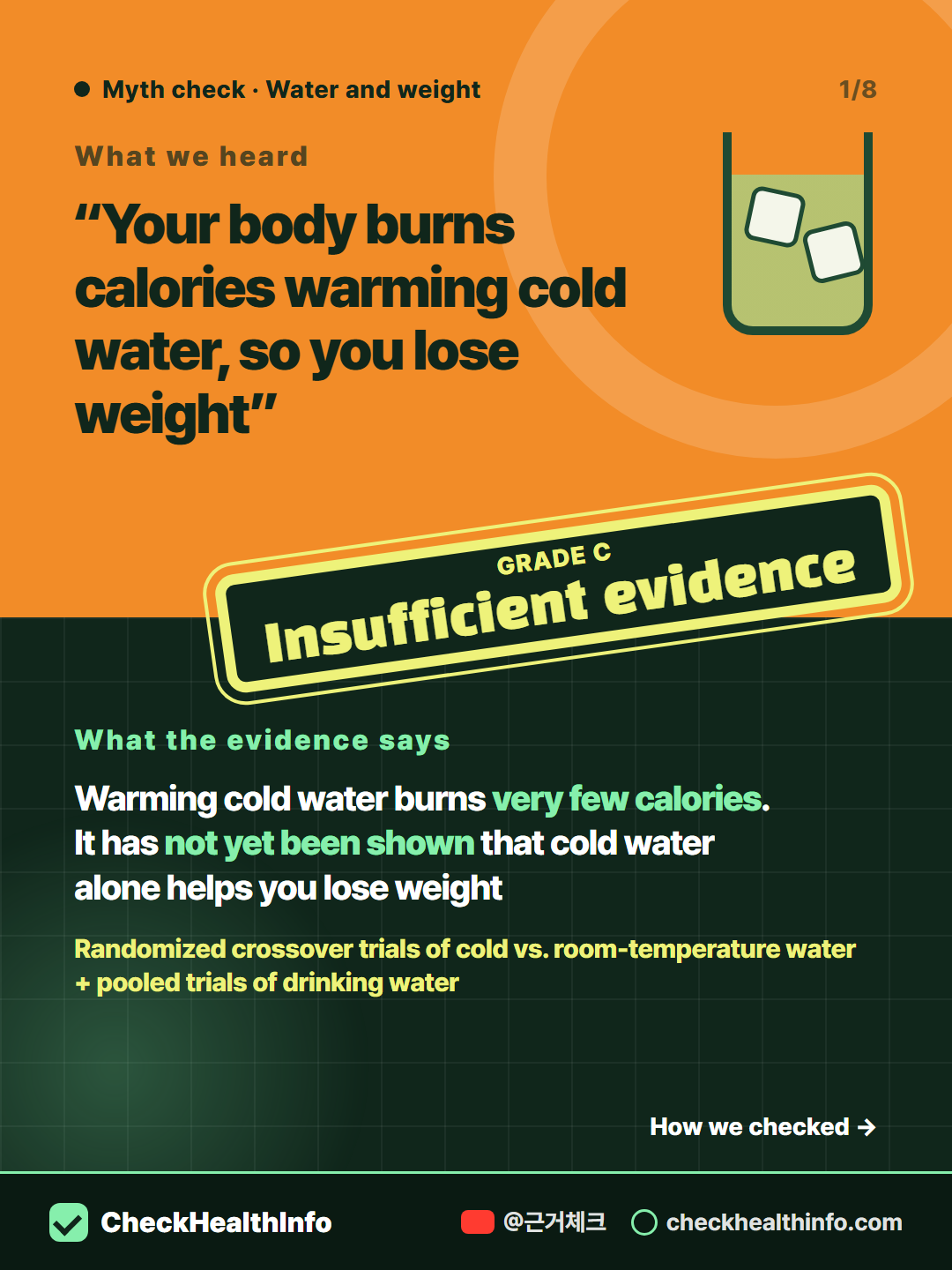
Does drinking cold water make you lose weight because your body burns calories warming it to body temperature?

We checked this verdict against 9 sources, such as published studies and clinical guidelines. · How checked: AI-drafted · automated evidence checks
Verdicts at a glance
| Claim | Verdict |
|---|---|
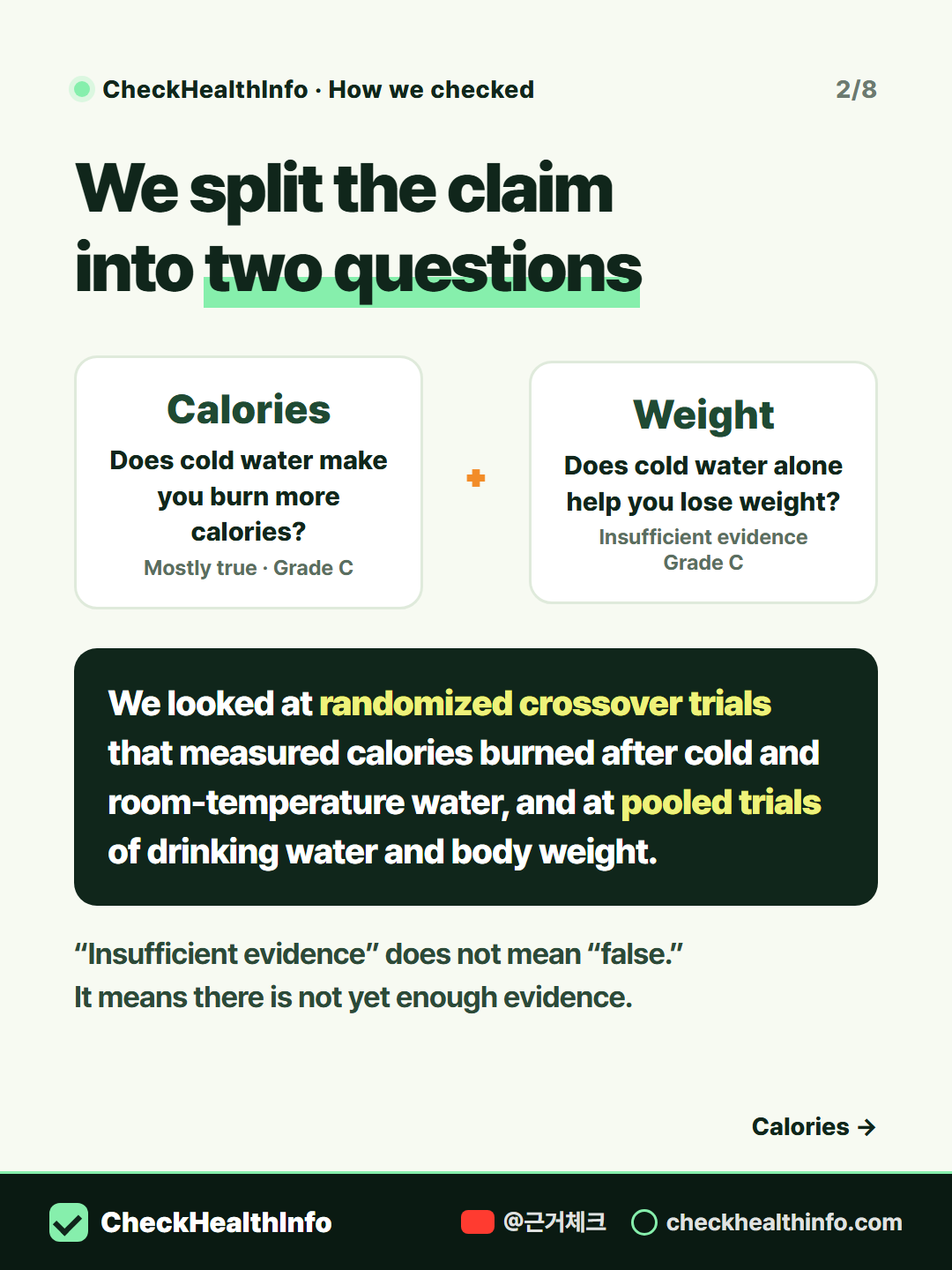
| Drinking cold water increases the calories your body burns to warm the water to body temperature | Mostly true · Evidence grade C |
| Drinking cold water alone makes you lose weight | Insufficient evidence · Evidence grade C |
Bottom line — Your body does burn slightly more calories warming cold water, but in later trials that re-measured it, the increase was very small: a few percent for about an hour. It has not yet been shown that drinking cold water alone helps you lose weight. So the claim that “drinking cold water makes you lose weight” is rated Insufficient evidence (this does not mean it is false). However, in trials in which people drank water before meals while also following a diet, they lost slightly more weight. Those trials looked at drinking water itself, not at cold water.
Energy expenditure — The number of calories your body uses. The trials in this article measured the calories used while resting, based on the gases people breathed out.
Randomized trial — A study in which participants are assigned to groups by chance and then compared.
Crossover trial — A trial in which the same people drink each type of water (for example, cold and room-temperature) on different days, so the drinks can be compared.
Sham drinking — A comparison in which people only pretend to drink, so that the effect of the act of drinking itself can be separated out.
Meta-analysis — An analysis that pools the results of several studies into one estimate.
95% confidence interval — The range in which the true value is likely to lie. If the range for a difference crosses 0, we cannot be confident there is a real difference.
This claim mixes two different questions, so we gave two separate verdicts: (1) does drinking cold water increase the calories your body burns to warm it, and (2) does drinking cold water alone help you lose weight?
Verdict 1. “Drinking cold water increases the calories your body burns to warm the water to body temperature”
Mostly true · Evidence grade C
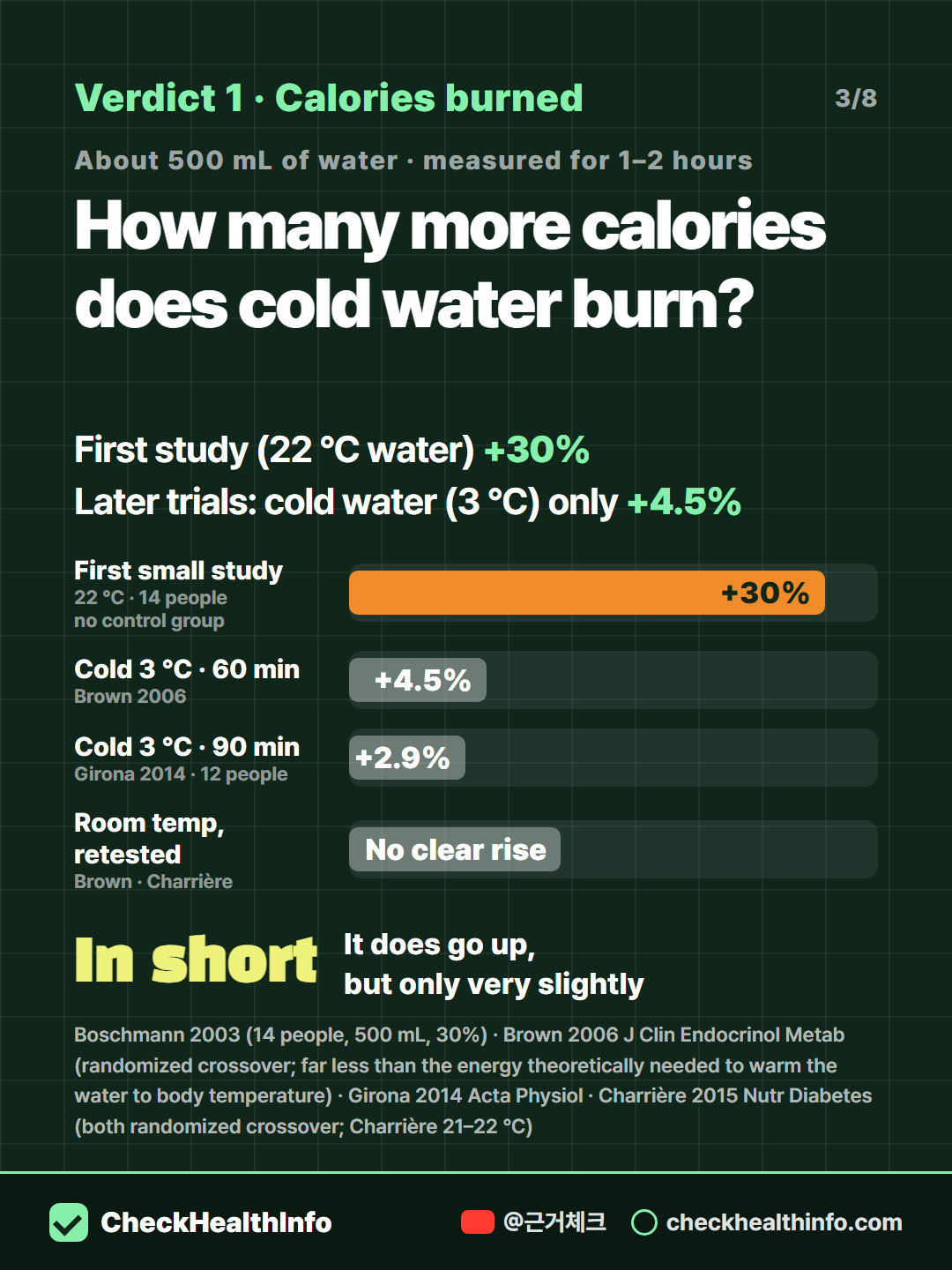
In plain terms Drinking cold water does increase the calories you burn, but only very slightly: a few percent for about an hour. The increase is real but small, so we rated it “Mostly true.”
- The idea is often traced to a small 2003 study. When 14 adults of normal weight drank 500 mL of water, their energy expenditure (metabolic rate) rose by 30%, and the authors reported that about 40% of this came from warming the water from 22 °C to 37 °C. The abstract does not describe a comparison group. [1]
- However, in a randomized crossover trial that re-measured the same question, room-temperature water (7.5 mL per kg of body weight, about 518 mL) did not increase energy expenditure, and water chilled to 3 °C increased it by 4.5% over 60 minutes. The authors said this rise was much smaller than the energy theoretically needed to warm the water to body temperature. [2]
- In a crossover trial in which 12 people drank 500 mL of water at 3 °C, 22 °C and 37 °C, cold water increased energy expenditure by 2.9% over 90 minutes, while the increase with room-temperature water (2.3%) was not clear. The body warmed the cold water partly by producing a little more heat and partly by reducing heat loss through the skin. [3]
- In a crossover trial of 27 people, drinking 500 mL of room-temperature (21–22 °C) water raised energy expenditure by less than 3%, which did not differ from sham drinking (only pretending to drink). [4]
Grade: It starts at B (randomized crossover trials that directly compared cold and room-temperature water), but we lowered it one step to C because the results are uncertain: the size of the effect varied widely between the first report (22 °C water, 30%) and later trials (cold water 2.9–4.5%; room-temperature water showed no increase or no difference from sham drinking), the trials were small (12 to 27 people, where the number was reported), and energy expenditure was measured for only 1–2 hours after a single drink.
Verdict 2. “Drinking cold water alone makes you lose weight”
Insufficient evidence · Evidence grade C
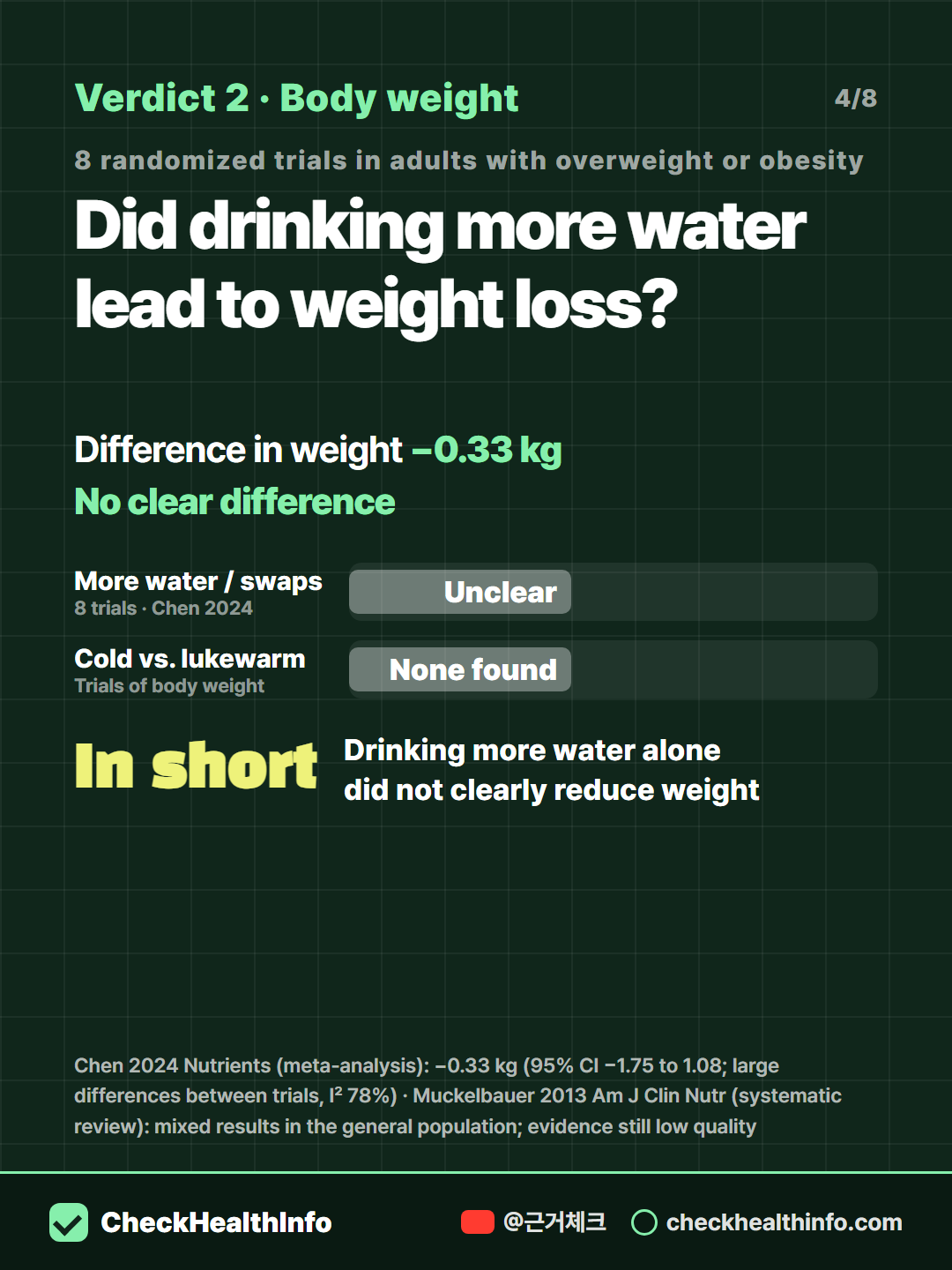
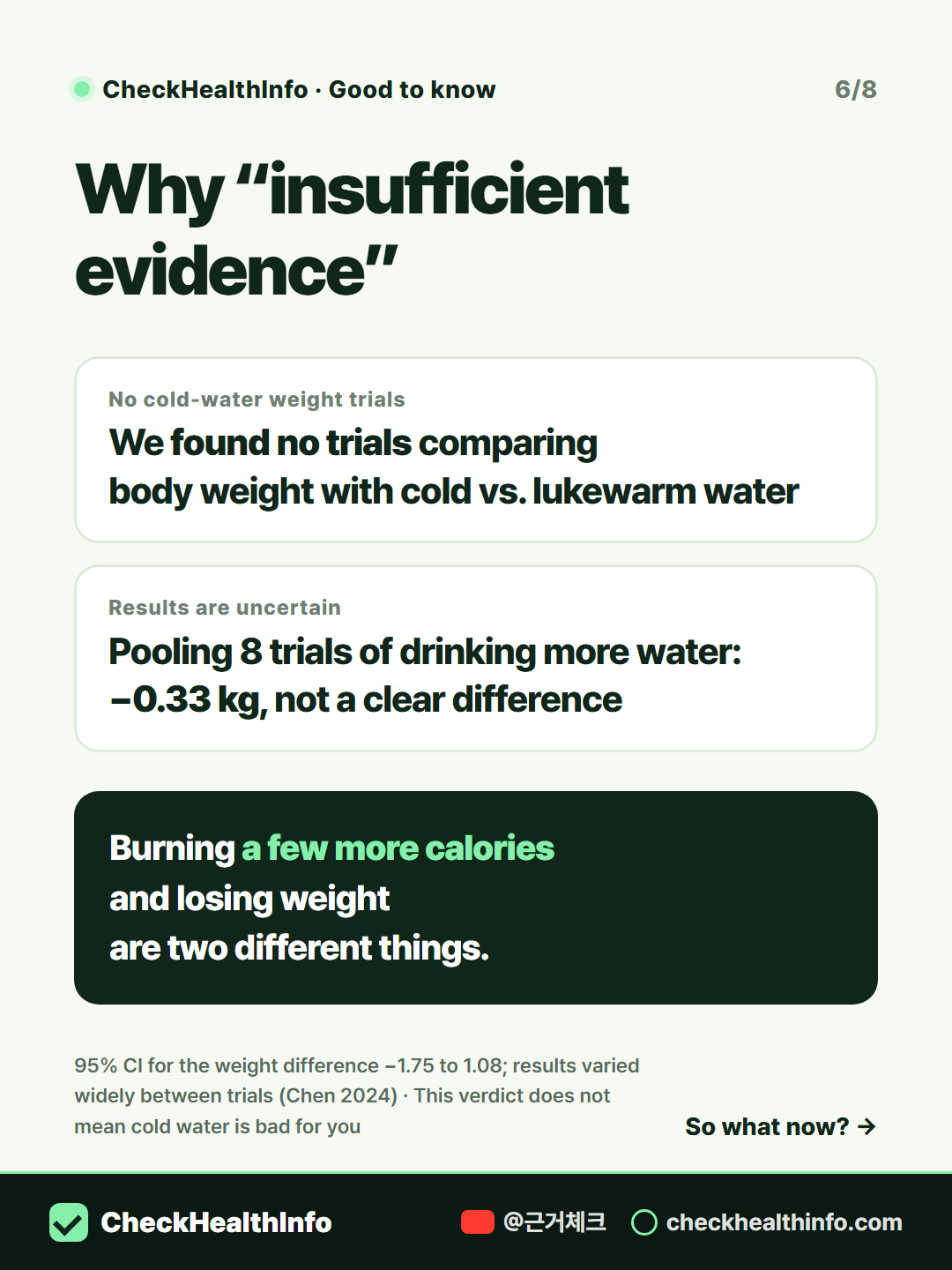
In plain terms We found no trials that compared body weight in people drinking cold vs. lukewarm water, and drinking more water alone did not clearly reduce weight. So we rated it “Insufficient evidence”: it has not yet been clearly shown.
- A meta-analysis of 8 randomized trials in which adults with overweight or obesity drank more water, or replaced other drinks with water, found that the difference in body weight, −0.33 kg (95% confidence interval −1.75 to 1.08), was not clear. In plain terms, drinking more water alone did not clearly reduce weight. [6]
- A systematic review of water and body weight also found that in people following a diet, drinking more water was linked to weight loss after 3–12 months, but in the general population the results were mixed, and the quality of the evidence was still low. [7]
- As shown in Verdict 1, the extra calories burned after drinking cold water were very few: a few percent for about an hour. [2]
Grade: It starts at A (a meta-analysis of randomized trials), but we lowered it two steps to C for two separate reasons: (1) the evidence is indirect, because it covers drinking water in general rather than cold water, and (2) the results are uncertain, because the confidence interval is wide and the results varied widely between trials.
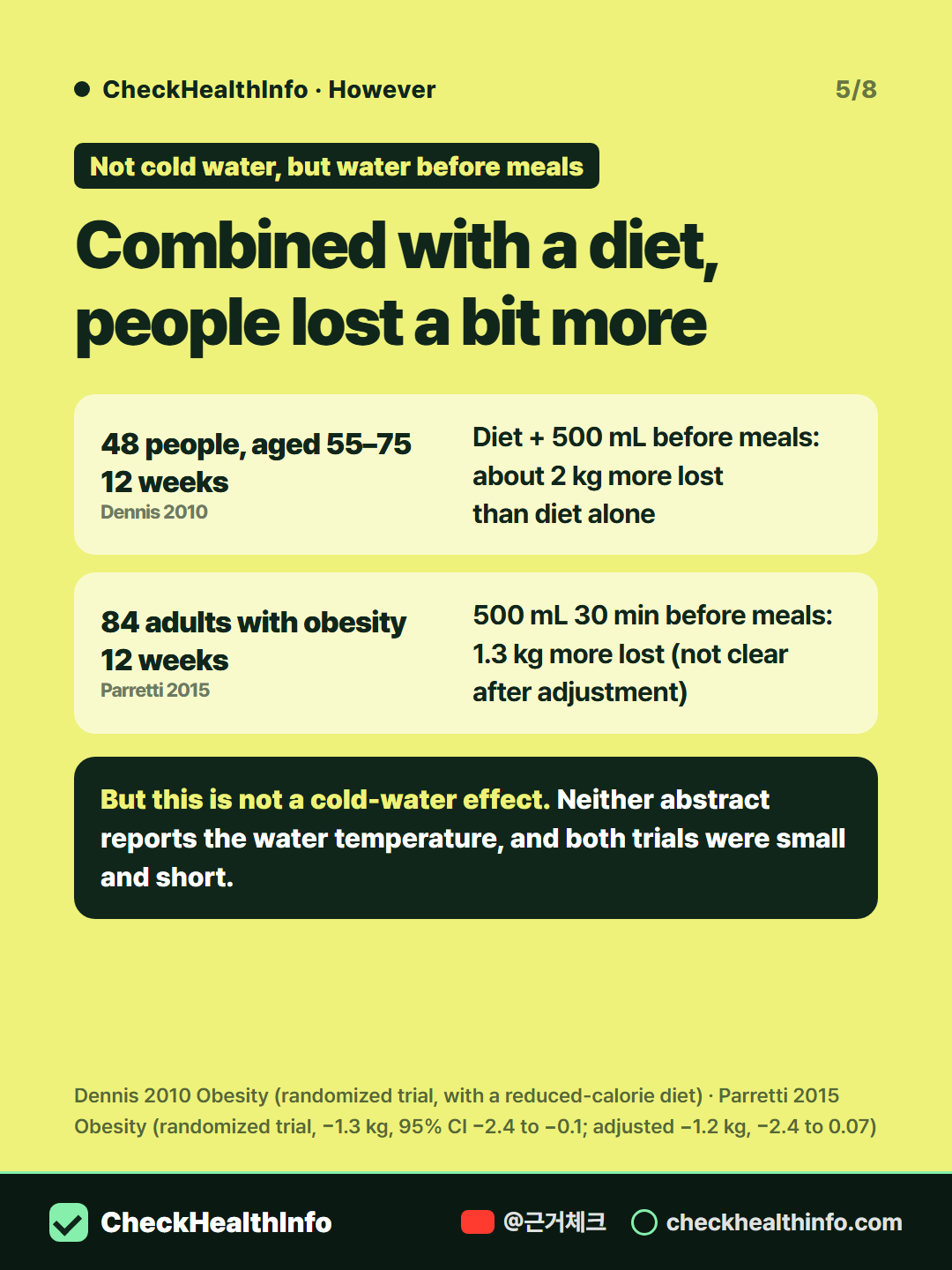
In a randomized trial of 48 adults aged 55–75 with overweight or obesity who followed a reduced-calorie diet, those who also drank 500 mL of water before each meal lost about 2 kg more over 12 weeks than those who followed the diet alone. [8]
In a randomized trial of 84 adults with obesity in UK primary care, drinking 500 mL of water 30 minutes before main meals led to 1.3 kg (95% confidence interval −2.4 to −0.1) more weight loss after 12 weeks than in the comparison group (who were asked to imagine feeling full). After adjustment for age, sex and other factors, the difference, 1.2 kg (−2.4 to 0.07), was no longer clear. [9]
These two trials looked at drinking water before meals, not at cold water, and the abstracts do not report the water temperature. They were small and short, and the water was combined with a diet or weight-management advice.
If you want to try water for weight management
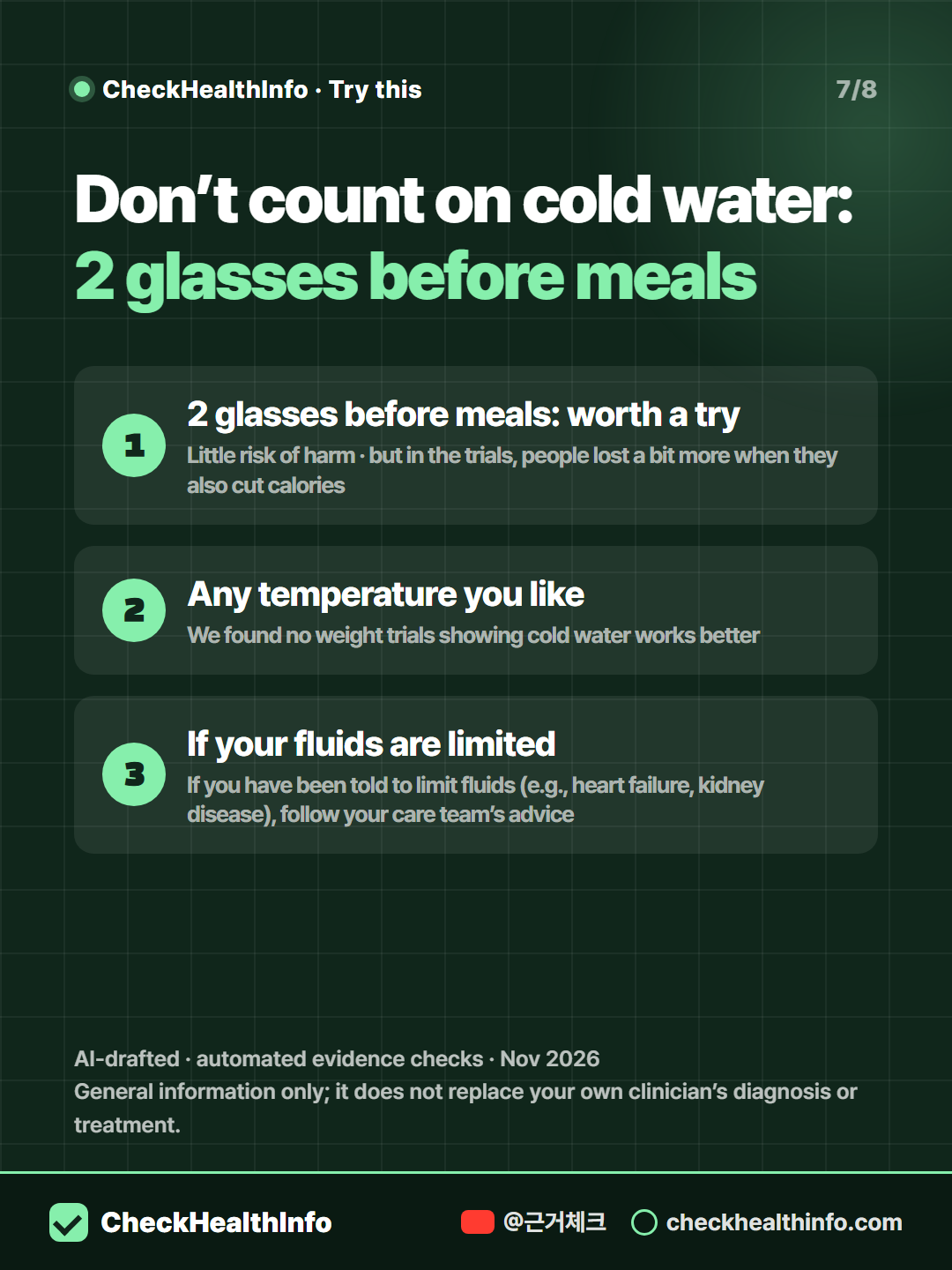
- Two glasses of water before meals (about 500 mL) — This habit carries little risk, so it is worth a try. But don’t rely on it alone; combine it with cutting back on calories. In the trials in which people lost slightly more weight, the water was combined with a diet. [8] [9]
- Any temperature you like — We found no weight trials showing that cold water works better than lukewarm water for weight loss.
- If you have been told to limit fluids — If you have been told to limit how much you drink (for example, because of heart failure or kidney disease), follow your care team’s advice. Drinking a very large amount at once is not recommended.
Scope: This verdict covers the link between cold water or drinking water and calories burned and body weight. It does not cover the effects of switching drinks (sugary drinks or artificially sweetened drinks) or the treatment of any disease.
Limitations of this verdict
- The calorie trials that reported their size were small (12 to 27 people) and measured energy expenditure for only about 1–2 hours after a single drink. Most participants were healthy young adults, so the results may not apply directly to middle-aged or older adults.
- A study in which 21 children with overweight drank cold water (4 °C) reported that resting energy expenditure rose by up to 25%, but it was a before-and-after comparison without a comparison group. [5]
- In the meta-analysis, trials that replaced sugary drinks with water leaned toward weight loss, −0.81 kg (−1.66 to 0.03), but the difference was not clear. In trials that replaced artificially sweetened drinks with water, body weight in the water group was actually 1.82 kg (0.97 to 2.67) higher. [6]
- We found no randomized trials in PubMed that had people drink cold water for several weeks and measured their body weight.
- Grades follow section 1 of our rating method. We check PubMed for new studies every month, and if a verdict changes, we record it in our corrections log.
Card news
Video (in Korean)
References
- Boschmann M, Steiniger J, Hille U, et al. Water-induced thermogenesis. J Clin Endocrinol Metab 2003;88(12):6015-9. PMID 14671205. PubMed abstract · Full article
- Brown CM, Dulloo AG, Montani JP. Water-induced thermogenesis reconsidered: the effects of osmolality and water temperature on energy expenditure after drinking. J Clin Endocrinol Metab 2006;91(9):3598-602. PMID 16822824. PubMed abstract · Full article
- Girona M, Grasser EK, Dulloo AG, et al. Cardiovascular and metabolic responses to tap water ingestion in young humans: does the water temperature matter?. Acta Physiol (Oxf) 2014;211(2):358-70. PMID 24684853. PubMed abstract · Full article
- Charrière N, Miles-Chan JL, Montani JP, et al. Water-induced thermogenesis and fat oxidation: a reassessment. Nutr Diabetes 2015;5(12):e190. PMID 26690288. PubMed abstract · Full article · Free full text
- Dubnov-Raz G, Constantini NW, Yariv H, et al. Influence of water drinking on resting energy expenditure in overweight children. Int J Obes (Lond) 2011;35(10):1295-300. PMID 21750519. PubMed abstract · Full article
- Chen QY, Khil J, Keum N. Water Intake and Adiposity Outcomes among Overweight and Obese Individuals: A Systematic Review and Meta-Analysis of Randomized Controlled Trials. Nutrients 2024;16(7):963. PMID 38612997. PubMed abstract · Full article · Free full text
- Muckelbauer R, Sarganas G, Grüneis A, et al. Association between water consumption and body weight outcomes: a systematic review. Am J Clin Nutr 2013;98(2):282-99. PMID 23803882. PubMed abstract · Full article
- Dennis EA, Dengo AL, Comber DL, et al. Water consumption increases weight loss during a hypocaloric diet intervention in middle-aged and older adults. Obesity (Silver Spring) 2010;18(2):300-7. PMID 19661958. PubMed abstract · Full article · Free full text
- Parretti HM, Aveyard P, Blannin A, et al. Efficacy of water preloading before main meals as a strategy for weight loss in primary care patients with obesity: RCT. Obesity (Silver Spring) 2015;23(9):1785-91. PMID 26237305. PubMed abstract · Full article
General information only, not medical advice. It does not replace your own clinician’s diagnosis or treatment. If you have been told to limit fluids (for example, because of heart failure or kidney disease), follow your care team’s advice.