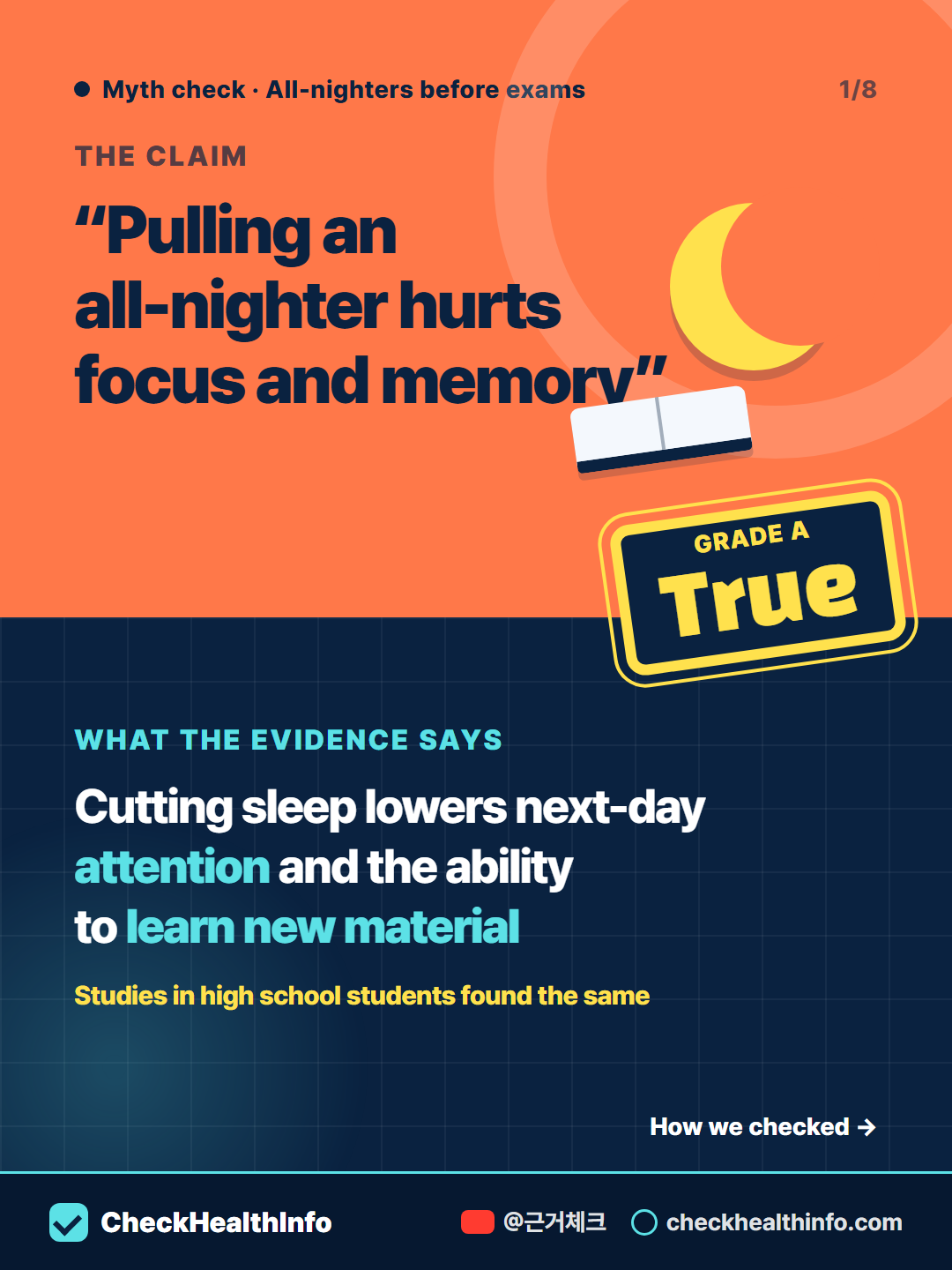
Is pulling an all-nighter before an exam better than sleeping?
Does cutting sleep or staying up all night to study before an exam lower focus and memory? And does sleeping after studying help you remember what you learned?

We checked this verdict against 9 sources, such as published studies and clinical guidelines. · How checked: AI-drafted · automated evidence checks
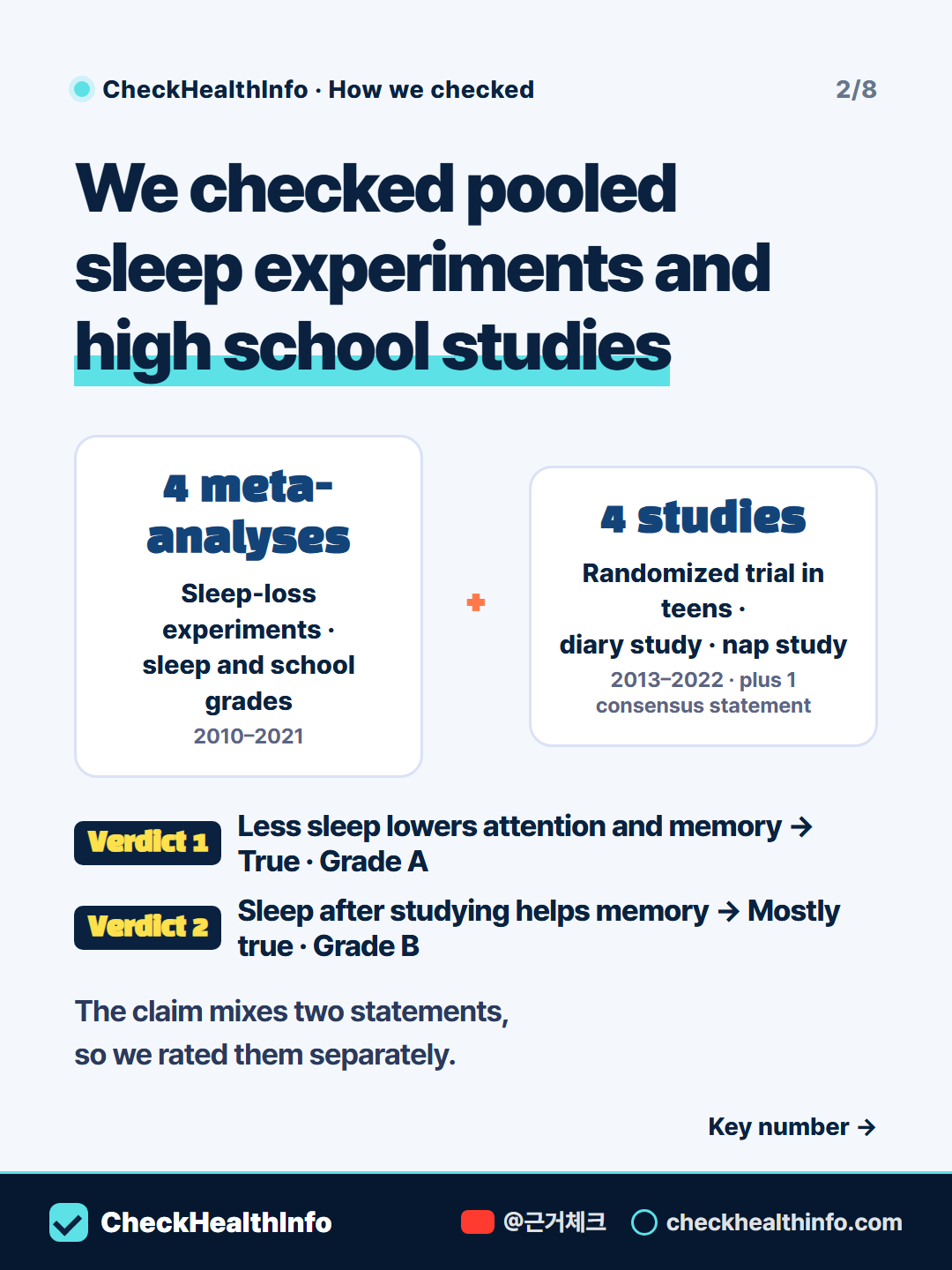
Verdicts at a glance
| Claim | Verdict |
|---|---|
| Pulling an all-nighter or cutting sleep lowers next-day attention and memory | True · Evidence grade A |
| Sleeping after studying helps you remember what you learned | Mostly true · Evidence grade B |
Bottom line — Staying up all night or cutting back on sleep lowers attention and memory the next day. Pooled experiments that took sleep away from volunteers and a randomized trial in high school students all pointed the same way. So the claim that “pulling an all-nighter or cutting sleep lowers next-day attention and memory” is rated True (evidence grade A). The claim that “sleeping after studying helps you remember what you learned” is rated Mostly true (evidence grade B): the direction is the same, but the effect is small, and the cost of losing sleep is larger and clearer.
Meta-analysis — An analysis that combines the results of several studies on the same question into one estimate.
Effect size (g) — A standardized measure of how large the difference between two groups is, so that studies using different scales can be compared. Zero means no difference; the farther from zero, the larger the difference. Studies report the sign differently: in this article, both the negative values and the positive values (the sleep deprivation and memory meta-analysis [3]) mean that the sleep-deprived group did worse.
95% confidence interval — The range in which the true value is likely to lie. If the range crosses zero, we cannot be confident there is a difference.
Correlation coefficient (r) — How closely two measures move together. Zero means no relationship; values closer to 1 (or −1) mean a stronger relationship.
Publication bias — Studies with clear results are more likely to be published, which can make pooled results look larger than they really are.
On November 12, 2026, a Korean broadcast news report described ways to manage sleep, nutrition and immunity in the week before the Suneung (College Scholastic Ability Test, or CSAT), Korea’s one-day national college entrance exam that weighs heavily in university admissions. Prompted by that report, we checked a common saying: “Pulling an all-nighter before an exam hurts memory and focus, and getting enough sleep helps lock in what you studied.” Because it mixes two different statements, we rated them separately.
Verdict 1. “Pulling an all-nighter or cutting sleep lowers next-day attention and memory”
True · Evidence grade A
In short After an all-nighter or short sleep, attention drifts the next day and less of what you learn sticks. High school students of exam age were no exception.
- Pooled all-nighter experiments — A meta-analysis of 70 studies (147 cognitive tests) of total sleep deprivation lasting less than 48 hours found the largest effect on lapses in simple attention (missed responses) (effect size g = −0.776, 95% confidence interval −0.96 to −0.60). Most other areas, including working memory and short-term memory, also declined. Reasoning accuracy, however, did not differ significantly (g = −0.125, 95% confidence interval −0.27 to 0.02). [1]
- Pooled sleep-restriction experiments — A meta-analysis of 61 studies in which sleep was shortened, rather than skipped entirely, also found lower overall cognitive performance (g = −0.383), including executive function (−0.324), sustained attention (−0.409) and long-term memory (−0.192). For some areas, such as general attention and multitasking, there was not enough evidence to detect an effect. [2]
- Learning after an all-nighter — After at least one full night without sleep, people remembered less of what they learned afterward (g = 0.621, 95% confidence interval 0.473 to 0.769). This was larger than the value the same authors found in a separate meta-analysis of sleep loss after learning (g = 0.277; Verdict 2). The authors reported publication bias and very low statistical power in most of the studies. [3]
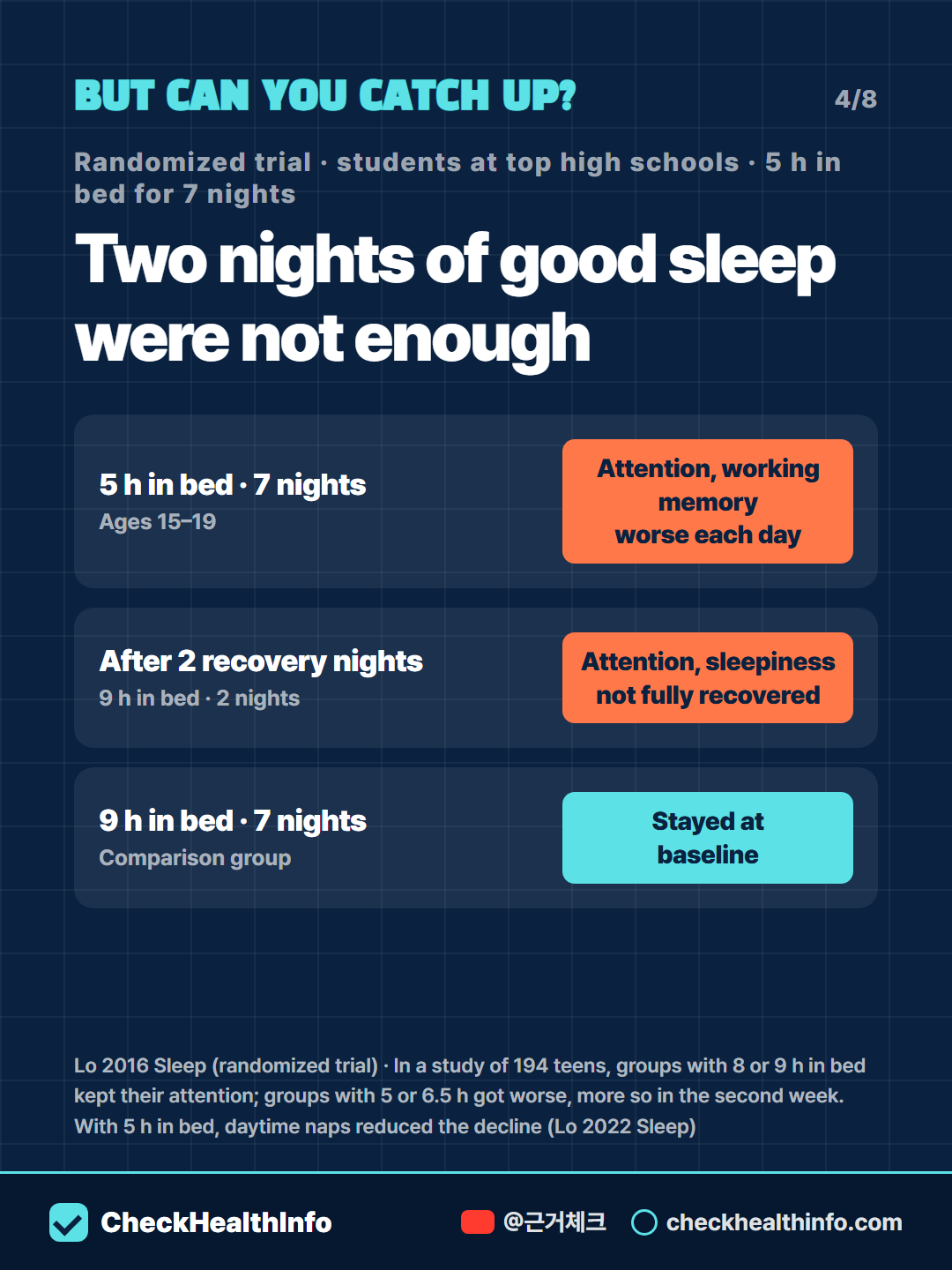
- Randomized trial in high school students — Fifty-six students aged 15 to 19 at top high schools were randomly assigned to 5 hours or 9 hours in bed for 7 nights. In the 5-hour group, sustained attention, working memory and executive function got worse day by day, sleepiness increased and positive mood decreased. The 9-hour group stayed at baseline. Even after two recovery nights, sustained attention and sleepiness did not return to baseline. [4]
- In a study that assigned 194 teens to 9, 8, 6.5 or 5 hours in bed on weekdays, the 9-hour and 8-hour groups kept their attention at baseline, while the 6.5-hour and 5-hour groups showed a growing decline that was more pronounced in the second week. Groups given a chance to nap showed a smaller decline. [5]
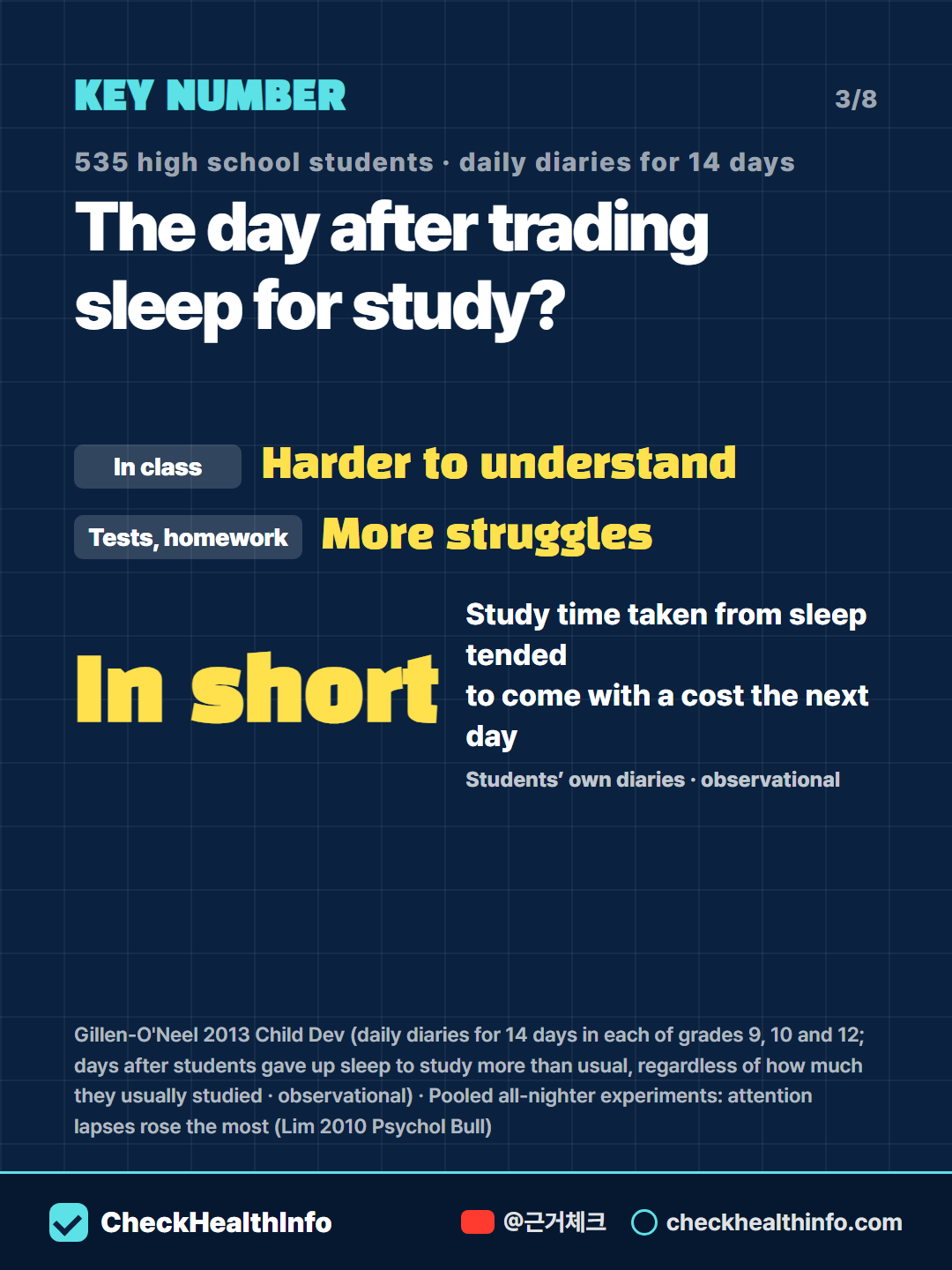
- High school diary study — In a study of 535 high school students who kept daily diaries for 14 days in each of grades 9, 10 and 12, students who gave up sleep to study more than usual tended to have more trouble understanding material in class the next day and struggled more on assignments and tests, regardless of how much they usually studied. Because this is an observational study based on students’ own diaries, it cannot prove that the lost sleep caused the problems. Trading sleep for study became more common in the later years of high school. [6]
Grade: Three meta-analyses of sleep-deprivation experiments all pointed the same way, so we rated the evidence A. A randomized trial in high school students showed the same result. Because some areas showed no clear effect or had too little evidence (reasoning; general attention and multitasking), we narrowed the verdict to attention and memory, where the effect was consistent, rather than lowering the grade. Publication bias is not one of the reasons for lowering a grade in our rating method (reasons 1–3), and the direction of the effect on attention and memory was consistent across studies.
Verdict 2. “Sleeping after studying helps you remember what you learned”
Mostly true · Evidence grade B
In short People who slept after learning remembered a little more. But the difference is small, and the cost of losing sleep (Verdict 1) is bigger.
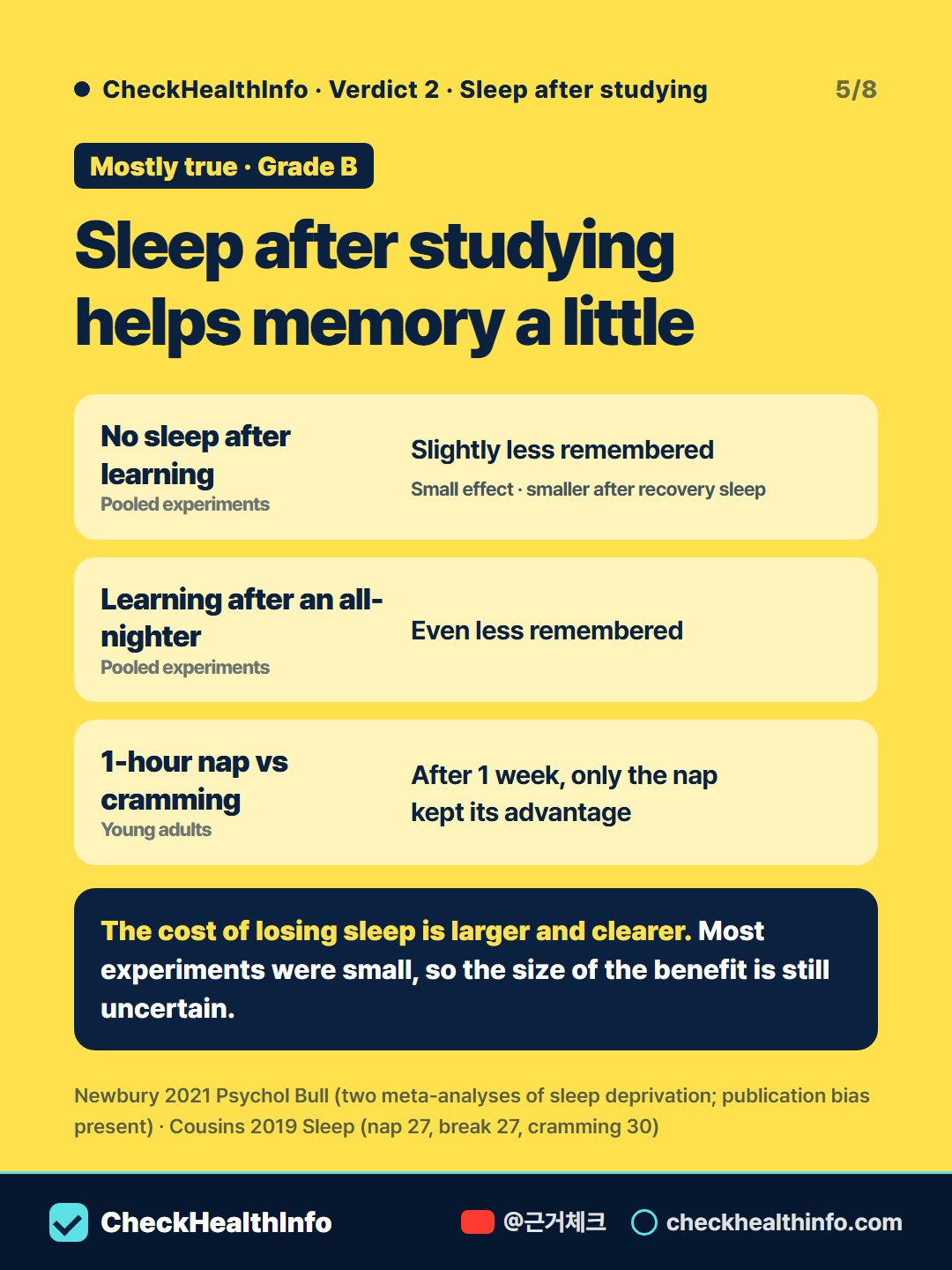
- Pooled experiments with no sleep after learning — Studies have reported that losing a night of sleep either before or after learning reduces memory for newly learned material. In a meta-analysis of experiments that took away at least one night of sleep after learning, the sleep-deprived group remembered less (g = 0.277, 95% confidence interval 0.177 to 0.377). The difference was larger when people were tested right after the sleepless night and smaller when they were tested after recovery sleep. It was larger for procedural memory (such as motor skills) than for declarative memory (such as textbook facts). The authors reported publication bias and very low statistical power in most of the studies. [3]
- Napping vs cramming — Young adults learned detailed factual material in sessions separated by 1 hour of napping (27 people), taking a break (27) or cramming the material (30). When tested 30 minutes later, both napping and cramming led to better memory than taking a break; after a week, only napping kept its advantage. [9]
Grade: We started from a meta-analysis of experiments that took away sleep after learning (A), but lowered it one grade to B under reason 3 of our rating method (uncertain results): the size of the effect differed clearly by when memory was tested (right away vs after recovery sleep) and by type of memory (procedural vs declarative), and the authors reported publication bias and very low statistical power in most studies. The direction supports the claim, but the effect is small (g = 0.277), so it is “Mostly true.”
Does more sleep mean better grades?
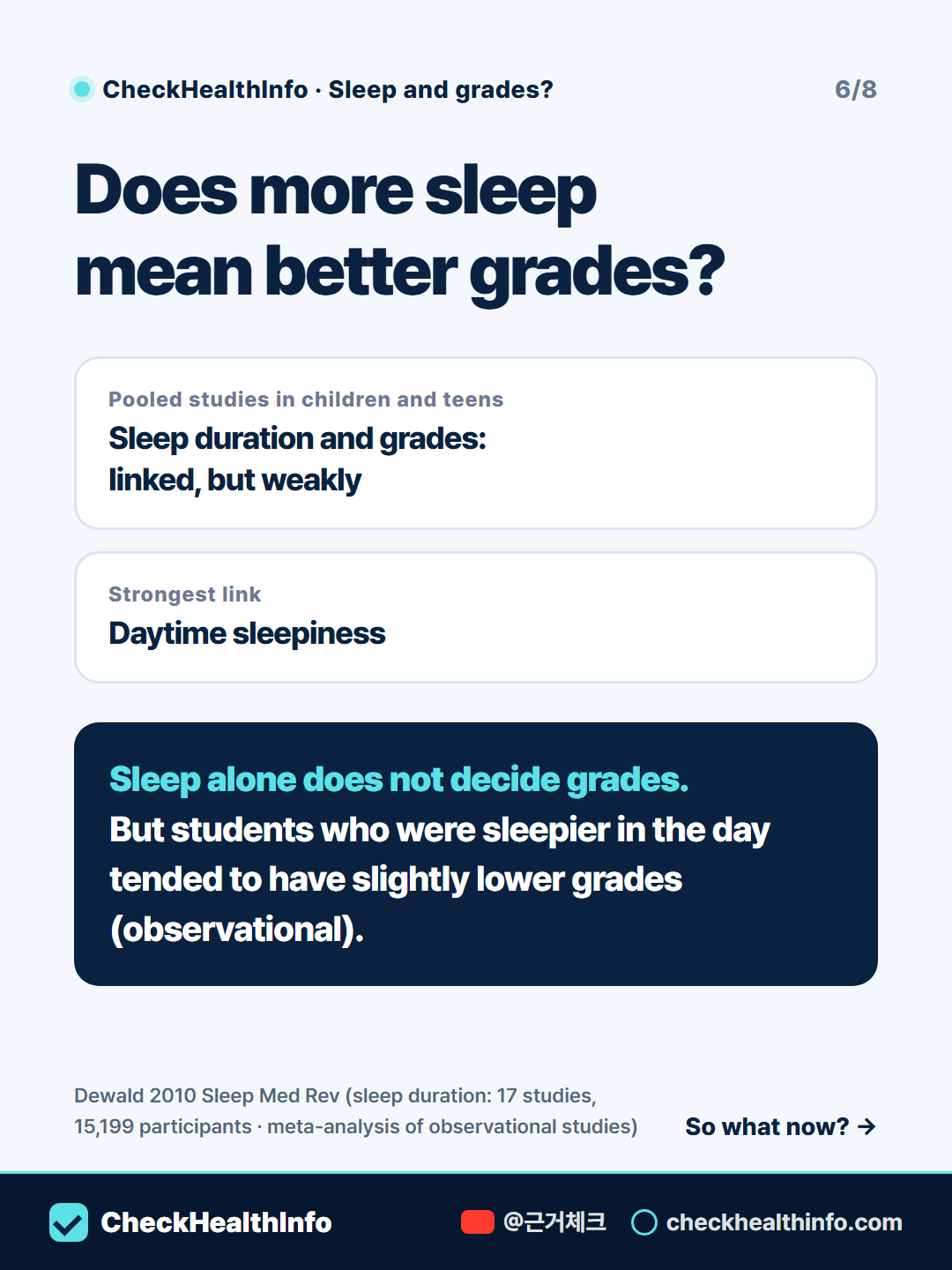
- A meta-analysis of studies in children and teens found that sleep duration was significantly but weakly related to school performance (correlation coefficient r = 0.069; 17 studies, 15,199 participants). Daytime sleepiness showed the strongest relationship: students who were sleepier in the day tended to have slightly lower grades (r = −0.133). This does not mean sleep alone determines grades (observational studies). [7]
- The American Academy of Sleep Medicine (AASM) has issued expert consensus recommendations on how much sleep children and teens need for good health. [8]
If you are preparing for a big exam
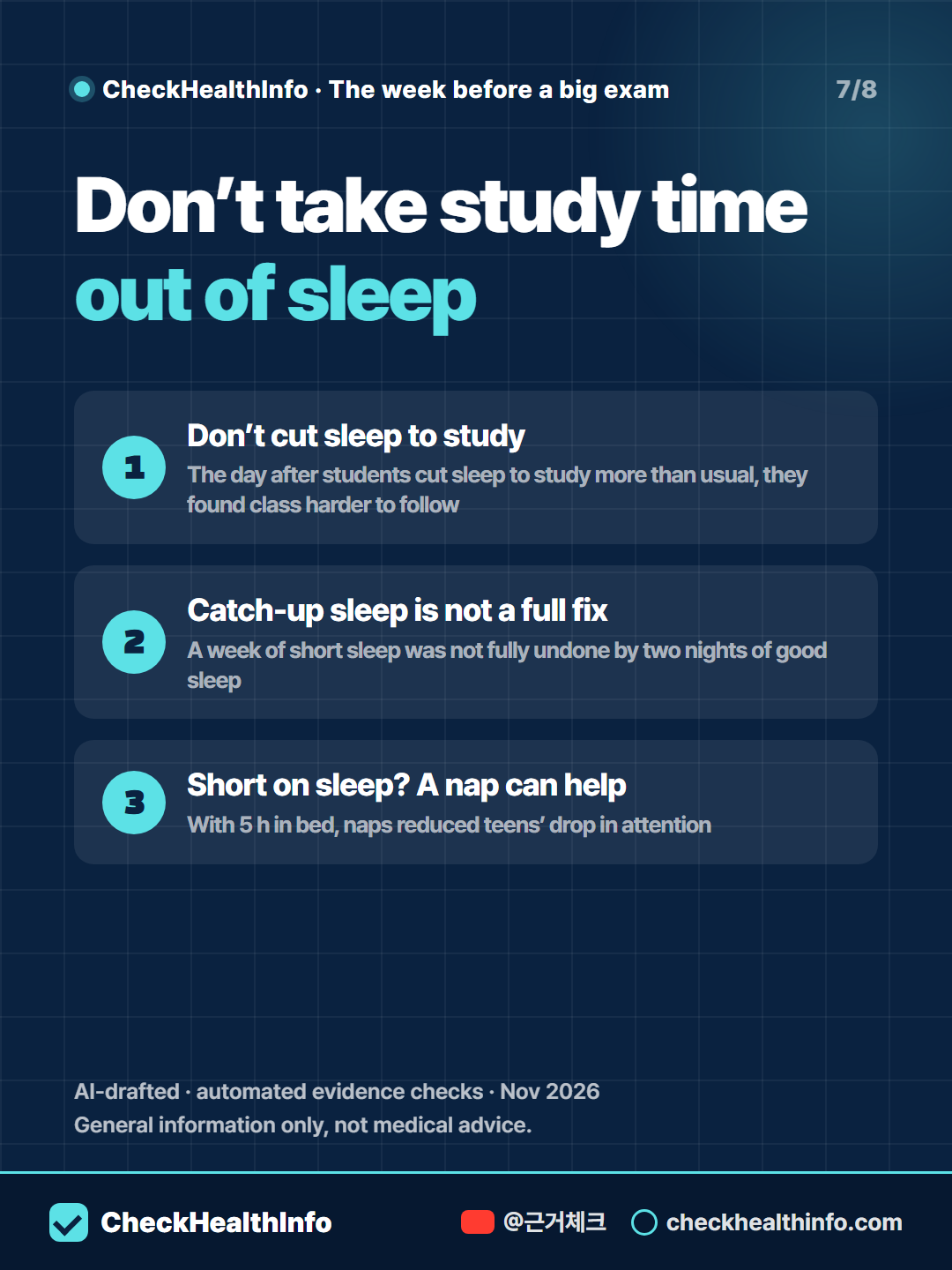
- Don’t take study time out of sleep — The day after students cut sleep to study more than usual, they tended to find class harder to follow and tests harder. [6]
- Catch-up sleep is not a full fix — After a week of short sleep, two nights of 9 hours in bed did not fully restore attention or relieve sleepiness. [4]
- Short on sleep? A nap can help — In teens limited to 5 hours in bed, naps reduced the drop in attention. [5]
- If sleeplessness persists or anxiety is severe, talk with a school nurse or a health care provider.
Scope: This verdict covers all-nighters and short sleep in relation to next-day attention and memory, and sleep after studying in relation to memory. It does not cover sleeping pills or other medicines, sleep disorders, or energy drinks and caffeine.
Limitations
- Most sleep experiments took away sleep for a set time in a laboratory; they did not directly measure real exam scores.
- The meta-analyses on sleep deprivation and memory showed publication bias, and most of the included studies had very low statistical power. [3]
- The high school diary study and the meta-analysis of sleep and grades are observational, so cause and effect cannot be established. [6] [7]
- The napping vs cramming experiment was a single study in young adults and compared 1 hour of review with a 1-hour nap; it did not directly test all-night studying. [9] Our search did not find a meta-analysis that directly measured the effect of post-study sleep in exam-age students.
- This article was prompted by a November 12, 2026, Korean broadcast news report on staying healthy and well rested before the Suneung. It does not evaluate any news outlet or person.
- Grades follow section 1 of our rating method. New studies are checked in our monthly PubMed review, and any change in a verdict is logged in our corrections log.
Card news
Video (in Korean)
References
- Lim J, Dinges DF. A meta-analysis of the impact of short-term sleep deprivation on cognitive variables. Psychol Bull 2010;136(3):375-89. PMID 20438143. PubMed abstract · Full article · Free full text
- Lowe CJ, Safati A, Hall PA. The neurocognitive consequences of sleep restriction: A meta-analytic review. Neurosci Biobehav Rev 2017;80:586-604. PMID 28757454. PubMed abstract · Full article
- Newbury CR, Crowley R, Rastle K, et al. Sleep deprivation and memory: Meta-analytic reviews of studies on sleep deprivation before and after learning. Psychol Bull 2021;147(11):1215-1240. PMID 35238586. PubMed abstract · Full article · Free full text
- Lo JC, Ong JL, Leong RL, et al. Cognitive Performance, Sleepiness, and Mood in Partially Sleep Deprived Adolescents: The Need for Sleep Study. Sleep 2016;39(3):687-98. PMID 26612392. PubMed abstract · Full article · Free full text
- Lo JC, Koa TB, Ong JL, et al. Staying vigilant during recurrent sleep restriction: dose-response effects of time-in-bed and benefits of daytime napping. Sleep 2022;45(4). PMID 35089345. PubMed abstract · Full article · Free full text
- Gillen-O'Neel C, Huynh VW, Fuligni AJ. To study or to sleep? The academic costs of extra studying at the expense of sleep. Child Dev 2013;84(1):133-42. PMID 22906052. PubMed abstract · Full article
- Dewald JF, Meijer AM, Oort FJ, et al. The influence of sleep quality, sleep duration and sleepiness on school performance in children and adolescents: A meta-analytic review. Sleep Med Rev 2010;14(3):179-89. PMID 20093054. PubMed abstract · Full article
- Paruthi S, Brooks LJ, D'Ambrosio C, et al. Recommended Amount of Sleep for Pediatric Populations: A Consensus Statement of the American Academy of Sleep Medicine. J Clin Sleep Med 2016;12(6):785-6. PMID 27250809. PubMed abstract · Full article · Free full text
- Cousins JN, Wong KF, Raghunath BL, et al. The long-term memory benefits of a daytime nap compared with cramming. Sleep 2019;42(1). PMID 30371902. PubMed abstract · Full article · Free full text
General information only, not medical advice. This article does not replace diagnosis or treatment from your own health care provider. If sleeplessness persists or anxiety is severe, talk with a school nurse or a health care provider.