Holiday drinks: do you get drunk faster on an empty stomach?
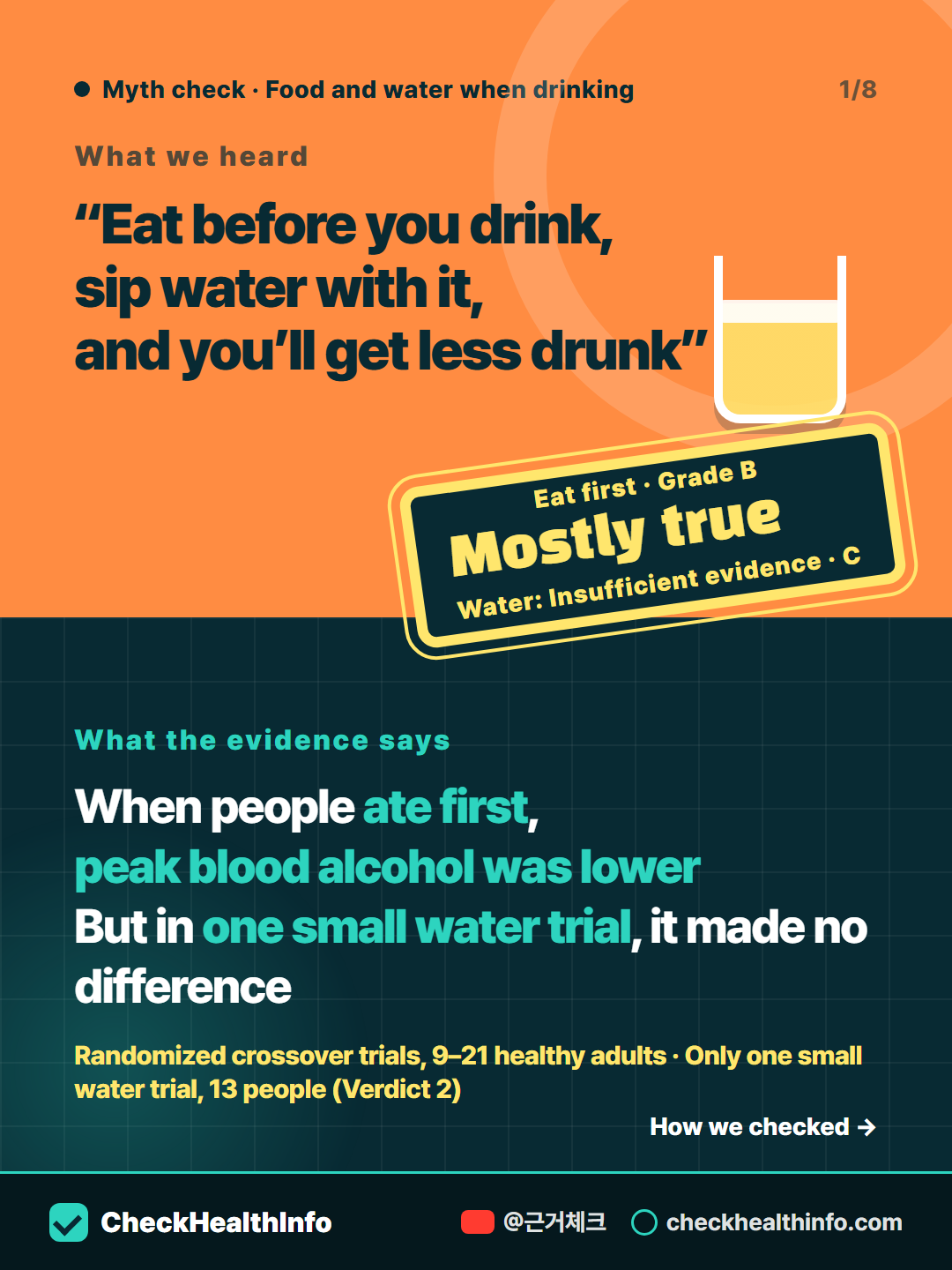
Does eating before you drink really make you less drunk? And can drinking water along with alcohol slow how quickly you get drunk?

We checked this verdict against 13 sources, such as published studies and clinical guidelines. · How checked: AI-drafted · automated evidence checks
Verdicts at a glance
| Claim | Verdict |
|---|---|
| Eating before you drink slows alcohol absorption, so you get less drunk | Mostly true · Evidence grade B |
| Drinking water along with alcohol can slow how quickly you get drunk | Insufficient evidence · Evidence grade C |
Bottom line — In studies where the same people drank the same amount of alcohol once on an empty stomach and once after eating, peak blood alcohol was lower after eating. In one study where people drank right after breakfast, the peak was about one-third lower than on an empty stomach, and every participant said they felt less drunk. So “eating before you drink slows alcohol absorption, so you get less drunk” is rated Mostly true (Evidence grade B). But in a trial in Japan where people drank water along with their alcohol, neither alcohol levels nor how drunk people felt differed with or without water. That was a single trial of 13 people, so “drinking water along with alcohol can slow how quickly you get drunk” is rated Insufficient evidence (Evidence grade C). The takeaway: eating first lowers the peak, but there is no evidence yet that water makes you less drunk. Neither one means it is safe to drink more.
Peak blood alcohol — The highest level alcohol reaches in the blood after drinking. Studies report it in mg/dL or as a percentage (blood alcohol concentration, or BAC).
Randomized crossover trial — The same people go through every condition (for example, drinking on an empty stomach and drinking after a meal) in a randomly assigned order, and the results are compared.
Gastric emptying — How food and drinks move from the stomach into the gut. In one study, the speed of alcohol absorption tracked closely with gastric emptying [8].
95% confidence interval — The range in which the true value most likely lies.
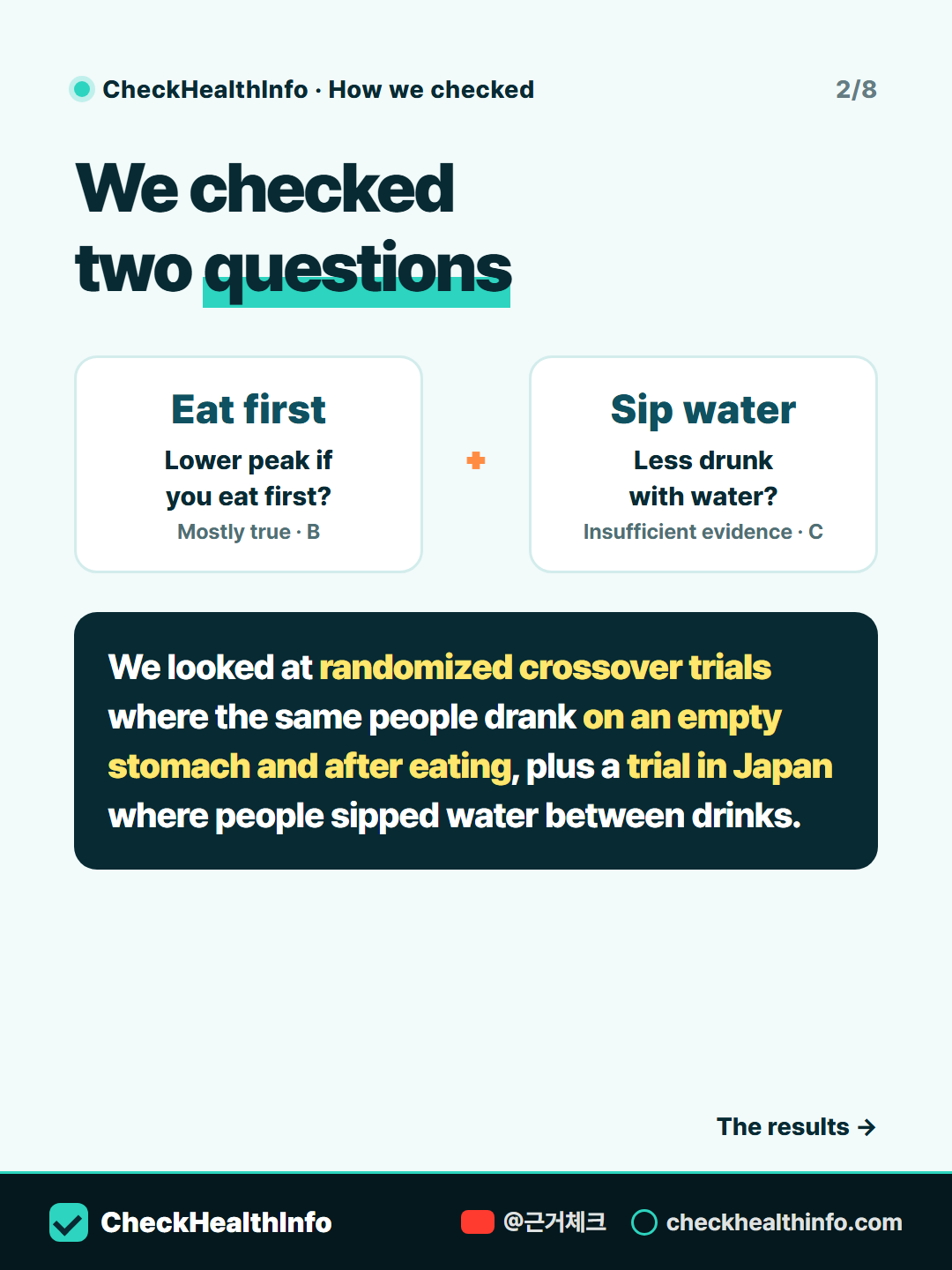
On November 18, 2026, a Korean TV news report on year-end drinking quoted experts as saying that a meal slows alcohol absorption and can keep you from getting drunk all at once, though that does not make heavy drinking okay, and that drinking plenty of water helps slow intoxication and prevent dehydration. “Food” and “water” are separate questions, so we split the claim into two verdicts.
Verdict 1. “Eating before you drink slows alcohol absorption, so you get less drunk”
Mostly true · Evidence grade B
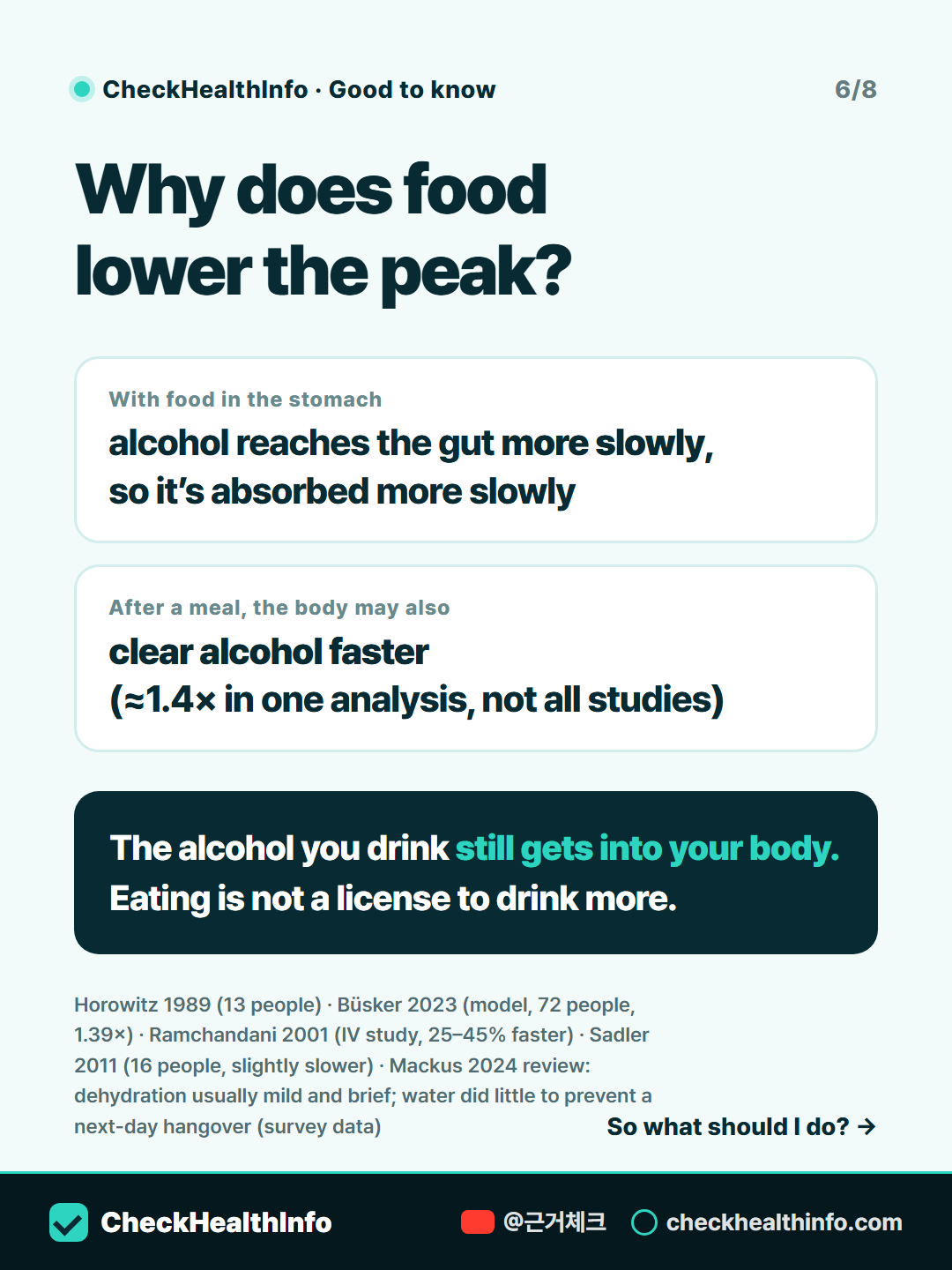
In plain terms With food in your stomach, alcohol moves into the gut more slowly, so blood alcohol doesn’t spike all at once. The body may also clear alcohol faster. But results vary a lot from person to person, and the alcohol you drink still gets into your body.
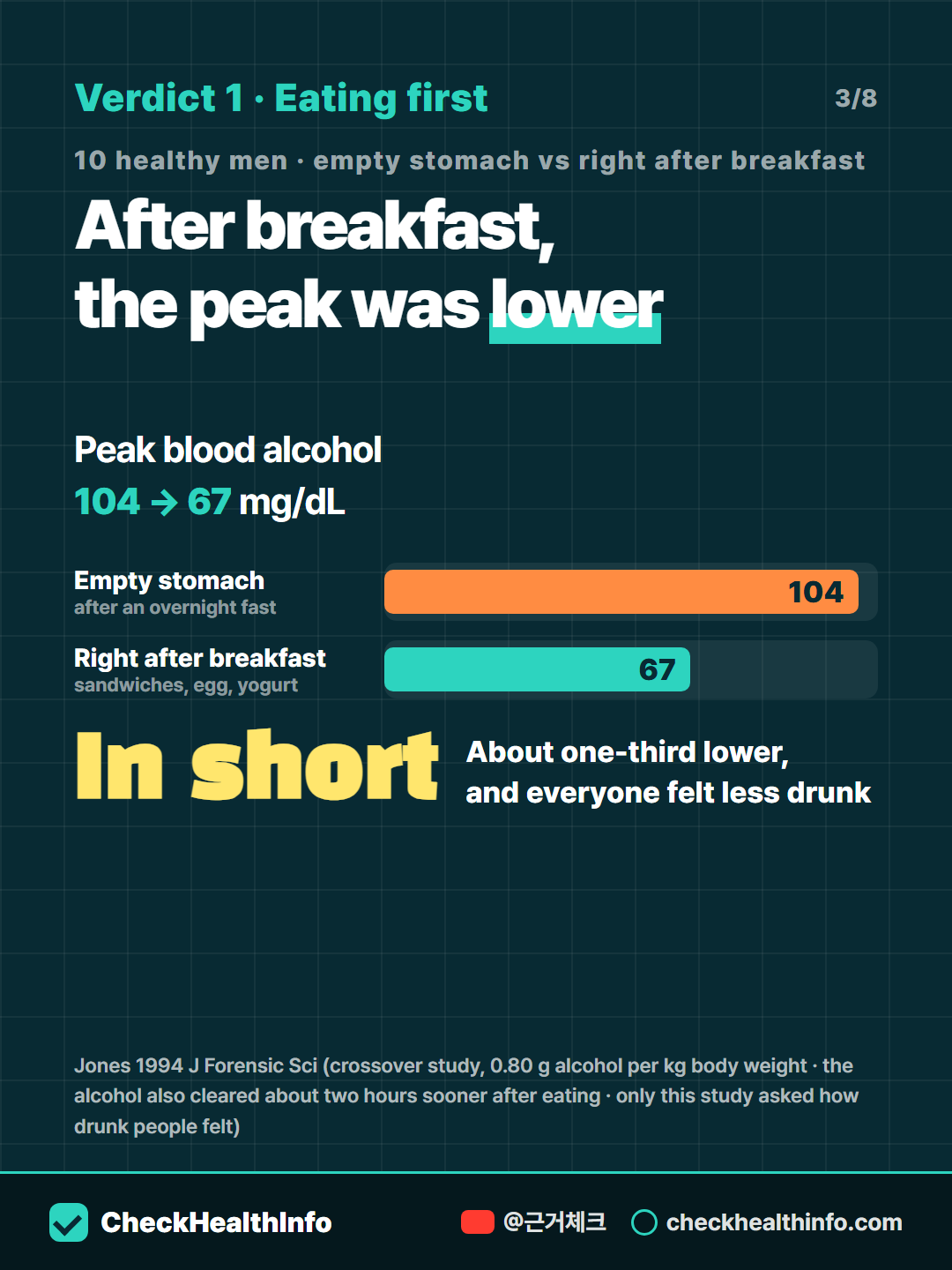
- Ten healthy men drank the same dose of alcohol (0.80 g per kg of body weight) once in the morning after an overnight fast and once right after breakfast. Peak blood alcohol was 104 mg/dL on an empty stomach and 67 mg/dL after breakfast, and every participant said they felt less drunk after eating. The alcohol also cleared from the body about two hours sooner after breakfast. [1]
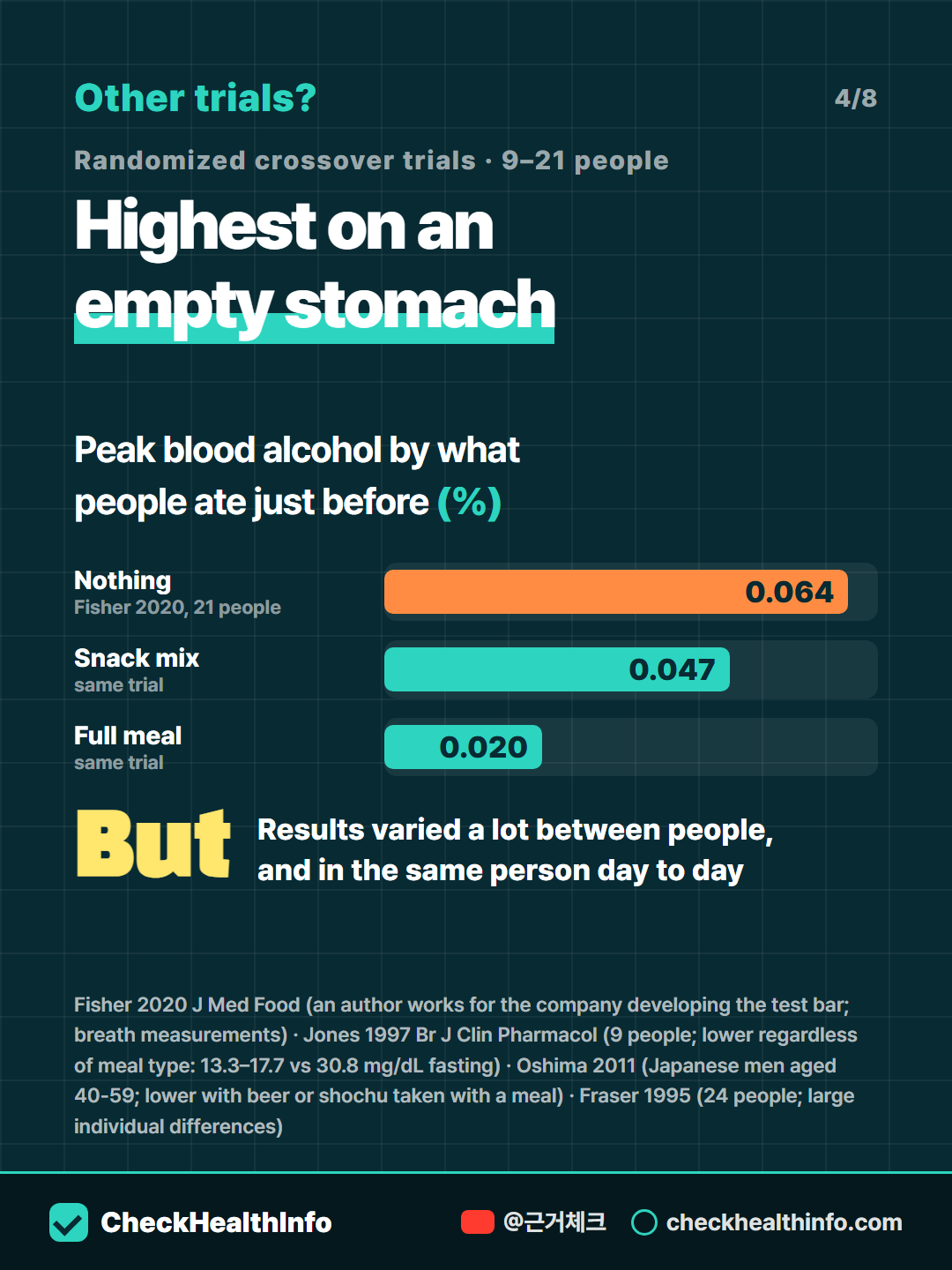
- In a randomized crossover trial, nine men drank after breakfasts high in fat, carbohydrate, or protein. Peaks were 13.3–17.7 mg/dL, compared with 30.8 mg/dL on an empty stomach, and less alcohol reached the bloodstream regardless of what the meal contained. [2]
- In a randomized crossover trial of 21 adults who ate nothing, a snack mix, a nutrition bar, or a full meal just before drinking, peaks were 0.064%, 0.047%, 0.031%, and 0.020%: highest after eating nothing and lowest after the full meal (an author works for the company developing the bar). [3] In another randomized crossover trial, eating a nutrition bar or a meal beforehand reduced the amount of alcohol absorbed by about 30% compared with fasting. [5]
- In a randomized crossover trial of Japanese men aged 40–59 who drank beer or shochu with a test meal, blood alcohol was lower and alcohol cleared faster. On an empty stomach, shochu produced a higher peak than beer, but that difference disappeared with a meal. However, in men with a gene type that makes people flush easily after drinking (ALDH2*1/*2), blood acetaldehyde was higher when they drank shochu with the meal than on an empty stomach (a study from a liquor company’s research lab). [4]
- In a study of 16 men and women, peak breath alcohol was lowest after a light meal, and the share of alcohol absorbed fell to 66% in women and 71% in men. [6]
Grade: We did not find a systematic review or meta-analysis on this exact question. The strongest evidence is randomized crossover trials comparing the same people fasted and fed, which gives grade B. Each trial was small, but the same people were compared across conditions, the effects were large, and the trials pointed the same way. Two of the trials [3][5] included an author from the same company that develops the bar. We rated it “Mostly true” for three reasons: our method uses “True” only with grade A evidence, only one study directly asked people how drunk they felt, and the lower levels are not due only to slower absorption.
Why is the peak lower? It’s not only about absorption
- When solid food is in the stomach, liquids leave the stomach more slowly, and the speed of alcohol absorption tracked closely with this gastric emptying. [8]
- An analysis combining data from 72 people found that food not only slowed absorption but also raised the maximum rate of alcohol clearance 1.39-fold (95% confidence interval 1.33–1.46), and that the lower overall blood alcohol exposure after eating was mainly due to this faster clearance. [9] In a study that gave alcohol by IV to bypass absorption, clearance was 25–45% faster after a meal. [10] But in a 16-person study measuring breath alcohol, clearance was slightly slower after a meal. [6] The 1.39-fold figure is a model estimate, not a directly measured value.
- Whether people had eaten or not, results varied widely between people and in the same person from day to day. [7] [2]
Verdict 2. “Drinking water along with alcohol can slow how quickly you get drunk”
Insufficient evidence · Evidence grade C
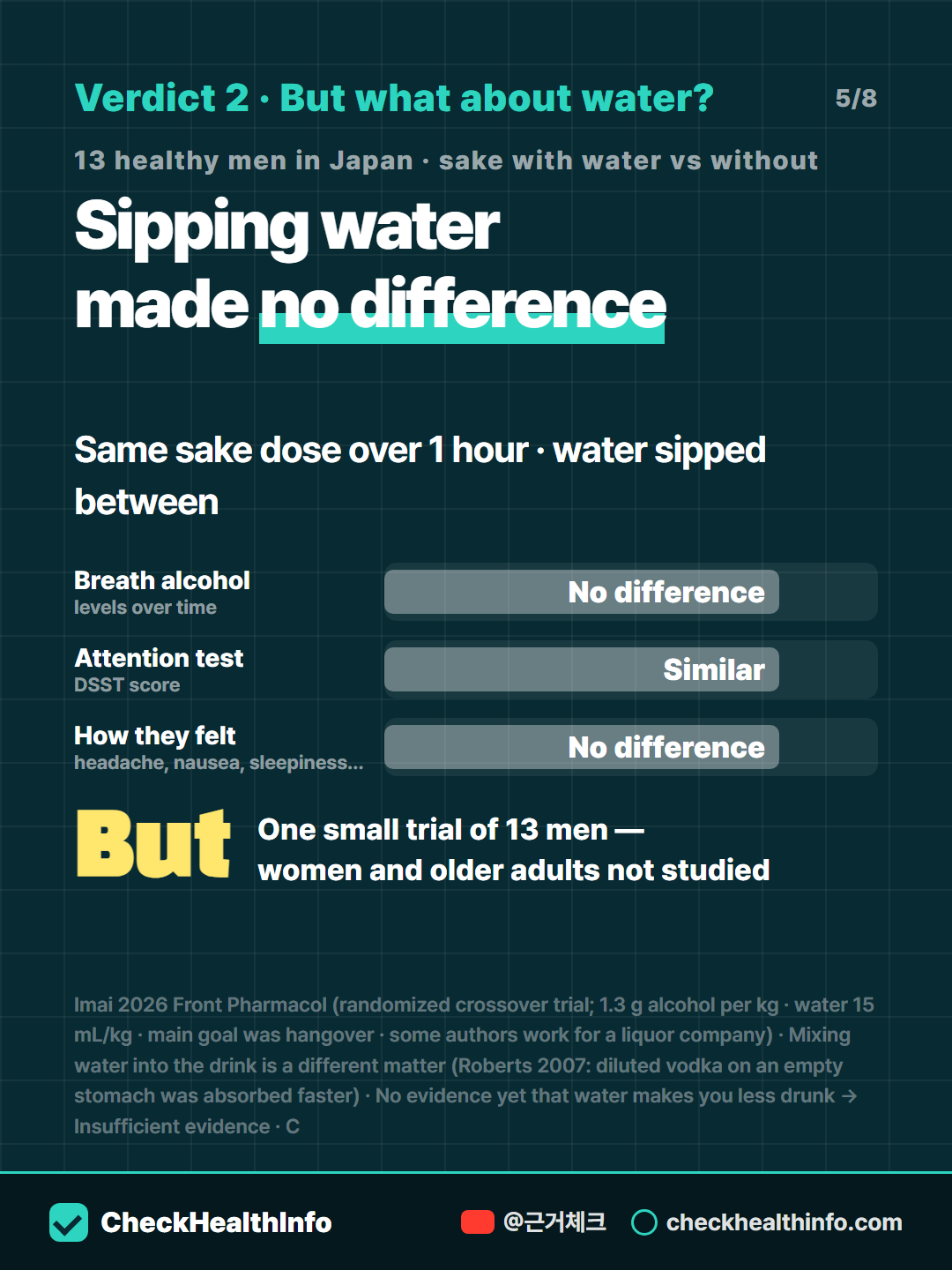
In plain terms One small trial found that drinking water alongside alcohol did not lower alcohol levels or make people feel less drunk. There is no evidence yet that water makes you less drunk. “Insufficient evidence” does not mean you shouldn’t drink water — water is low-risk, so it’s fine to drink, but don’t drink more alcohol because you’re having water.
- In a randomized crossover trial, 13 healthy men in Japan drank the same amount of sake (1.3 g of alcohol per kg of body weight) over one hour, once without water and once with water (15 mL per kg of body weight) sipped in between. Changes in breath alcohol and acetaldehyde did not differ between the two conditions. Scores on an attention test and self-rated symptoms (facial flushing, headache, nausea, concentration, sleepiness, and feeling high) also did not differ. [11]
- A review of hangover and dehydration research concluded that drinking water during or right after drinking did little to prevent a next-day hangover (survey data) and that alcohol-related dehydration is usually mild and short-lived. [12] We did not rate the news report’s point about preventing dehydration.
Grade: Only one randomized crossover trial directly measured intoxication when water was taken with alcohol. As a randomized trial, it starts at grade B, but with only 13 participants in a single study, even its “no difference” result is imprecise, so we lowered it one step to C. Although that trial found no difference, one small trial is not enough to rate the claim “False,” so we rated it “Insufficient evidence.”
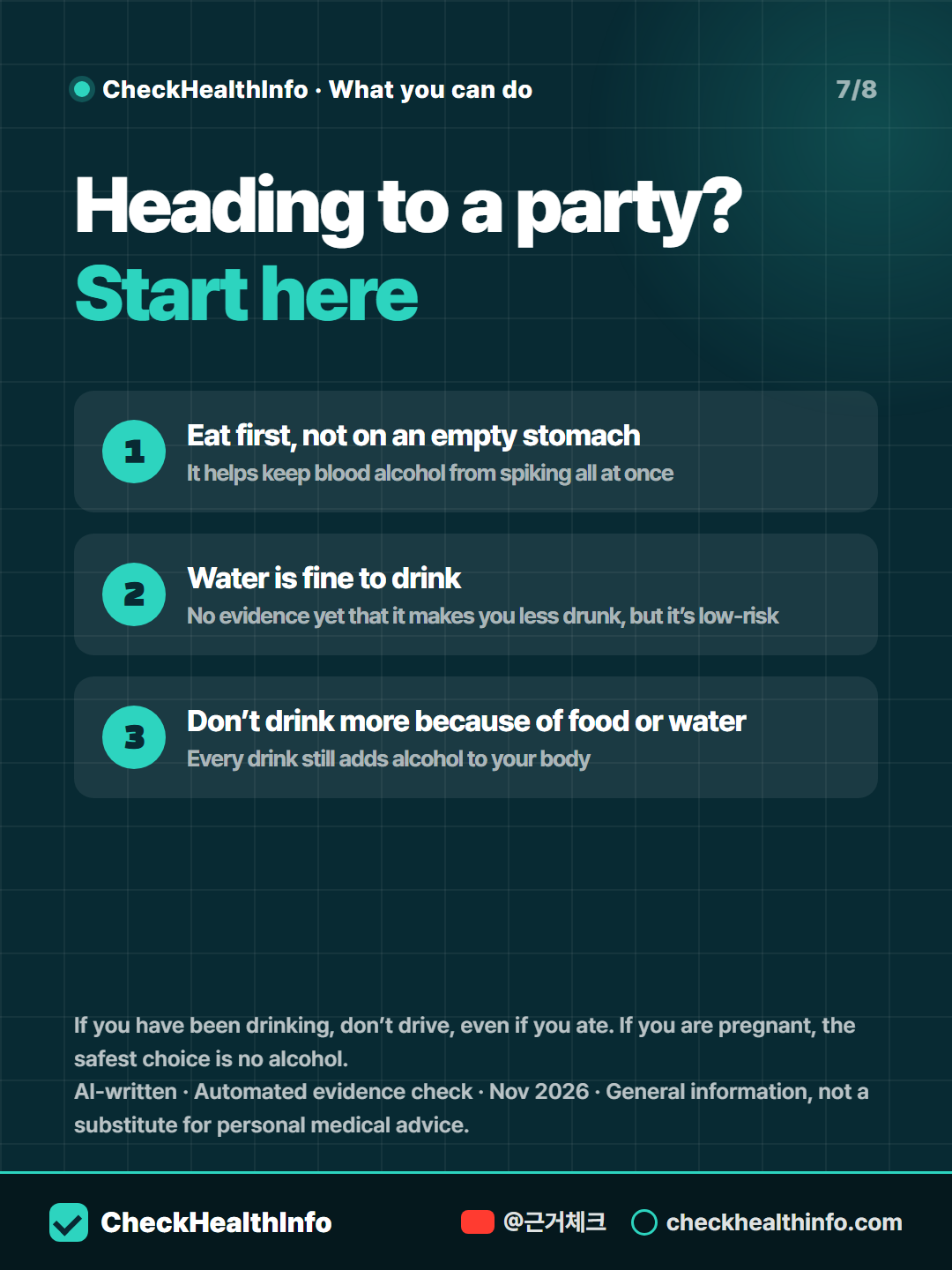
Heading to a party? Try this
- Eat first instead of drinking on an empty stomach — it helps keep blood alcohol from spiking all at once. [1] [3]
- Water is fine to drink — there is no evidence yet that it makes you less drunk, but it is a low-risk habit.
- Don’t drink more because you ate or had water — every drink still adds alcohol to your body.
- If you have been drinking, don’t drive, even if you ate. If you are pregnant, the safest choice is no alcohol.
Scope: This verdict covers eating before drinking and blood alcohol, and drinking water with alcohol and intoxication. It does not cover hangover products, liver or stomach health, or drinking limits.
Limitations of this verdict
- The Verdict 1 trials were small studies of 9 to 21 healthy adults (mostly men), with low to moderate doses of alcohol (0.3–0.8 g per kg of body weight). None directly studied hours of heavy drinking at a real party.
- Only the breakfast study [1] directly asked how drunk people felt, and the abstract gives no rating-scale numbers.
- The Verdict 2 trial was a single study of 13 healthy men in Japan with one specific alcohol-metabolism gene type, so the results may not apply to women, older adults, or people who flush easily after drinking. It measured breath alcohol, not blood.
- The evidence does not show whether drinking water leads people to drink less alcohol or drink more slowly. The Verdict 2 trial’s main goal was hangover, and some of its authors work for a liquor company.
- Mixing water into your drink is a different matter. In one study, when vodka was diluted to half strength with water and drunk on an empty stomach, 20 of 21 people actually absorbed it faster than straight vodka [13], so this verdict is not a reason to water down drinks.
- This article was prompted by a November 18, 2026 TV news report. It does not evaluate any news outlet or person.
- Grades follow section 1 of our rating method. We check for new studies in our monthly PubMed review, and if a verdict changes, we record it in our corrections log.
Card news
Video (in Korean)
References
- Jones AW, Jönsson KA. Food-induced lowering of blood-ethanol profiles and increased rate of elimination immediately after a meal. J Forensic Sci 1994;39(4):1084-93. PMID 8064267. PubMed abstract
- Jones AW, Jönsson KA, Kechagias S. Effect of high-fat, high-protein, and high-carbohydrate meals on the pharmacokinetics of a small dose of ethanol. Br J Clin Pharmacol 1997;44(6):521-6. PMID 9431825. PubMed abstract · Full article · Free full text
- Fisher JM, Wolever TMS, Campbell JE, et al. Effect of a Snack Bar Optimized to Reduce Alcohol Bioavailability: A Randomized Controlled Clinical Trial in Healthy Individuals. J Med Food 2020;23(4):432-439. PMID 31755823. PubMed abstract · Full article · Free full text
- Oshima S, Haseba T, Masuda C, et al. [Alcohol metabolism at moderate drinking in healthy men. Comparison between differences of alcohol beverages, with and without meal, and genetic polymorphism]. Nihon Arukoru Yakubutsu Igakkai Zasshi 2011;46(3):357-67. PMID 21861333. PubMed abstract
- Staudt T, Fisher JM, Alves ALS, et al. Optimized food: A strategy for reducing blood alcohol concentration. An Acad Bras Cienc 2026;98(suppl 1):e20240963. PMID 42524898. PubMed abstract · Full article
- Sadler DW, Fox J. Intra-individual and inter-individual variation in breath alcohol pharmacokinetics: The effect of food on absorption. Sci Justice 2011;51(1):3-9. PMID 21334574. PubMed abstract · Full article
- Fraser AG, Rosalki SB, Gamble GD, et al. Inter-individual and intra-individual variability of ethanol concentration-time profiles: comparison of ethanol ingestion before or after an evening meal. Br J Clin Pharmacol 1995;40(4):387-92. PMID 8554941. PubMed abstract · Full article · Free full text
- Horowitz M, Maddox A, Bochner M, et al. Relationships between gastric emptying of solid and caloric liquid meals and alcohol absorption. Am J Physiol 1989;257(2 Pt 1):G291-8. PMID 2764113. PubMed abstract · Full article
- Büsker S, Jones AW, Hahn RG, et al. Population Pharmacokinetics as a Tool to Reevaluate the Complex Disposition of Ethanol in the Fed and Fasted States. J Clin Pharmacol 2023;63(6):681-694. PMID 36688276. PubMed abstract · Full article
- Ramchandani VA, Kwo PY, Li TK. Effect of food and food composition on alcohol elimination rates in healthy men and women. J Clin Pharmacol 2001;41(12):1345-50. PMID 11762562. PubMed abstract · Full article
- Imai H, Kushio S, Matsuura K, et al. Water intake during drinking does not alleviate hangover symptoms. Front Pharmacol 2026;17:1852528. PMID 42375618. PubMed abstract · Full article · Free full text
- Mackus M, Stock AK, Garssen J, et al. Alcohol hangover versus dehydration revisited: The effect of drinking water to prevent or alleviate the alcohol hangover. Alcohol 2024;121:9-18. PMID 39069212. PubMed abstract · Full article
- Roberts C, Robinson SP. Alcohol concentration and carbonation of drinks: the effect on blood alcohol levels. J Forensic Leg Med 2007;14(7):398-405. PMID 17720590. PubMed abstract · Full article
General information only, not medical advice. It does not replace your own clinician’s diagnosis or treatment. The studies described here included healthy adults. If you have been drinking, don’t drive, even if you ate. If you are pregnant, the safest choice is no alcohol.