Constipation: do two kiwifruit a day really help?
If you have constipation, does eating two kiwifruit a day really help you have more bowel movements and ease belly discomfort?

We checked this verdict against 10 sources, such as published studies and clinical guidelines. · How checked: AI-drafted · automated evidence checks
Verdicts at a glance
| Claim | Verdict |
|---|---|
| Eating two kiwifruit a day relieves constipation (bowel movement frequency and discomfort) | Mostly true · Evidence grade B |
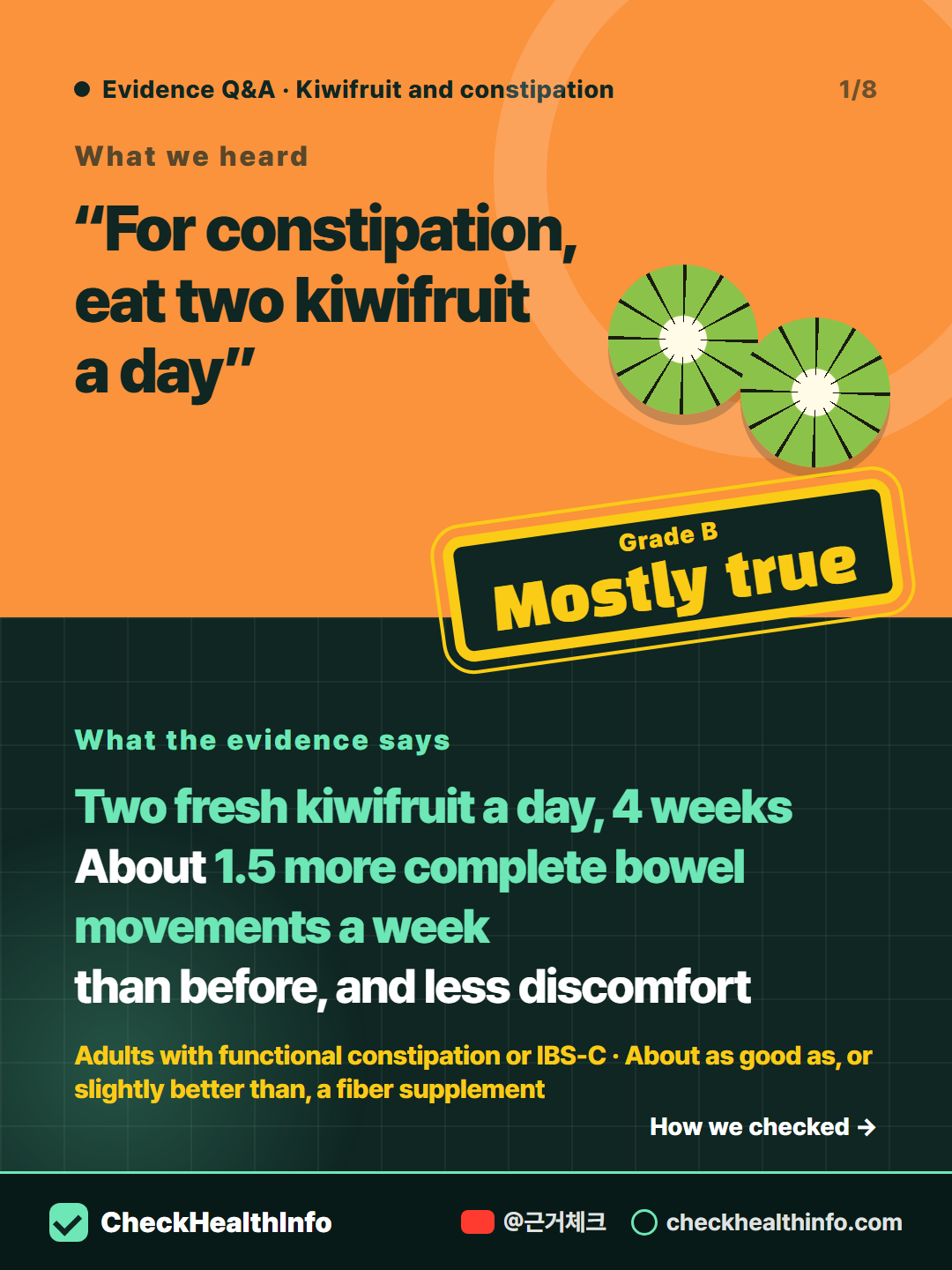
Bottom line — In trials where adults with constipation ate two fresh kiwifruit a day for 4 weeks, complete bowel movements (ones that leave you feeling fully emptied) rose by about one and a half per week compared with before they started, and abdominal discomfort eased. Compared with psyllium, a fiber supplement with proven benefit, kiwifruit worked about as well or slightly better. So “eating two kiwifruit a day relieves constipation (bowel movement frequency and discomfort)” is rated Mostly true (Evidence grade B). The effect is modest, the certainty of the evidence is not high, and kiwifruit extract capsules and powders have not been shown to work. The takeaway: two fresh kiwifruit may add roughly one or two bowel movements a week, and since kiwifruit is inexpensive and low-risk, it is worth a try.
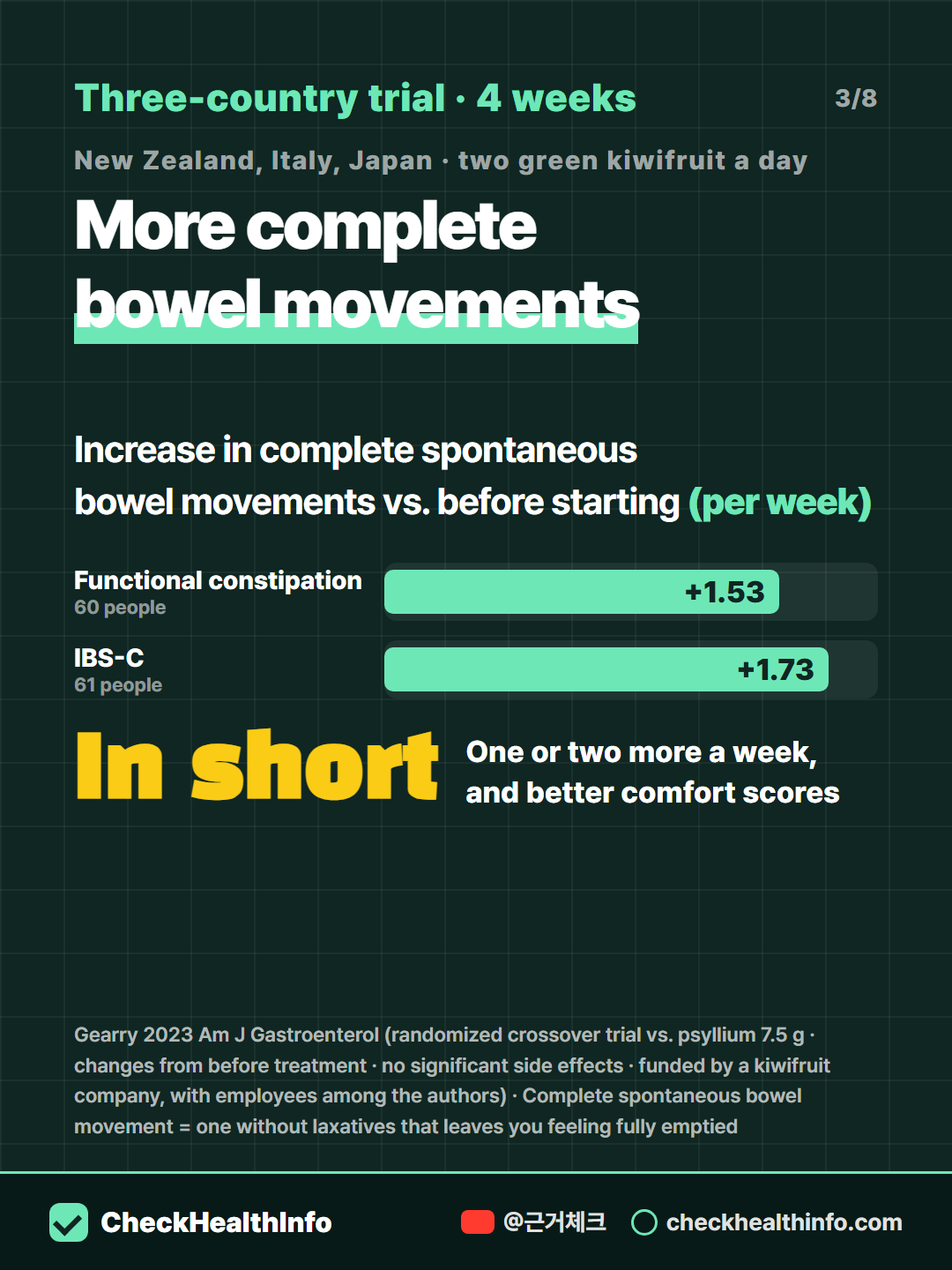
Complete spontaneous bowel movement (CSBM) — A bowel movement that happens without laxatives or enemas and leaves you feeling fully emptied. It is often the main outcome in constipation trials (for example, [4] and [5] in this article).
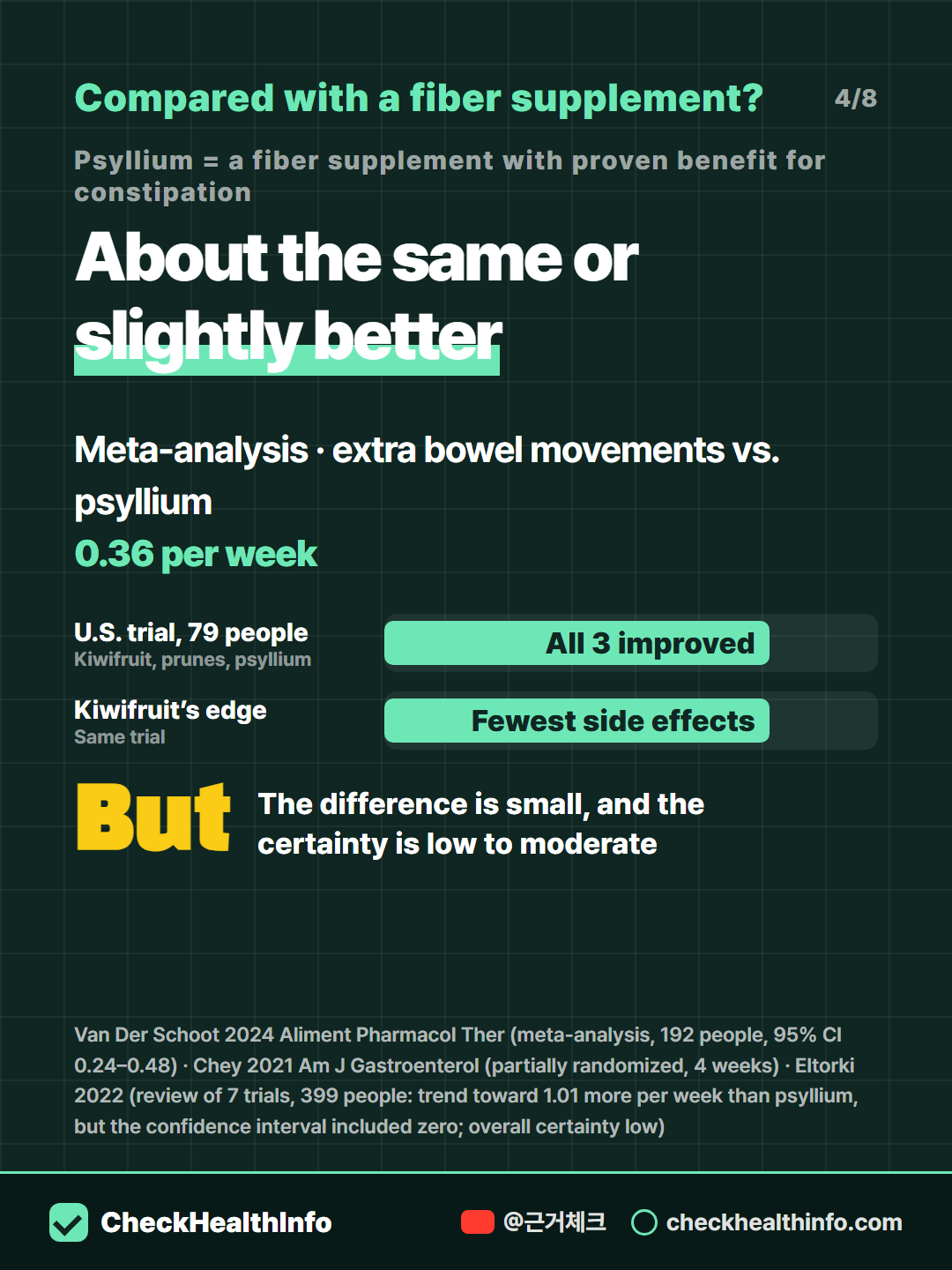
Psyllium — A soluble fiber supplement with proven benefit for constipation. Most kiwifruit trials compared against it.
Functional constipation · Constipation-predominant irritable bowel syndrome (IBS-C) — Functional constipation is long-term constipation with no other underlying cause. IBS-C is a bowel disorder in which constipation comes with abdominal pain.
Randomized crossover trial — The same people try both options (for example, 4 weeks of kiwifruit and 4 weeks of psyllium) in a randomly assigned order, and the results are compared.
95% confidence interval — The range in which the true value most likely lies. If it includes zero, there may be no real difference.
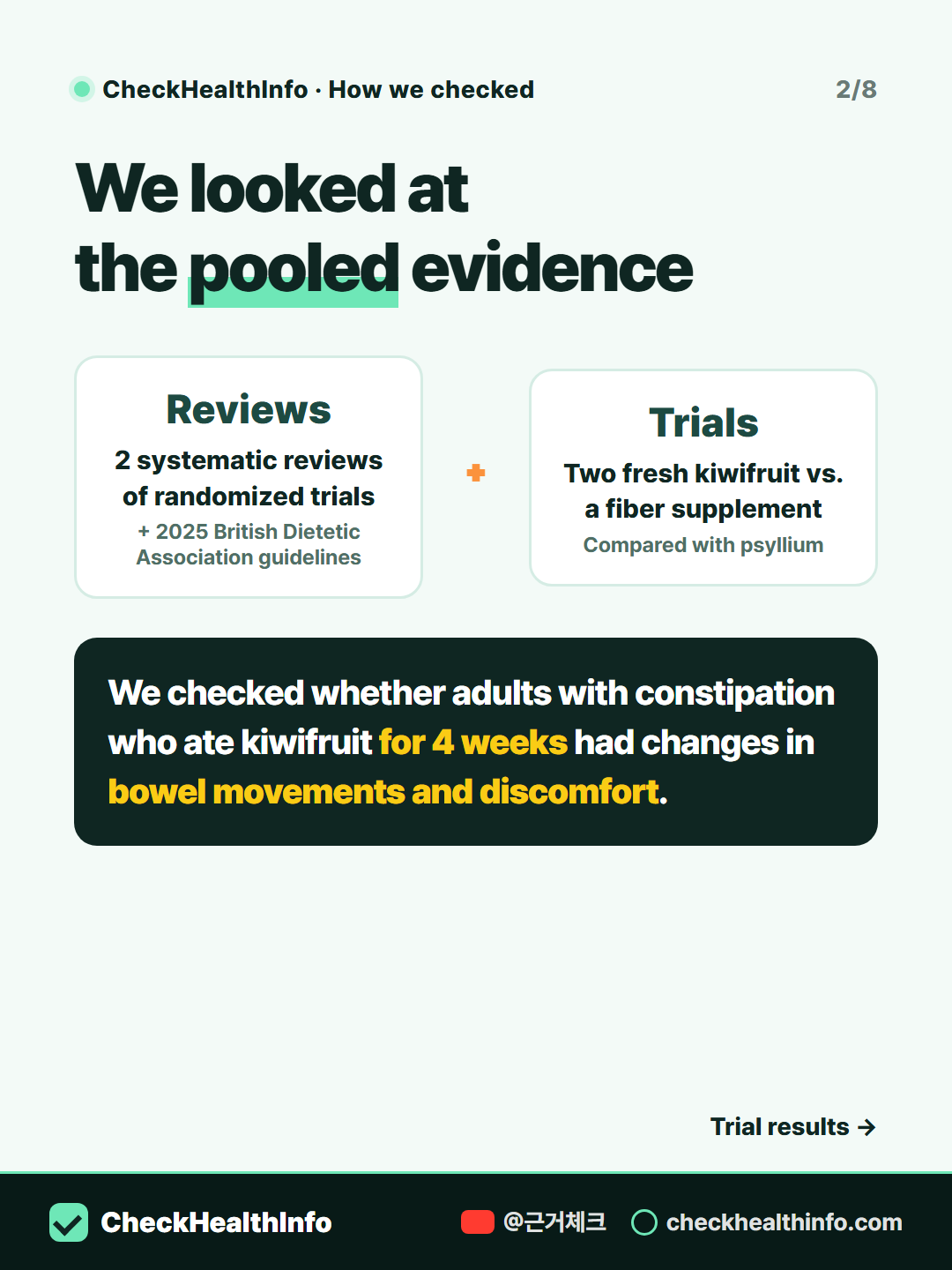
A recent news story suggested “two kiwifruit a day when it’s hard to go to the bathroom.” We checked the trial results to see whether two kiwifruit really help with constipation.
Verdict. “Eating two kiwifruit a day relieves constipation (bowel movement frequency and discomfort)”
Mostly true · Evidence grade B
In plain terms If you eat two fresh kiwifruit every day for 4 weeks, you may have one or two more complete bowel movements a week and feel a bit more comfortable. The benefit is similar to a fiber supplement — not large or certain.
- In a randomized crossover trial in New Zealand, Italy, and Japan, 60 people with functional constipation and 61 with IBS-C (plus 63 healthy people) took two green kiwifruit a day and 7.5 g of psyllium a day for 4 weeks each. On kiwifruit, complete spontaneous bowel movements rose by 1.53 per week (functional constipation) and 1.73 per week (IBS-C) compared with before treatment. Gastrointestinal comfort scores also improved, with no significant side effects. These numbers are changes from before treatment. The trial was mainly funded by a kiwifruit company, and company employees were among the authors. [4]
- In a 4-week trial in the United States (partially randomized), 79 people with chronic constipation were assigned to two green kiwifruit a day, 100 g of prunes a day, or 12 g of psyllium a day. Complete spontaneous bowel movements increased in all three groups, and the main outcome (the share of people gaining at least one more complete bowel movement a week) was similar. Kiwifruit improved stool consistency, straining, and bloating, and had the fewest side effects and the lowest dissatisfaction. [5]
- A small crossover trial found that two gold kiwifruit a day worked as well as fiber-matched psyllium (including 11 people with functional constipation and 13 with IBS-C; the kiwifruit company supplied the fruit and part of the funding). [6] In a small controlled trial in people with IBS-C who received kiwifruit (41 people) or placebo capsules (13 people), those eating kiwifruit had more bowel movements than before and shorter colon transit time (randomization not reported; the abstract gives no figures for the difference versus placebo). [7]
- A systematic review of seven randomized trials (399 people) found that kiwifruit tended to increase spontaneous bowel movements by 1.01 per week more than psyllium, but the 95% confidence interval (−0.02 to 2.04) included zero. The authors rated the overall certainty of the evidence as low. In the same review, kiwifruit extracts might increase spontaneous bowel movements compared with placebo (low certainty). [2]
- A meta-analysis of foods and constipation found that kiwifruit increased stool frequency by 0.36 bowel movements per week more than psyllium (95% confidence interval 0.24 to 0.48). That is a small difference. [3]
- The 2025 British Dietetic Association guidelines on diet for chronic constipation in adults included recommendation statements on kiwifruit for the first time (low-certainty evidence). [1]
Grade: The strongest evidence is systematic reviews and meta-analyses of randomized trials and a clinical guideline built on them, so the grade starts at A. Because the results are uncertain (one analysis had a confidence interval that included zero, and overall certainty was low), we lowered it one level to B. There is no large trial comparing fresh kiwifruit directly with a placebo, but kiwifruit was compared head-to-head with psyllium, a proven treatment, and did as well or slightly better, so we did not lower it further. We did not use the before-and-after increases (1.53 and 1.73 per week) as evidence of effect size, because they may include a placebo response. Note that under the international GRADE system, both the guideline and the systematic review rated the certainty as low, so our grade of B follows our rules but is one level more generous. Because the trials studied adults with constipation and the benefit is about one or two more bowel movements a week, the verdict is “Mostly true” rather than “True.”
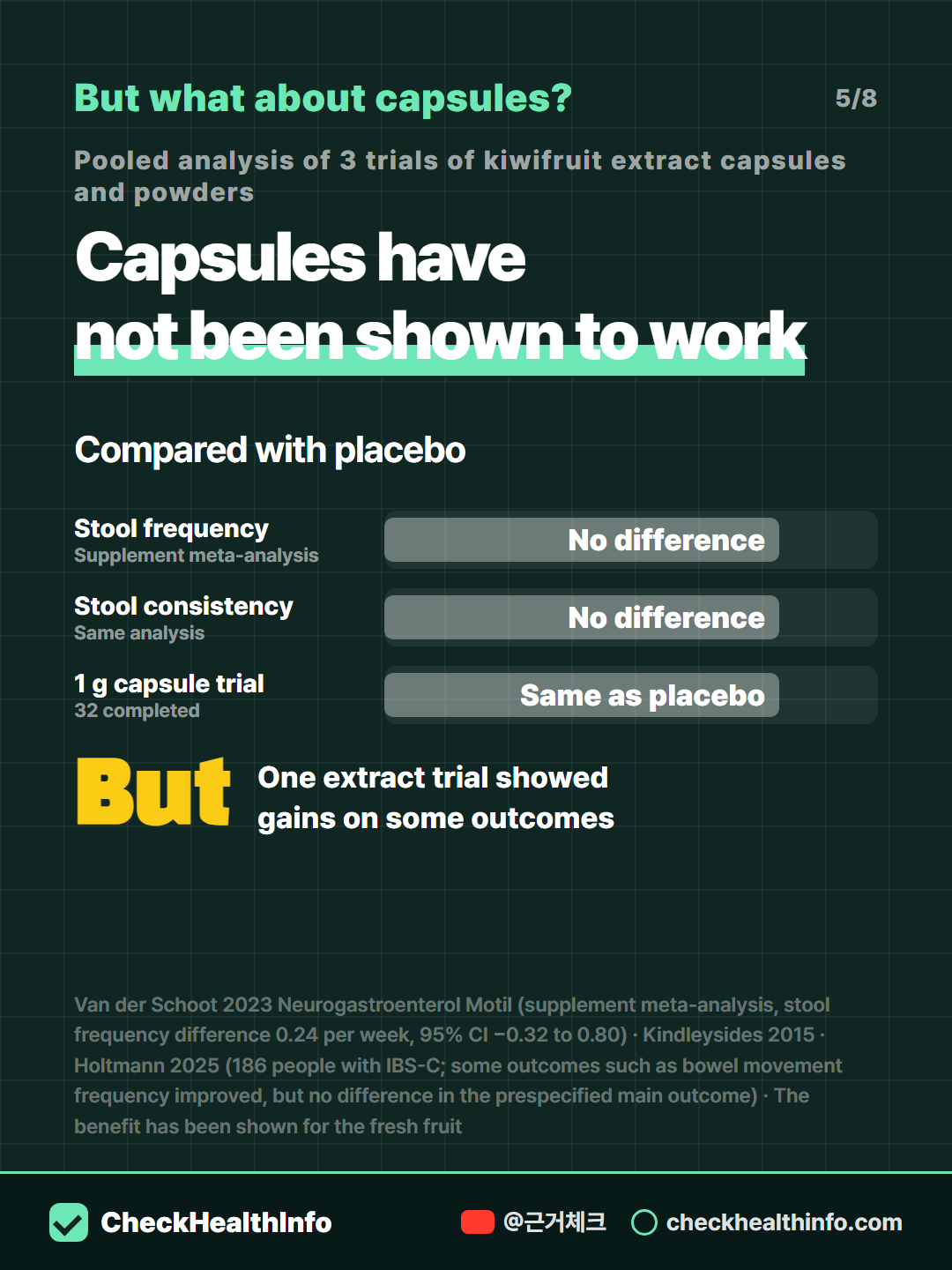
But what about capsules or powders? — Not shown to work
- An analysis pooling three trials of kiwifruit extract capsules and powders found no difference from control in stool frequency (0.24 per week; 95% confidence interval −0.32 to 0.80) or stool consistency. [8]
- In a crossover trial comparing 1 g a day of freeze-dried kiwifruit extract in capsules with placebo (32 people completed it), there was no difference in stool frequency, ease of passing stool, consistency, digestive symptoms, or quality of life. [9]
- However, in a placebo-controlled trial of kiwifruit extract in 186 people with IBS-C, some outcomes improved, such as the share of people with more spontaneous bowel movements (54% vs. 36% on placebo), but there was no difference in the prespecified main outcome (24% vs. 26%). [10]
- In plain terms: the benefit has been shown for the fresh fruit, and it is not yet clear that capsules or powders work the same way.
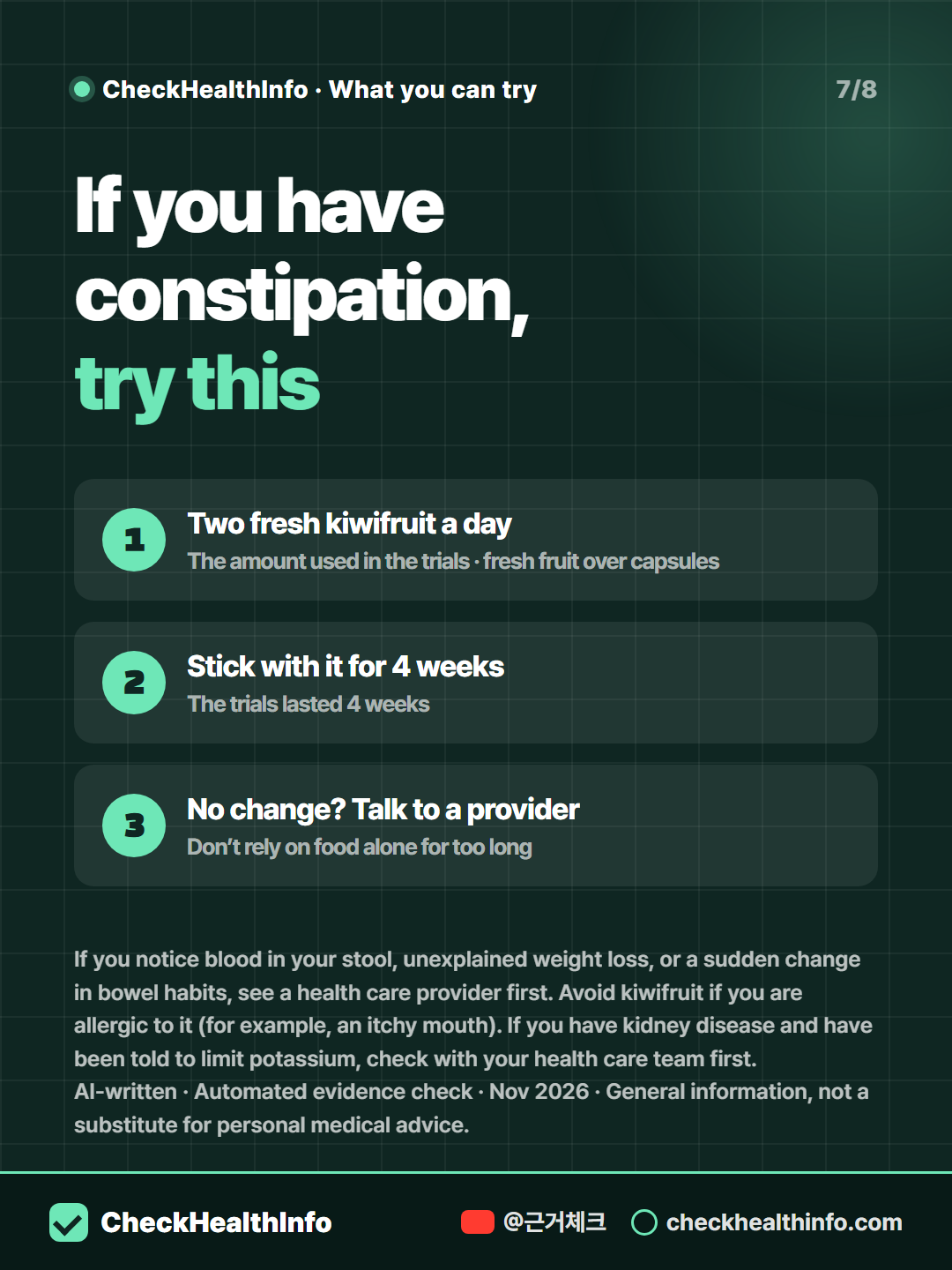
If you have constipation, here’s what you can try
- Two fresh kiwifruit a day — the amount used in the trials. Choose the fresh fruit over capsules. [4] [5]
- Stick with it for 4 weeks — the trials lasted 4 weeks.
- If nothing changes, talk to a health care provider — don’t rely on food alone for too long.
- If you notice blood in your stool, unexplained weight loss, or a sudden change in bowel habits, see a health care provider first. Avoid kiwifruit if you are allergic to it (for example, an itchy mouth). Kiwifruit is high in potassium, so if you have kidney disease and have been told to limit potassium, check with your health care team first.
Scope: This verdict covers fresh kiwifruit and constipation in adults (bowel movement frequency and abdominal discomfort). It does not cover laxatives or enemas, constipation in children, or how kiwifruit ranks against other fruits.
Limitations of this verdict
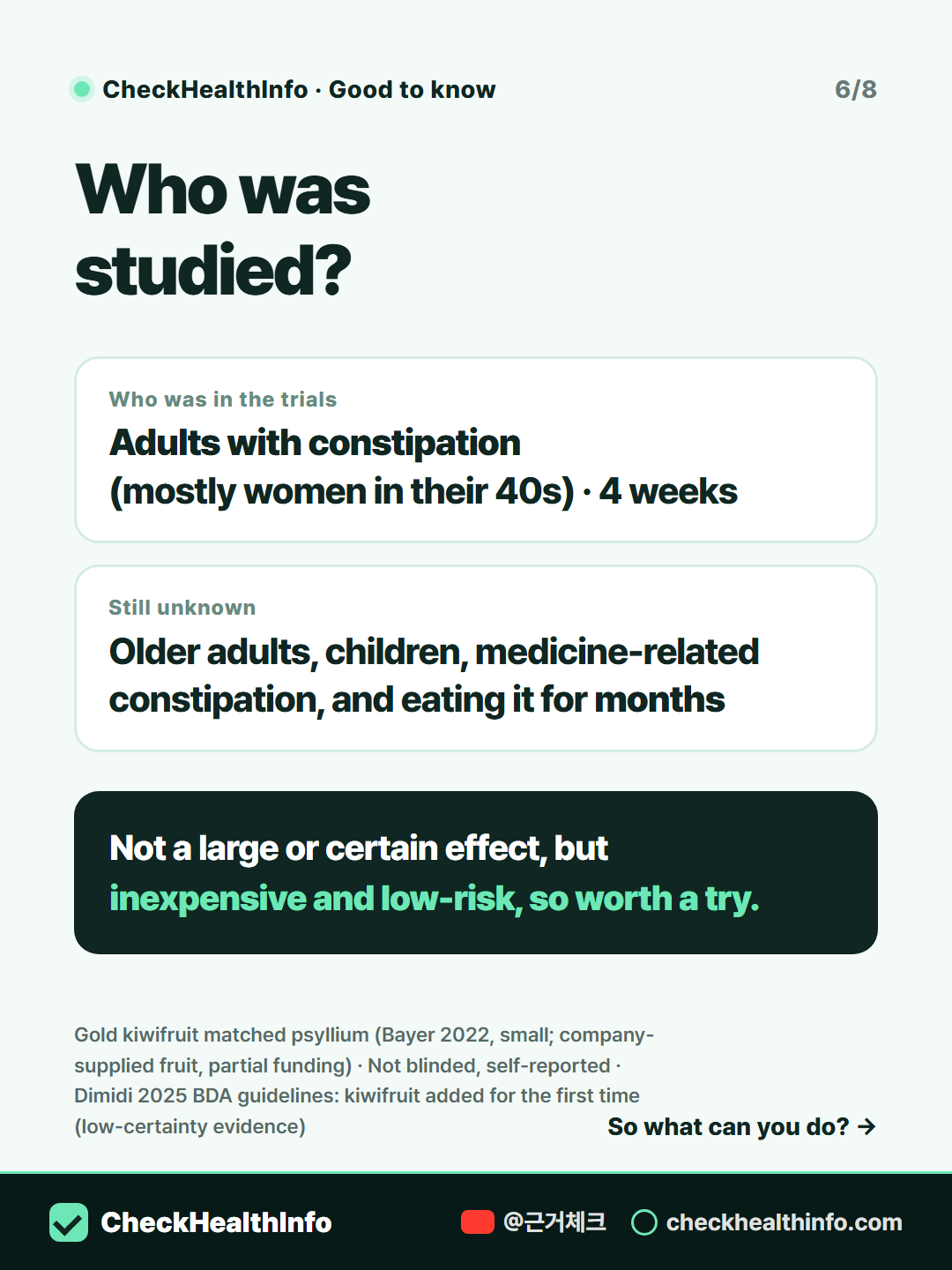
- The trials included adults with functional constipation or IBS-C (mostly women, average age in their 40s), and the treatment lasted 4 weeks. Older adults, children, constipation caused by medicines, and eating kiwifruit for several months were not studied separately.
- There is no large randomized trial comparing fresh kiwifruit directly with a placebo. In the largest trial, the increase of more than 1.5 per week was compared with before treatment, and the abstract does not report the difference versus psyllium.
- The largest trial was funded by a kiwifruit company and included company employees as authors, and the gold kiwifruit trial also received the fruit and part of its funding (10%) from the same company. The U.S. trial used partial randomization.
- In fresh kiwifruit trials, participants know what they are eating (no blinding), and bowel movements and discomfort are self-reported. Before-and-after increases may include a placebo response.
- This article was prompted by a news story. It does not evaluate any news outlet or person.
- Grades follow section 1 of our verdict criteria. We check for new studies in our monthly PubMed review, and any change in a verdict is recorded in our corrections log.
Card news
Video (in Korean)
References
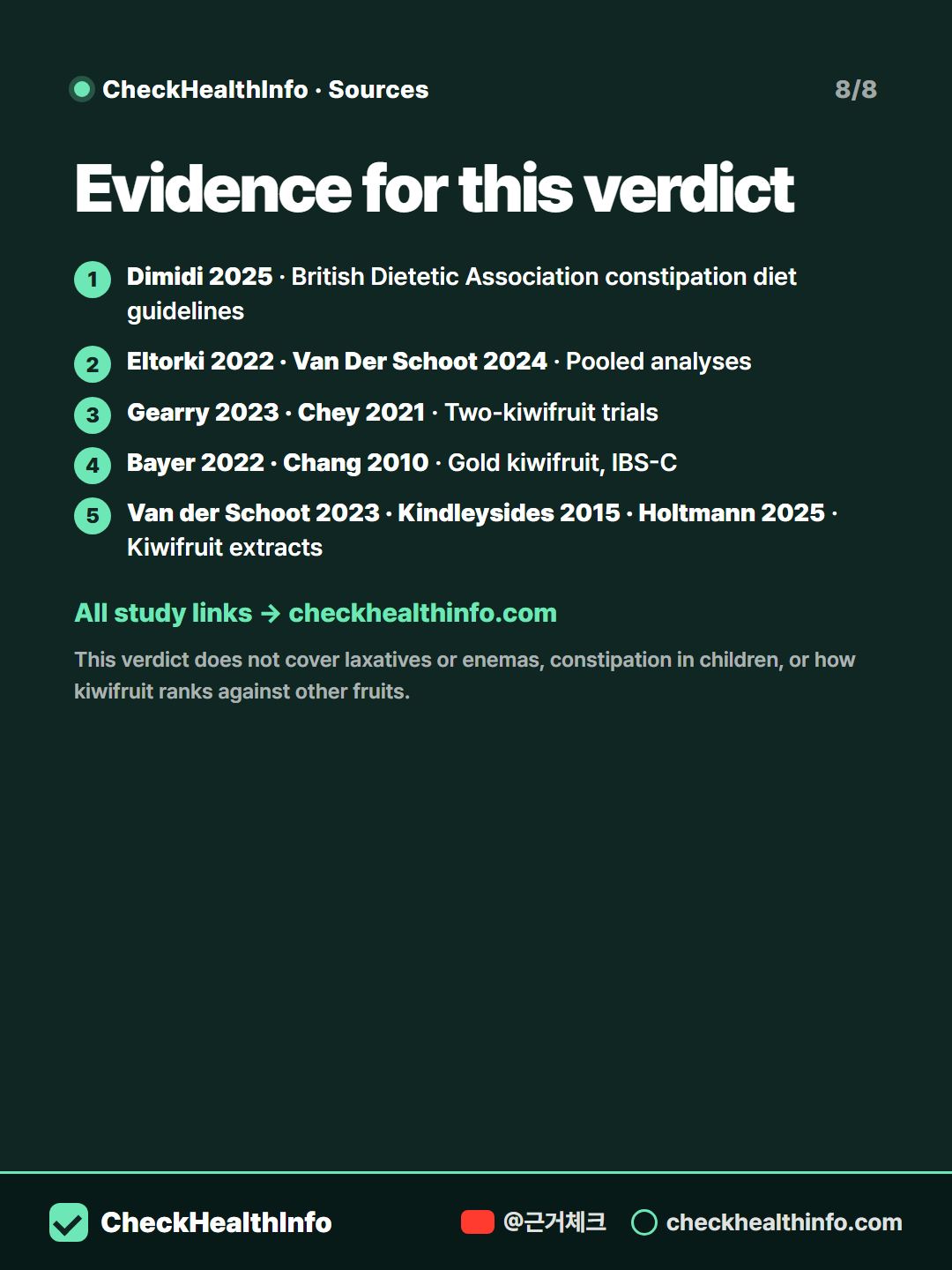
- Dimidi E, van der Schoot A, Barrett K, et al. British Dietetic Association Guidelines for the Dietary Management of Chronic Constipation in Adults. Neurogastroenterol Motil 2025;37(12):e70173. PMID 41081381. PubMed abstract · Full article · Free full text
- Eltorki M, Leong R, Ratcliffe EM. Kiwifruit and Kiwifruit Extracts for Treatment of Constipation: A Systematic Review and Meta-Analysis. Can J Gastroenterol Hepatol 2022;2022:7596920. PMID 36247043. PubMed abstract · Full article · Free full text
- Van Der Schoot A, Katsirma Z, Whelan K, et al. Systematic review and meta-analysis: Foods, drinks and diets and their effect on chronic constipation in adults. Aliment Pharmacol Ther 2024;59(2):157-174. PMID 37905980. PubMed abstract · Full article
- Gearry R, Fukudo S, Barbara G, et al. Consumption of 2 Green Kiwifruits Daily Improves Constipation and Abdominal Comfort-Results of an International Multicenter Randomized Controlled Trial. Am J Gastroenterol 2023;118(6):1058-1068. PMID 36537785. PubMed abstract · Full article · Free full text
- Chey SW, Chey WD, Jackson K, et al. Exploratory Comparative Effectiveness Trial of Green Kiwifruit, Psyllium, or Prunes in US Patients With Chronic Constipation. Am J Gastroenterol 2021;116(6):1304-1312. PMID 34074830. PubMed abstract · Full article
- Bayer SB, Heenan P, Frampton C, et al. Two Gold Kiwifruit Daily for Effective Treatment of Constipation in Adults-A Randomized Clinical Trial. Nutrients 2022;14(19). PMID 36235798. PubMed abstract · Full article · Free full text
- Chang CC, Lin YT, Lu YT, et al. Kiwifruit improves bowel function in patients with irritable bowel syndrome with constipation. Asia Pac J Clin Nutr 2010;19(4):451-7. PMID 21147704. PubMed abstract
- van der Schoot A, Creedon A, Whelan K, et al. The effect of food, vitamin, or mineral supplements on chronic constipation in adults: A systematic review and meta-analysis of randomized controlled trials. Neurogastroenterol Motil 2023;35(11):e14613. PMID 37243443. PubMed abstract · Full article
- Kindleysides S, Kuhn-Sherlock B, Yip W, et al. Encapsulated green kiwifruit extract: a randomised controlled trial investigating alleviation of constipation in otherwise healthy adults. Asia Pac J Clin Nutr 2015;24(3):421-9. PMID 26420182. PubMed abstract · Full article
- Holtmann G, Talley NJ, Nandurkar S, et al. Randomized, Placebo-Controlled, Double-Blind 8-Week Trial on the Efficacy of A Proprietary Kiwifruit Extract on Constipation-Predominant Irritable Bowel Syndrome. JGH Open 2025;9(8):e70250. PMID 40786128. PubMed abstract · Full article · Free full text
This is general information, not medical advice, and it does not replace diagnosis or treatment from your own clinician. If you notice blood in your stool, unexplained weight loss, or a sudden change in bowel habits, see a health care provider first. Avoid kiwifruit if you are allergic to it, and if you have kidney disease and have been told to limit potassium, check with your health care team first.