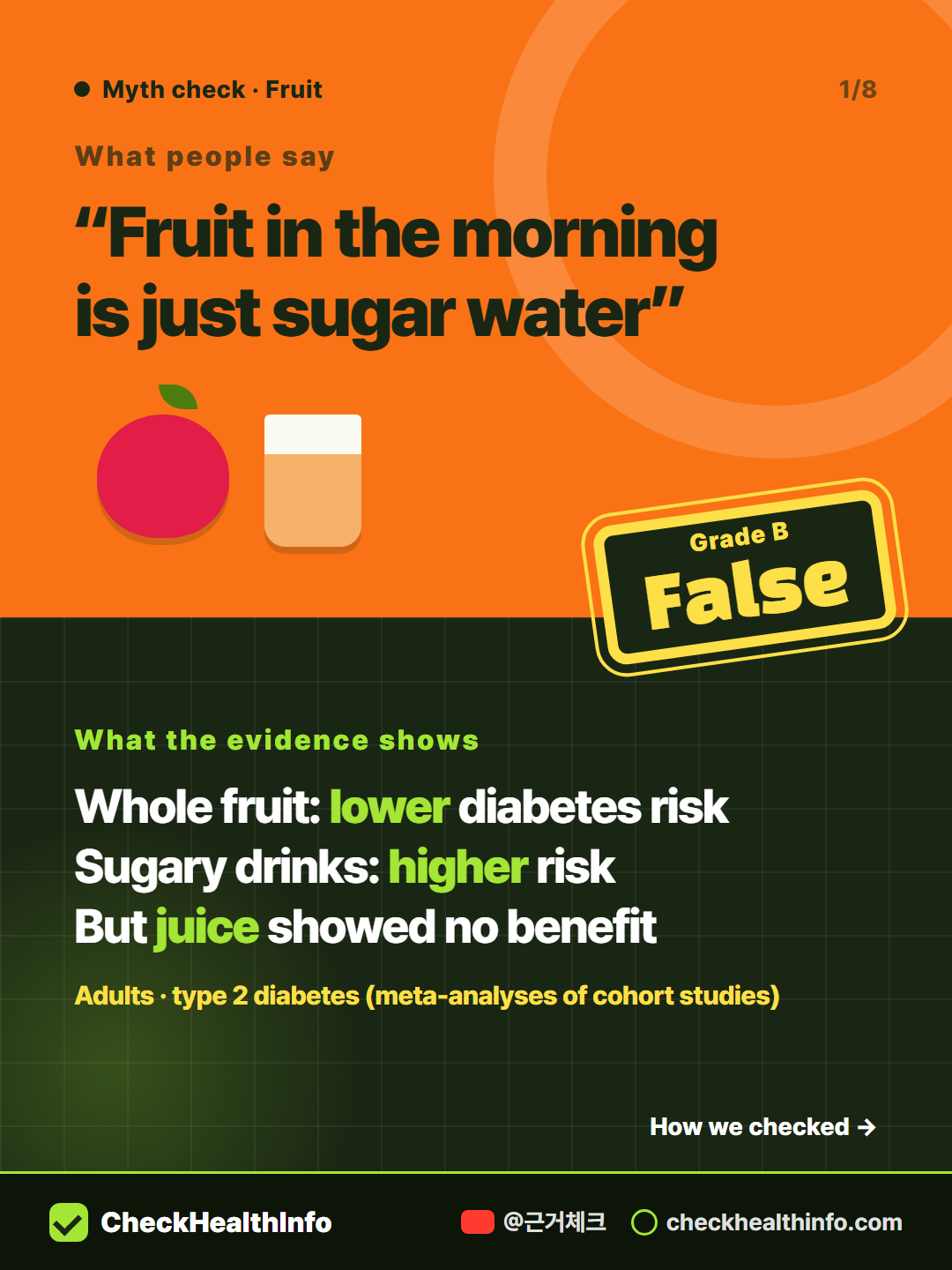
Is eating fruit in the morning the same as drinking sugar water?
Fruit contains sugar, so is eating fruit the same for your body as drinking sugar water (sugar-sweetened beverages)? What about blending it or drinking it as juice?

We checked this verdict against 6 sources, such as published studies and clinical guidelines. · How checked: AI-drafted · automated evidence checks
Verdicts at a glance
| Claim | Verdict |
|---|---|
| Eating whole fruit affects diabetes risk the same way as drinking sugar-sweetened beverages (sugar water) | False · Evidence grade B |
Bottom line — Across studies that followed people for years and looked at fruit and sugary drinks separately, eating whole fruit was linked with a slightly lower risk of type 2 diabetes, while sugary drinks were linked with a higher risk. So the claim that “eating whole fruit affects diabetes risk the same way as drinking sugar water” is rated “False.” Here is what the evidence shows: fruit does contain sugar, but whole fruit and sugary drinks pointed in opposite directions (all observational studies). Fruit juice, however, did not show the benefit seen with whole fruit. We did not rate the idea that fruit is worse “in the morning, on an empty stomach,” because we found no studies comparing the time of day.
Sugar-sweetened beverages (sugary drinks) — Sodas and other drinks sweetened with added sugars.
Meta-analysis — An analysis that pools the results of several studies into a single estimate.
Cohort study — An observational study that follows many people over a long time. It shows that two things go together, but it is less certain than a randomized trial about cause and effect.
Relative risk / hazard ratio — Compares how often a disease develops in two groups. A value of 1 means no difference; less than 1 means less often, more than 1 means more often.
95% confidence interval — The range in which the true value is likely to lie. If it crosses 1, we cannot be sure there is a difference.
Claim. “Eating whole fruit affects diabetes risk the same way as drinking sugar-sweetened beverages (sugar water)”
False · Evidence grade B
In plain terms Fruit does contain sugar, but whole fruit and sugary drinks were linked with diabetes risk in opposite directions. That is why we rated the claim “False.”
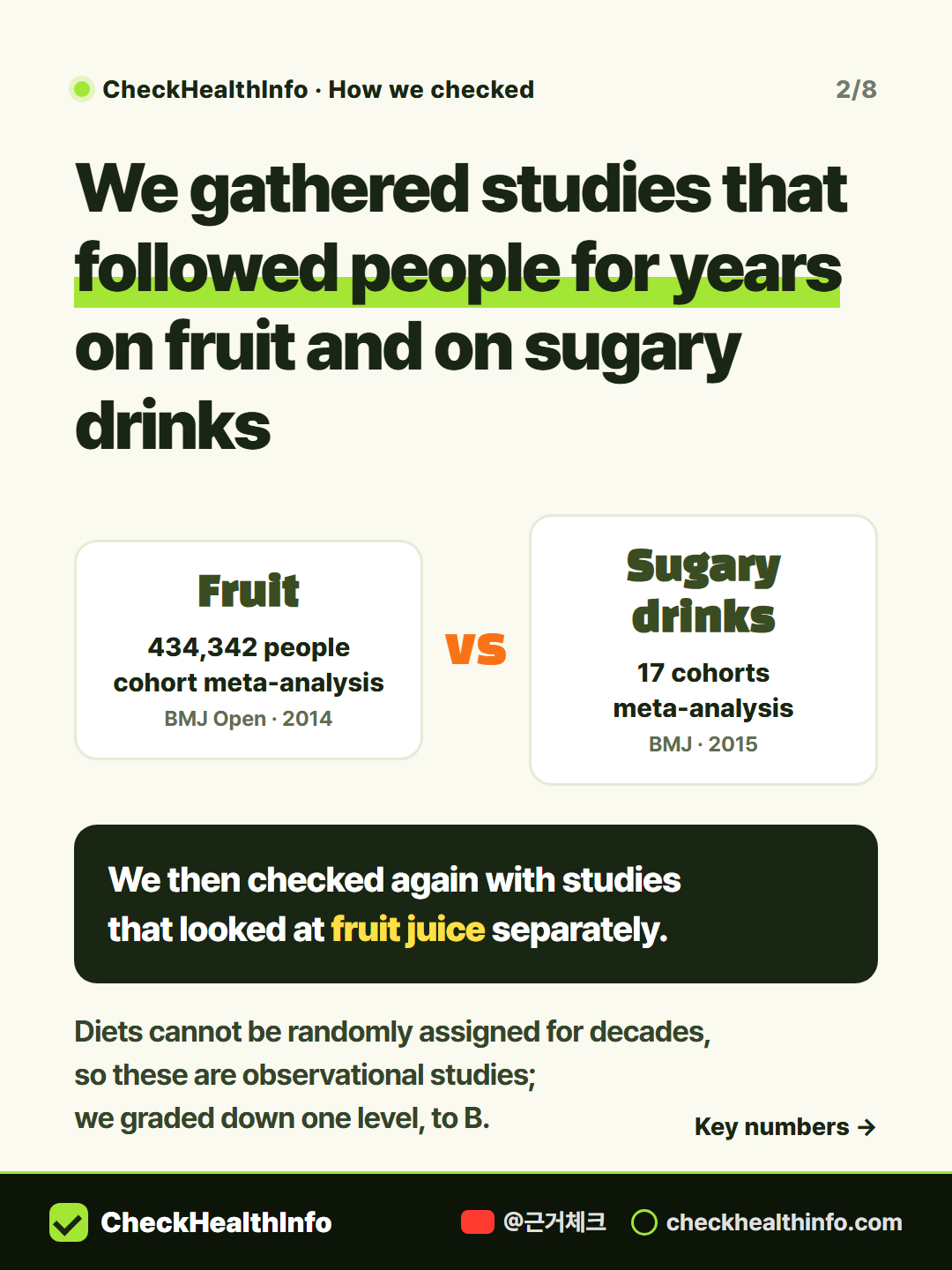
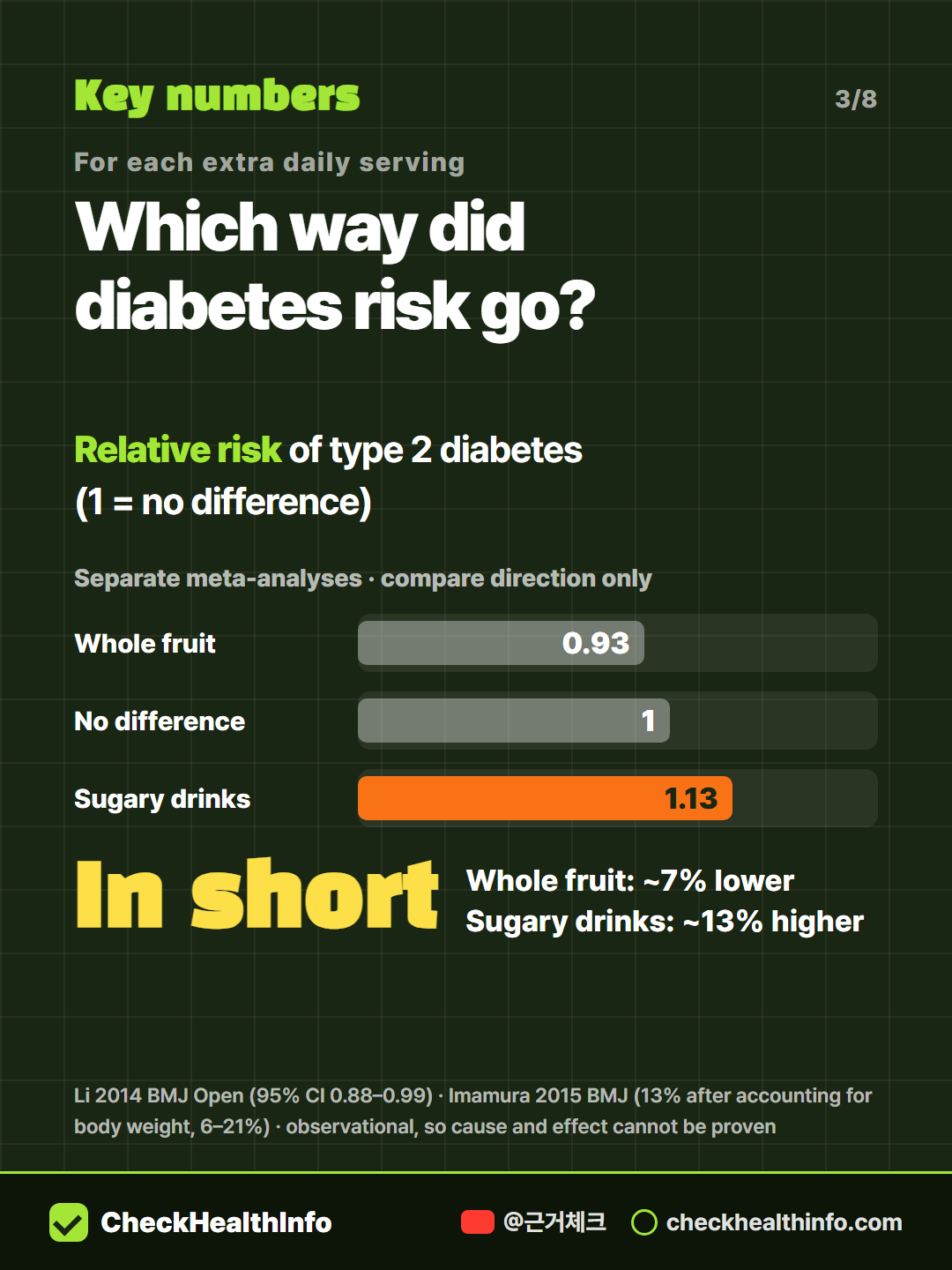
- In a meta-analysis of prospective cohort studies (434,342 people, 24,013 with diabetes), each extra daily serving of fruit was linked with a 0.93 relative risk of type 2 diabetes (95% confidence interval 0.88 to 0.99), and results were consistent across studies. In plain terms, people who ate one more serving of fruit a day had about a 7% lower relative risk of diabetes (these are observational studies, so we cannot say for certain that fruit was the cause). [1]
- In a meta-analysis of 17 cohorts, each extra daily serving of sugar-sweetened beverages was linked with an 18% higher risk of diabetes (95% confidence interval 9% to 28%), and a 13% higher risk (6% to 21%) after accounting for body weight. In plain terms, people who drank one more sugary drink a day had about a 13% higher relative risk of diabetes, even after accounting for body weight. [2]
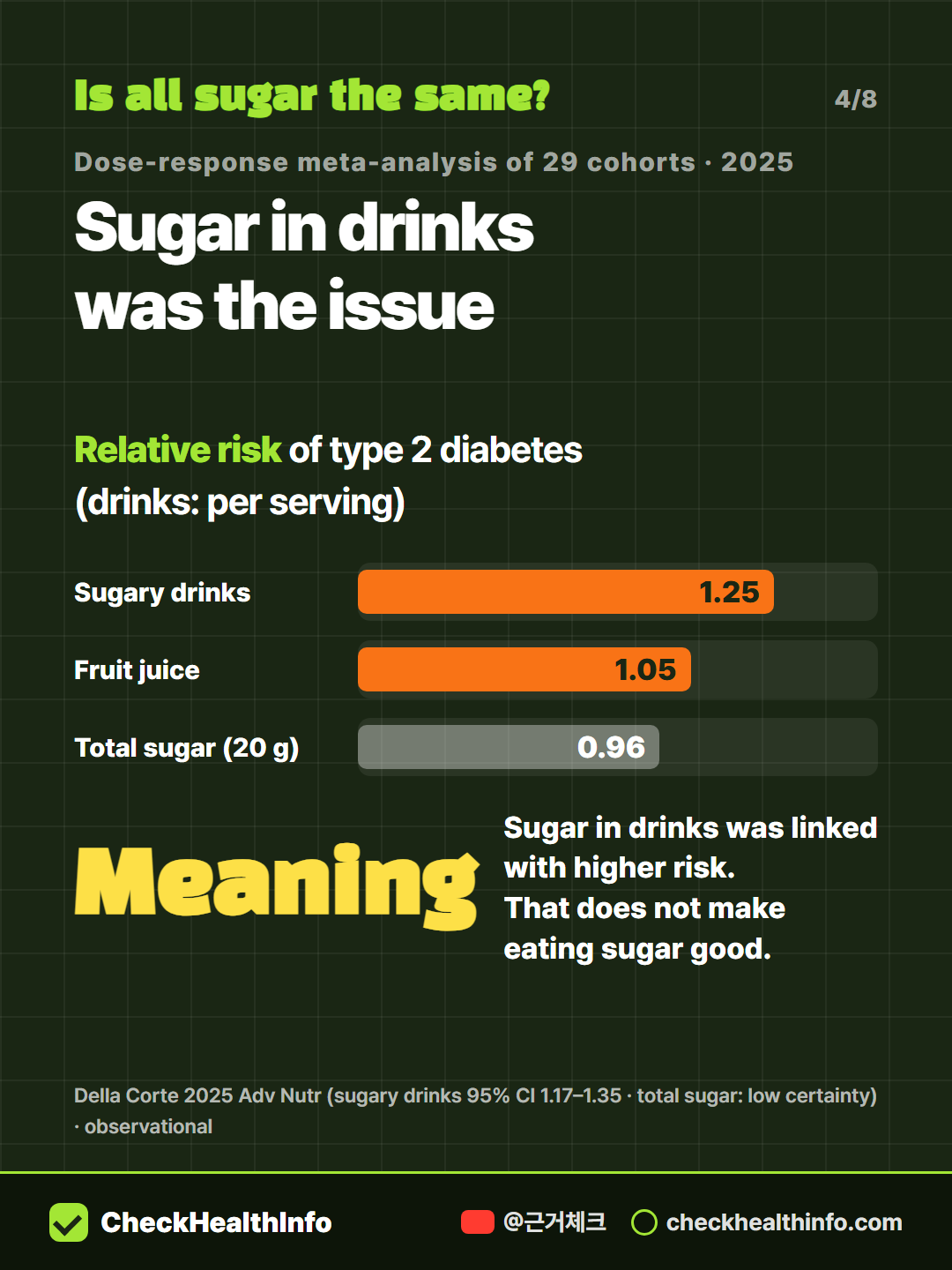
- In a 2025 dose-response meta-analysis of 29 cohorts, each serving of sugar-sweetened beverages was linked with a relative risk of 1.25 (1.17 to 1.35). By contrast, total sugar from the diet as a whole (0.96 per 20 g a day; low certainty) and sucrose (table sugar; 0.95, moderate certainty) were not linked with higher risk. The authors concluded that it was sugar consumed in drinks that was linked with diabetes risk. This does not mean that eating sugar is good for you. [3]
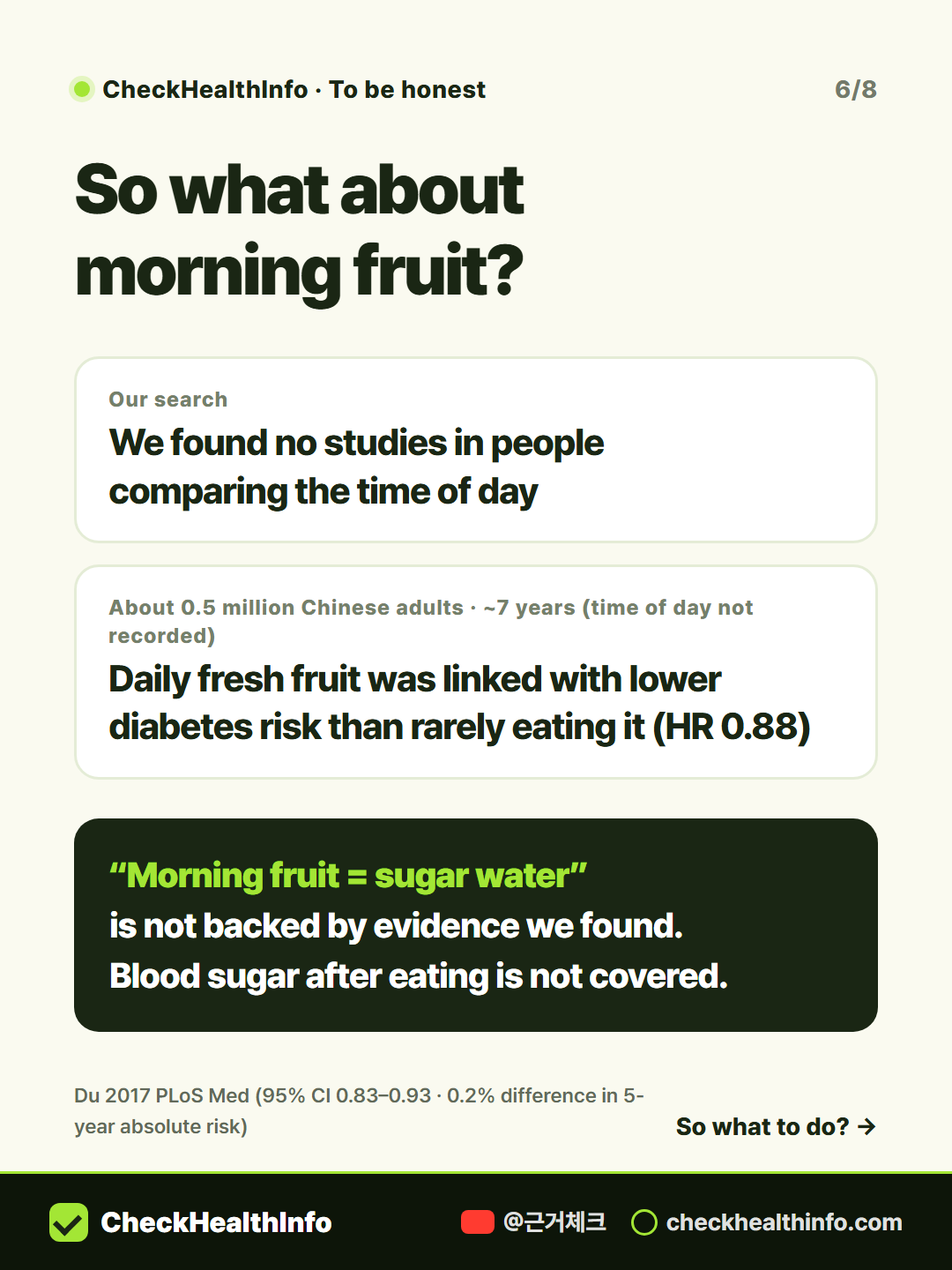
- In a Chinese cohort of 482,591 adults aged 30 to 79 followed for about 7 years, people who ate fresh fruit every day had a lower risk of diabetes than those who rarely or never did (hazard ratio 0.88, 95% confidence interval 0.83 to 0.93). The difference in absolute 5-year risk, however, was small: 0.2%. [6]
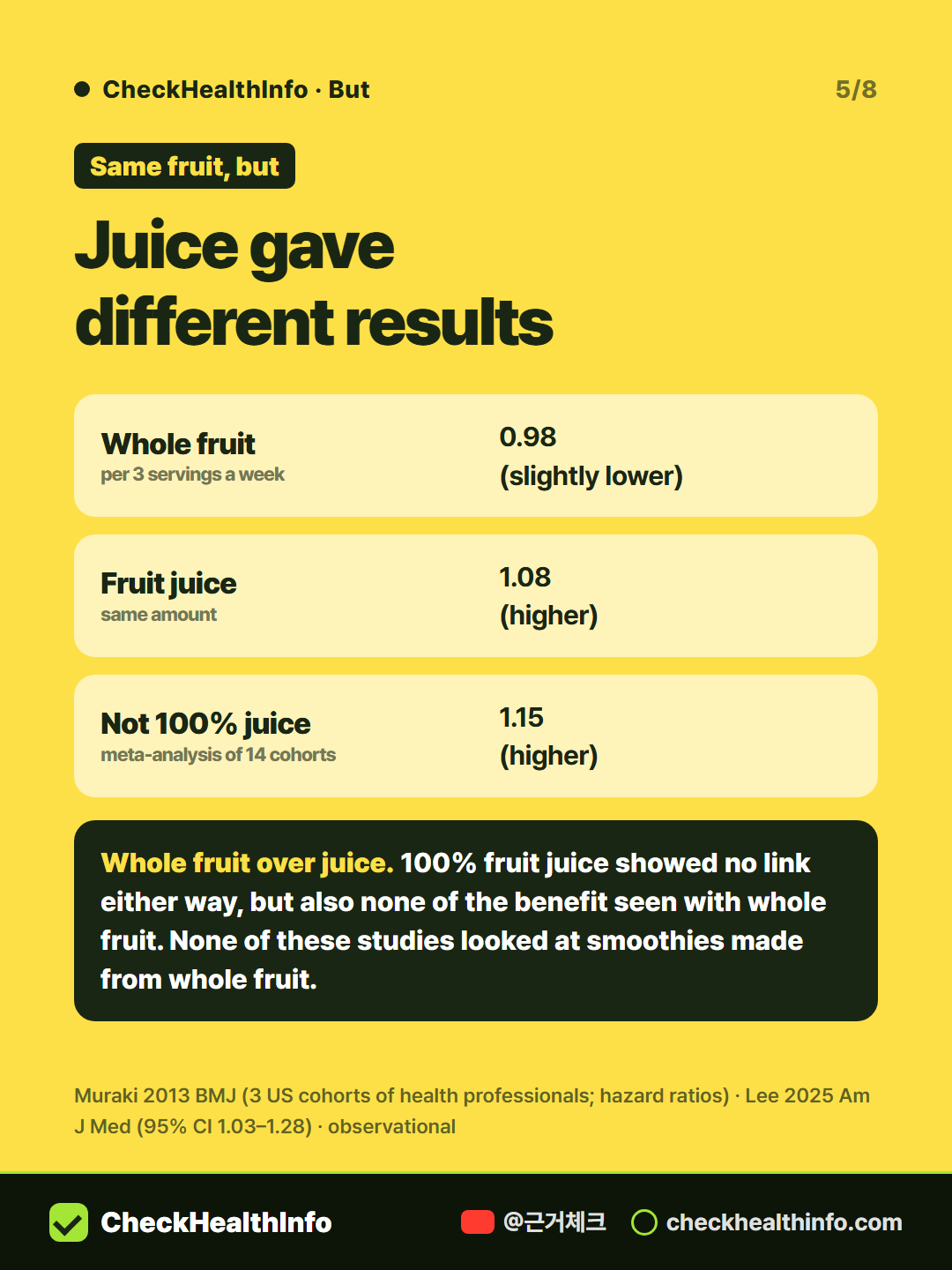
The same fruit gave different results when people drank it as juice. In three cohorts of about 187,000 US health professionals, every 3 servings a week of whole fruit was linked with a slightly lower risk of diabetes (hazard ratio 0.98, 95% confidence interval 0.97 to 0.99), but the same amount of fruit juice was linked with a higher risk (1.08, 1.05 to 1.11). Blueberries (0.74), grapes and raisins (0.88), and apples and pears (0.93) were on the lower-risk side, and cantaloupe (1.10) on the higher-risk side; results differed from fruit to fruit. [4]
Meta-analyses of fruit juice alone gave mixed results. In the sugary-drink meta-analysis, fruit juice was linked with a 7% (1% to 14%) higher risk of diabetes per serving after accounting for body weight, but the authors noted that this finding may have been affected by bias. [2] In a 2025 meta-analysis of 14 prospective cohort studies, fruit juice overall was not significantly linked with diabetes (1.06, 0.98 to 1.15); 100% fruit juice showed no link, while juice that was not 100% fruit juice was linked with a higher risk (1.15, 1.03 to 1.28). The link between fruit juice and diabetes was stronger in Asian populations (1.17, 1.02 to 1.34). [5]
In plain terms, juice is not as good as whole fruit, and juice that is not 100% juice was on the higher-risk side. None of these studies looked separately at smoothies made by blending whole fruit.
In our search, we found no studies in people comparing fruit eaten at different times of day (morning or on an empty stomach versus other times). So the idea that “fruit in the morning is the same as sugar water” is not supported by evidence we could find, and this verdict does not rate the time-of-day question. It also does not cover blood sugar changes right after eating (the short-term blood sugar response).
Tips for eating fruit
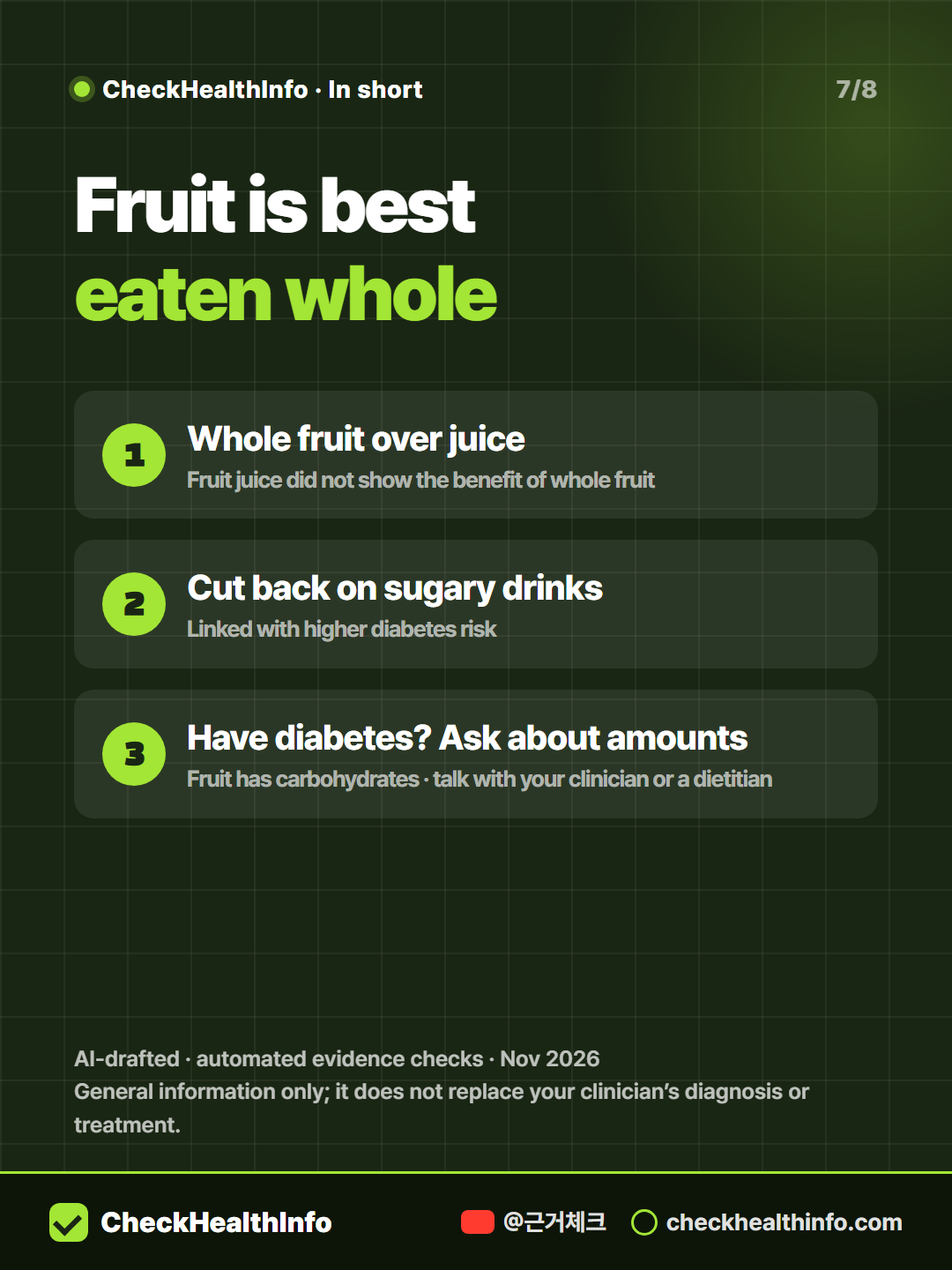
- Choose whole fruit over juice — Whole fruit was linked with lower diabetes risk; fruit juice did not show that benefit.
- Cut back on sugary drinks — Sugar-sweetened beverages were linked with higher diabetes risk, even after accounting for body weight.
- If you have diabetes, ask about amounts — Fruit also contains carbohydrates, so talk with your clinician or a dietitian about how much and what kinds of fruit to eat each day.
Scope: This verdict covers only how whole fruit, sugar-sweetened beverages and fruit juice consumed by adults relate to the risk of developing type 2 diabetes. It does not cover the time of day, blood sugar right after eating, or diabetes medicines or insulin.
Limitations of this verdict
- All of these are observational studies, so we cannot fully rule out the effect of other healthy habits among people who eat a lot of fruit (people who drink many sugary drinks may also live differently). Intake was mostly self-reported on questionnaires.
- No single analysis compared fruit and sugary drinks head to head, so this is a comparison between separate meta-analyses. Still, the confidence intervals did not overlap and the results pointed in opposite directions. The 7% and 13% figures also use different definitions of a “serving,” so their sizes cannot be compared.
- Results for sugar-sweetened beverages varied a lot between studies (I² 79% to 89%). The authors found no clear source of bias, and the studies pointed in the same direction.
- A relative risk compares how common something was; the difference in any one person’s absolute chance of getting diabetes is much smaller (0.2% over 5 years in the Chinese cohort).
- In the Chinese cohort, people who already had diabetes and ate more fruit also had a lower risk of death (hazard ratio 0.83 per 100 g a day), but this is an observational finding that may reflect changes in diet after a diabetes diagnosis. [6]
- The data come mainly from the US, Europe and China; we did not find studies of Korean adults specifically.
- The grade follows section 1 of our rating method. We check for new studies in our monthly PubMed review, and if the verdict changes, we record it in our corrections log.
Card news
Video (in Korean)
References
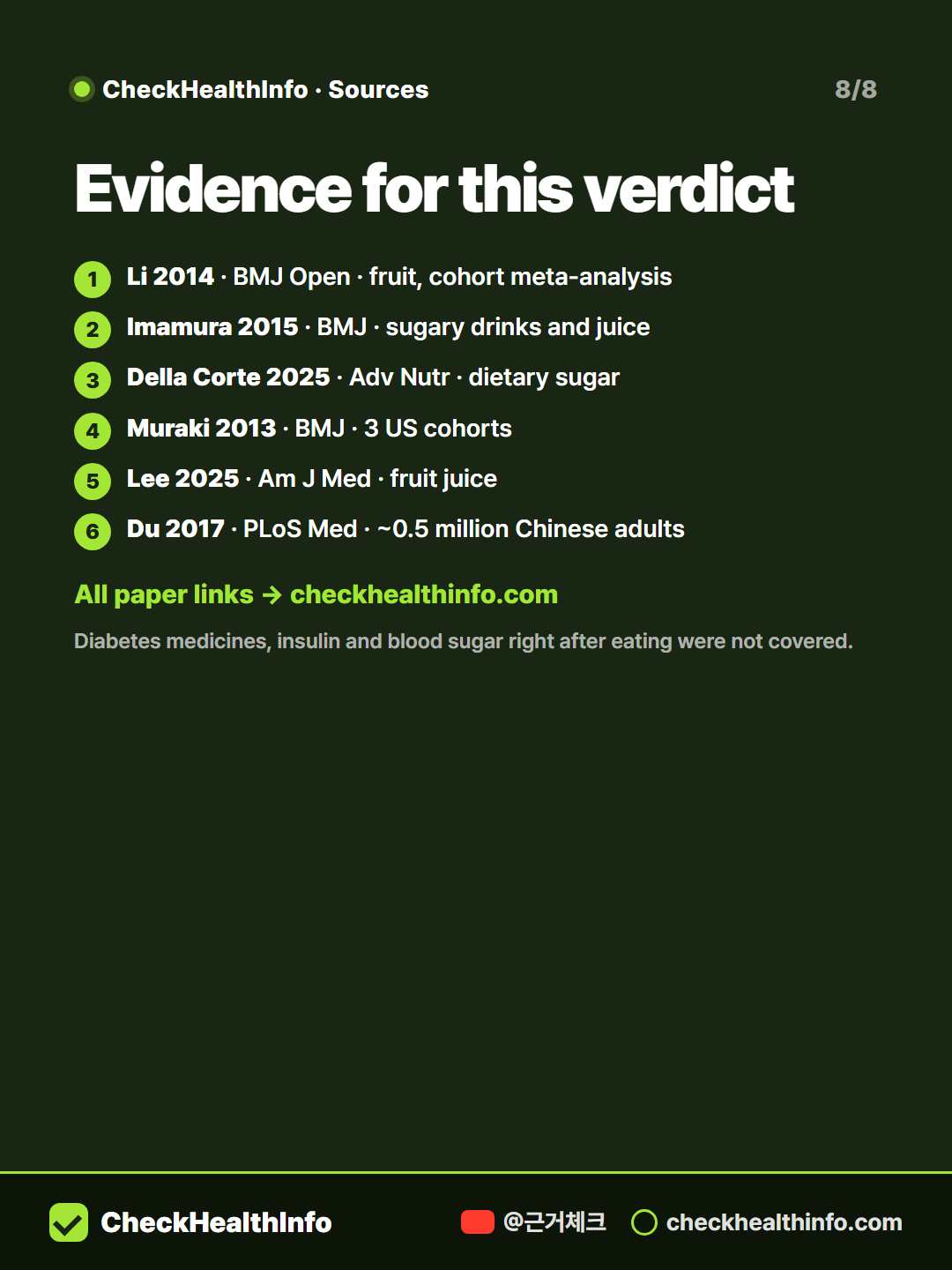
- Li M, Fan Y, Zhang X, et al. Fruit and vegetable intake and risk of type 2 diabetes mellitus: meta-analysis of prospective cohort studies. BMJ Open 2014;4(11):e005497. PMID 25377009. PubMed abstract · Full article · Free full text
- Imamura F, O'Connor L, Ye Z, et al. Consumption of sugar sweetened beverages, artificially sweetened beverages, and fruit juice and incidence of type 2 diabetes: systematic review, meta-analysis, and estimation of population attributable fraction. BMJ 2015;351:h3576. PMID 26199070. PubMed abstract · Full article · Free full text
- Della Corte KA, Bosler T, McClure C, et al. Dietary Sugar Intake and Incident Type 2 Diabetes Risk: A Systematic Review and Dose-Response Meta-Analysis of Prospective Cohort Studies. Adv Nutr 2025;16(5):100413. PMID 40122386. PubMed abstract · Full article · Free full text
- Muraki I, Imamura F, Manson JE, et al. Fruit consumption and risk of type 2 diabetes: results from three prospective longitudinal cohort studies. BMJ 2013;347:f5001. PMID 23990623. PubMed abstract · Full article · Free full text
- Lee CW, Myung SK. Consumption of Fruit Juice and Risk of Type 2 Diabetes Mellitus: A Systematic Review and Meta-Analysis of Prospective Cohort Studies. Am J Med 2025;138(10):1428-1437. PMID 40393612. PubMed abstract · Full article
- Du H, Li L, Bennett D, et al. Fresh fruit consumption in relation to incident diabetes and diabetic vascular complications: A 7-y prospective study of 0.5 million Chinese adults. PLoS Med 2017;14(4):e1002279. PMID 28399126. PubMed abstract · Full article · Free full text
General information only, not medical advice. It does not replace your own clinician’s diagnosis or treatment. If you have diabetes, talk with your clinician or a dietitian about how much fruit to eat.