Water before brushing in the morning: are you swallowing mouth bacteria?
If you drink water before brushing your teeth in the morning, do you swallow the bacteria that built up overnight, and is that harmful?

We checked this verdict against 4 sources, such as published studies and clinical guidelines. · How checked: Operator-approved
Verdicts at a glance
| Claim | Verdict |
|---|---|
| Drinking water before brushing your teeth in the morning means swallowing the bacteria that built up overnight, and that is harmful | Insufficient evidence · Evidence grade D |
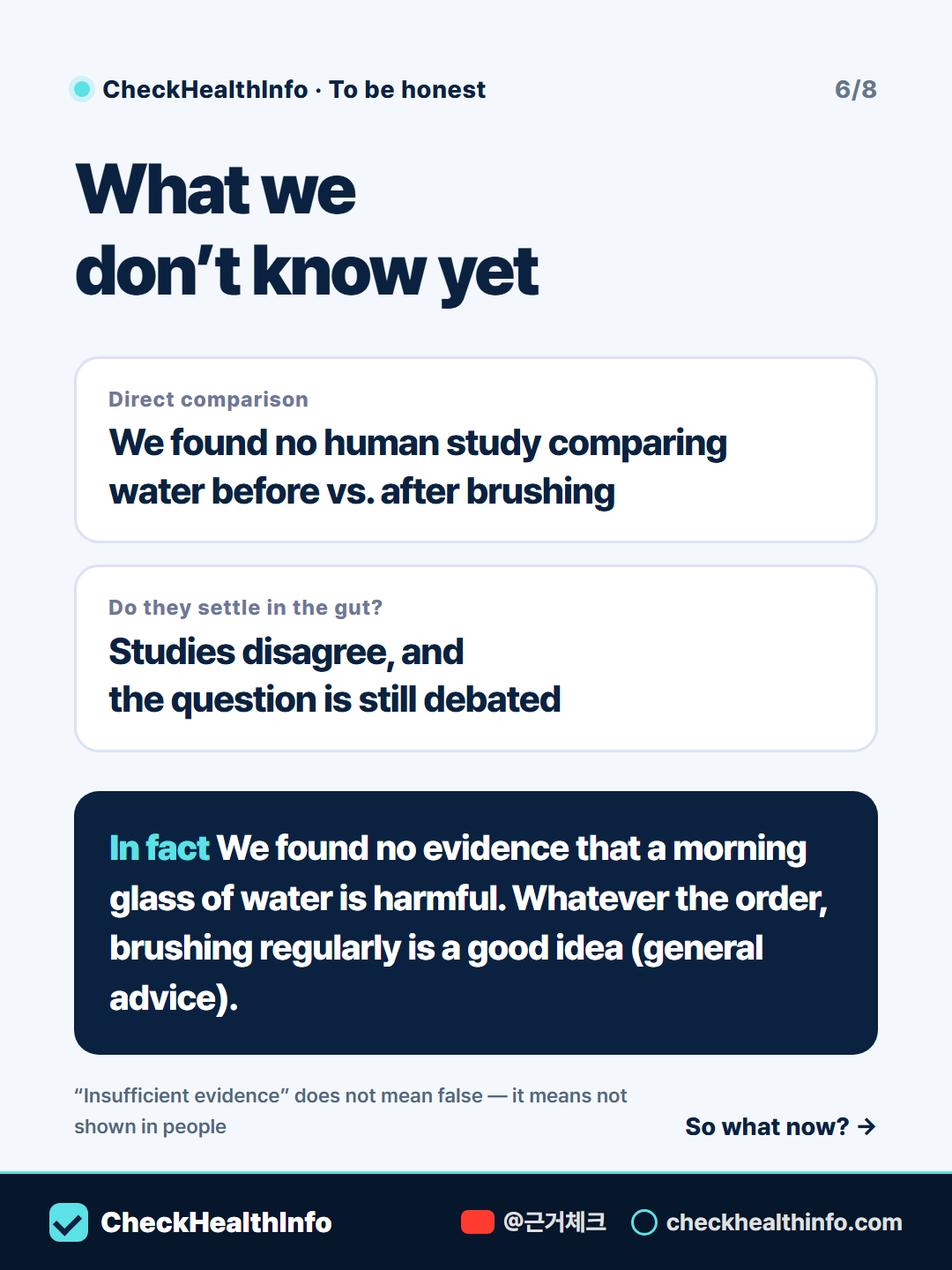
Bottom line — We found no evidence that drinking water before brushing your teeth in the morning is harmful. Because saliva connects the mouth and the gut, swallowing mouth bacteria is not something that happens only with a morning glass of water. So the claim that “drinking water before brushing your teeth in the morning means swallowing the bacteria that built up overnight, and that is harmful” is rated “Insufficient evidence.” That does not mean it is false; it means it has not been shown in people. Whatever the order, brushing regularly is a good idea (general advice).
Observational study — A study that looks at people as they are, without assigning them to do anything. It can show associations but cannot firmly establish cause and effect.
Strain — A genetically distinct lineage within a bacterial species. Finding the same strain in the mouth and the gut suggests it may have traveled from the mouth to the gut.
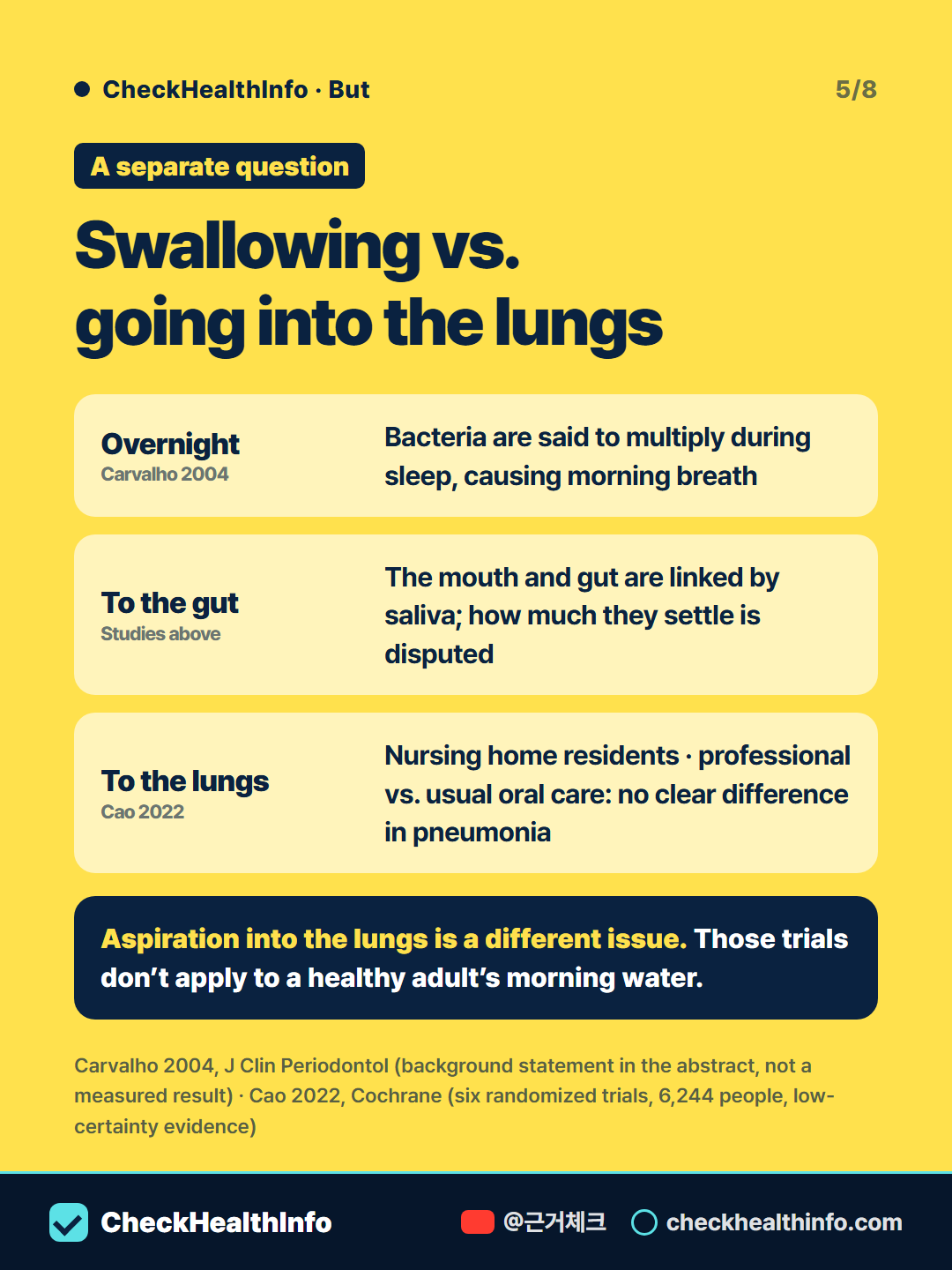
Aspiration — When saliva or food goes down the airway into the lungs instead of down the esophagus. This is a different issue from swallowing into the stomach and gut.
Relative risk — A number comparing two groups. A value of 1 means no difference; below 1 means the outcome happened less often in the group that got the intervention.
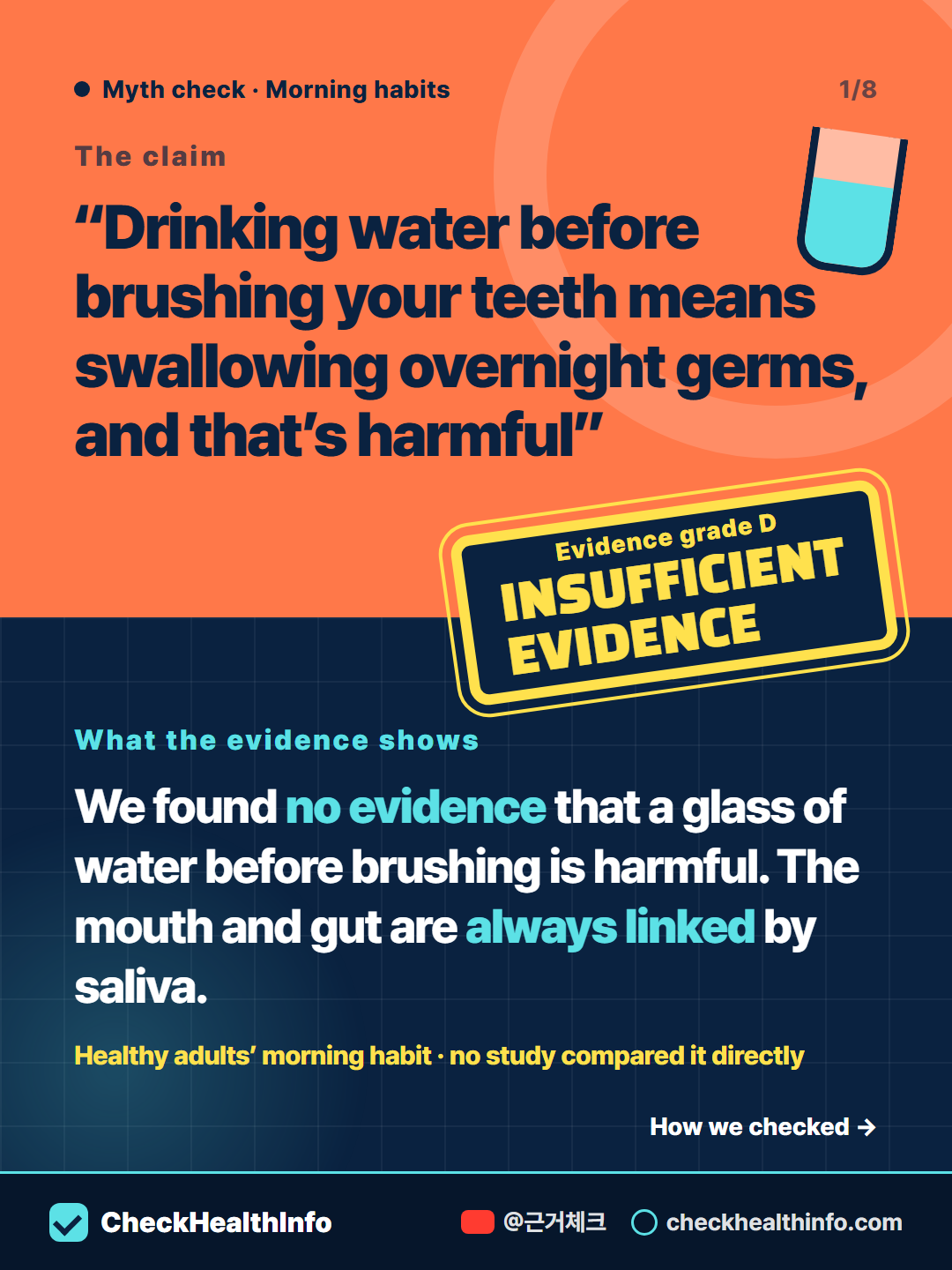
Claim. “Drinking water before brushing your teeth in the morning means swallowing the bacteria that built up overnight, and that is harmful”
Insufficient evidence · Evidence grade D
In plain terms We found no study comparing health outcomes between drinking water before and after brushing. Studies also disagree on whether mouth bacteria settle in the gut. There is no evidence that a morning glass of water is harmful.
- Bacteria in the mouth are said to multiply during sleep, even in healthy people, causing morning breath. This appears as a background statement in the abstract of a small mouthrinse trial (12 healthy dental students); it was not a result that study measured. [3]
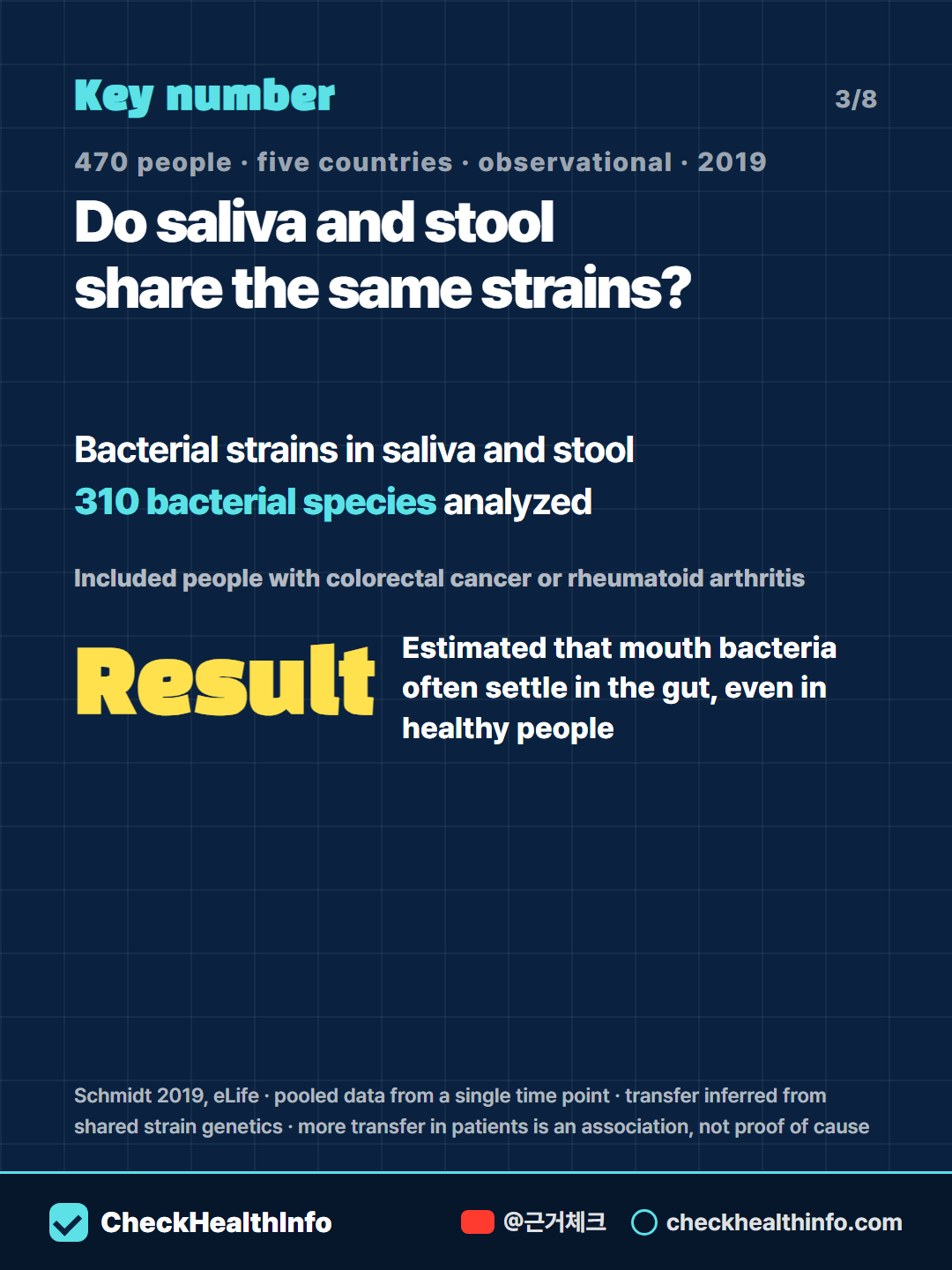
- A study comparing bacterial strains in the saliva and stool of 470 people in five countries (including people with colorectal cancer or rheumatoid arthritis) estimated that mouth bacteria commonly and extensively reach and settle in the large intestine, even in healthy people. The authors described the mouth as an “endogenous reservoir” of gut bacteria. However, the study used existing samples taken at a single point in time and inferred transfer from shared strain genetics; it did not follow people over time. In the same study, transfer was more common in people with colorectal cancer or rheumatoid arthritis, but this is only an association, so we cannot tell whether it is a cause. [1]
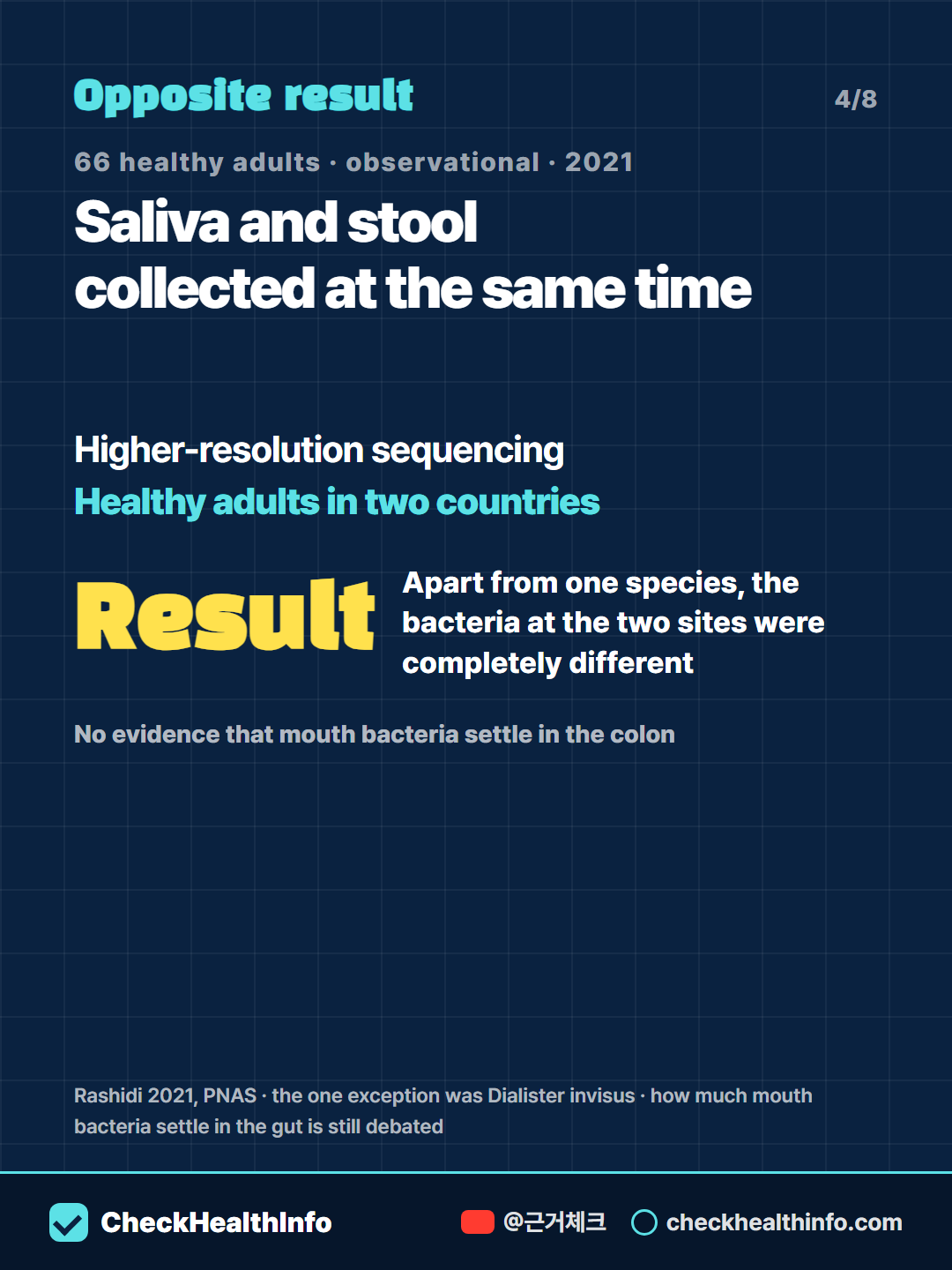
- In contrast, a study of 66 healthy adults in two countries compared saliva and stool collected at the same time, using more detailed (higher-resolution) sequencing. Apart from one species (Dialister invisus), the bacteria at the two sites were completely different. The authors concluded there was no evidence that mouth bacteria settle in (colonize) the colon. In plain terms, how much mouth bacteria settle in the gut is still debated. [2]
- Mouth bacteria entering the lungs rather than the stomach and gut (aspiration) is a different issue. A Cochrane review of six randomized trials (6,244 people) in nursing home residents found no clear evidence that professional oral care reduces pneumonia (low-certainty evidence). Pneumonia-related deaths may have been lower at 24 months (relative risk 0.43, 95% confidence interval 0.25–0.76, 454 people, low-certainty evidence). All trials were at high risk of bias, and because they involved nursing home residents, the results do not apply to a healthy adult’s morning glass of water. [4]
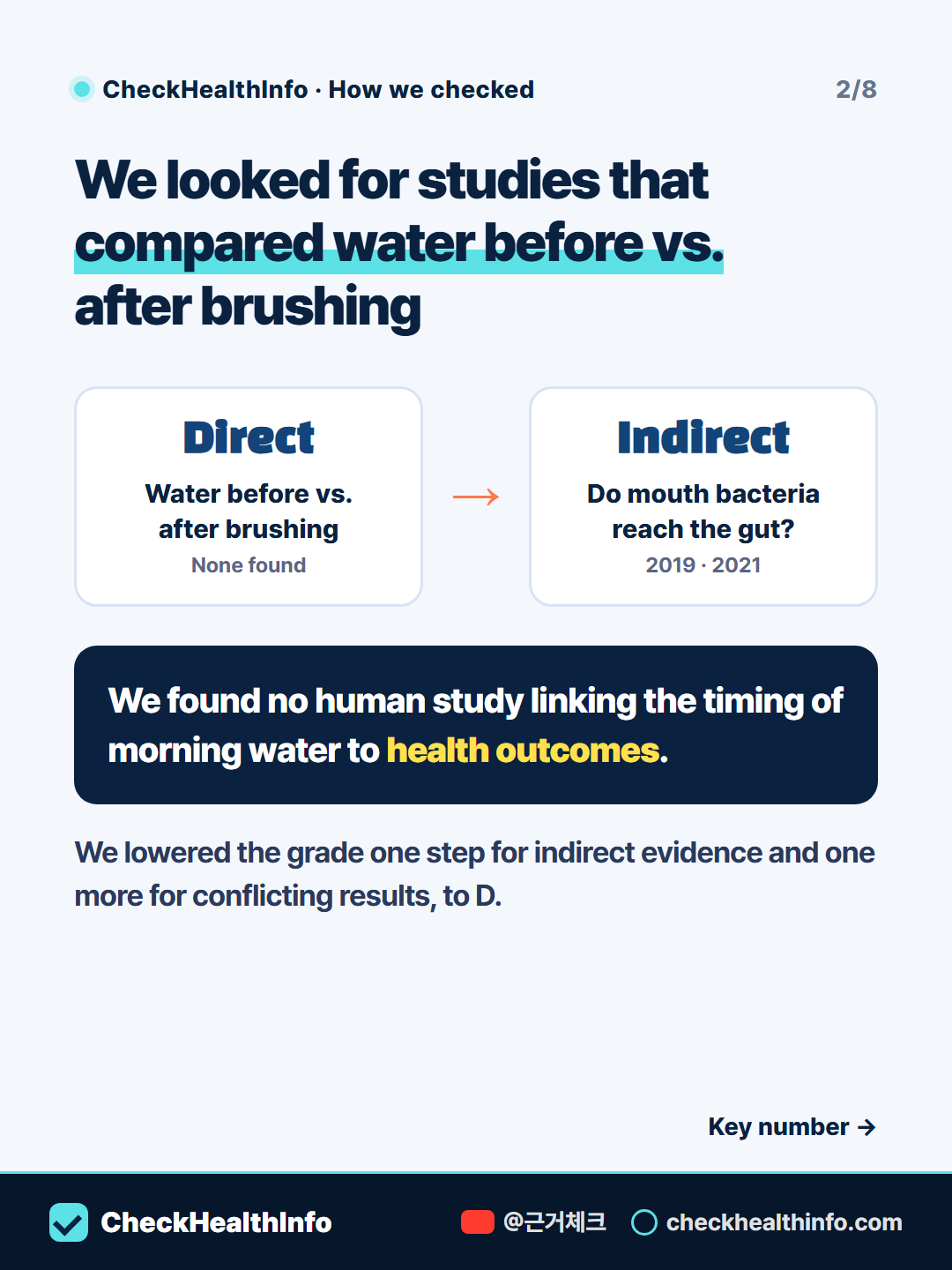
We found no human study that directly examined this claim (drinking water before brushing → harm to health). So we started at B with the closest evidence, an observational study comparing strains in 470 people. Because it did not look at when people drink water or at health outcomes, we lowered the grade one step for indirectness (grading method, section 1, reason 1). Because a study of 66 healthy adults found the opposite result, we lowered it one more step for inconsistent results (reason 3), to D. We used the Cochrane review only as supporting evidence, because it covers a different population (nursing home residents) and a different route (aspiration into the lungs). Harm has not been shown in people, so the rating is “Insufficient evidence” (section 2: this does not mean the claim is false). We did not rate it “False,” because no trial has directly shown that it is safe either.
Things to keep in mind
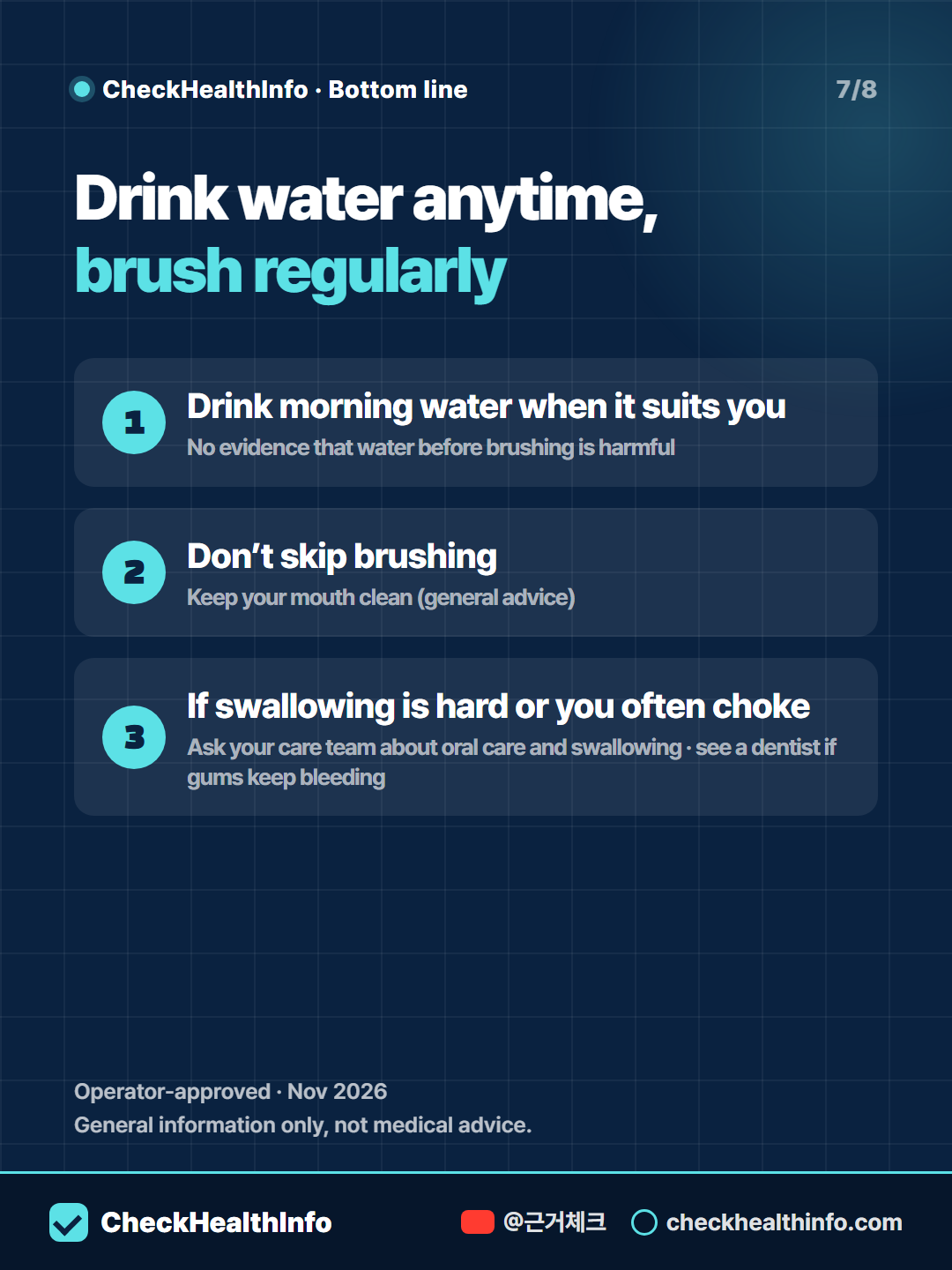
- Drink your morning water whenever it suits you — There is no evidence that water before brushing is harmful.
- Don’t skip brushing — Whatever the order, keep your mouth clean (general advice).
- If swallowing is difficult or you often choke — Talk to your health care team about oral care and swallowing (general precaution).
- If your gums keep bleeding or severe bad breath persists — See a dentist (general precaution).
Scope: This verdict covers only healthy adults drinking water before brushing in the morning. It does not judge links between mouth bacteria and specific diseases, or care for people with swallowing difficulties.
Limitations of this verdict
- We found no study comparing people who drank water before vs. after brushing. The verdict rests on indirect evidence only.
- Both studies on whether mouth bacteria settle in the gut are single-time-point observational studies, and they reached opposite conclusions. Their methods and participants (whether patients were included) differed, so which one is right is not settled.
- We did not find a human study that directly measured how well stomach acid blocks swallowed bacteria, so we did not cite one. We also found no clinical guideline on PubMed about the order of brushing and drinking water.
- The grade follows section 1 of our grading method. We check for new studies in our monthly PubMed review, and if the verdict changes, we record it in our corrections log (in Korean).
Card news
Video (in Korean)
References
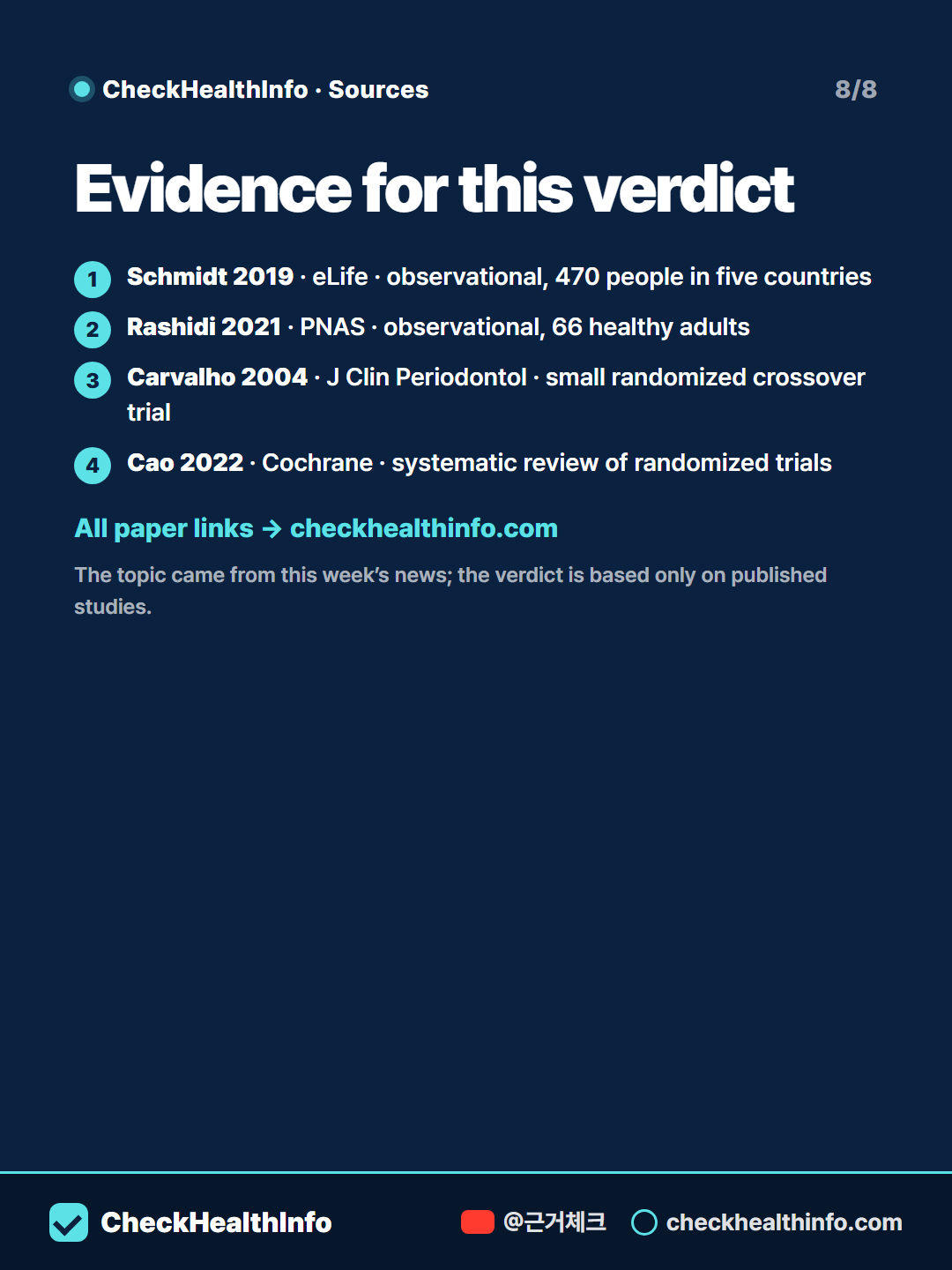
- Schmidt TS, Hayward MR, Coelho LP, et al. Extensive transmission of microbes along the gastrointestinal tract. Elife 2019;8:e42693. PMID 30747106. PubMed abstract · Full article · Free full text
- Rashidi A, Ebadi M, Weisdorf DJ, et al. No evidence for colonization of oral bacteria in the distal gut in healthy adults. Proc Natl Acad Sci U S A 2021;118(42):e2114152118. PMID 34610963. PubMed abstract · Full article · Free full text
- Carvalho MD, Tabchoury CM, Cury JA, et al. Impact of mouthrinses on morning bad breath in healthy subjects. J Clin Periodontol 2004;31(2):85-90. PMID 15016031. PubMed abstract · Full article
- Cao Y, Liu C, Lin J, et al. Oral care measures for preventing nursing home-acquired pneumonia. Cochrane Database Syst Rev 2022;11(11):CD012416. PMID 36383760. PubMed abstract · Full article · Free full text
General information only, not medical advice. It does not replace your own clinician’s diagnosis or treatment. If swallowing is difficult or you often choke, talk to your health care team; see a dentist if your gums keep bleeding.