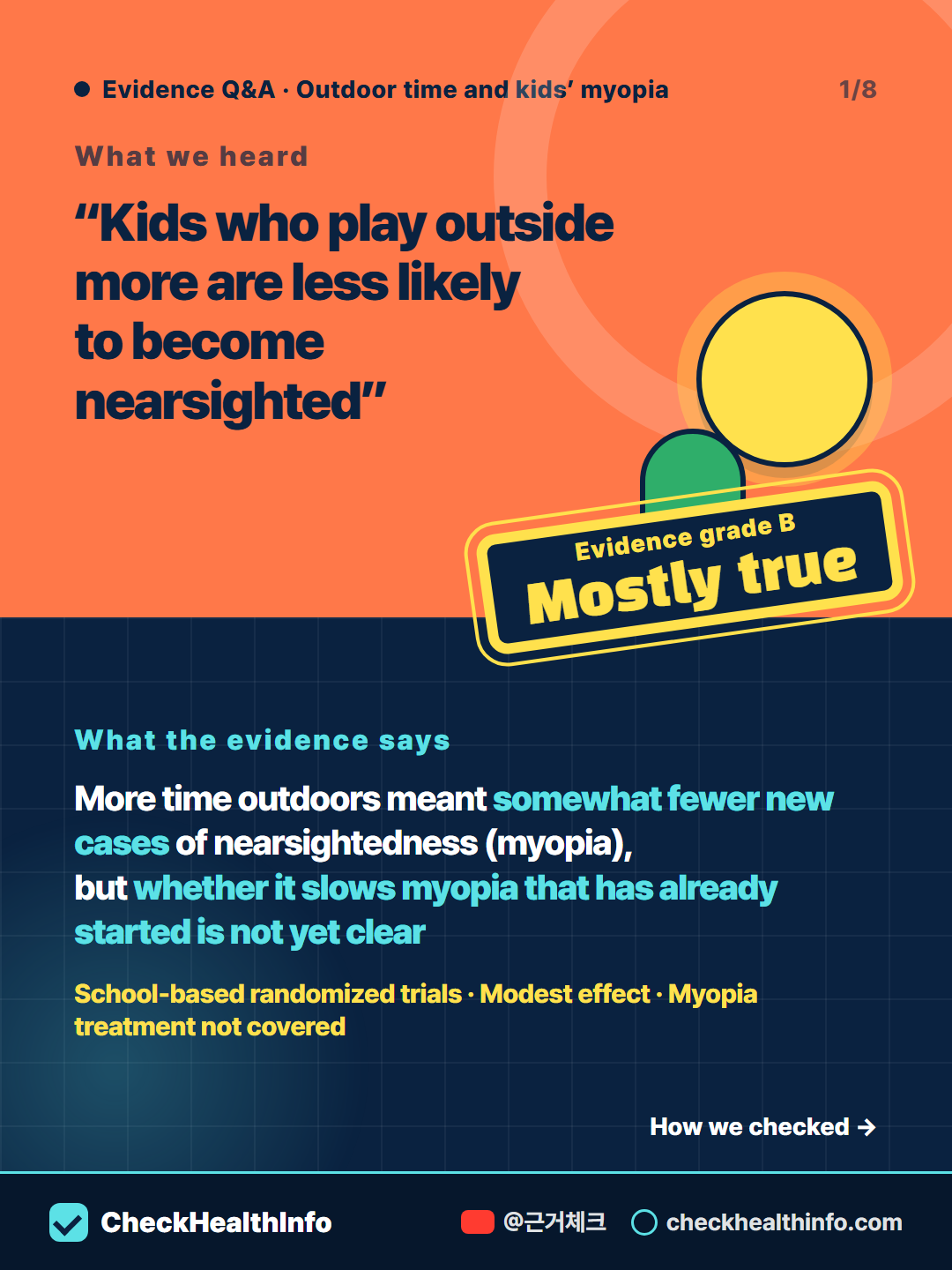
Does more time outdoors make children less likely to become nearsighted?
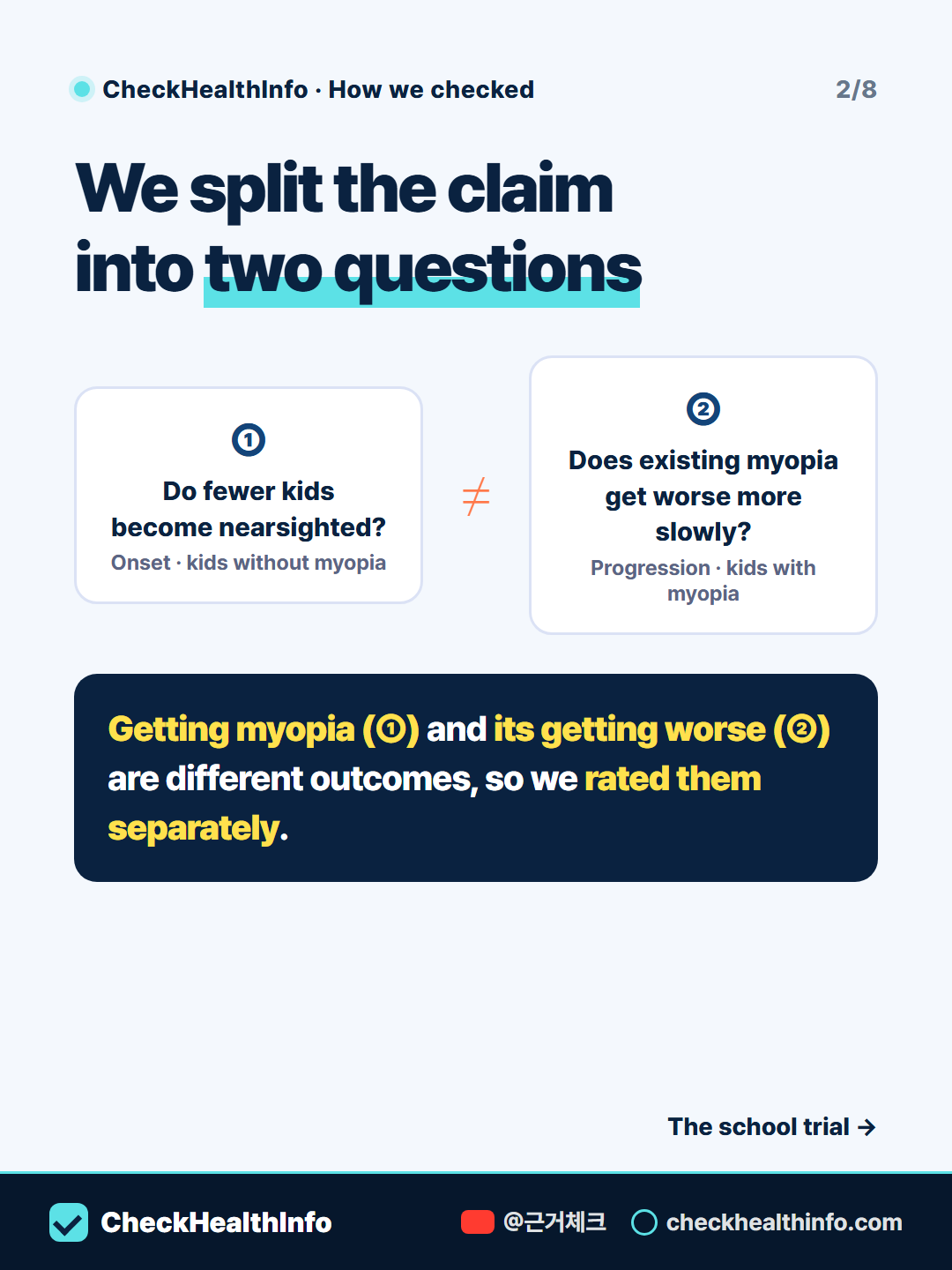
If children spend more time outdoors each day, are they less likely to develop nearsightedness (myopia)? And does it slow myopia in children who are already nearsighted?

We checked this verdict against 8 sources, such as published studies and clinical guidelines. · How checked: AI-drafted · automated evidence checks
Verdicts at a glance
| Claim | Verdict |
|---|---|
| Spending more time outdoors each day makes children less likely to develop myopia | Mostly true · Evidence grade B |
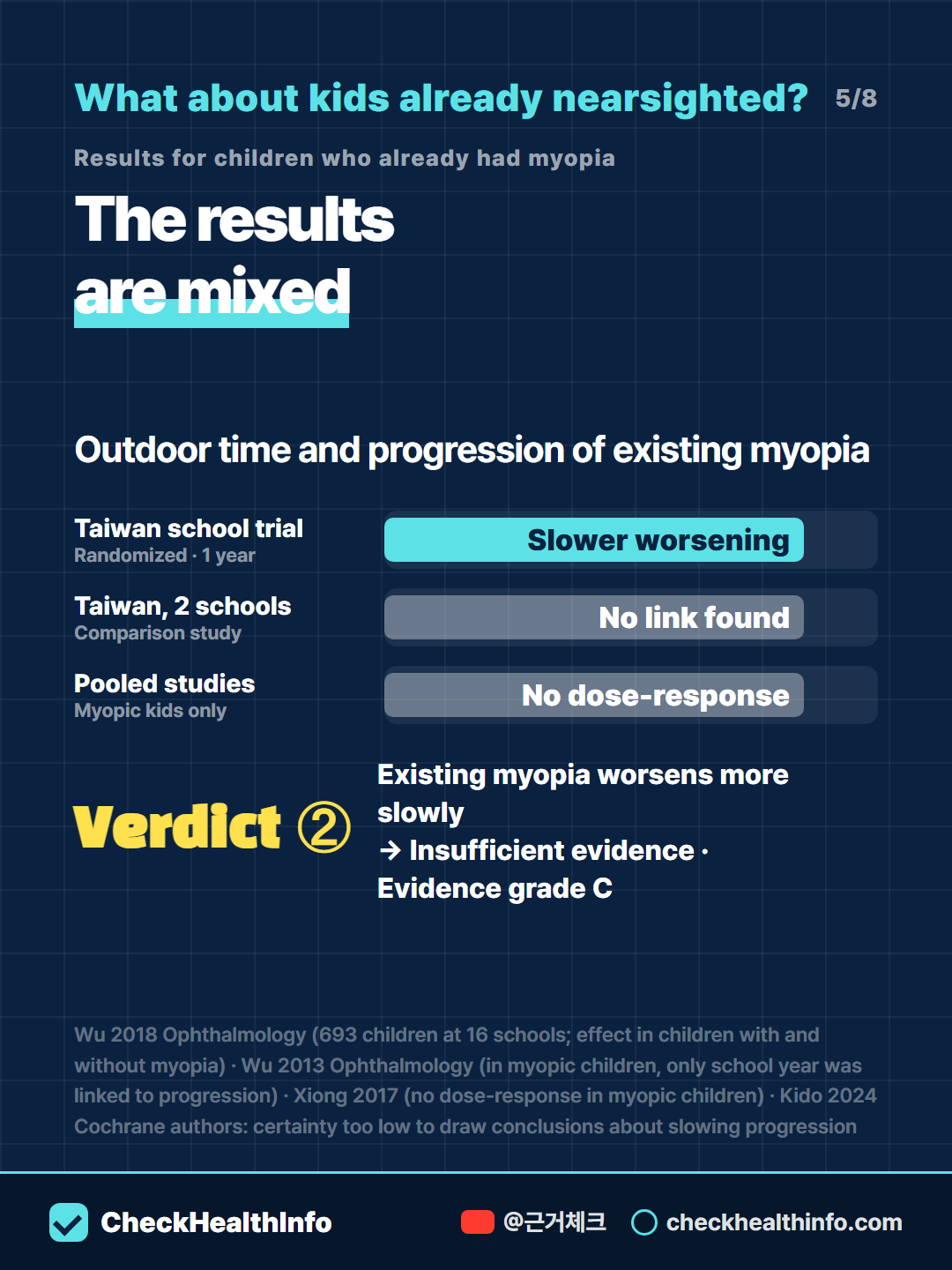
| More time outdoors slows myopia in children who are already nearsighted | Insufficient evidence · Evidence grade C |
Bottom line — In randomized trials that added outdoor time at school, somewhat fewer children became nearsighted. So “spending more time outdoors each day makes children less likely to develop nearsightedness (myopia)” is rated Mostly true (Evidence grade B). It does not fully prevent myopia; it lowers the number of children who develop it by a modest amount. “More time outdoors slows myopia that a child already has” is rated Insufficient evidence (Evidence grade C): one trial found slower worsening, but an analysis of nearsighted children found no link, so the results are mixed. The takeaway: more time outdoors modestly reduces new cases of myopia, and because it is a low-risk habit, it is worth trying even for children who are already nearsighted, though the benefit for them is not proven. Talk to an eye doctor about myopia treatment.
Myopia onset — A child who was not nearsighted becomes nearsighted.
Myopia progression — Existing nearsightedness gets worse. It is usually measured by how far the refraction moves toward myopia (in diopters, D) and how much the eye grows in length (axial length).
Cluster randomized trial — A trial that randomizes whole schools, rather than individual children, to compare groups.
Relative risk · incidence rate ratio — The risk (or rate) of new cases in one group divided by the risk (or rate) in the comparison group. A value below 1 means that group had fewer new cases.
Odds ratio — Read much like a relative risk, but when the outcome is common it can make the difference look somewhat larger.
95% confidence interval — The range likely to contain the true value. If a ratio’s interval includes 1, or a difference’s interval includes 0, there may be no real difference.
A recent news segment on KBS, South Korea’s public broadcaster, discussed nearsightedness starting earlier in childhood and treatments that slow it. This article does not cover treatment. Instead, it checks whether more time outdoors, something families and schools can do, helps with myopia, split into two questions.
Verdict 1. “Spending more time outdoors each day makes children less likely to develop myopia”
Mostly true · Evidence grade B
In plain terms Fewer new cases of myopia occurred in schools that added outdoor time. It did not fully prevent myopia; it reduced it somewhat.
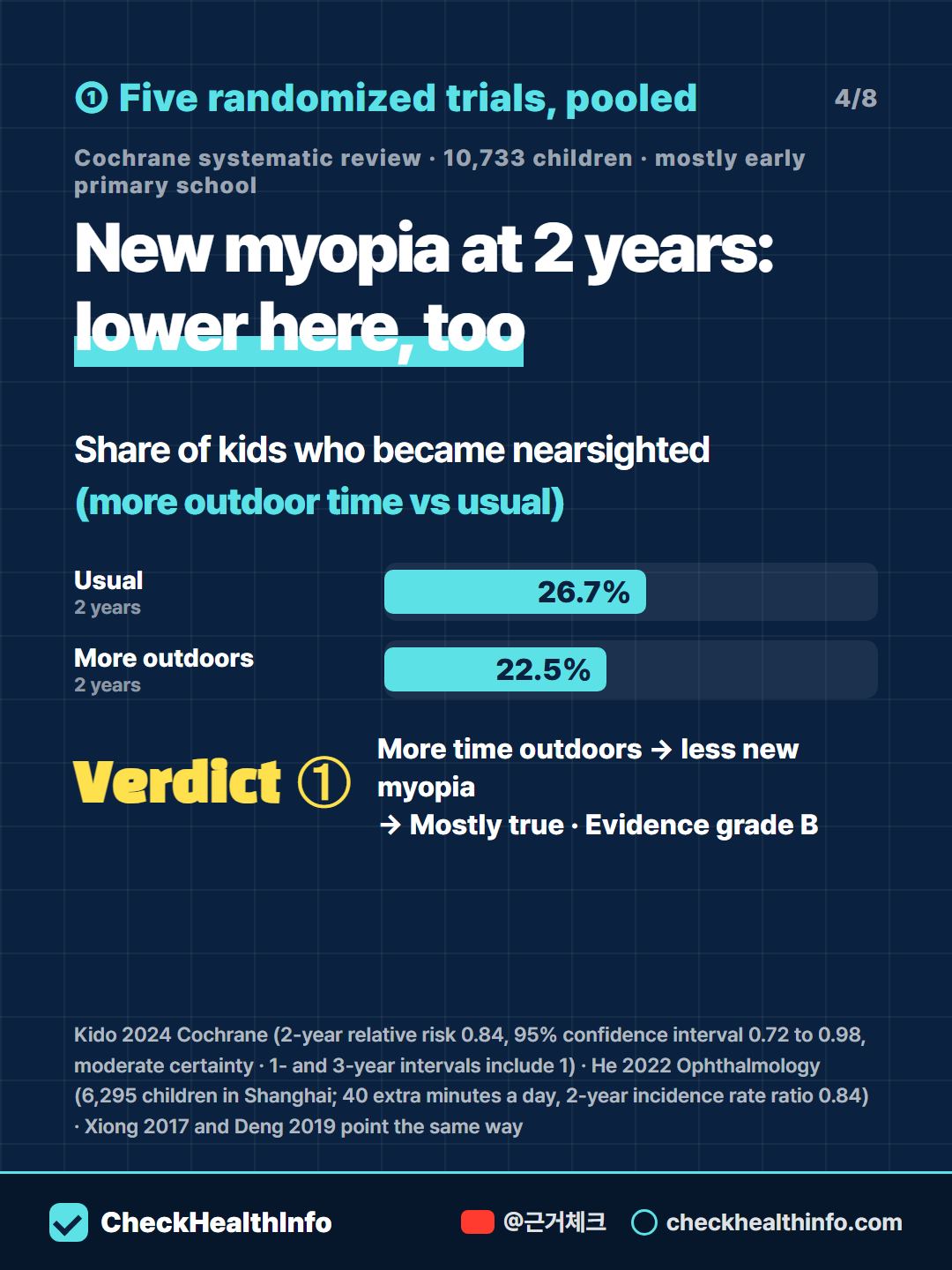
- A Cochrane systematic review of five randomized trials (10,733 children, mostly in early primary school) found that 22.5% of children with more outdoor time developed myopia over 2 years, compared with 26.7% of children without it (relative risk 0.84, 95% confidence interval 0.72 to 0.98; moderate certainty). The 3-year result (one trial) was 30.5% vs 39.8%, but its confidence interval included 1 (0.77, 0.59 to 1.01), as did the 1-year result (0.82, 0.56 to 1.19). No adverse events were reported. [1]
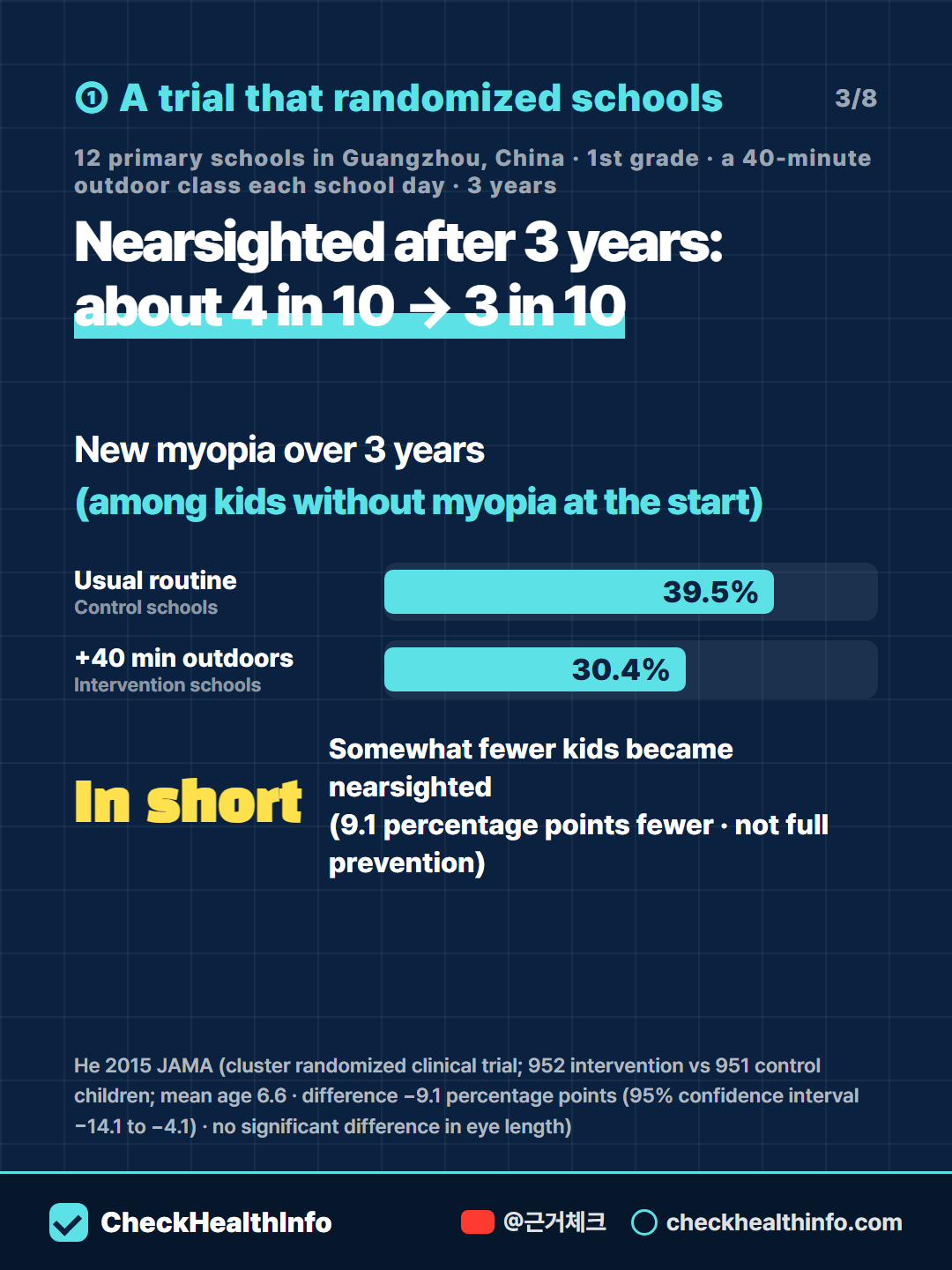
- In a trial in Guangzhou, China, that randomized 12 primary schools (first graders, mean age 6.6), schools that added a 40-minute outdoor class each school day and encouraged outdoor activity after school and on weekends had a 3-year cumulative myopia incidence of 30.4%, compared with 39.5% in schools that kept their usual routine: 9.1 percentage points lower (95% confidence interval 4.1 to 14.1). In plain terms, after 3 years about 4 in 10 children at the usual schools had become nearsighted, compared with about 3 in 10 at the schools with extra outdoor time. The difference in eye length, however, was not significant (−0.03 mm, 95% confidence interval −0.07 to 0.003). [2]
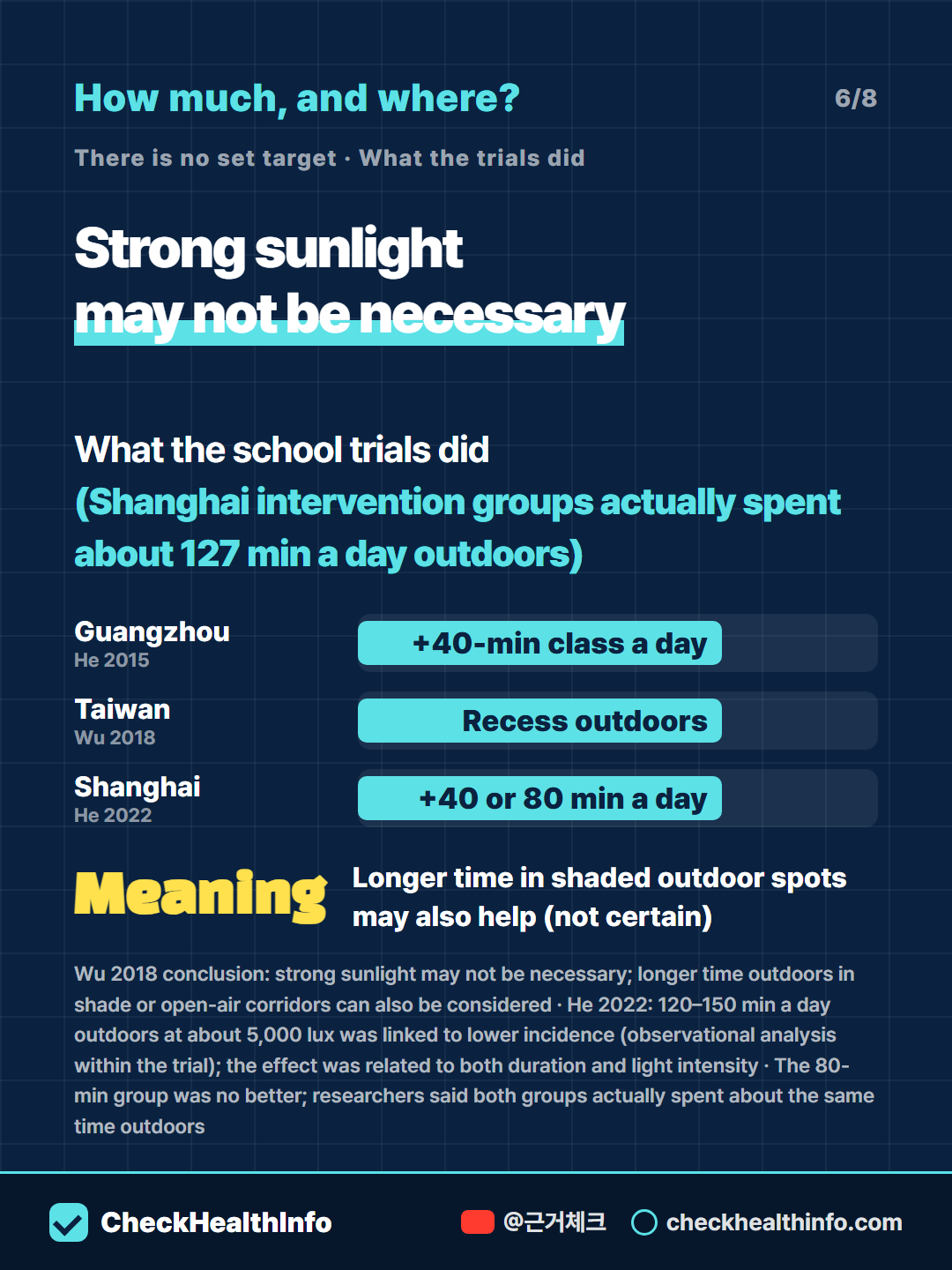
- In a trial of 6,295 children aged 6 to 9 at 24 primary schools in Shanghai, adding 40 minutes a day lowered 2-year myopia incidence by 16% (incidence rate ratio 0.84, 95% confidence interval 0.72 to 0.99), and adding 80 minutes lowered it by 11% (0.89, 0.79 to 0.99). In practice, children in both intervention groups spent about the same time outdoors: 127 minutes a day. [3]
- A meta-analysis of 25 studies, including observational ones, pointed the same way (clinical trials: relative risk 0.536, 95% confidence interval 0.338 to 0.850), and another meta-analysis of five clinical trials also found a lower risk of myopia onset (0.66, 0.49 to 0.89; the authors described it as “slightly lower”). The two meta-analyses partly overlap in the studies they include. [4] [5]
- The International Myopia Institute (IMI) risk factor report also concluded that randomized clinical trials have confirmed the protective effect of time outdoors against developing myopia (supporting evidence). [8]
Grade: The strongest evidence is a Cochrane review limited to randomized trials, which starts at A on our scale. We moved down one level to B because the 1-year and 3-year confidence intervals included 1, making the results uncertain (Cochrane also rated the 2-year result as moderate certainty). The individual trials and the other meta-analyses all pointed in the same direction. It is “Mostly true” rather than “True” because, although the reduction was confirmed, the effect is smaller than “preventing myopia,” and the trials mainly involved early primary school children in China and Taiwan, a narrower group than the claim implies.
Evidence grades run from A (high) to D (very low). We move down one level when results are uncertain. Full criteria are on our rating method page.
Verdict 2. “More time outdoors slows myopia in children who are already nearsighted”
Insufficient evidence · Evidence grade C
In plain terms It is not yet clear whether outdoor time alone can slow myopia in a child who is already nearsighted. This does not mean the claim is wrong; it means the results are mixed.
- In the Cochrane review, the shift in refraction toward myopia was slightly smaller with more outdoor time (2-year mean difference 0.13 diopters, 95% confidence interval 0.06 to 0.19), but the 1-year (0.08, −0.01 to 0.17) and 3-year (0.17, −0.17 to 0.51) intervals included 0. These values were not limited to children who were already nearsighted, and the authors said the certainty was too low to draw conclusions about slowing progression. [1]
- In a cluster randomized trial of 693 first graders at 16 primary schools in Taiwan, children in an outdoor recess program had a smaller 1-year shift toward myopia (0.35 vs 0.47 diopters), and the odds ratio for rapid myopia progression was 0.46 (95% confidence interval 0.28 to 0.77). The researchers reported an effect in children both with and without myopia. [7]
- However, a meta-analysis that included observational studies found no dose-response relationship between outdoor time and progression when only nearsighted children were considered, and the authors concluded that outdoor time was not effective in slowing progression in eyes that were already myopic. [4]
- In a study comparing two schools in Taiwan, school year was the only factor significantly linked to progression in nearsighted children. In a meta-analysis of five clinical trials, the shift toward myopia was slower in two of three groups of children who were nearsighted at the start. The Shanghai researchers also noted that the effect was seen especially in children who were not nearsighted at the start. [6] [5] [3]
Grade: The strongest evidence is the Cochrane review (A), but its refraction values were not limited to nearsighted children, so the evidence is indirect (one level down). Results are also mixed and uncertain: studies that looked only at nearsighted children disagree, and Cochrane’s 1-year and 3-year intervals include 0 (one more level down), giving C. Starting instead from the most direct evidence, the Taiwan cluster randomized trial (B), the conflicting results still bring it to C. The label is “Insufficient evidence”: this does not mean outdoor time has been shown not to help.
If you are worried about your child’s eyesight
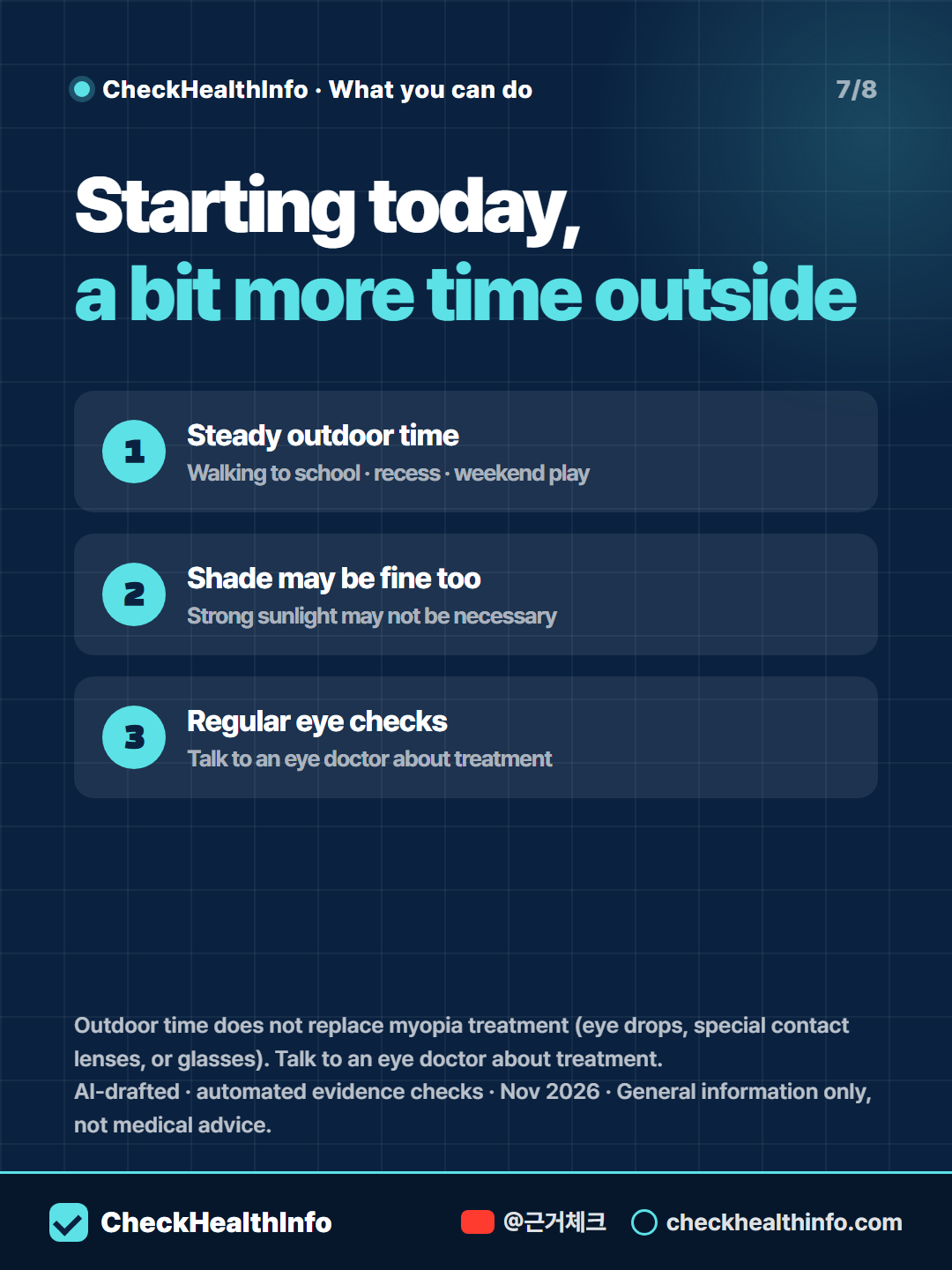
- Make outdoor time a steady habit — walking to school, recess, weekend play. Trials found it modestly reduces new cases of myopia. [1] [2]
- Shade may be fine too — the Taiwan researchers said strong sunlight may not be necessary, and spending longer outdoors in less bright spots, such as shade or open-air school corridors, can also be considered. [7]
- There is no set number of hours. In the Shanghai trial, 120 to 150 minutes a day outdoors at about 5,000 lux was linked to lower incidence (an analysis observed within the trial), and the researchers found the effect was related to both the length of time and light intensity. Children in the intervention groups actually spent about 127 minutes a day outdoors. [3]
- Get regular eye checks, and talk to an eye doctor about myopia treatment. Outdoor time does not replace treatment.
Scope: This verdict covers children’s outdoor time and the onset and progression of myopia. It does not cover treatments that slow myopia (eye drops, special contact lenses, glasses) or screen time.
Limitations of this verdict
- Most trials involved early primary school children in China and Taiwan. Our search found no randomized trial in Korean children.
- The effect is modest: even at schools with extra outdoor time, about 3 in 10 children became nearsighted over 3 years. In the Guangzhou trial, the difference in eye length was not significant.
- In the Shanghai trial, adding 80 minutes did not work better than adding 40 minutes; the researchers attributed this to both groups getting similar actual outdoor time (incomplete adherence).
- In the Taiwan cluster randomized trial, 8 of the original 24 schools dropped out before enrollment, leaving 16 schools, and follow-up was 1 year. The two-school Taiwan comparison was not randomized.
- The meta-analysis result for nearsighted children came from a dose-response analysis that included observational studies.
- We did not cite recommendations from groups such as the WHO or the American Academy of Ophthalmology, because their figures could not be checked against PubMed abstracts.
- This article was prompted by a news report. We do not evaluate any news outlet or person.
- Grades follow section 1 of our rating method. We check for new studies in our monthly PubMed review, and any change to a verdict is logged in our corrections log.
Card news
Video (in Korean)
References
- Kido A, Miyake M, Watanabe N. Interventions to increase time spent outdoors for preventing incidence and progression of myopia in children. Cochrane Database Syst Rev 2024;6(6):CD013549. PMID 38864362. PubMed abstract · Full article · Free full text
- He M, Xiang F, Zeng Y, et al. Effect of Time Spent Outdoors at School on the Development of Myopia Among Children in China: A Randomized Clinical Trial. JAMA 2015;314(11):1142-8. PMID 26372583. PubMed abstract · Full article
- He X, Sankaridurg P, Wang J, et al. Time Outdoors in Reducing Myopia: A School-Based Cluster Randomized Trial with Objective Monitoring of Outdoor Time and Light Intensity. Ophthalmology 2022;129(11):1245-1254. PMID 35779695. PubMed abstract · Full article
- Xiong S, Sankaridurg P, Naduvilath T, et al. Time spent in outdoor activities in relation to myopia prevention and control: a meta-analysis and systematic review. Acta Ophthalmol 2017;95(6):551-566. PMID 28251836. PubMed abstract · Full article · Free full text
- Deng L, Pang Y. Effect of Outdoor Activities in Myopia Control: Meta-analysis of Clinical Studies. Optom Vis Sci 2019;96(4):276-282. PMID 30907857. PubMed abstract · Full article
- Wu PC, Tsai CL, Wu HL, et al. Outdoor activity during class recess reduces myopia onset and progression in school children. Ophthalmology 2013;120(5):1080-5. PMID 23462271. PubMed abstract · Full article
- Wu PC, Chen CT, Lin KK, et al. Myopia Prevention and Outdoor Light Intensity in a School-Based Cluster Randomized Trial. Ophthalmology 2018;125(8):1239-1250. PMID 29371008. PubMed abstract · Full article
- Morgan IG, Wu PC, Ostrin LA, et al. IMI Risk Factors for Myopia. Invest Ophthalmol Vis Sci 2021;62(5):3. PMID 33909035. PubMed abstract · Full article · Free full text
General information only, not medical advice. It does not replace your own clinician’s diagnosis or treatment. Myopia treatments (eye drops, special lenses, glasses) are not covered; if you are concerned about your child’s vision, talk to an eye doctor.