Taking a memory supplement? Can phosphatidylserine prevent dementia?
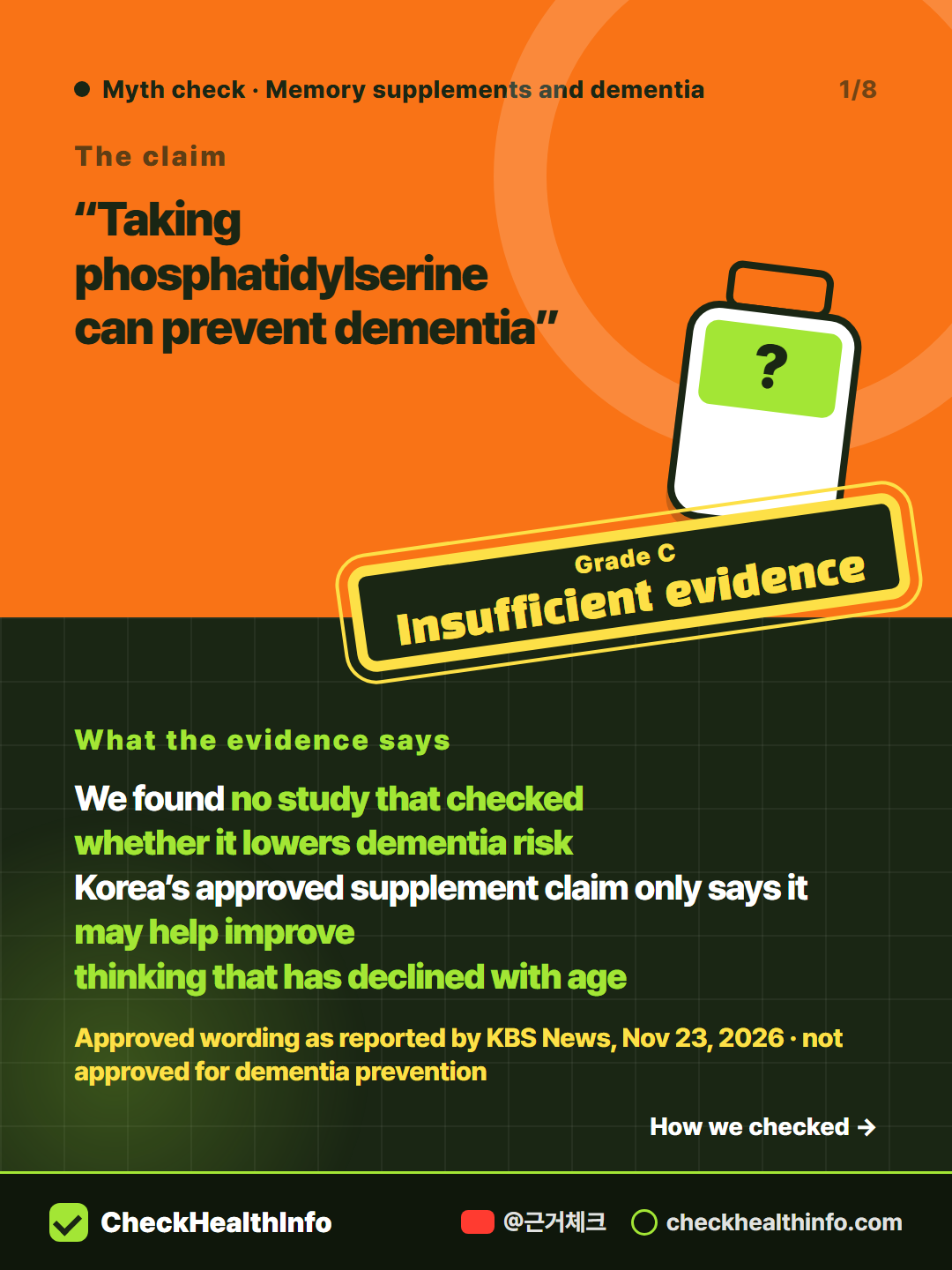
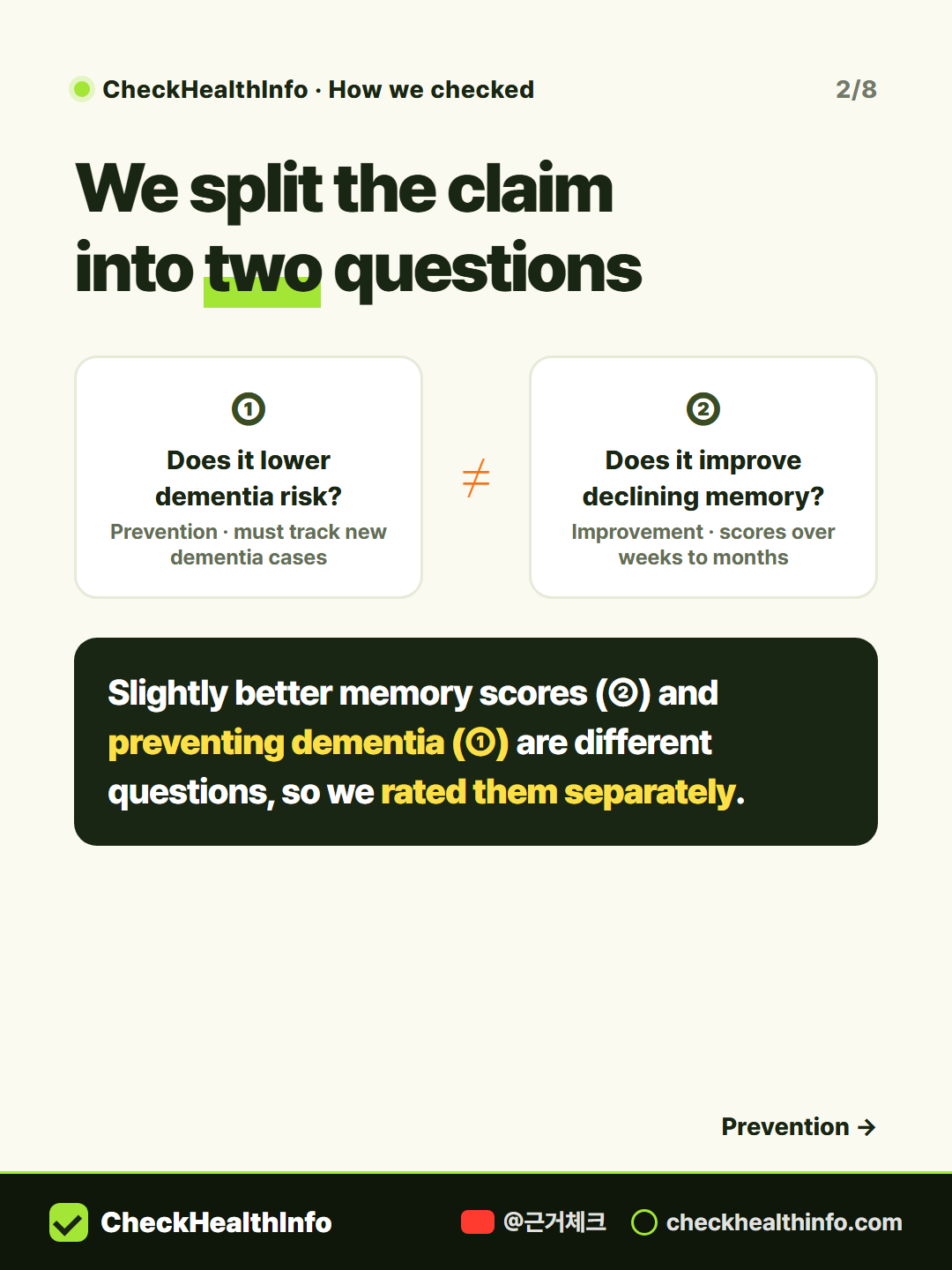
Can taking phosphatidylserine prevent dementia? And does it improve memory and thinking that have declined with age?

We checked this verdict against 9 sources, such as published studies and clinical guidelines. · How checked: AI-drafted · automated evidence checks
Verdicts at a glance
| Claim | Verdict |
|---|---|
| Taking phosphatidylserine can prevent dementia (lower the number of new cases) | Insufficient evidence · Evidence grade C |
| Taking phosphatidylserine improves memory and thinking that have declined with age (in middle-aged and older adults with memory complaints or mild cognitive impairment) | Insufficient evidence · Evidence grade C |
Bottom line — We found no study that directly checked whether people who take phosphatidylserine are less likely to develop dementia. So “taking phosphatidylserine can prevent dementia” is rated Insufficient evidence (Evidence grade C). “It improves memory and thinking that have declined with age” is also rated Insufficient evidence (Evidence grade C): trials of an older form made from cow brain showed better scores than placebo, but trials of other forms, including the soy-derived form preferred for people, gave mixed results. The takeaway: the health claim approved for this ingredient in Korea says only that it “may help improve cognitive function that has declined with age.” It is not approved for preventing dementia. If you are worried about your memory, get checked before reaching for a supplement.
Phosphatidylserine (PS) — A fat-like molecule (phospholipid) found in brain cell membranes. Supplement studies have used PS made from cow brain (bovine cortex, BC-PS) and from soy (S-PS). For people, soy-derived PS is preferred because of a possible risk of prion infection from brain tissue.
Dementia prevention (incidence) — Lowering the number of people who develop dementia for the first time. Checking this means following people for a long time to see whether fewer of them are diagnosed with dementia.
Mild cognitive impairment — Memory or thinking is worse than expected for a person’s age, but they can still manage most daily activities on their own.
MMSE and ADAS-Cog — Tests of memory and thinking. The MMSE is a brief screening test; the ADAS-Cog is a more detailed test used in Alzheimer’s disease research.
Placebo — A dummy pill with no active ingredient. It lets researchers separate real effects from changes caused simply by expecting to benefit.
Network meta-analysis — An analysis that pools many trials and compares several supplements at once, including ones never tested against each other directly.
On November 23, 2026, KBS News reported that Korea’s broadcasting and media standards commission had imposed a formal sanction, a “caution,” on 11 health-information broadcasts that overstated the benefits of ingredients used in health functional foods (Korea’s government-regulated category of dietary supplements). Eight of them presented phosphatidylserine as if it could prevent dementia. According to the report, Korea’s Ministry of Food and Drug Safety (MFDS) has approved this ingredient with the health claim that it “may help improve cognitive function that has declined with age,” but it has not been approved for preventing dementia. So what does the research say? We split the question in two.
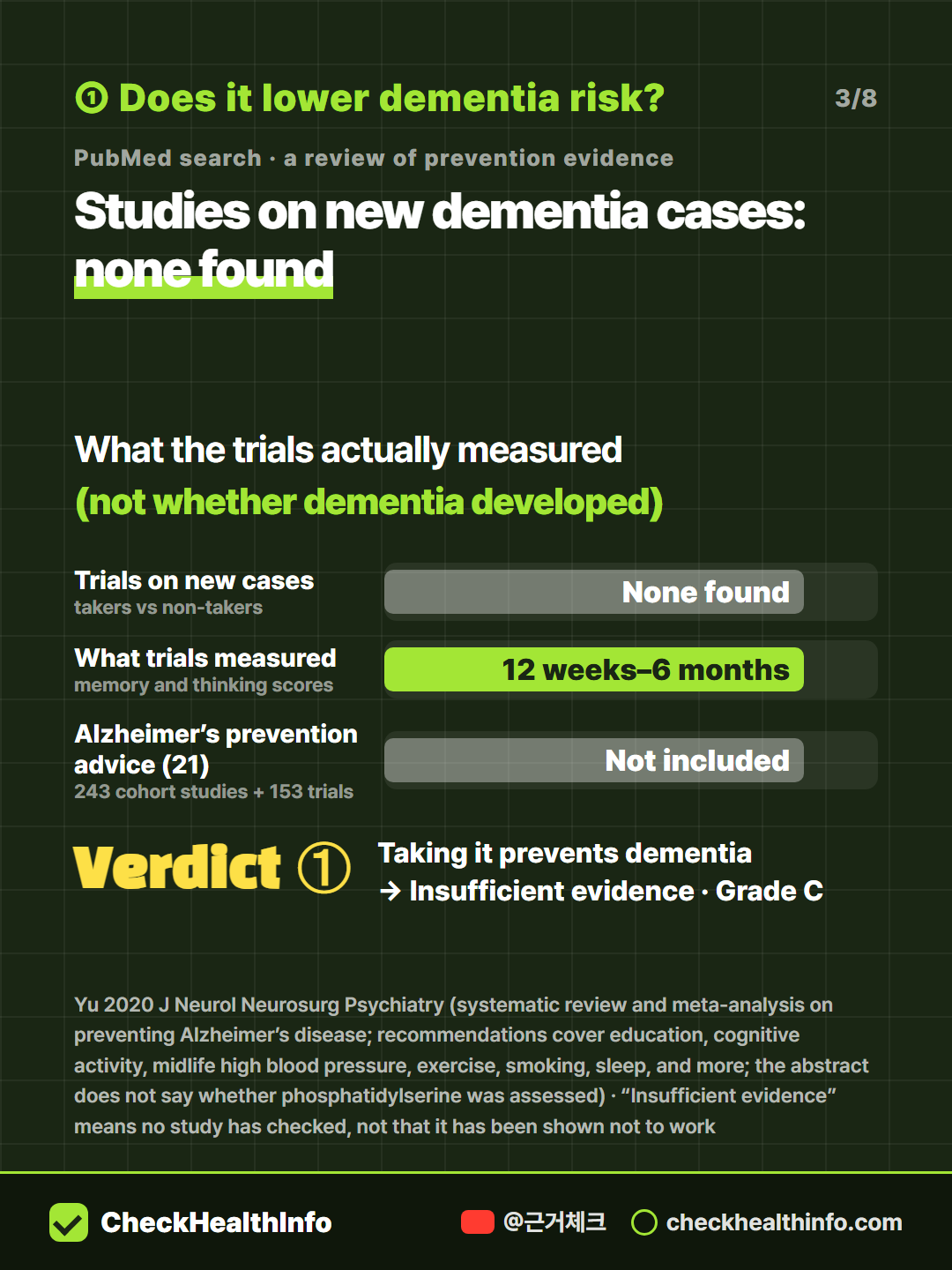
Verdict 1. “Taking phosphatidylserine can prevent dementia”
Insufficient evidence · Evidence grade C
In plain words We found no study that directly checked whether phosphatidylserine prevents dementia. This does not mean it has been shown not to work — it means no study has checked.
- The trials so far gave it for a few weeks to 6 months to people who already had memory or thinking problems, then measured memory and thinking scores. Our PubMed search found no trial or cohort study that looked at new cases of dementia as the outcome.
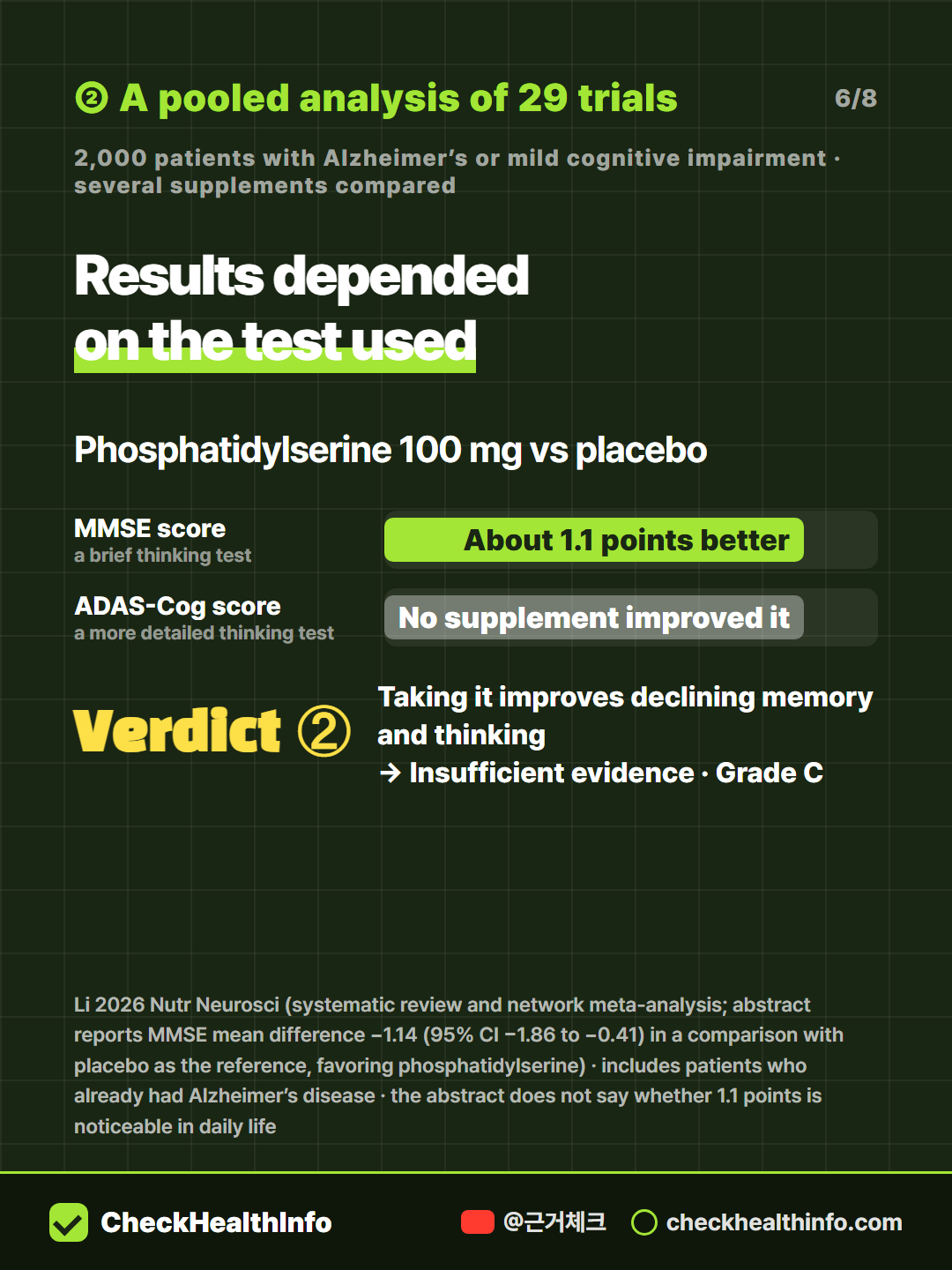
- A network meta-analysis of 29 trials (2,000 patients with Alzheimer’s disease or mild cognitive impairment) found that MMSE scores were better with 100 mg of phosphatidylserine than with placebo (the abstract reports a mean difference of −1.14, 95% confidence interval −1.86 to −0.41, in a comparison with placebo as the reference). But on the more detailed ADAS-Cog test, no supplement led to a meaningful improvement. This analysis also looked at test scores, not at new cases of dementia. [1]
- A systematic review and meta-analysis of evidence on preventing Alzheimer’s disease (243 prospective observational studies and 153 randomized trials) made 21 recommendations. They cover factors such as education, cognitive activity, high blood pressure in midlife, diabetes, depression, exercise, smoking, and sleep, but phosphatidylserine is not on the list (the abstract does not say whether phosphatidylserine was assessed). [2]
- In a trial of 494 people aged 65 to 93 at 23 hospitals in Italy, those who took 300 mg a day of cow brain–derived phosphatidylserine for 6 months scored better than placebo on behavior and thinking scales, but the trial did not look at whether new dementia developed. [3]
Grade: The evidence closest to the claim is the network meta-analysis, so we started at A. We lowered it one level because it is indirect (short-term scores in people who already had cognitive problems, not new cases of dementia), and one more level because results were mixed depending on the test and the source of PS (MMSE better but ADAS-Cog not; cow brain–derived better but soy-derived no different), giving C. We use “False” only when reliable studies show the opposite; here, no study has looked at new dementia cases at all, so the rating is “Insufficient evidence.”
Evidence grades run from A (high) to D (very low). We lower the grade one level for each separate reason, such as evidence that does not address the claim directly or results that conflict. See How we rate for details.
Verdict 2. “Taking phosphatidylserine improves memory and thinking that have declined with age”
Insufficient evidence · Evidence grade C
In plain words Some trials found better scores and others found no difference, and most of the positive trials used the older cow brain–derived form. So it is too early to say that it improves memory.
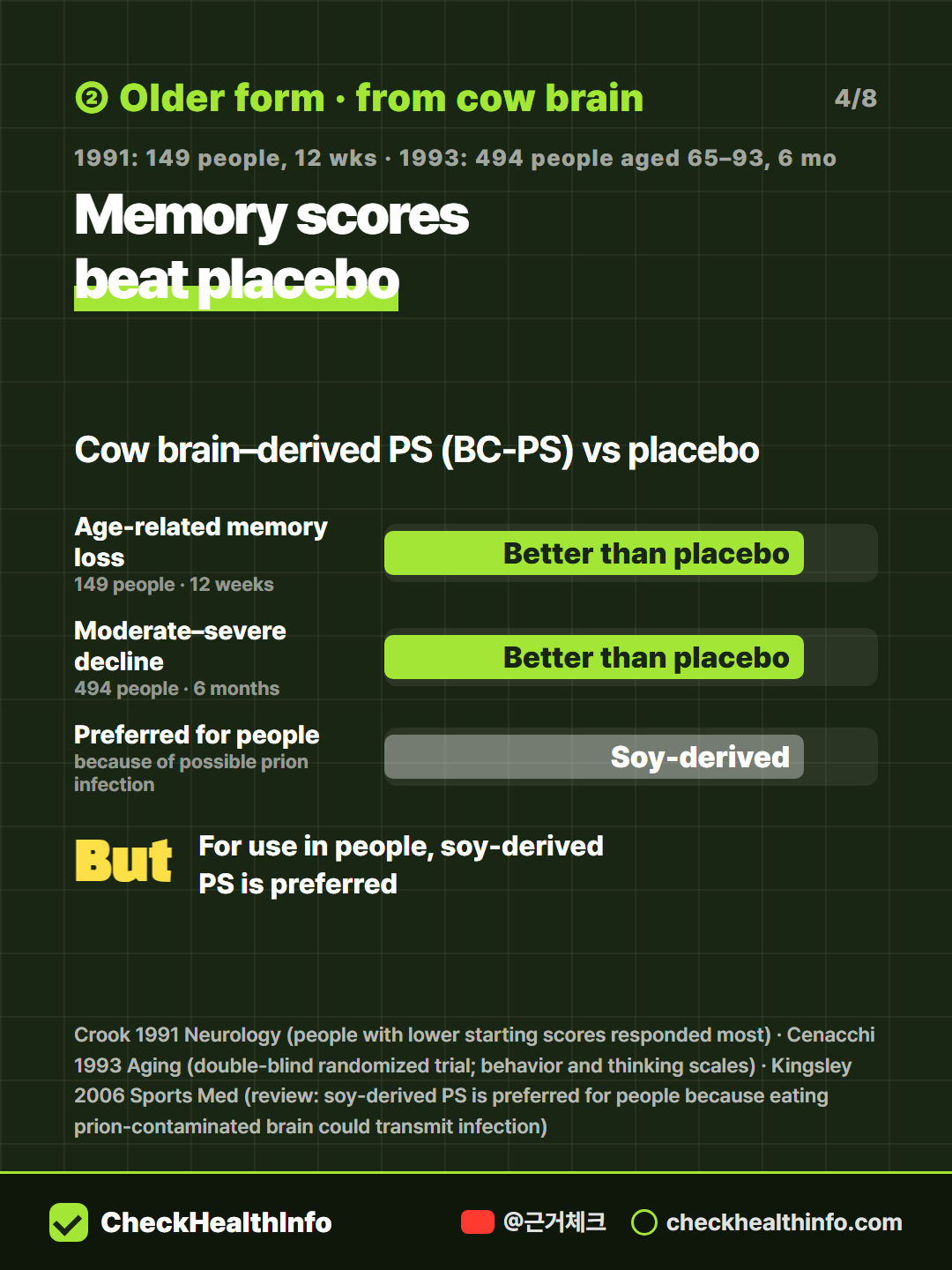
- Cow brain–derived PS: In a trial of 149 people with age-associated memory impairment who took it for 12 weeks, scores on everyday learning and memory tasks were better than with placebo, mainly in people who started with lower scores. In the trial of 494 people aged 65 to 93 who took it for 6 months, behavior and thinking scales were also better than with placebo. [4] [3]
- However, for people, soy-derived PS is preferred because eating prion-contaminated brain tissue could transmit infection (review). [8]
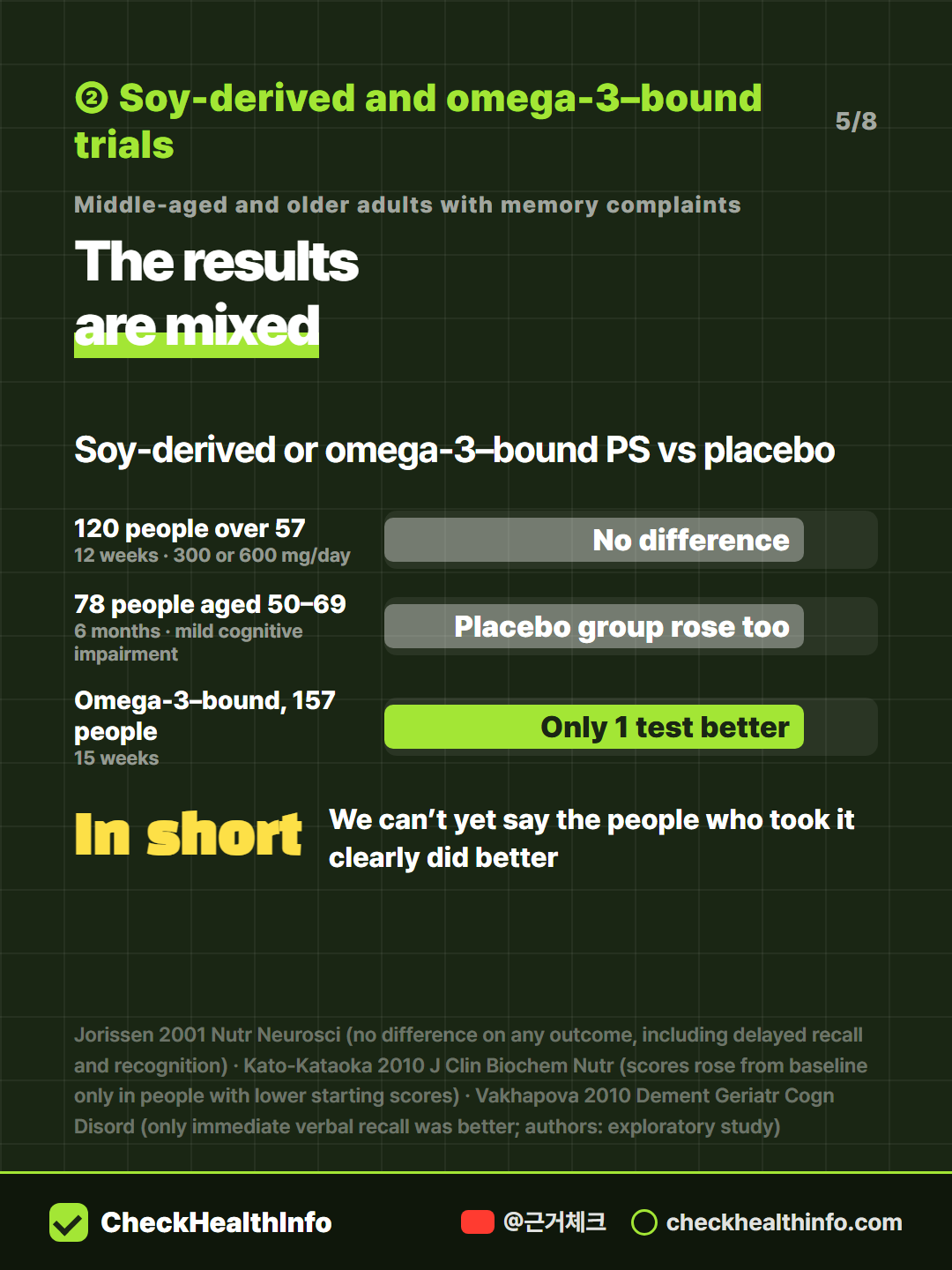
- Soy-derived PS: In a trial of 120 adults over 57 who took 300 mg or 600 mg a day for 12 weeks, there was no difference from placebo on any outcome, including delayed recall and recognition. [5]
- In a Japanese trial of 78 people aged 50 to 69 with mild cognitive impairment who took 100 mg or 300 mg a day for 6 months, scores rose by a similar amount in every group, including placebo. In an analysis limited to people with relatively low starting scores, memory scores in the PS groups rose from baseline (no change with placebo), mainly in delayed verbal recall. [6]
- In a trial of 157 people who took omega-3–bound phosphatidylserine for 15 weeks, only immediate verbal recall was better than with placebo, and the authors called it an exploratory study that needs confirmation. [7]
- In the network meta-analysis above, MMSE scores were about 1.1 points better, but no supplement improved ADAS-Cog scores, and the authors noted that the choice of test matters. The abstract does not say whether 1.1 points is a difference people would notice in daily life. [1]
Grade: The strongest evidence is the network meta-analysis, so we started at A. We lowered it one level because results were mixed (by test and by source of PS), and one more level because the analysis included patients already diagnosed with Alzheimer’s disease and the individual trials with better scores used the older cow brain–derived form (indirect), giving C. Starting from the individual randomized trials, the mixed results also lead to C. The rating is “Insufficient evidence” — it has not been shown not to work, either.
According to the news report, the MFDS has approved this ingredient with the health functional food claim that it “may help improve cognitive function that has declined with age.” That approval follows Korea’s standard for health functional food claims, which is not the same standard as our evidence grades. A supplement’s approved health claim is not the same as preventing or treating a disease.
If you are worried about your memory
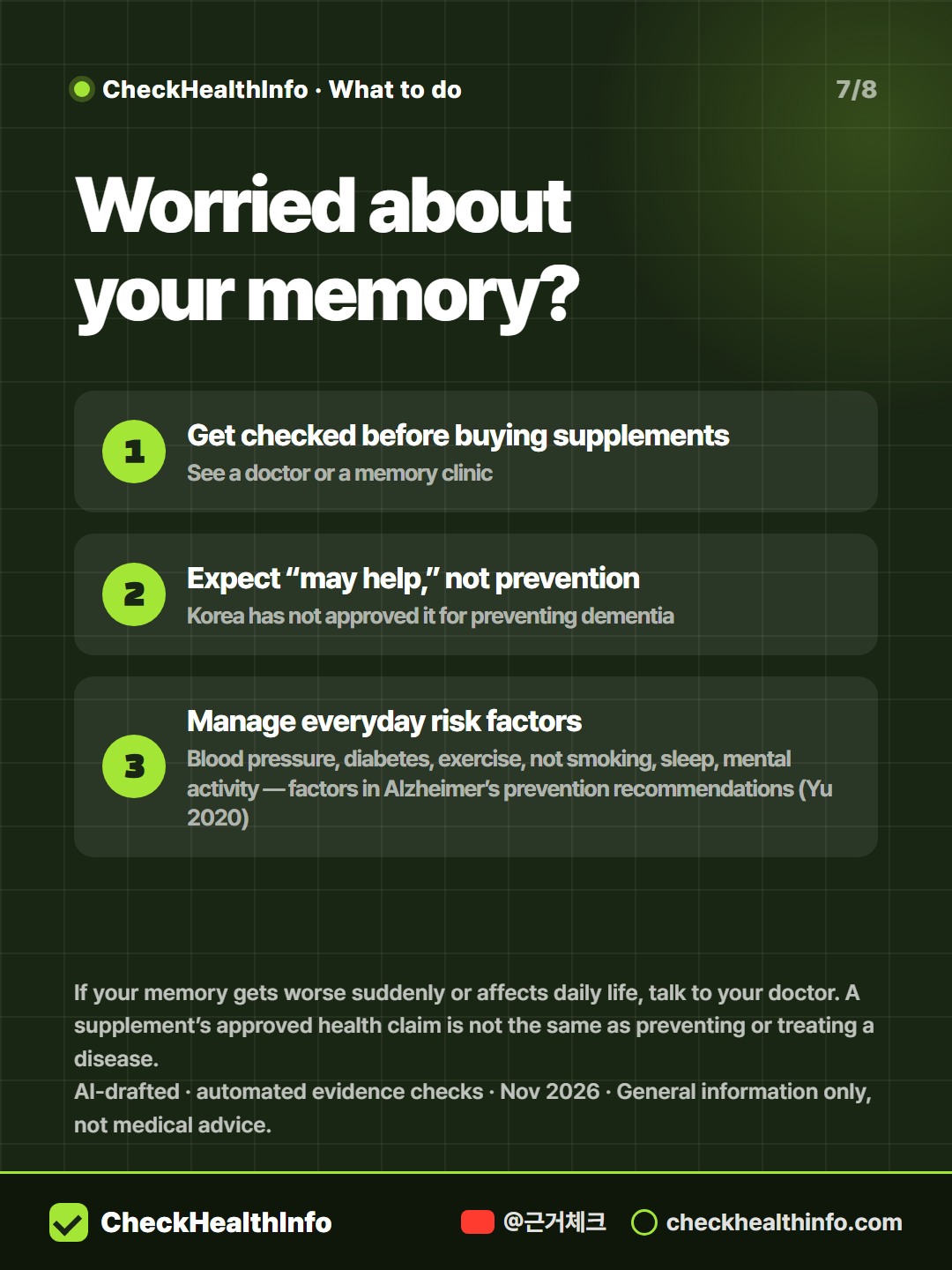
- Get checked before buying supplements — If you are worried about your memory, get a memory check from your doctor or a memory clinic (in Korea, a dementia care center at the local public health center). If your memory gets worse suddenly or affects daily life, talk to your doctor.
- Expect “may help,” not prevention — If you take phosphatidylserine, expect no more than the health claim approved in Korea (“may help”), not dementia prevention.
- Manage everyday risk factors — The recommendations from the review of Alzheimer’s prevention evidence include factors such as education and cognitive activity, high blood pressure in midlife, diabetes, depression, exercise, smoking, and sleep. [2]
- Safety — In a safety analysis of 120 older adults who took 300 mg or 600 mg of soy-derived PS a day for 12 weeks, blood tests, blood pressure, heart rate, and side effects did not differ from placebo. [9]
Scope: This verdict covers phosphatidylserine taken on its own and its effects on dementia prevention and on memory and thinking. It does not cover multi-ingredient products, interactions with medicines, or studies of children with ADHD.
Limitations
- Our PubMed search found no study of new dementia cases. Sources outside our search or studies published later may not be included.
- Among the trials we reviewed, the only ones in which the whole study group scored better than placebo were two early-1990s trials of cow brain–derived PS. The soy-derived trials (120 and 78 people) and the omega-3–bound trial (157 people) were small and short (12 weeks to 6 months).
- In the soy-derived and omega-3–bound trials, better results mostly came from analyses limited to people with low starting scores (compared with their own baseline), from one test among several, or from post hoc analyses. The cow brain–derived trials showed better scores than placebo across all participants, and in one of them people with lower starting scores responded most.
- The network meta-analysis pooled patients with Alzheimer’s disease and mild cognitive impairment, and its abstract does not say how many trials were in the 100 mg phosphatidylserine group.
- We used the approved health-claim wording exactly as reported in the news and did not consult the official Korean health functional food code. We did not cite WHO guidelines or the Lancet Commission report because their content could not be checked against PubMed abstracts.
- This article was prompted by a news report. We do not rate any specific broadcast, outlet, person, or product.
- Grades follow section 1 of How we rate. We check for new studies in our monthly PubMed review, and any change to a verdict is recorded in our corrections log.
Card news
Video (in Korean)
References
- Li Y, Leng Q, Wang Y. The impact of supplements on cognitive function for Alzheimer's disease or mild cognitive impairment: a systematic review and network meta-analysis. Nutr Neurosci 2026:1-19. PMID 42494057. PubMed abstract · Full article
- Yu JT, Xu W, Tan CC, et al. Evidence-based prevention of Alzheimer's disease: systematic review and meta-analysis of 243 observational prospective studies and 153 randomised controlled trials. J Neurol Neurosurg Psychiatry 2020;91(11):1201-1209. PMID 32690803. PubMed abstract · Full article · Free full text
- Cenacchi T, Bertoldin T, Farina C, et al. Cognitive decline in the elderly: a double-blind, placebo-controlled multicenter study on efficacy of phosphatidylserine administration. Aging (Milano) 1993;5(2):123-33. PMID 8323999. PubMed abstract · Full article
- Crook TH, Tinklenberg J, Yesavage J, et al. Effects of phosphatidylserine in age-associated memory impairment. Neurology 1991;41(5):644-9. PMID 2027477. PubMed abstract · Full article
- Jorissen BL, Brouns F, Van Boxtel MP, et al. The influence of soy-derived phosphatidylserine on cognition in age-associated memory impairment. Nutr Neurosci 2001;4(2):121-34. PMID 11842880. PubMed abstract · Full article
- Kato-Kataoka A, Sakai M, Ebina R, et al. Soybean-derived phosphatidylserine improves memory function of the elderly Japanese subjects with memory complaints. J Clin Biochem Nutr 2010;47(3):246-55. PMID 21103034. PubMed abstract · Full article · Free full text
- Vakhapova V, Cohen T, Richter Y, et al. Phosphatidylserine containing omega-3 fatty acids may improve memory abilities in non-demented elderly with memory complaints: a double-blind placebo-controlled trial. Dement Geriatr Cogn Disord 2010;29(5):467-74. PMID 20523044. PubMed abstract · Full article
- Kingsley M. Effects of phosphatidylserine supplementation on exercising humans. Sports Med 2006;36(8):657-69. PMID 16869708. PubMed abstract · Full article
- Jorissen BL, Brouns F, Van Boxtel MP, et al. Safety of soy-derived phosphatidylserine in elderly people. Nutr Neurosci 2002;5(5):337-43. PMID 12385596. PubMed abstract · Full article
General information only, not medical advice. It does not replace your own clinician’s diagnosis or treatment. If your memory suddenly gets worse or problems get in the way of daily life, talk to a health care provider.