If you play badminton or tennis, will you live longer?
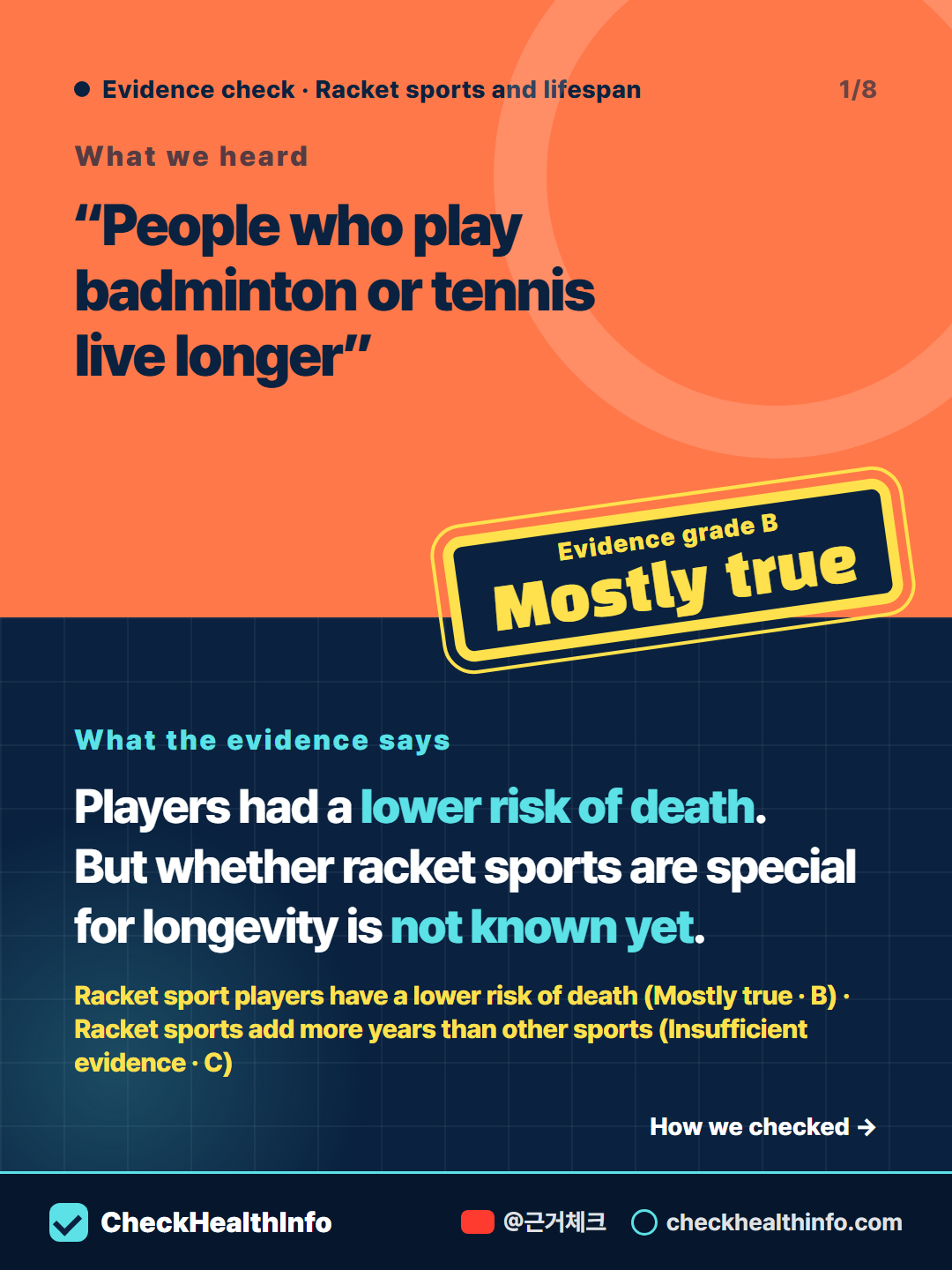
Do people who play racket sports such as badminton and tennis have a lower risk of death, and do racket sports add more years of life than other sports?

We checked this verdict against 7 sources, such as published studies and clinical guidelines. · How checked: AI-drafted · automated evidence checks
Verdicts at a glance
| Claim | Verdict |
|---|---|
| People who play racket sports such as badminton and tennis have a lower risk of death than people who do not | Mostly true · Evidence grade B |
| Racket sports add more years of life than other sports (for example, playing tennis adds 9.7 years) | Insufficient evidence · Evidence grade C |
Bottom line — People who play racket sports such as badminton and tennis had a lower risk of death than non-players in UK and US studies, and a longer life expectancy than mostly inactive people in a Danish study (Mostly true). But these are observational comparisons of people who play with people who don't, and at the same amount of activity, other types of exercise were also linked with a lower risk. So the claim that racket sports add more years of life than other sports is rated Insufficient evidence (this does not mean it is false). If you enjoy racket sports and can keep them up, they are a good way to reach your weekly activity target.
Cohort study — An observational study that asks many people about their habits and follows them for years to see who gets sick or dies.
Hazard ratio (HR) — Compares the risk of death over the same period between two groups. Below 1 means a lower risk (0.53 means the risk was about half as high).
Relative risk — Like the hazard ratio, it shows how many times higher or lower one group's risk is compared with another's.
95% confidence interval (CI) — The range likely to contain the true value. The wider it is, the less certain the result.
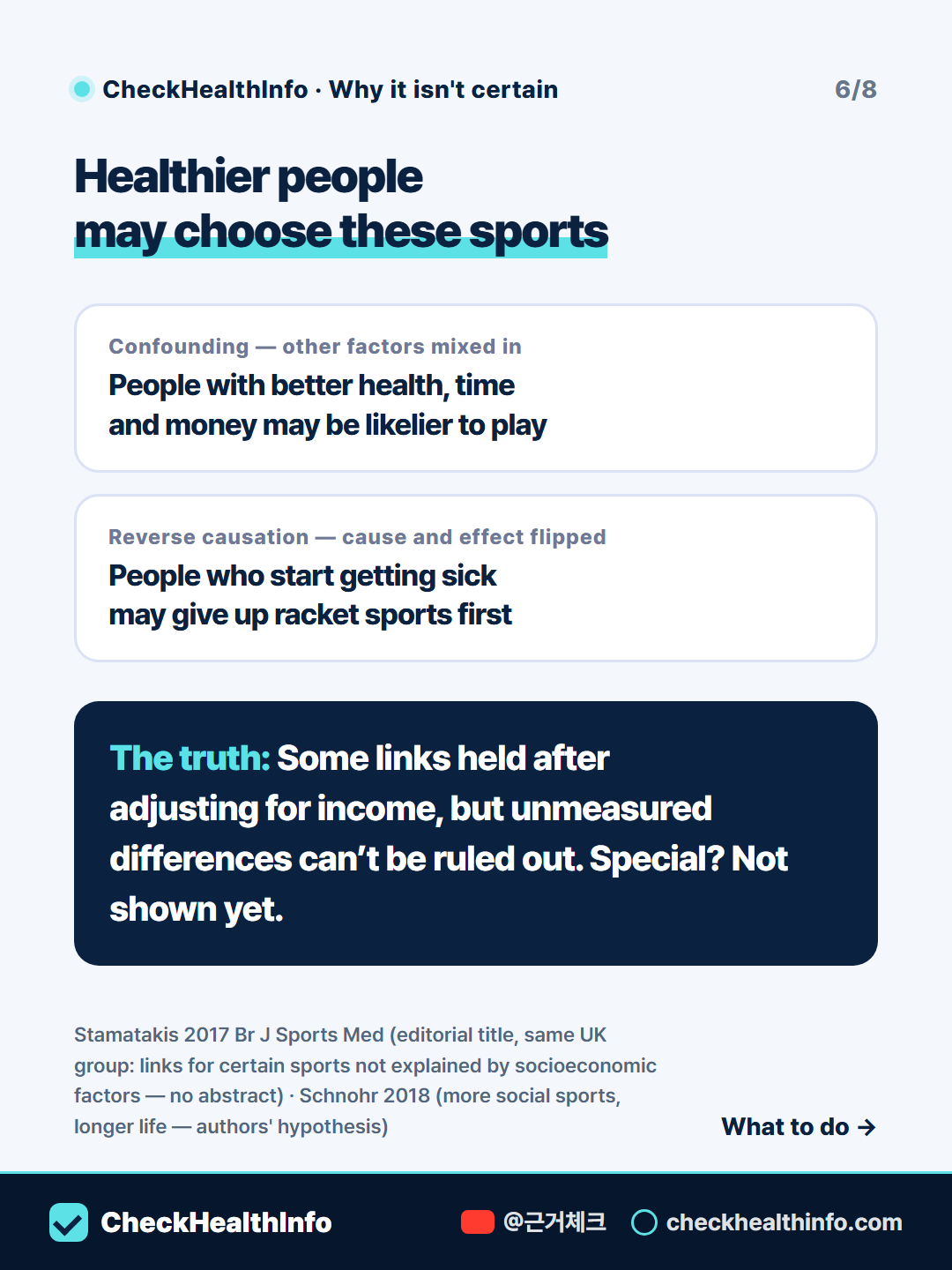
Confounding — When factors other than exercise (baseline health, income, free time) are mixed into the result.
Reverse causation — When cause and effect run the other way, for example, people who start getting sick give up exercise first.
MET-hours — A unit for the amount of activity, combining intensity and time.
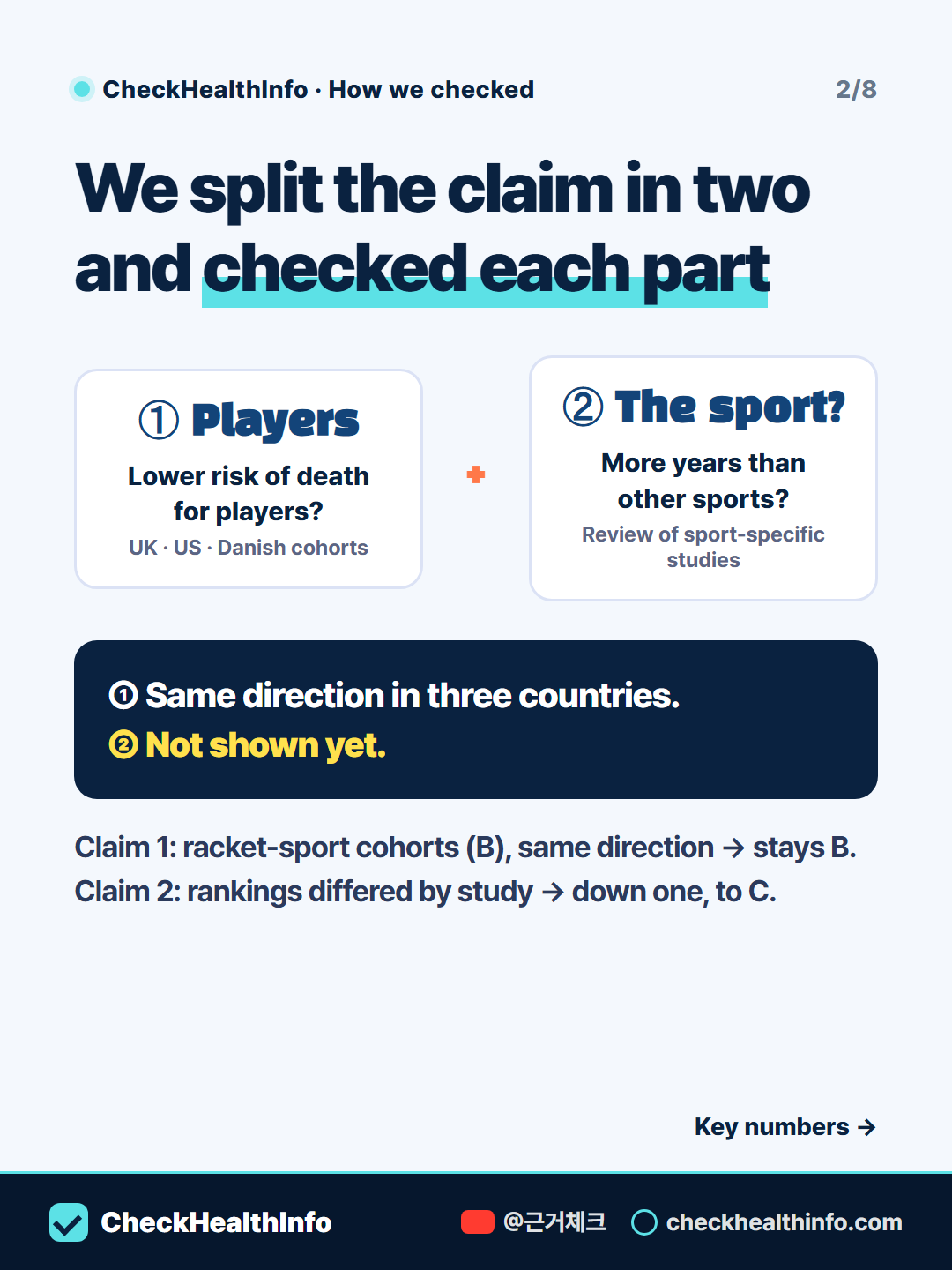
This claim mixes two different statements, so we split it into two verdicts: ① do people who play racket sports have a lower risk of death (an association), and ② do racket sports add more years of life than other sports (cause and ranking)?
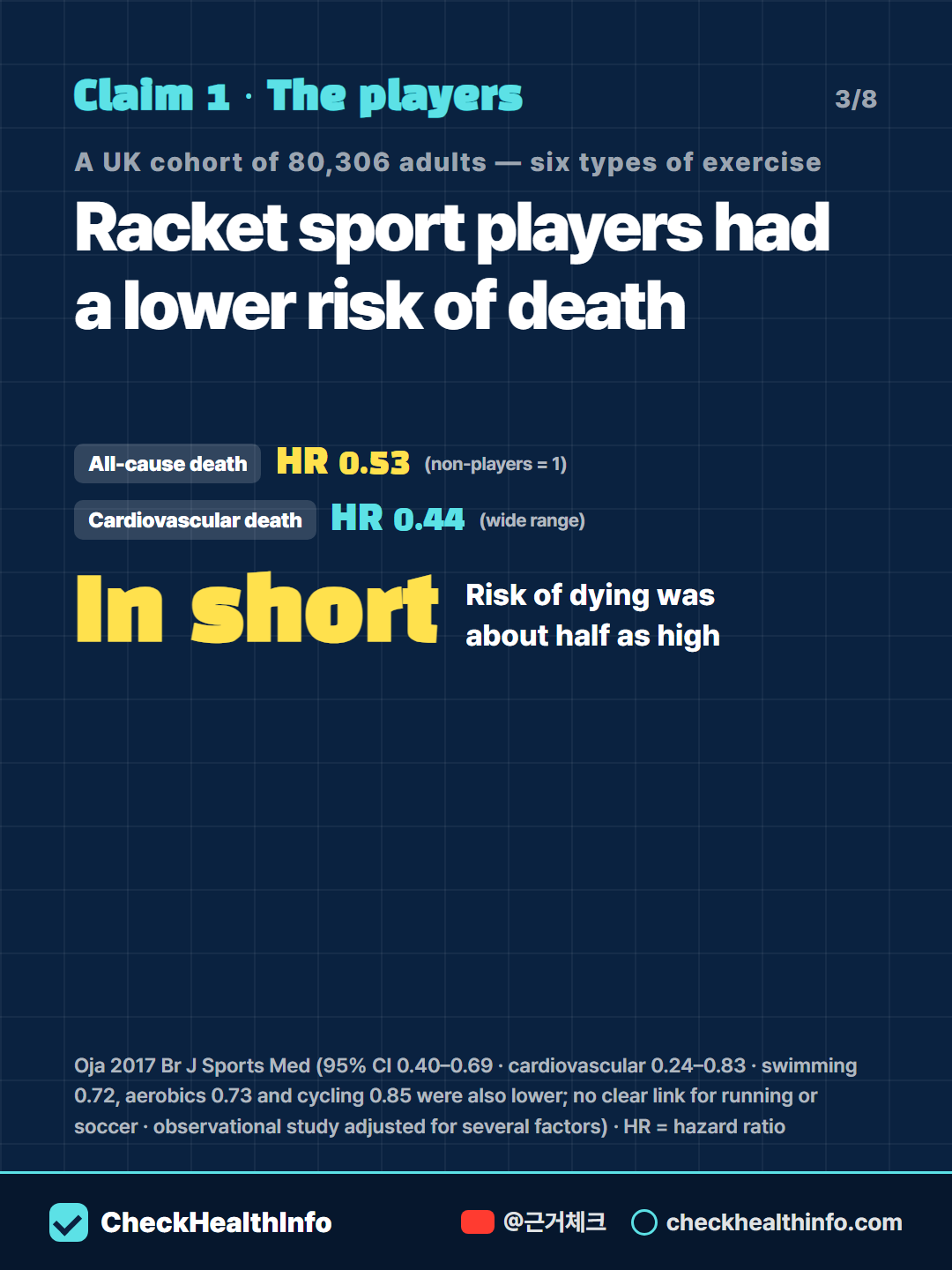
Claim 1 — People who play racket sports have a lower risk of death: Mostly true · Evidence grade B
To see whether different sports are linked with different lifespans, researchers ask many people what exercise they do and follow them for years. In a cohort of 80,306 UK adults (54% women, mean age 52), people who played racket sports had a lower risk of death from any cause than those who did not (HR 0.53, 95% CI 0.40–0.69). [1] Put simply, their risk of dying over the same period was about half as high. Their risk of death from cardiovascular disease was also lower (HR 0.44, 0.24–0.83). In the same study, swimming (0.72), aerobics (0.73) and cycling (0.85) were also linked with a lower risk of death, while running and soccer showed no clear link.
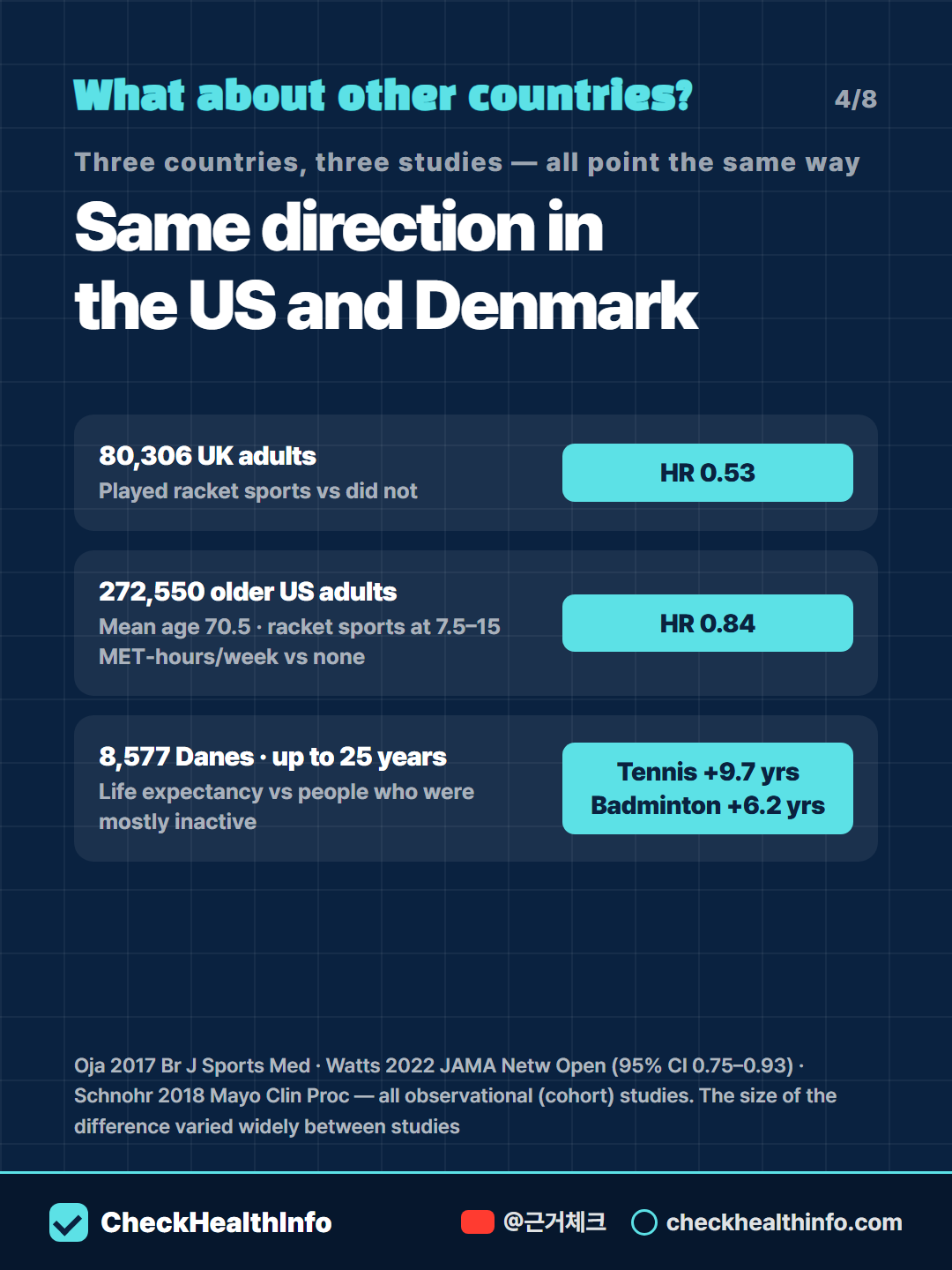
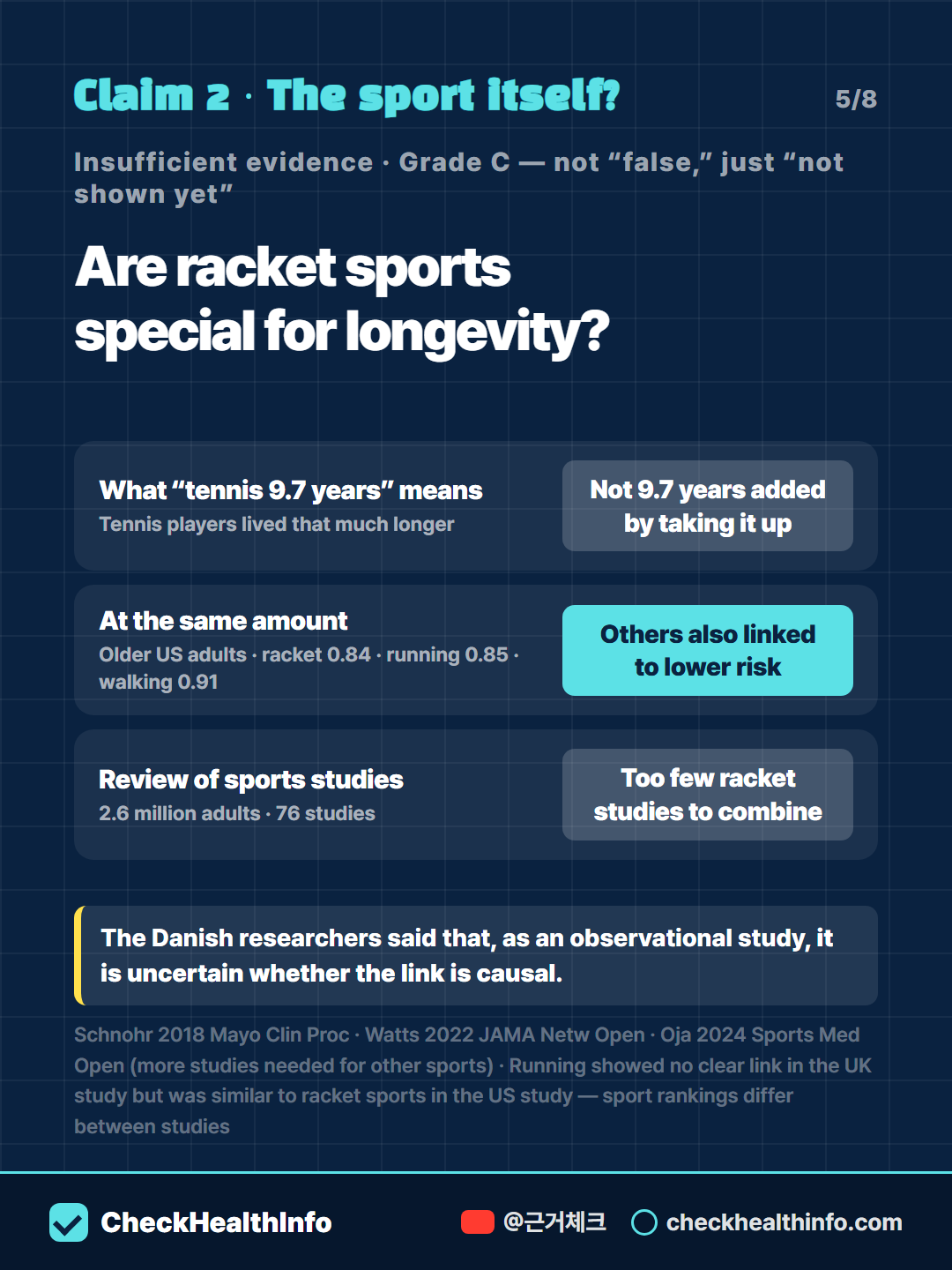
In a study that followed 272,550 older US adults (mean age 70.5) for an average of 12.4 years, people who did 7.5 to less than 15 MET-hours per week of racket sports also had a lower risk of death than those who did not play (HR 0.84, 95% CI 0.75–0.93). [2] In a study that followed 8,577 people in Copenhagen, Denmark, for up to 25 years, life expectancy compared with mostly inactive people was 9.7 years longer for tennis players and 6.2 years longer for badminton players. [3]
Because studies from three countries point the same way, Claim 1 is rated Mostly true · Evidence grade B. A systematic review of sport-specific studies did not pool racket sports [5], so we graded this claim on the cohort studies that looked at racket sports directly (B). It is rated “Mostly true” rather than “True” because the size of the difference varied widely between studies (HR 0.53 to 0.84), and because all of the studies were observational, so they do not show that racket sports themselves caused the difference.
Claim 2 — Racket sports add more years of life than other sports: Insufficient evidence · Evidence grade C
In the Danish study, the differences for tennis (9.7 years) and badminton (6.2 years) were larger than for jogging (3.2 years) or health club activities (1.5 years). That is where the idea that racket sports are “the best sports for longevity” comes from. But the researchers said that, because the study was observational, it remains uncertain whether the relationship is causal, and that the finding that more social sports were linked with longer life needs further investigation. [3] Put simply, it does not mean that playing tennis adds 9.7 years to your life; it means that people who played tennis lived that much longer.
The ranking of sports also differed between studies. In the UK study, running showed no clear link with death [1], but in the US study of older adults, racket sports (0.84) and running (0.85) were linked with the greatest risk reductions at the same amount of activity, and the two were similar; walking (0.91), golf (0.93), swimming (0.95) and cycling (0.97) were also linked with a lower risk. The researchers concluded that this amount of activity was associated with a lower risk of death whatever the type. [2] A systematic review of sport-specific studies (about 2.6 million adults) pooled only cycling, running, swimming and a few other sports, and said more studies were needed for other sports. [5]
So Claim 2 is rated Insufficient evidence · Evidence grade C. We started from the cohort studies that compared several sports (B) and lowered the grade by one level because the sport rankings differed between studies. The systematic review did not cover racket sports, so we used it only as supporting evidence.
Racket sports need a partner, a court and equipment, so people who are already healthier and have more time and money may be more likely to play (confounding). People who start getting sick may also give up demanding sports first (reverse causation). The researchers adjusted for several confounding factors, and the same UK research group later wrote in an editorial that links between certain sports and lower mortality were not explained by affluence and other socioeconomic factors. [4] Even so, differences that were not measured cannot be ruled out.
More certain than the type of sport: the amount
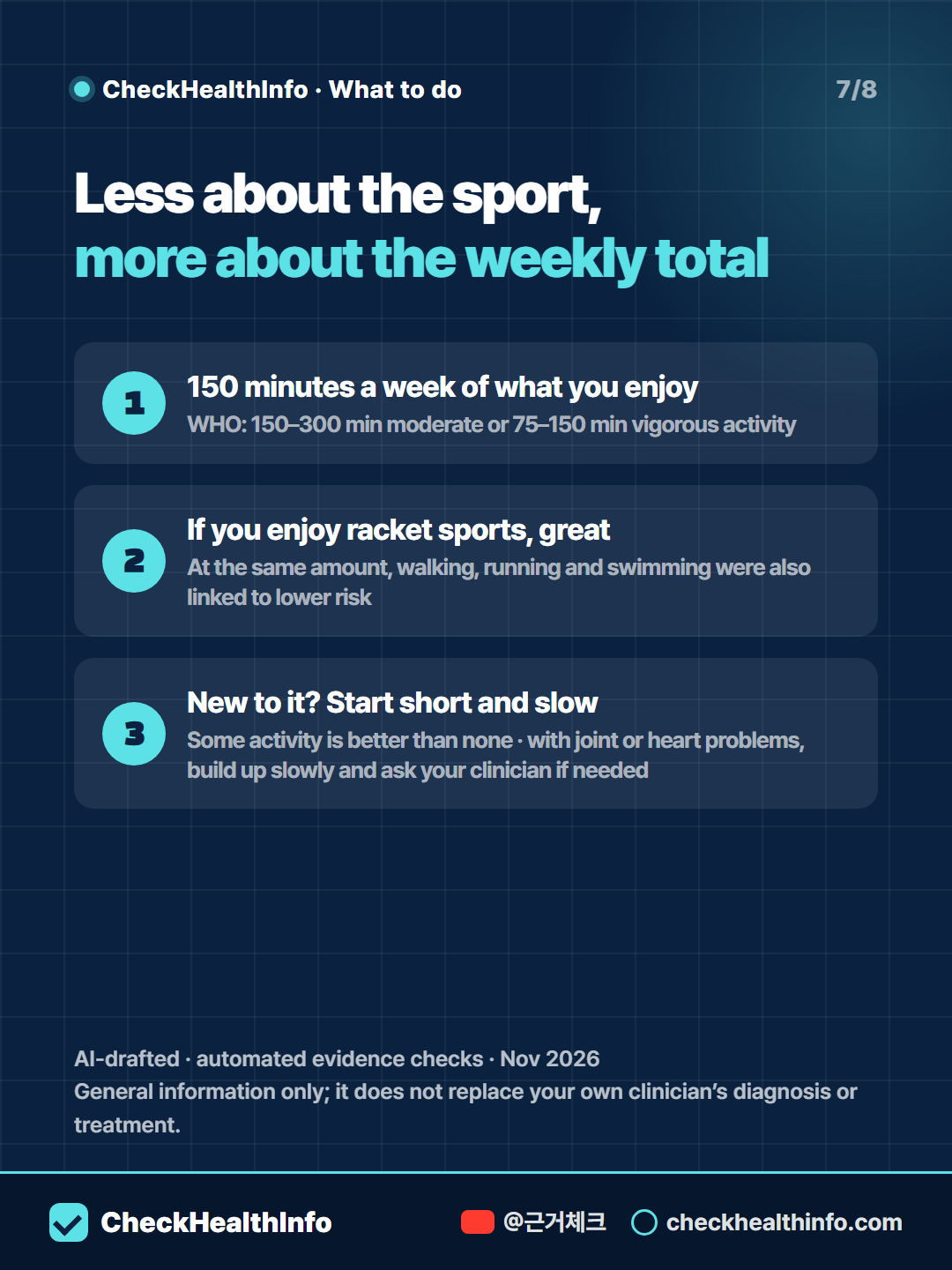
There is far more evidence on the amount of activity and death. A meta-analysis of 80 cohort studies found that 150 minutes a week of moderate-to-vigorous activity was associated with a relative risk of death of 0.86 (95% CI 0.80–0.92), and 300 minutes a week with 0.74 (0.65–0.85). [6] The World Health Organization's 2020 guidelines recommend that adults get 150–300 minutes of moderate-intensity or 75–150 minutes of vigorous-intensity aerobic activity a week, plus regular muscle-strengthening activity, and say that some physical activity is better than none. [7]
If you play racket sports, or want to start
- Reach your weekly total with an activity you enjoy — at least 150 minutes a week of moderate-intensity activity. If you enjoy racket sports, they are a good way to get there. [7]
- No need to chase sport rankings — at the same amount of activity, walking, running, swimming and cycling were also linked with a lower risk of death. [2]
- If you're new, start short and slow — some activity is better than none. If you have joint problems (knees, shoulders) or heart disease, build up intensity slowly and talk to your clinician if needed (the studies in this verdict did not look at injury risk).
Scope: This verdict covers racket sport participation and death or life expectancy. It does not cover other health effects such as muscle, bone or weight, or injury risk.
Limitations of this verdict
- All of the studies linking racket sports with death were observational (cohort) studies, and the type of exercise was self-reported. The abstracts give only relative effects (hazard ratios), not absolute differences in risk.
- In the UK study, the confidence interval for cardiovascular death was wide (0.24–0.83). [1] The studies were done in the UK, the US and Denmark; none of these studies were done in Korea.
- The “9.7 years” is an adjusted difference in life expectancy compared with mostly inactive people, not the number of years you gain by taking up tennis. [3]
- Grades follow section 1 of our rating method. We check for new studies in our monthly PubMed review, and any change in a verdict is recorded in our corrections log.
Card news
Video (in Korean)
References
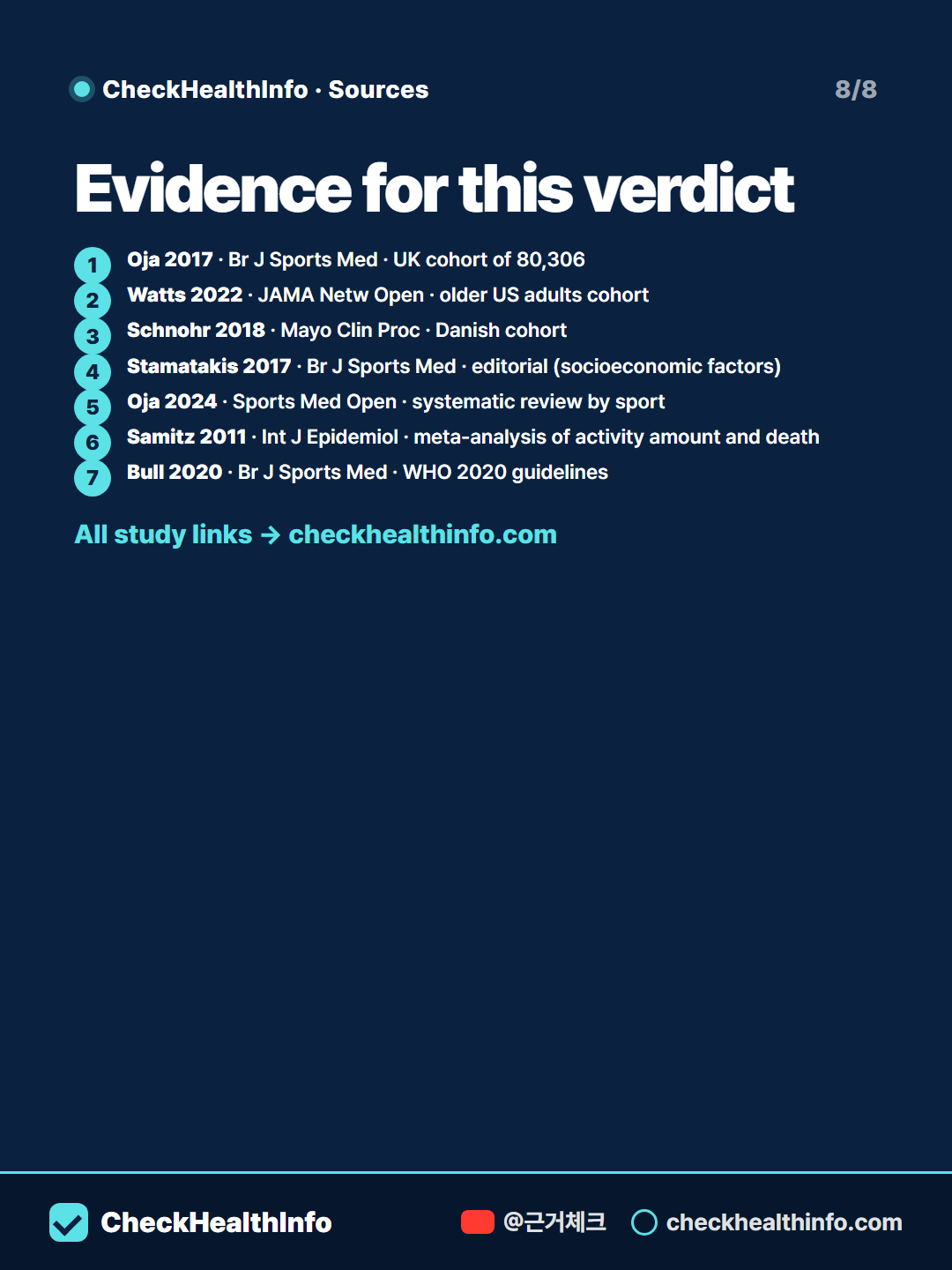
- Oja P, Kelly P, Pedisic Z, et al. Associations of specific types of sports and exercise with all-cause and cardiovascular-disease mortality: a cohort study of 80 306 British adults. Br J Sports Med 2017;51(10):812-817. PMID 27895075. PubMed abstract · Full article
- Watts EL, Matthews CE, Freeman JR, et al. Association of Leisure Time Physical Activity Types and Risks of All-Cause, Cardiovascular, and Cancer Mortality Among Older Adults. JAMA Netw Open 2022;5(8):e2228510. PMID 36001316. PubMed abstract · Full article · Free full text
- Schnohr P, O'Keefe JH, Holtermann A, et al. Various Leisure-Time Physical Activities Associated With Widely Divergent Life Expectancies: The Copenhagen City Heart Study. Mayo Clin Proc 2018;93(12):1775-1785. PMID 30193744. PubMed abstract · Full article
- Stamatakis E, Kelly P, Titze S, et al. The associations between participation in certain sports and lower mortality are not explained by affluence and other socioeconomic factors. Br J Sports Med 2017;51(21):1514-1515. PMID 28179259. PubMed abstract · Full article
- Oja P, Memon AR, Titze S, et al. Health Benefits of Different Sports: a Systematic Review and Meta-Analysis of Longitudinal and Intervention Studies Including 2.6 Million Adult Participants. Sports Med Open 2024;10(1):46. PMID 38658416. PubMed abstract · Full article · Free full text
- Samitz G, Egger M, Zwahlen M. Domains of physical activity and all-cause mortality: systematic review and dose-response meta-analysis of cohort studies. Int J Epidemiol 2011;40(5):1382-400. PMID 22039197. PubMed abstract · Full article
- Bull FC, Al-Ansari SS, Biddle S, et al. World Health Organization 2020 guidelines on physical activity and sedentary behaviour. Br J Sports Med 2020;54(24):1451-1462. PMID 33239350. PubMed abstract · Full article · Free full text
General information only, not medical advice. It does not replace your own clinician’s diagnosis or treatment. If you are just starting to exercise, begin with short, light sessions and build up gradually. If you have joint problems (such as knees or shoulders) or heart disease, increase intensity slowly and talk to your clinician if needed. If you get chest pain, severe shortness of breath or dizziness during exercise, stop right away. In an emergency, call 911 (119 in Korea).