Do Shorts and Reels hurt your focus and memory if you watch them a lot?
Do people who watch a lot of short videos, such as Shorts, Reels and TikTok, really have weaker attention and memory? And does watching short videos actually cause the brain’s focus and memory to get worse?

We checked this verdict against 9 sources, such as published studies and clinical guidelines. · How checked: AI-drafted · automated evidence checks
Verdicts at a glance
| Claim | Verdict |
|---|---|
| People who watch a lot of short videos, such as Shorts and Reels, score lower on attention | Mostly true · Evidence grade B |
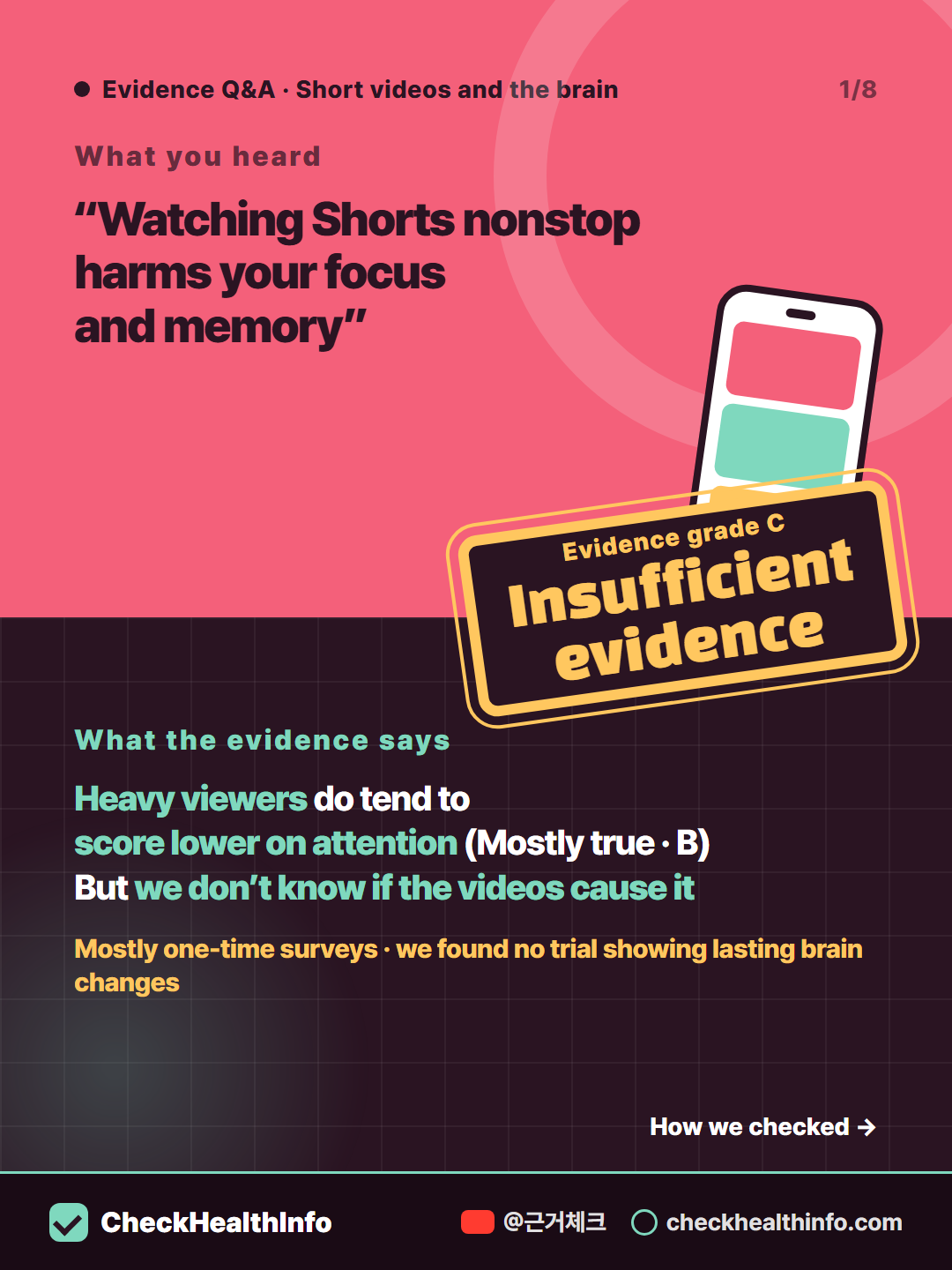
| Watching short videos all the time harms the brain’s focus and memory | Insufficient evidence · Evidence grade C |
Bottom line — Pooled analyses of studies from many countries have repeatedly found that people who watch a lot of short videos, such as YouTube Shorts and Instagram Reels, score lower on attention. So “people who watch a lot of short videos score lower on attention” is rated Mostly true (Evidence grade B). But “watching short videos all the time harms the brain’s focus and memory” is rated Insufficient evidence (Evidence grade C). Most studies surveyed people only once, so people who already find it hard to focus may simply watch more; and in experiments, memory scores were lower right after swiping through videos, but no one measured how long that lasted. Lasting changes in the brain have not been shown. The takeaway: we can’t yet say that short videos harm the brain over time, but setting a viewing limit and taking breaks is a low-risk habit that is worth a try, even without proof.
Cross-sectional study — A study that measures viewing habits and attention at the same time. It can show that two things go together, but not which came first.
Correlation coefficient (r) — How closely two measures move together (the strength of the link). Zero means no link; a negative value means that as one goes up, the other tends to go down. It does not mean videos lower attention scores by a certain number of points.
Inhibitory control — The ability to hold back or stop an impulse. Together with attention, it is part of what we call focus.
Prospective memory — Remembering to do something later at the right time, such as getting to an appointment.
Randomized experiment — A study that assigns people by chance, like drawing lots, so only one group watches short videos. It is the best way to separate cause from coincidence. All the experiments described here measured people only right after watching, and only some of the papers state that people were randomly assigned.
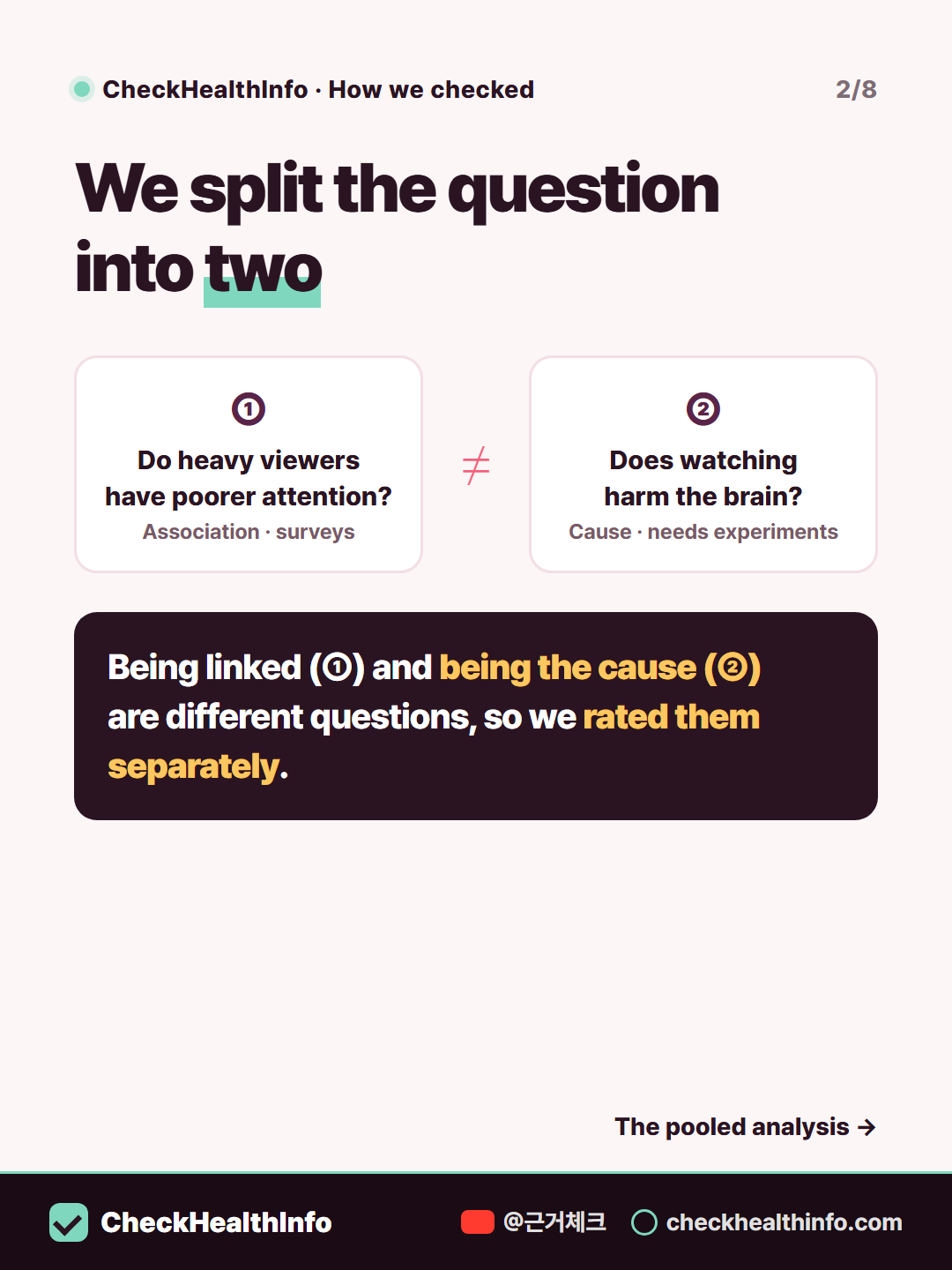
A recent news story said that watching Shorts all the time can get the brain used to intense stimulation, weakening focus and causing forgetfulness. We checked whether short videos really harm the brain’s focus and memory by splitting the claim into two questions. CheckHealthInfo makes Shorts too, so this question matters to us as well.
Verdict 1. “People who watch a lot of short videos, such as Shorts and Reels, score lower on attention”
Mostly true · Evidence grade B
In plain terms Study after study has found that people who watch more short videos tend to have lower attention scores (on tests or questionnaires). But these studies can’t tell us whether the videos are the cause.
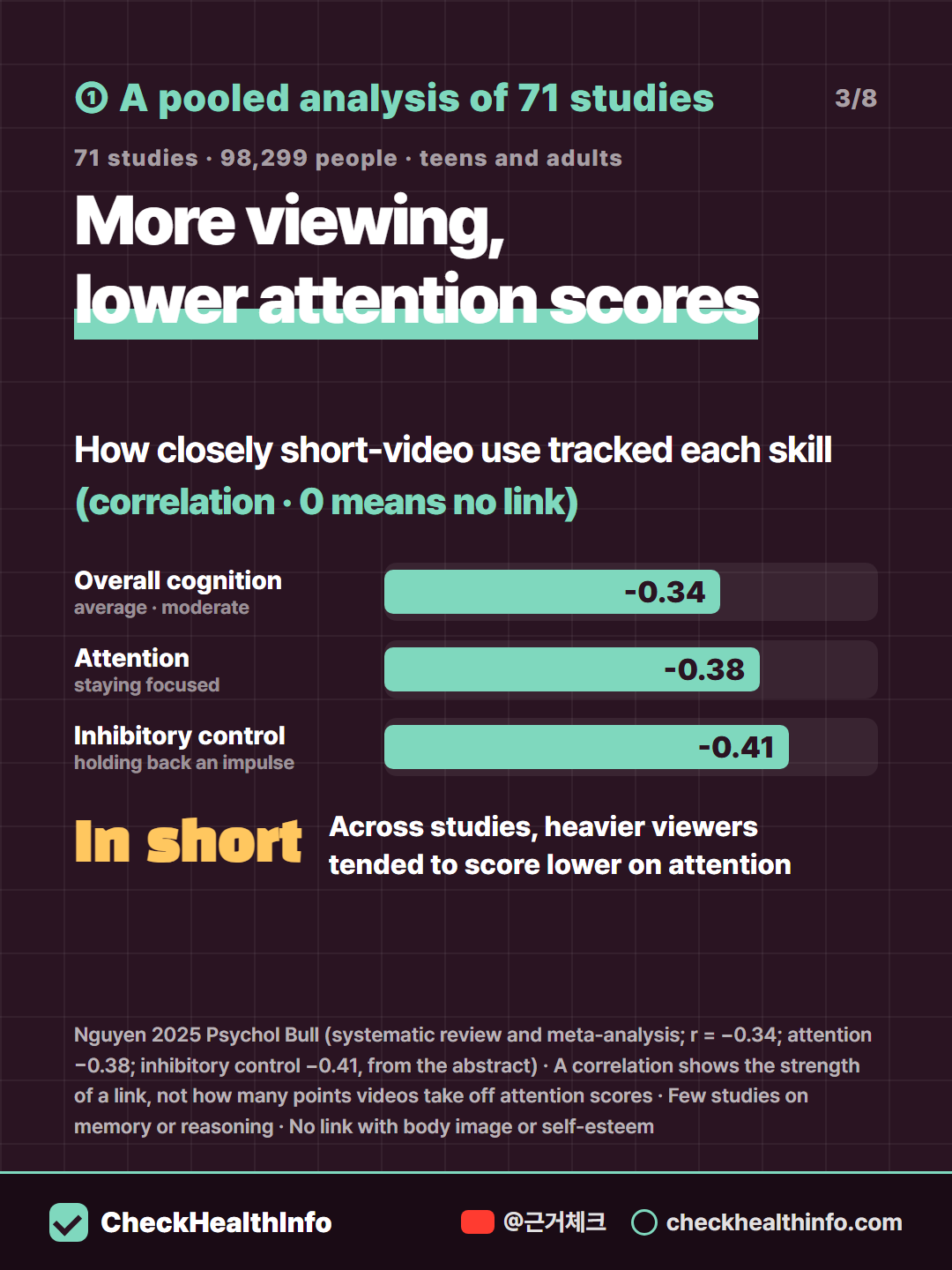
- A meta-analysis of 71 studies with 98,299 people found that heavier short-video use went along with lower scores on thinking skills (average correlation r = -0.34, which the authors called moderate). The links were strongest for attention (-0.38) and inhibitory control (-0.41), and they were similar in teens and adults and across platforms. Few studies looked at other skills such as memory or reasoning, and there was no link with body image or self-esteem. [1]
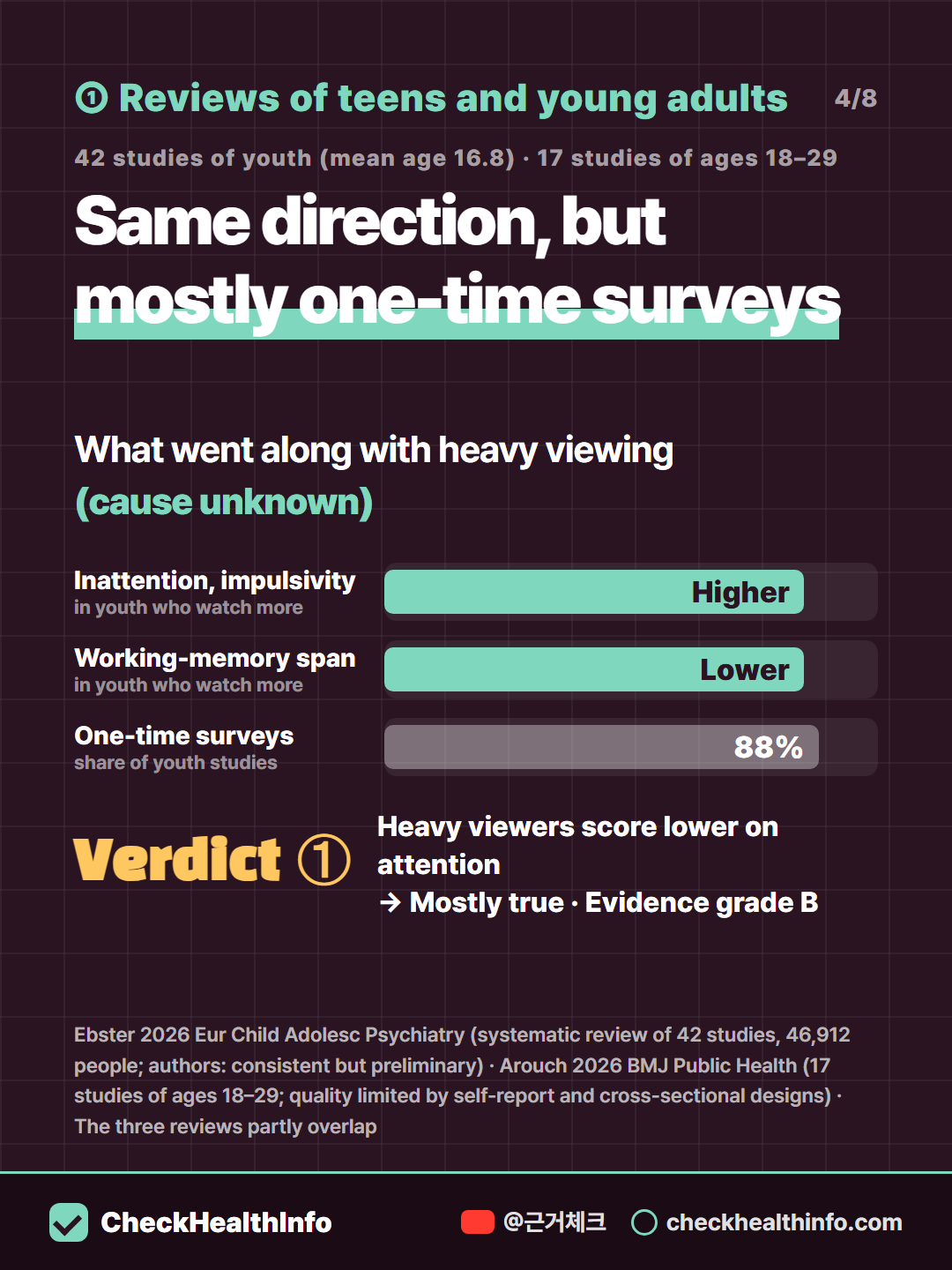
- A systematic review of 42 studies of young people (46,912 participants, mean age 16.8) also found that heavy, poorly controlled viewing was consistently linked with more inattention and impulsivity and with a smaller working-memory span and weaker self-regulation. However, 88% of the studies were cross-sectional, and the authors called the evidence consistent but preliminary. [2]
- A review of 17 studies of adults aged 18 to 29 reported preliminary evidence that heavier viewing went along with fragmented attention and weaker executive control. It judged the quality of the evidence to be limited by self-report and inconsistent outcome definitions. [3]
Grade: The strongest evidence is systematic reviews and meta-analyses, so we started at A, then moved down one level to B because they pool observational studies (mostly cross-sectional surveys) rather than randomized trials. We did not move it down further because all three reviews pointed in the same direction, but it is a borderline call, since many studies measured viewing through self-report or “addiction” scales. It is rated “Mostly true” rather than “True” because, although the link has been found again and again, we can’t tell which came first, and there is too little evidence on memory, so the finding is narrower than the claim.
Evidence grades run in four levels, from A (high) to D (very low). Pooled observational studies are moved down one level to B. See our rating method for details.
Verdict 2. “Watching short videos all the time harms the brain’s focus and memory”
Insufficient evidence · Evidence grade C
In plain terms It has not been shown that short videos harm the brain over the long term. This doesn’t mean the claim is wrong; it means there is not yet enough research on lasting changes.
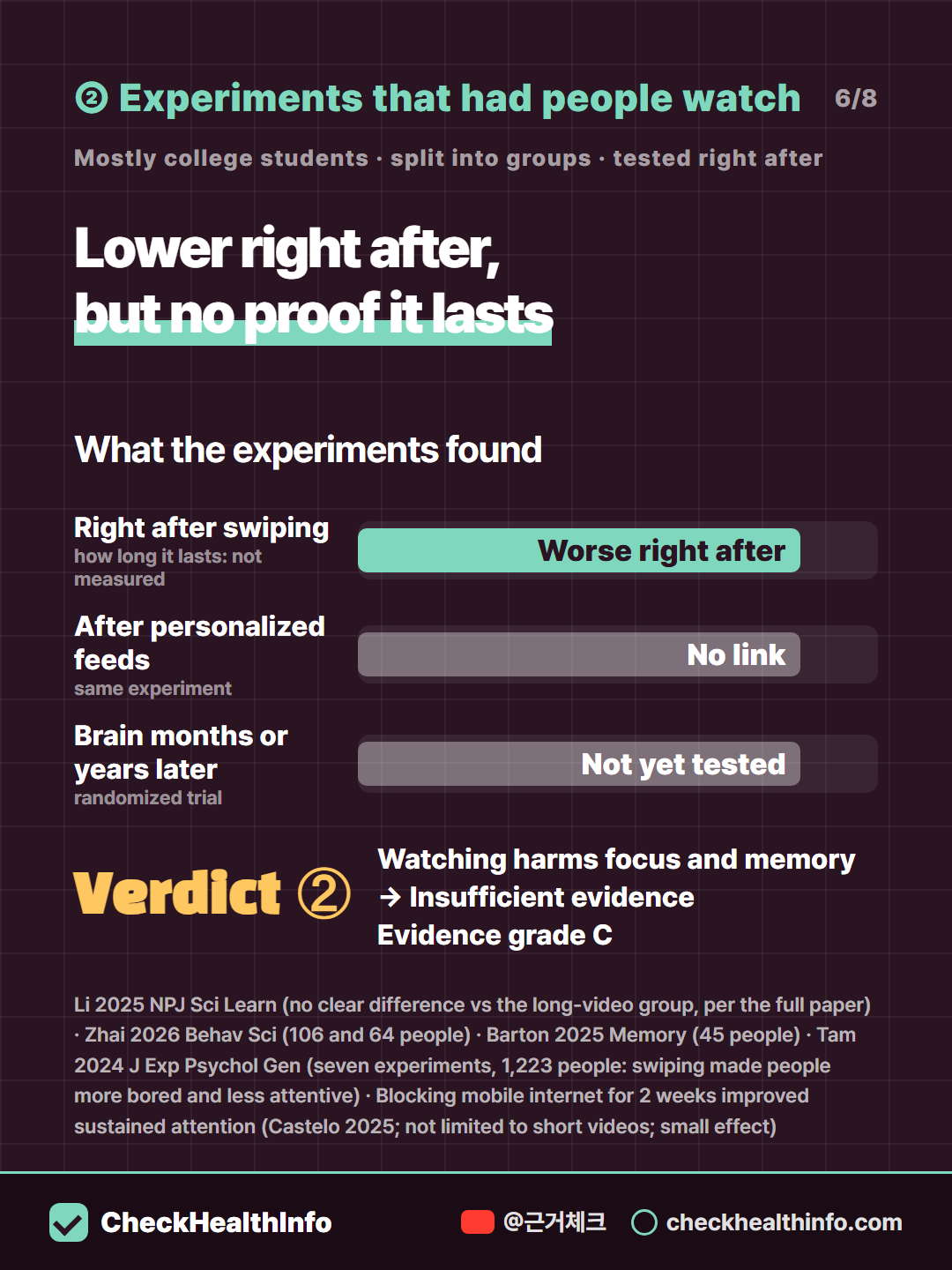
- In a randomized experiment (113 college students, per the full paper), people watched 15 minutes of short videos. The authors summarized that after a random mix of short videos, people remembered a longer video less well, especially those who usually watch a lot of short videos. However, in the full paper, memory scores were not clearly different from those of a group that watched a documentary, and in the group that watched their own personalized feeds there was no such link. [4]
- In experiments with 106 and 64 college students, those who spent a long stretch watching short videos, rather than one long video, were less accurate at remembering to do something later (prospective memory). In an experiment with 45 people, prospective memory also got worse when people could swipe through videos as fast as they liked, but it actually improved when swiping was limited. [5] [6]
- In seven experiments (1,223 people), swiping between and within videos did not relieve boredom; it made people more bored and lowered satisfaction and attention. The results were less clear for online articles and for people who were not college students. [7]
- In plain terms, some experiments found lower memory and attention scores right after swiping through short videos, but they did not measure how long this lasted, and our search found no randomized trial that checked whether the brain is different months or years later.
- One trial came at the question from the opposite side, by cutting back. In a randomized trial that blocked mobile internet on smartphones for 2 weeks (467 people, per the full paper; texts, calls, and internet on computers were still allowed), objectively measured sustained attention, mental health, and well-being improved. However, it blocked all mobile internet, not just short videos, and the effects were small (per the full paper). [8]
Grade: In our search, we found no trial that randomly set how many short videos people watched and followed them over time. The lab experiments compared groups, so they start at B (random assignment is stated in only some of the papers), but they measured a short-lived change right after watching, not a lasting change in the brain (indirect evidence), so we moved them down one level to C; and because the results depended on the conditions (no link in the personalized-feed group, and limited swiping actually improved memory), they would be D on their own. The mobile-internet trial is also indirect because it did not block only short videos, so it is C. That is why we rated it C. The label is “Insufficient evidence.” That does not mean short videos have been shown to be harmless, either.
If you watch a lot of Shorts, try this
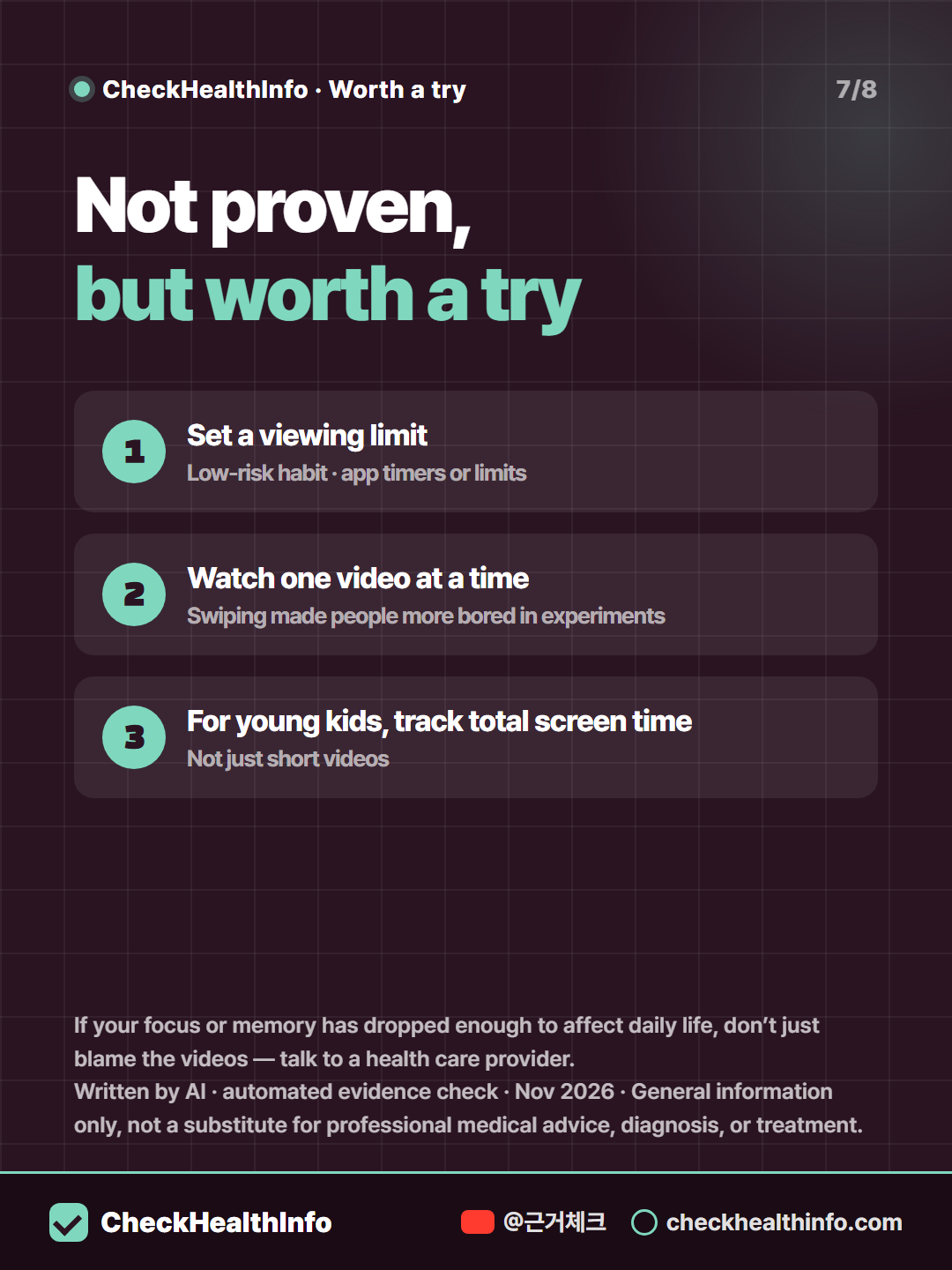
- Set a viewing limit. It hasn’t been shown to protect the brain, but it is a low-risk habit. You can use your phone’s app time limits or a timer.
- Watch one video at a time instead of swiping. In experiments, swiping made people more bored and less attentive. [7]
- For young children, keep an eye on total screen time. In a study of 2,441 Canadian children assessed at 24, 36, and 60 months, more screen time at one age went along with slightly lower developmental screening scores at the next age (an observational study based on mothers’ reports, and not specific to short videos). [9]
- If your focus or memory has dropped enough to affect daily life, don’t just blame the videos; talk to a health care provider.
Scope: This verdict covers short-video viewing and focus and memory in teens and adults. It does not cover dopamine receptor changes, diagnoses such as ADHD or dementia, or differences by video content (educational vs. entertainment).
Limitations of this verdict
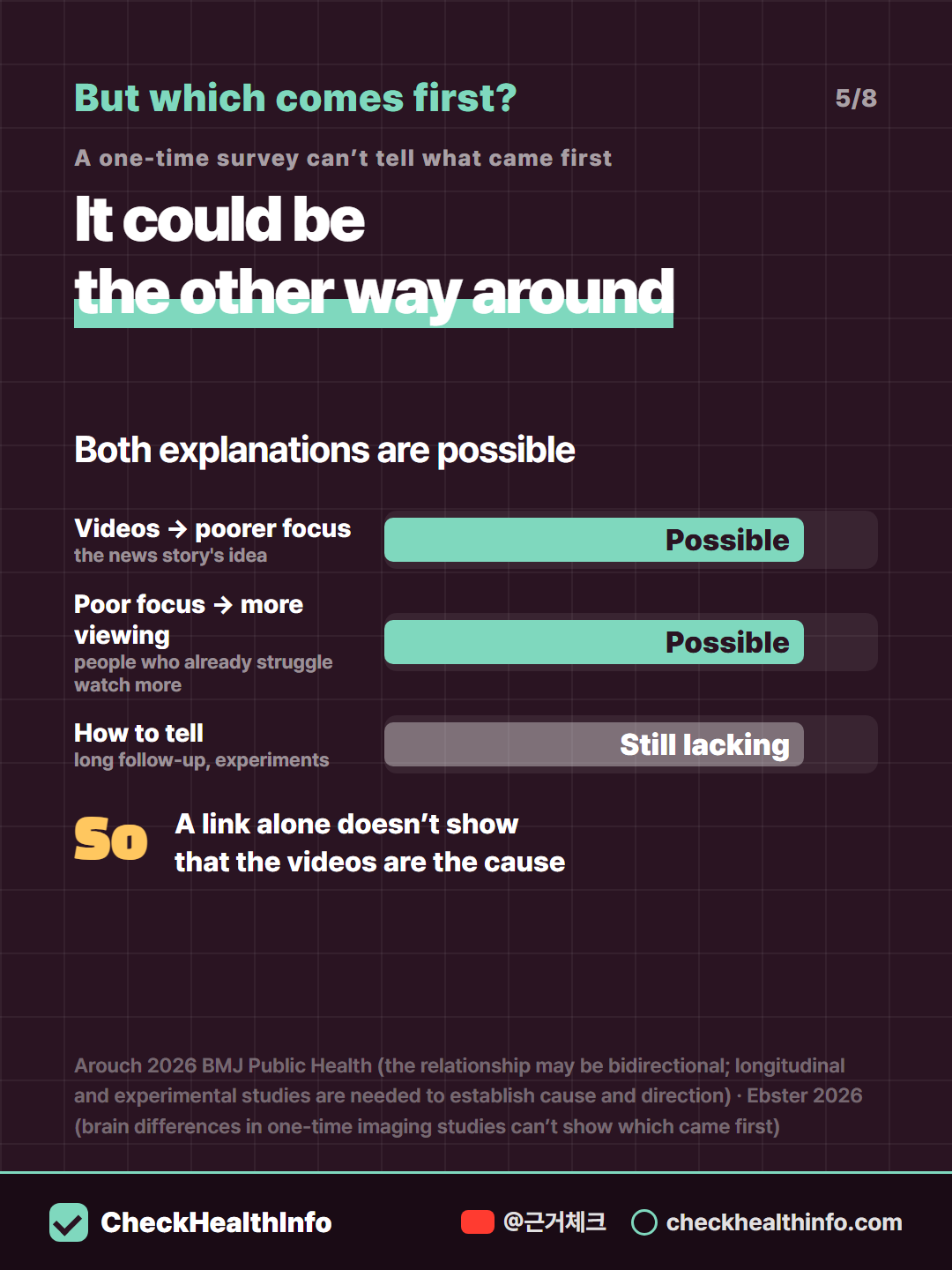
- The evidence for Verdict 1 comes mostly from cross-sectional surveys. The review authors noted that the relationship may run both ways: people who already have attention or mental health difficulties may watch short videos more often and find it harder to stop. [3]
- Viewing was mostly self-reported or measured with “addiction” scales, and some studies also measured attention with questionnaires. A correlation shows the strength of a link, not how many points videos take off attention scores. The three reviews partly include the same studies, so they are not fully independent confirmations.
- Most participants were teens, college students, or young adults; there is little data on middle-aged or older adults.
- The lab experiments measured people only right after watching, and they used different comparisons (a long video, a documentary, or no video) and tasks, so their effect sizes can’t be compared. In the mobile-internet trial, participants knew their internet was blocked, so expectations may have played a part; according to the full paper, only 119 of 467 people (25.5%) kept the block as defined in advance, and most participants were strongly motivated to cut back. One memory experiment recruited only students who usually watch 0.5 to 3 hours a day and excluded some participants without preregistration (per the full paper).
- The brain-imaging studies of young people (included in review [2]) compared people at a single time point, so they can’t show whether videos changed the brain or whether people with different brains watched more. As for the news story’s claim that dopamine receptors decrease, our search found no study showing that watching short videos causes this change in people.
- This article was prompted by a news story. We do not evaluate any news outlet or person.
- Grades follow section 1 of our rating method. We check for new studies in our monthly PubMed review, and if a verdict changes, we record it in our corrections log.
Card news
Video (in Korean)
References
- Nguyen L, Walters J, Paul S, et al. Feeds, feelings, and focus: A systematic review and meta-analysis examining the cognitive and mental health correlates of short-form video use. Psychol Bull 2025;151(9):1125-1146. PMID 41231585. PubMed abstract · Full article
- Ebster M, Lauerer M, Nagel E, et al. Taming the endless scroll? Short-form videos, digital routines and neurocognitive outcomes in youth : a systematic literature review. Eur Child Adolesc Psychiatry 2026;35(9):2727-2743. PMID 42287412. PubMed abstract · Full article · Free full text
- Arouch S, Edgcumbe D, Pezaro S, et al. Short-form video, cognitive and mental health outcomes: a systematic review. BMJ Public Health 2026;4(3):e004086. PMID 42781066. PubMed abstract · Full article · Free full text
- Li H, Li J, Hao X, et al. Behavioral and eye-tracking investigation of event segmentation following short video watching. NPJ Sci Learn 2025;10(1):86. PMID 41298532. PubMed abstract · Full article · Free full text
- Zhai K, Guo Y, Wang L. The Influence of Short-Video Usage on Prospective Memory Under Different Cue Type Conditions. Behav Sci (Basel) 2026;16(6). PMID 42352735. PubMed abstract · Full article · Free full text
- Barton N, Smyth M. Context-switching in short-form videos: What is the impact on prospective memory?. Memory 2025;33(7):788-801. PMID 40553577. PubMed abstract · Full article
- Tam KYY, Inzlicht M. Fast-forward to boredom: How switching behavior on digital media makes people more bored. J Exp Psychol Gen 2024;153(10):2409-2426. PMID 39158465. PubMed abstract · Full article
- Castelo N, Kushlev K, Ward AF, et al. Blocking mobile internet on smartphones improves sustained attention, mental health, and subjective well-being. PNAS Nexus 2025;4(2):pgaf017. PMID 39967678. PubMed abstract · Full article · Free full text
- Madigan S, Browne D, Racine N, et al. Association Between Screen Time and Children's Performance on a Developmental Screening Test. JAMA Pediatr 2019;173(3):244-250. PMID 30688984. PubMed abstract · Full article · Free full text
General information only, not medical advice. It does not replace your own clinician’s diagnosis or treatment. If problems with focus or memory are getting in the way of daily life, don’t just blame short videos — talk to a health care provider.