If you hit snooze and go back to sleep, is it worse for your body?
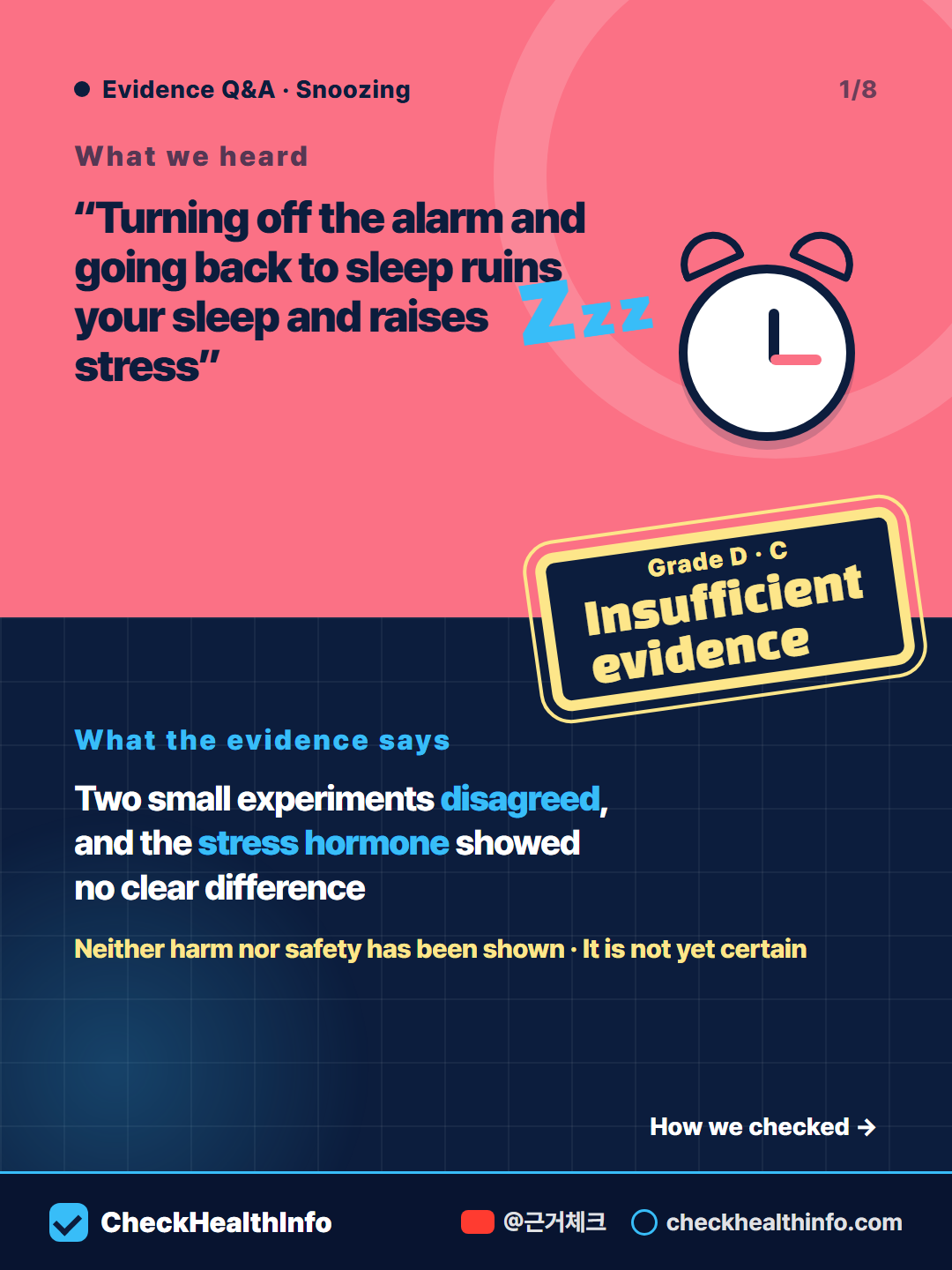
Does waking up several times by snoozing ruin your sleep, leave you more tired, or increase stress such as cortisol?

We checked this verdict against 8 sources, such as published studies and clinical guidelines. · How checked: AI-drafted · automated evidence checks
Verdicts at a glance
| Claim | Verdict |
|---|---|
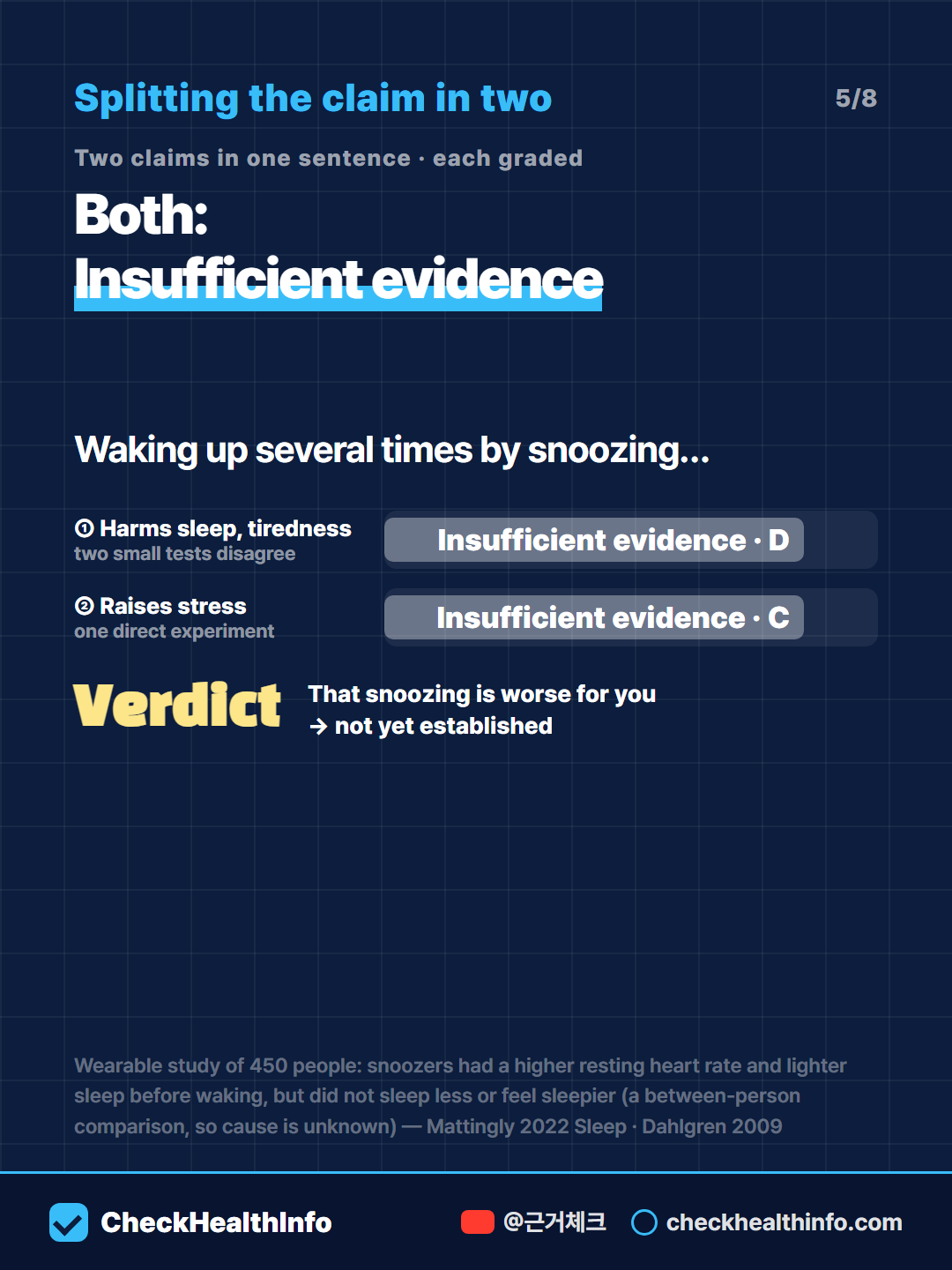
| Waking up several times by snoozing ruins your sleep and leaves you more tired | Insufficient evidence · Evidence grade D |
| Waking up several times by snoozing increases stress (a stress response such as cortisol) | Insufficient evidence · Evidence grade C |
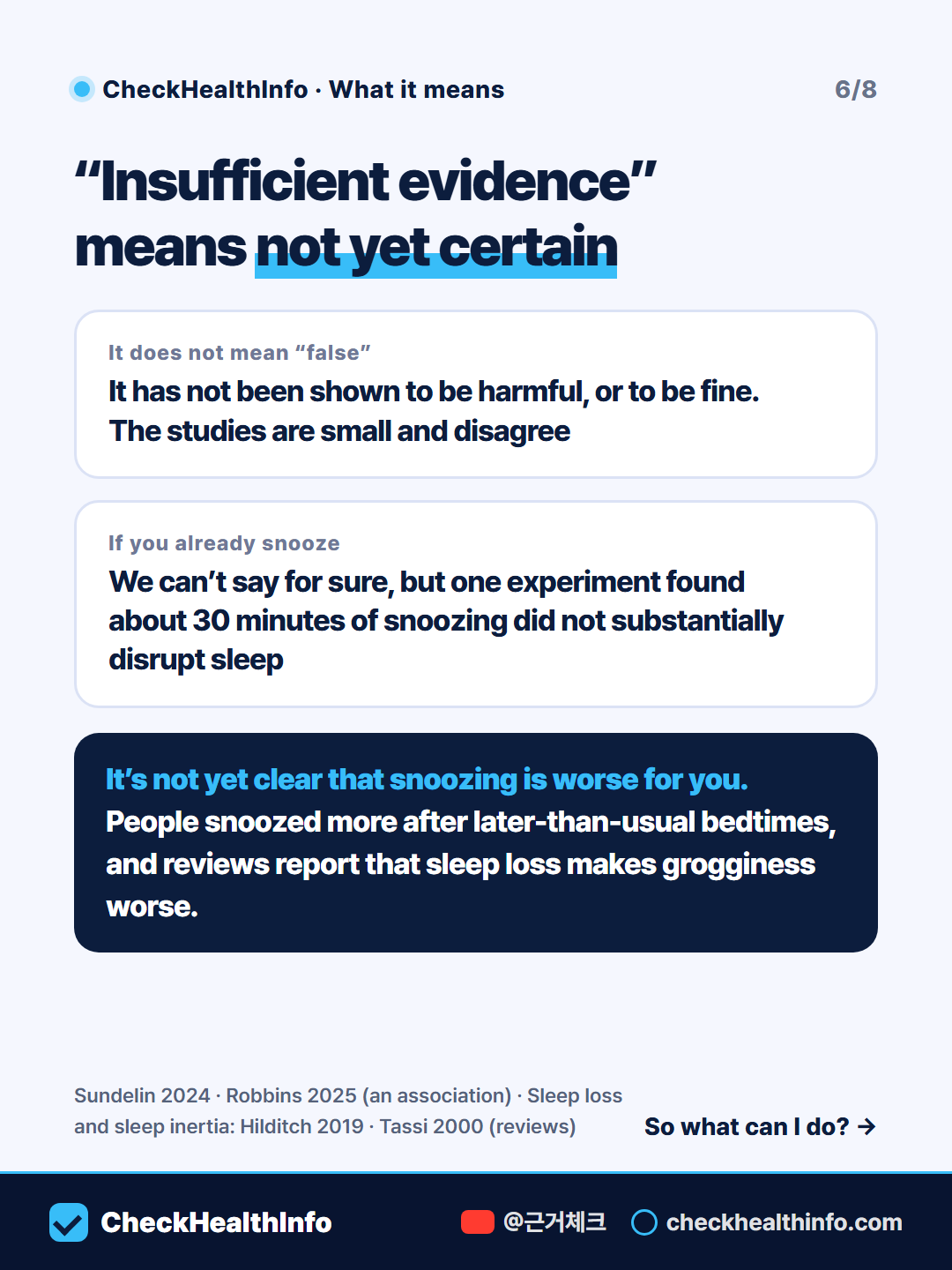
Bottom line — The claim that waking up several times by hitting snooze ruins your sleep and leaves you more tired is rated Insufficient evidence (Evidence grade D). The claim that it increases stress (a stress response such as cortisol) is also rated Insufficient evidence (Evidence grade C). Two small experiments disagreed, and the one experiment that measured the stress hormone directly found no clear difference. In short, it is not yet established that snoozing is worse for you. We can’t say for sure, but one experiment found that about 30 minutes of snoozing did not substantially disrupt sleep. If you want to get up with the first alarm, not going to bed late may be worth trying first (no study has yet tested whether this reduces snoozing).
Snoozing — Turning off an alarm so it rings again a few minutes later and dozing in between. Setting several alarms works the same way.
Sleep inertia — The groggy state right after waking, when your mind is slow for a while.
Polysomnography — An overnight test that records brain waves, breathing, heart rate and more to see how deep (which stage) your sleep is.
Cortisol awakening response — The normal, brief rise in the stress hormone cortisol after waking in the morning.
We checked the claim that “setting multiple alarms, turning them off and going back to sleep ruins your sleep and raises your stress.” Because it mixes two statements — ① sleep and morning tiredness, and ② stress — we gave two separate verdicts.
Verdict 1. “Waking up several times by snoozing ruins your sleep and leaves you more tired”
Insufficient evidence · Evidence grade D
In plain words Two small experiments reached different results, so we can’t yet say whether snoozing harms sleep or is fine. “Insufficient evidence” does not mean “false”; it means the evidence in people is not yet enough.
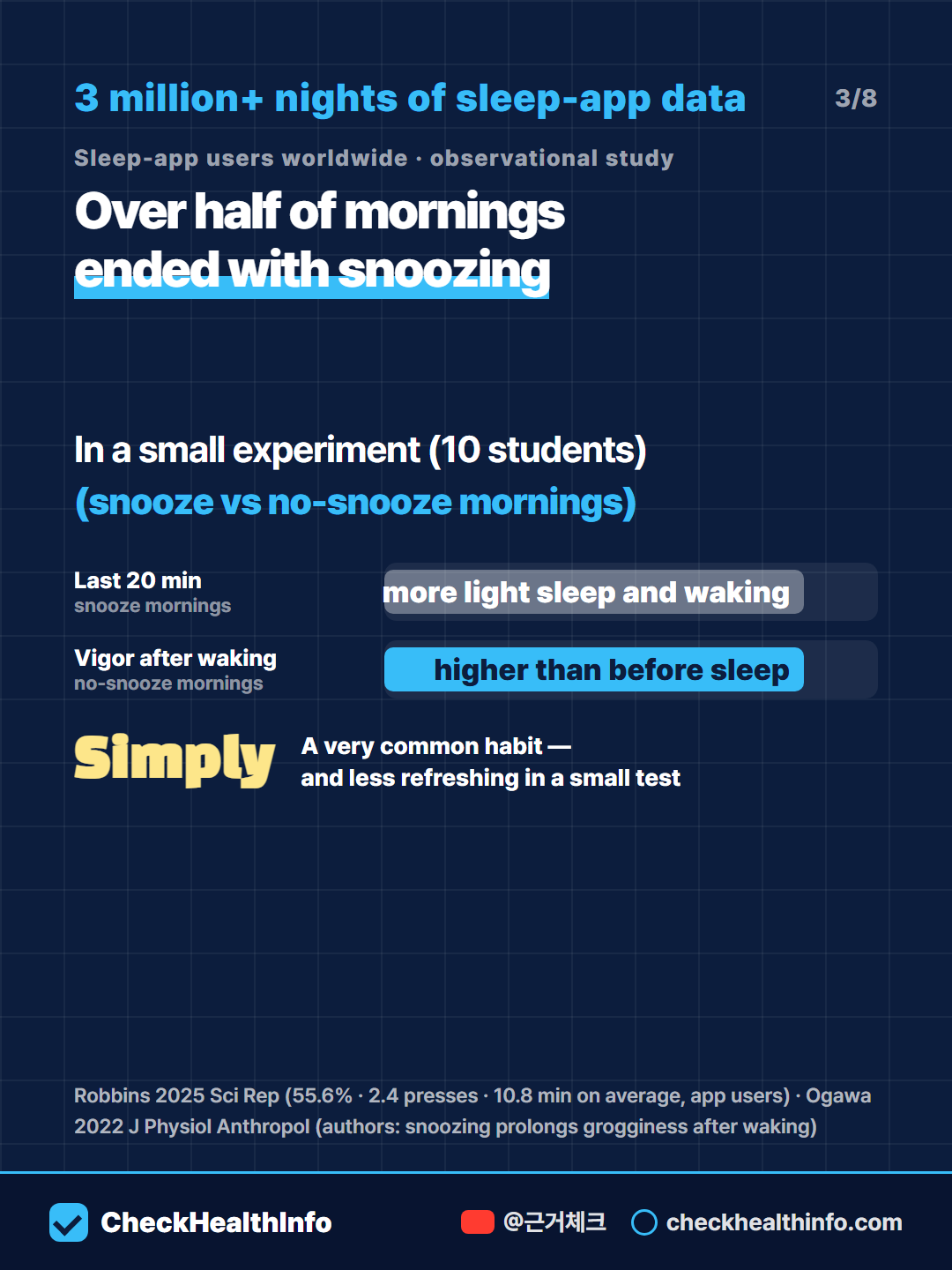
- Snoozing is very common. A study of more than 3 million nights recorded by users of a sleep app worldwide found that over half (55.6%) of logged sleep sessions ended with snoozing; on those mornings, people pressed snooze 2.4 times on average, for 10.8 minutes. App users may differ from the general population. [1]
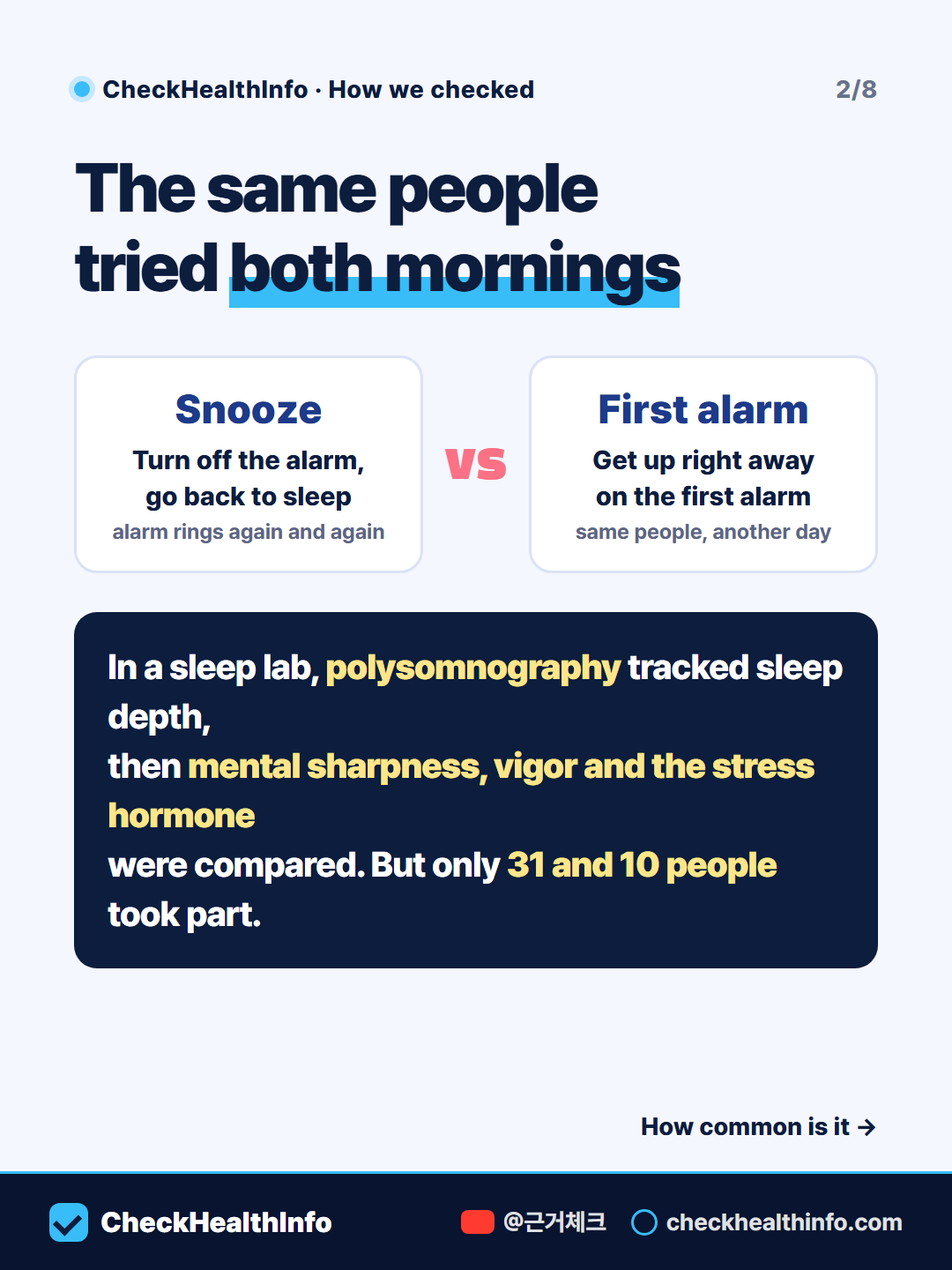
- In a sleep-lab study of 10 Japanese university students, snoozing increased wake time and light sleep (stage N1) during the last 20 minutes before getting up. Only on mornings without snoozing was vigor higher after waking than before sleep, and the authors concluded that snoozing, by forcing repeated awakenings, prolongs sleep inertia compared with a single alarm. In the same study’s survey of 293 students, 70.5% said they often used the snooze function on their phones, mainly because they worried about oversleeping. [2]
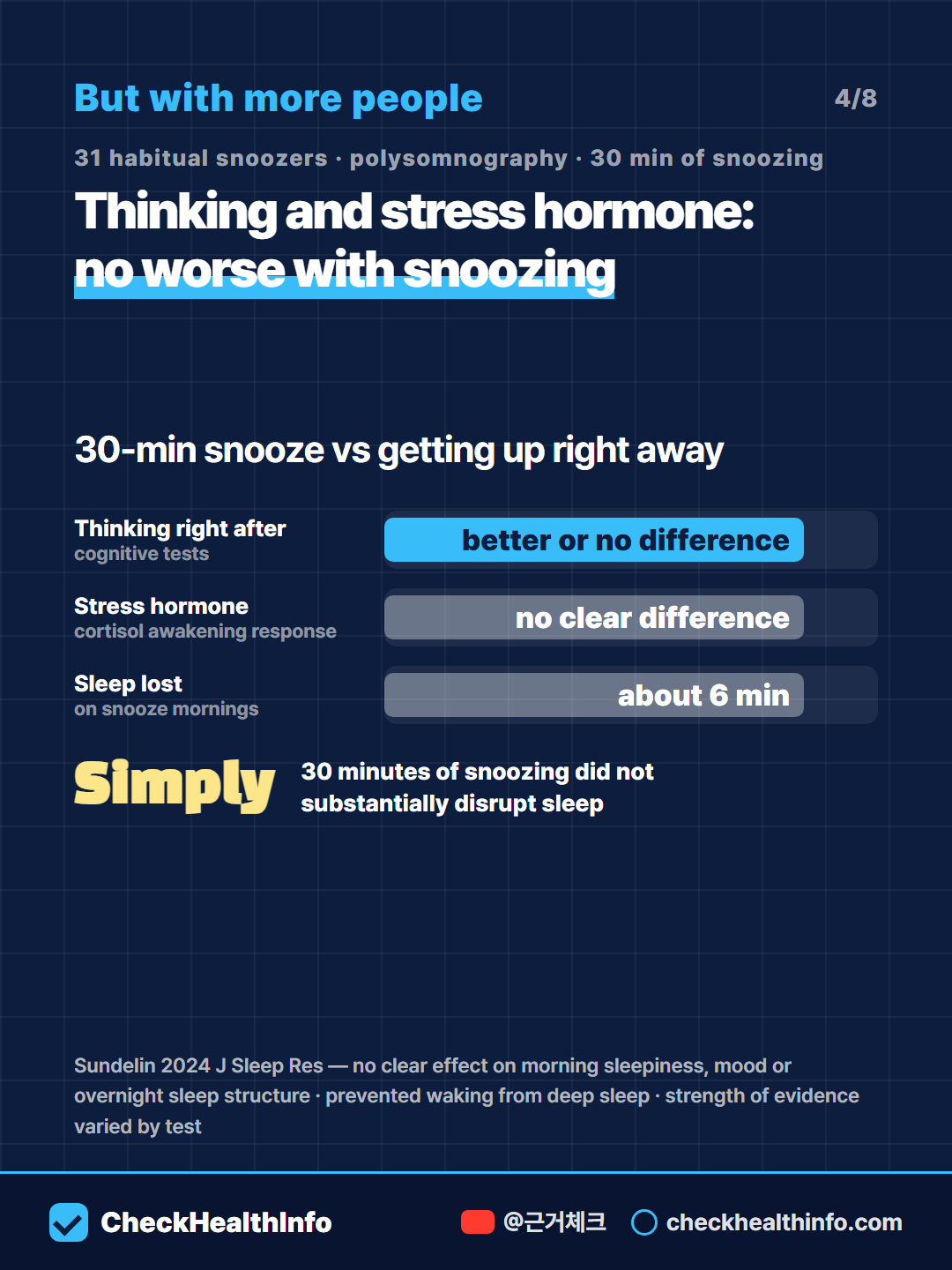
- However, an experiment in 31 habitual snoozers, also done in a sleep lab with polysomnography, found that 30 minutes of snoozing improved or did not affect performance on cognitive tests right after getting up, compared with waking abruptly (the strength of evidence varied by test). Snoozing cost about 6 minutes of sleep, prevented waking from deep sleep (N3), and had no clear effect on morning sleepiness, mood or overnight sleep structure. [3] In plain words, in the experiment with more people, 30 minutes of snoozing did not substantially disrupt sleep.
- In a study of 450 people using wearable devices, 57% snoozed. Snoozers had lighter sleep before waking, but they did not sleep less, feel sleepier or nap more. [4]
Grade: The most direct evidence on snoozing and sleep or morning tiredness comes from two small sleep-lab studies (31 and 10 people), so the rating starts at C. Because their results conflict, we lowered it one level to D. The large survey and app-data studies are observational and looked at how common snoozing is and who snoozes, which is indirect for the question of cause, so they did not raise the grade. No reliable study (A or B) has shown it is harmless either, so the verdict is “Insufficient evidence,” not “False.”
Evidence grades run from A (high) to D (very low). Small studies start at C, and conflicting results lower the grade one level. See How we rate for details.
Verdict 2. “Waking up several times by snoozing increases stress (a stress response such as cortisol)”
Insufficient evidence · Evidence grade C
In plain words Only one snoozing experiment measured the stress hormone directly, and it found no increase. Because it is just one study, this is not yet certain.
- In an experiment comparing a morning of 30 minutes of snoozing with a morning of getting up right away in 31 habitual snoozers, there was no clear difference in the cortisol awakening response, and no clear effect on mood or morning sleepiness. [3]
- In an observational study of 450 people, snoozers had a higher resting heart rate. But because it compared snoozers with non-snoozers, we can’t tell whether snoozing caused this or whether people with a higher heart rate tend to snooze more. [4]
- In a study where 14 office workers measured cortisol in saliva for 4 weeks, on mornings when no cortisol awakening response was detected, they stayed in bed longer after first waking. The authors only suggested that snoozing may have shifted the sampling time so the response was missed; they did not measure snoozing directly. [5]
Grade: The most direct evidence is one small experiment (31 people), so the grade is C. The higher heart rate in the observational study is an indirect marker, not cortisol, and the direction of cause is unknown, so we list it only as supporting evidence. Feeling startled or annoyed by an alarm is common, but that is not evidence that it raises stress enough to harm health.
If you want to get up with the first alarm
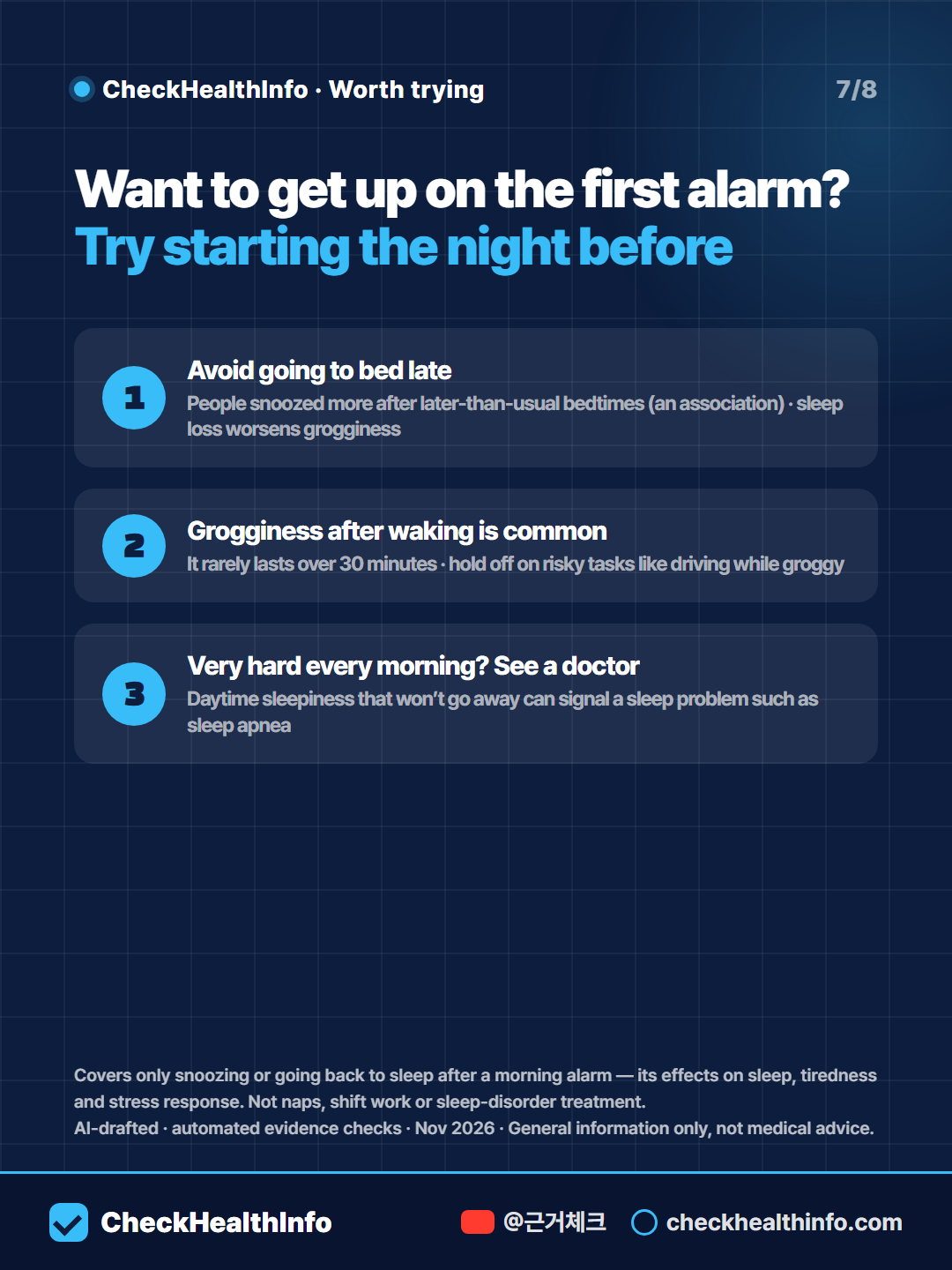
- Avoid going to bed late (a habit worth trying) — in sleep-app data, people who went to bed earlier snoozed less, and those who went to bed later than usual snoozed more (an association). [1] Reviews also report that prior sleep loss makes grogginess after waking (sleep inertia) worse. [6] [7]
- Grogginess right after waking is common — it is stronger when you are woken abruptly from deep sleep, and without major sleep loss it rarely lasts more than 30 minutes. [6] While you feel groggy, it is best to hold off on risky tasks such as driving (general safety advice).
- Choosing an alarm sound — in non-emergency awakenings, melodic alarms or music people liked showed positive results, but evidence on alarm types for adults is not yet firm. [8]
- If you already snooze — we can’t say for sure, but one experiment found that about 30 minutes of snoozing did not substantially disrupt sleep. [3] In a small experiment where the alarm rang several times in the last 20 minutes, however, people felt less refreshed. [2] If getting up is very hard every morning or you stay sleepy during the day, it could be a sleep problem such as sleep apnea, so consider seeing a doctor (general advice).
Scope: These verdicts cover only the habit of turning off a morning alarm and going back to sleep (snoozing, multiple alarms) and sleep, morning tiredness and stress response. They do not cover naps, shift work, or the diagnosis or treatment of sleep disorders.
Limitations
- The experiments that looked directly at snoozing were small (31 and 10 people) and lasted one or a few nights. We don’t know what happens with years of daily snoozing, or in older adults, shift workers, or people with heart disease or high blood pressure. [2] [3]
- In the survey and wearable studies, snoozers more often reported morning drowsiness, short sleep and a late chronotype. Rather than snoozing being the cause, people who are short on sleep or go to bed late may simply snooze more. However, in the same app data, nights longer than 9 hours were also more likely to end with snoozing, and in the wearable study snoozers did not sleep less, so lack of sleep alone does not explain it. [1] [3] [4]
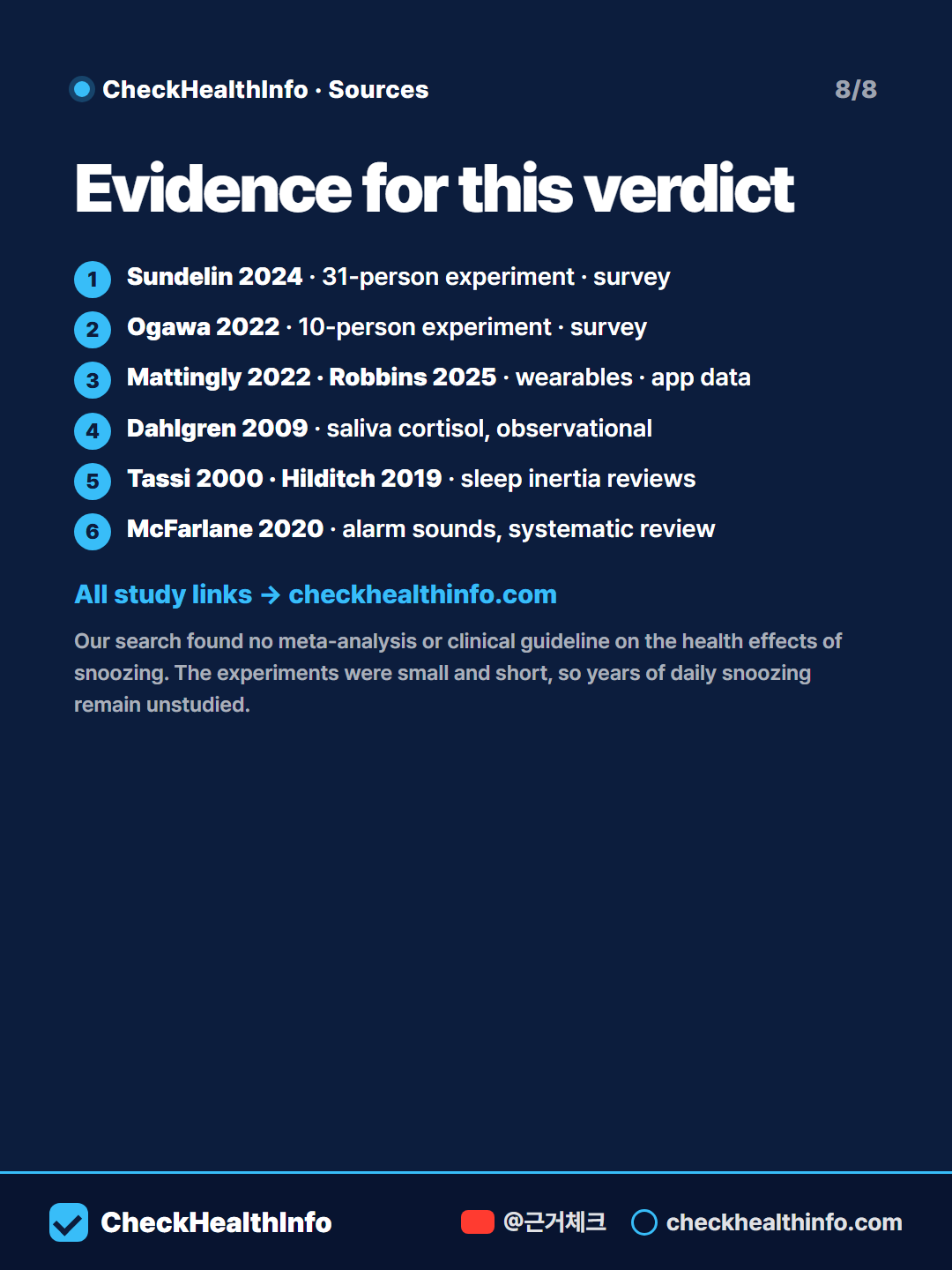
- Our search found no systematic review, meta-analysis or clinical guideline on the health effects of snoozing. The authors of the app-data study also said more research is needed on how snoozing affects daytime performance. [1]
- This article was prompted by a news story. We do not evaluate any media outlet, person or product.
- Grades follow section 1 of How we rate. We check new studies in our monthly PubMed review, and any change to a verdict is logged in Corrections.
Card news
Video (in Korean)
References
- Robbins R, Sääf D, Weaver MD, et al. Snooze alarm use in a global population of smartphone users. Sci Rep 2025;15(1):16942. PMID 40389592. PubMed abstract · Full article · Free full text
- Ogawa K, Kaizuma-Ueyama E, Hayashi M. Effects of using a snooze alarm on sleep inertia after morning awakening. J Physiol Anthropol 2022;41(1):43. PMID 36587230. PubMed abstract · Full article · Free full text
- Sundelin T, Landry S, Axelsson J. Is snoozing losing? Why intermittent morning alarms are used and how they affect sleep, cognition, cortisol, and mood. J Sleep Res 2024;33(3):e14054. PMID 37849039. PubMed abstract · Full article
- Mattingly SM, Martinez G, Young J, et al. Snoozing: an examination of a common method of waking. Sleep 2022;45(10). PMID 35951011. PubMed abstract · Full article · Free full text
- Dahlgren A, Kecklund G, Theorell T, et al. Day-to-day variation in saliva cortisol--relation with sleep, stress and self-rated health. Biol Psychol 2009;82(2):149-55. PMID 19596045. PubMed abstract · Full article
- Tassi P, Muzet A. Sleep inertia. Sleep Med Rev 2000;4(4):341-353. PMID 12531174. PubMed abstract · Full article
- Hilditch CJ, McHill AW. Sleep inertia: current insights. Nat Sci Sleep 2019;11:155-165. PMID 31692489. PubMed abstract · Full article · Free full text
- McFarlane SJ, Garcia JE, Verhagen DS, et al. Alarm Tones, Voice Warnings, and Musical Treatments: A Systematic Review of Auditory Countermeasures for Sleep Inertia in Abrupt and Casual Awakenings. Clocks Sleep 2020;2(4):416-433. PMID 33118526. PubMed abstract · Full article · Free full text
General information only, not medical advice. It does not replace your own clinician’s diagnosis or treatment. If you often feel very sleepy during the day, avoid driving while drowsy and talk to your doctor or healthcare provider.