Does a hot bowl of soup raise your blood pressure?
Does eating a lot of soup (Korean soups, stews and broths) really raise your blood pressure?

We checked this verdict against 6 sources, such as published studies and clinical guidelines. · How checked: AI-drafted · automated evidence checks
Verdicts at a glance
| Claim | Verdict |
|---|---|
| Eating a lot of soup makes you eat more salt, which can raise your blood pressure | Mostly true · Evidence grade B |
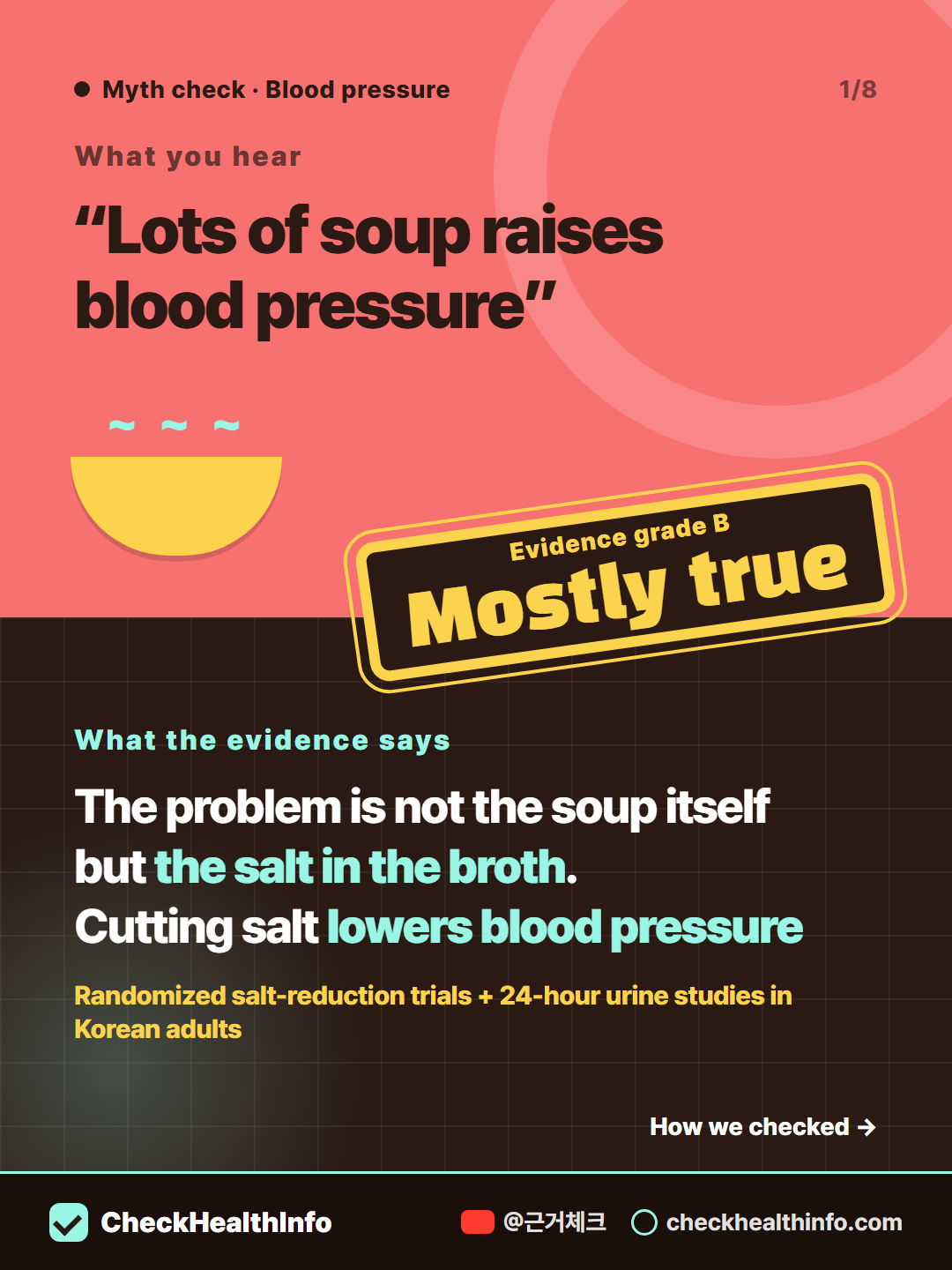
Bottom line — The claim that “eating a lot of soup (Korean soups, stews and broths) makes you eat more salt, which can raise your blood pressure” is rated “Mostly true.” Here is what the evidence shows: the problem is not the soup itself but the salt in it. People who enjoy salty broth and drink every last drop were eating more salt, and randomized trials have shown that cutting salt lowers blood pressure. This does not mean one bowl will raise your blood pressure right away, and we found no randomized trial that tested cutting back on soup itself.
Randomized trial — a study that assigns people to groups by chance, like drawing lots, and compares them. It is the best way to show cause and effect.
Systematic review · meta-analysis — a study that gathers all relevant studies using set methods, appraises them, and combines their results.
Cross-sectional study — an observational study that measures many people once, at a single point in time. It can show a link but cannot prove cause.
Systolic (top) blood pressure · mmHg — systolic pressure is the top number on a blood pressure reading; mmHg is the unit.
Odds ratio — compares how likely something is in two groups. A value of 1 means no difference; above 1 means more likely.
95% confidence interval — the range in which the true value is likely to fall.
Claim. “Eating a lot of soup makes you eat more salt, which can raise your blood pressure”
Mostly true · Evidence grade B
In plain terms If soup affects blood pressure, it is because of the salt in the broth. Many randomized trials have shown that eating less salt lowers blood pressure, and the habit of finishing the broth was linked to eating more salt.
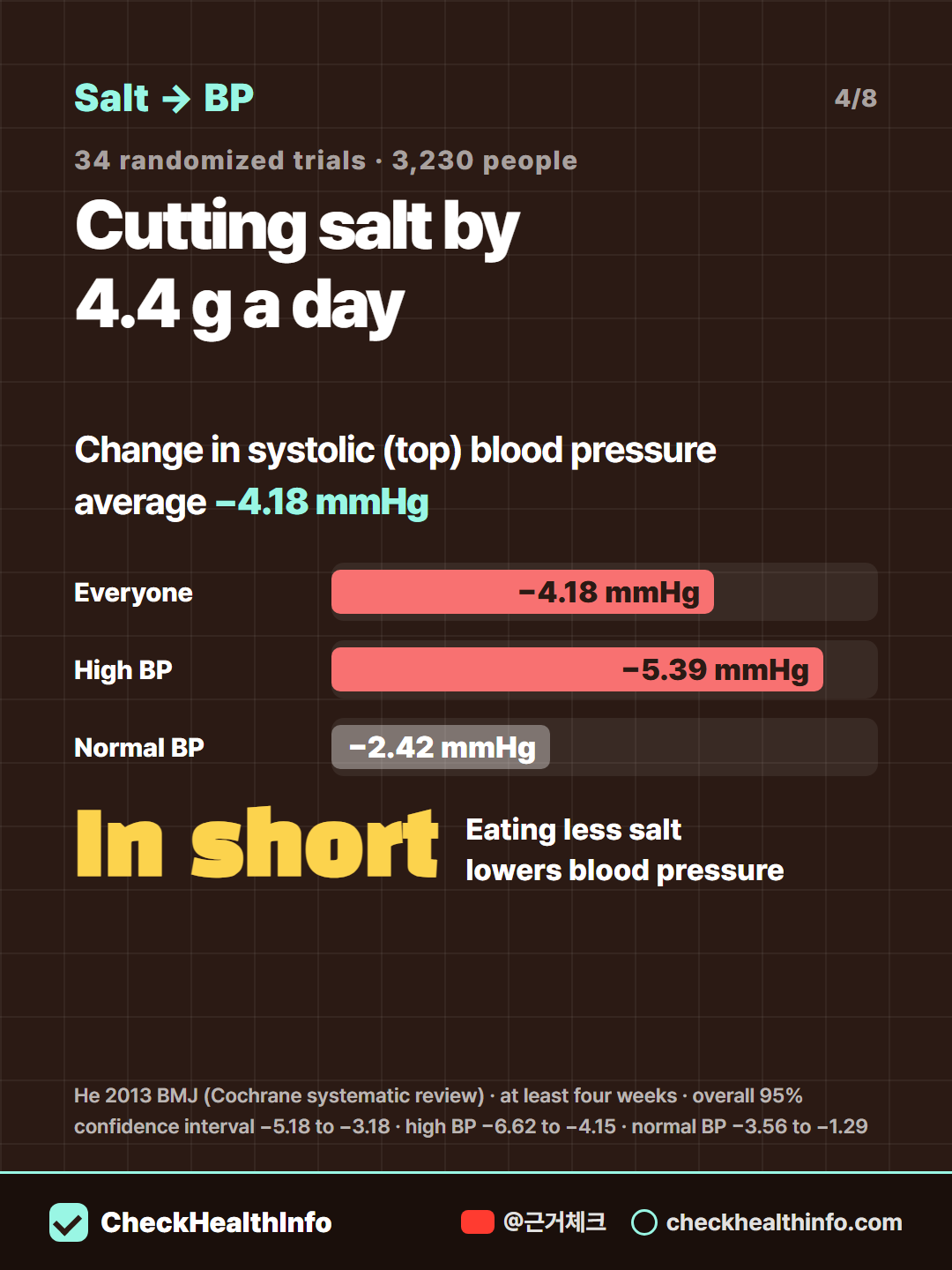
- A Cochrane systematic review of 34 randomized trials (3,230 people) that modestly reduced salt for at least four weeks found that when urinary sodium fell by 75 mmol a day (about 4.4 g less salt a day), systolic blood pressure fell by an average of 4.18 mmHg (95% confidence interval 3.18 to 5.18). It fell by 5.39 mmHg in people with high blood pressure and by 2.42 mmHg even in people with normal blood pressure. In plain terms, eating about 4.4 g less salt a day lowered the top number by about 4 mmHg on average. [1]
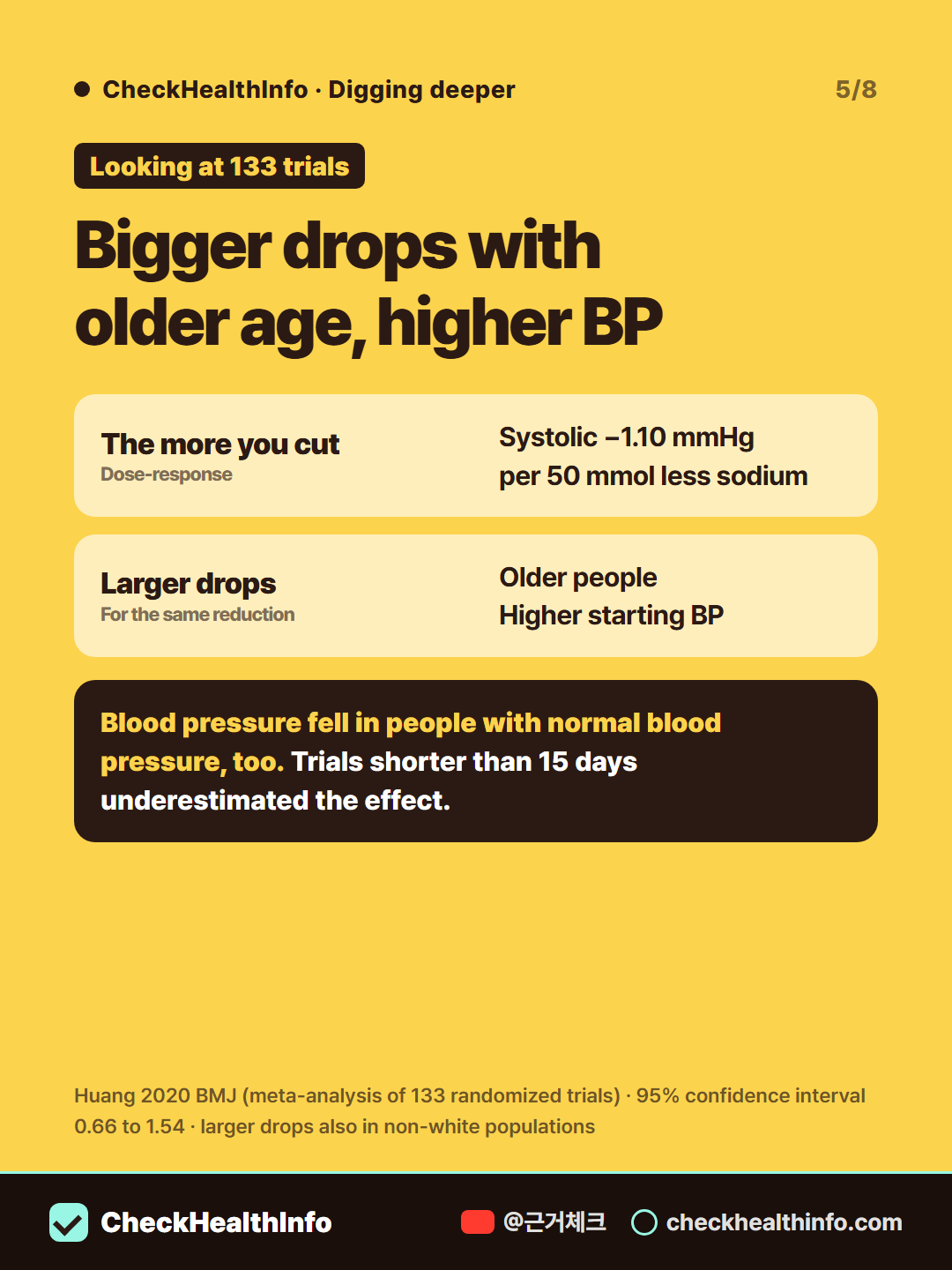
- A meta-analysis of 133 randomized trials (12,197 people) also found that larger salt reductions lowered blood pressure more (systolic pressure fell 1.10 mmHg for every 50 mmol less sodium), and that for the same reduction, the drop was larger in older people and in those with higher blood pressure to begin with. Trials shorter than 15 days underestimated the effect. In plain terms, the more salt people cut, the more their blood pressure fell. [2]
- An umbrella review of 21 meta-analyses found that high salt intake was linked to higher odds of high blood pressure (odds ratio 1.33, 95% confidence interval 1.24 to 1.42), and that each additional 1 g of sodium a day was linked to 0.60 mmHg higher systolic blood pressure. [3]
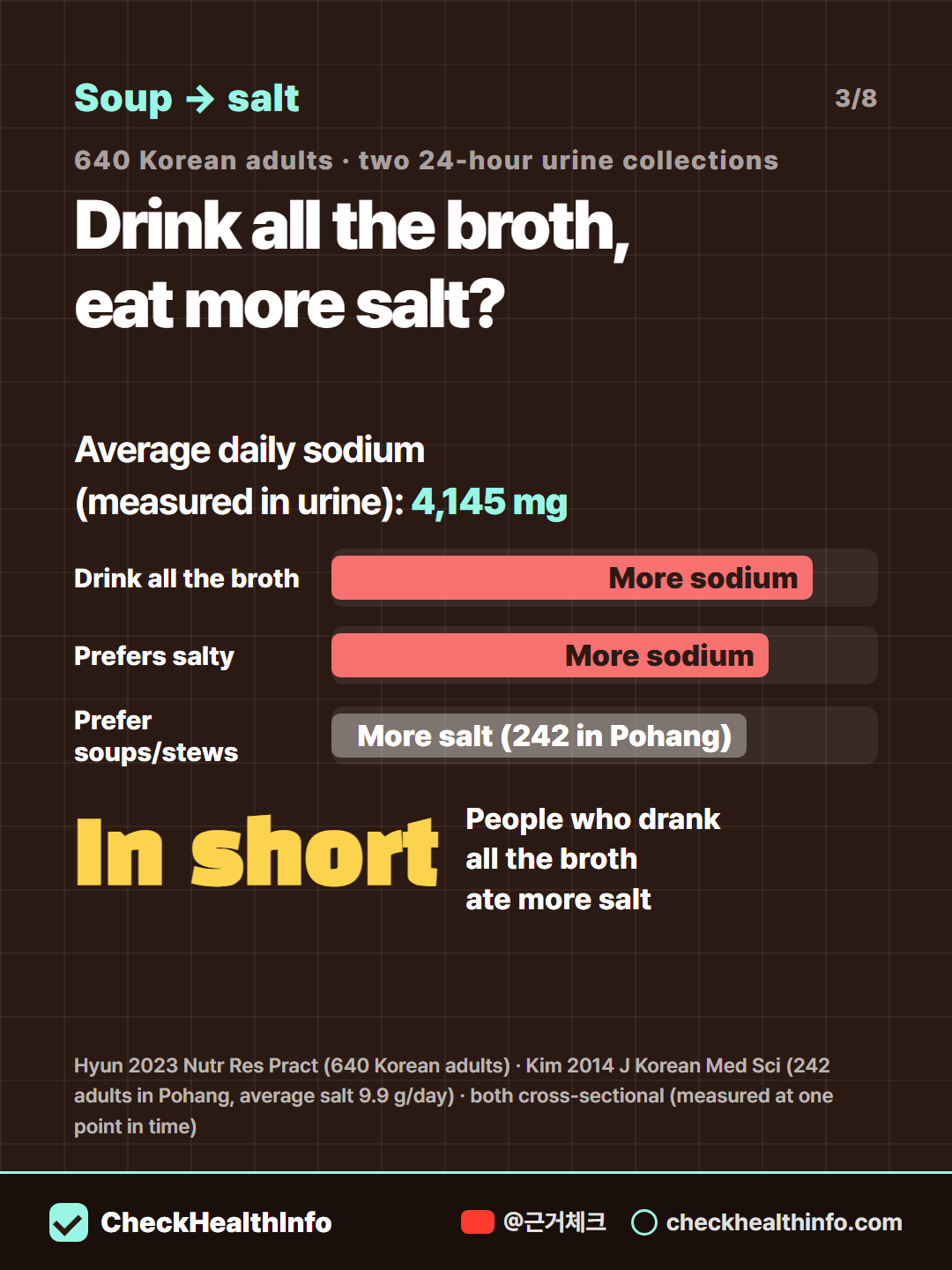
- In a study of 640 Korean adults who each collected 24-hour urine twice, average sodium intake was 4,145 mg a day, and people who drank all the broth ate significantly more sodium. [4] In a study of 242 adults in Pohang, Korea (average salt intake 9.9 g a day), people who preferred soups and stews also ate more salt. [5]
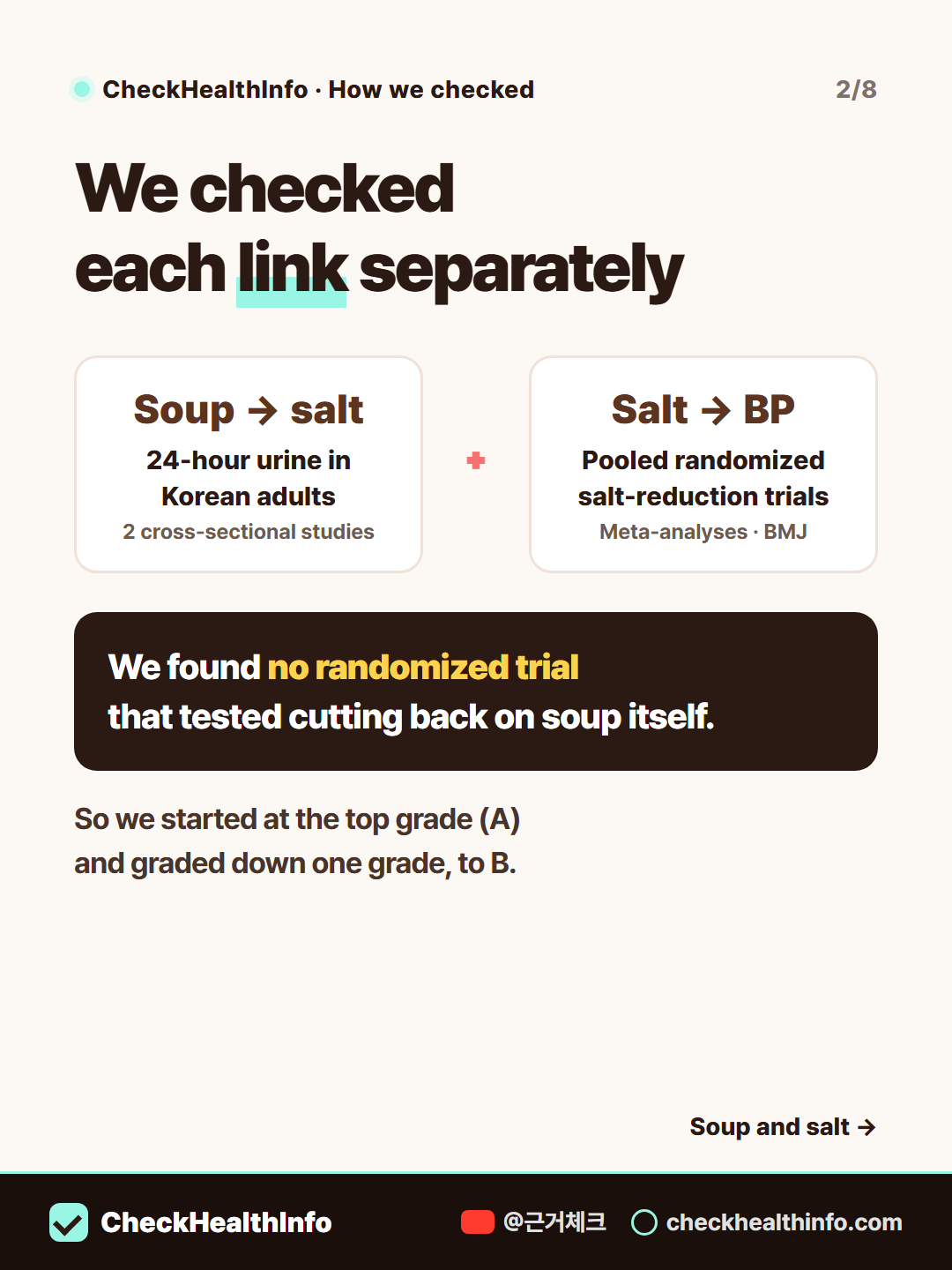
The highest level of evidence is systematic reviews and meta-analyses of randomized trials, so we started at A. But those trials looked at cutting salt overall, not soup, and the link “people who enjoy soup eat more salt” comes only from cross-sectional studies in Korean adults, so the evidence is indirect (reason (1) in section 1 of our rating method; down one grade). That gives B. Results of the salt-reduction trials varied a lot between studies (heterogeneity I² 75%), but age, ethnicity, blood pressure status and the amount of salt cut explained 68% of that variation, and blood pressure fell in every subgroup, so we did not grade down further. This claim is a single chain of cause and effect (soup → salt → blood pressure), so we did not split it into two verdicts. The evidence supports the claim, but soup matters only because of its salt, and the effect depends on how salty it is and how much broth you drink, so it is rated “Mostly true” (section 2 of our rating method).
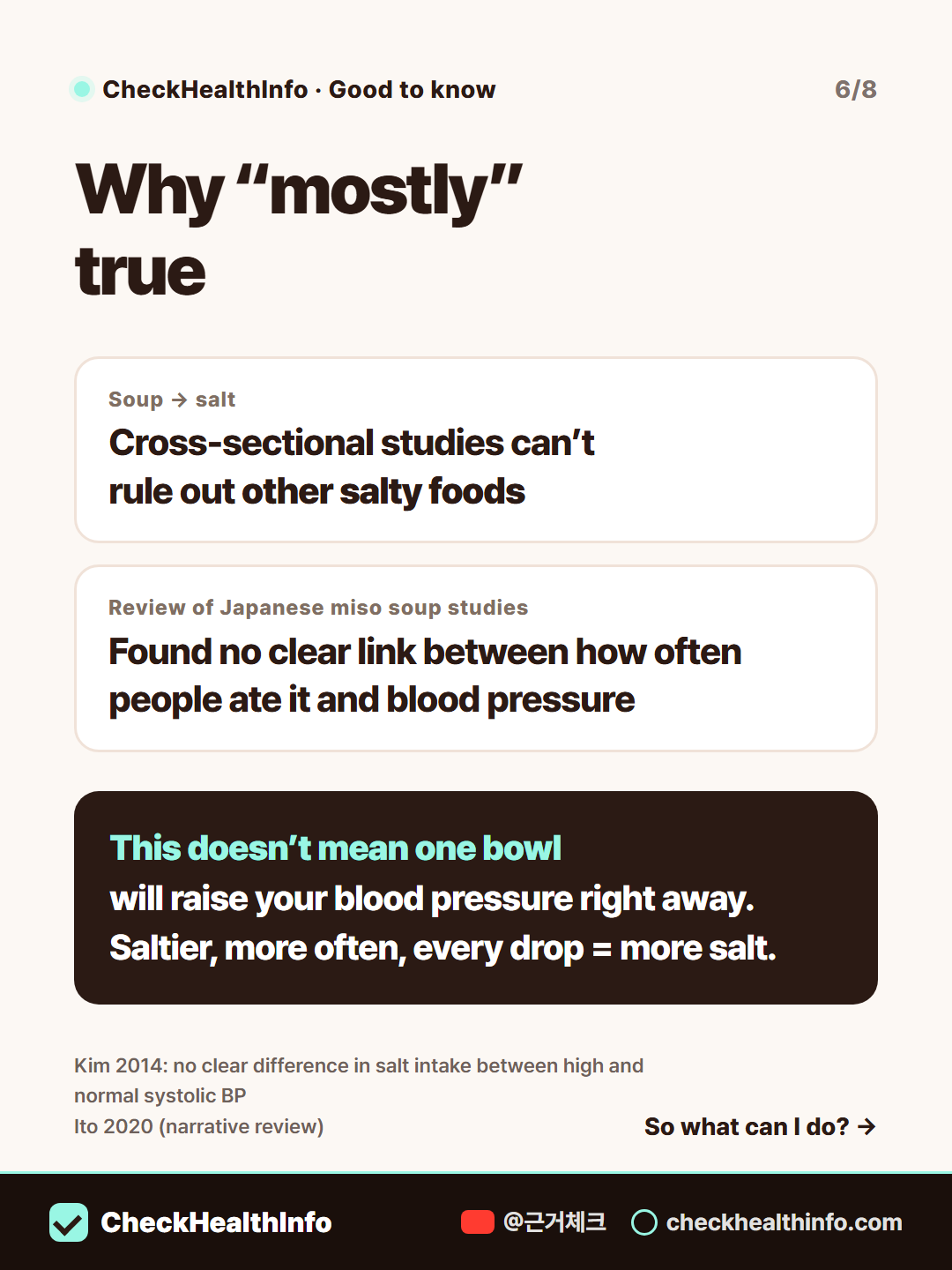
Limits of cross-sectional studies — The link between soup and salt intake comes from studies that measured people at one point in time, so we cannot rule out that people who like soup also eat other salty foods. The 640-person study was designed to compare food records with 24-hour urine measurements, and the soup–sodium link was a secondary analysis adjusted only for sex, age and energy intake. [4]
Compared directly with blood pressure — In the Pohang study, salt intake did not differ clearly between people with high and normal systolic blood pressure (242 people in one region, measured once). [5]
Miso soup studies — A narrative review of Japanese miso soup research reported that observational studies found no link between how often people ate miso soup and their blood pressure or their chance of developing high blood pressure. It is not a systematic review, and its explanation of how miso soup might work in the body relies mainly on laboratory studies. So we do not assume every kind of soup is the same. [6]
Averages — The blood pressure drops in salt-reduction trials are averages and vary from person to person. For the same reduction, the drop was larger in older people, non-white populations, and those with higher blood pressure to begin with. We did not include salt-reduction trials done only in Korean people. [2]
How to enjoy soup with less salt
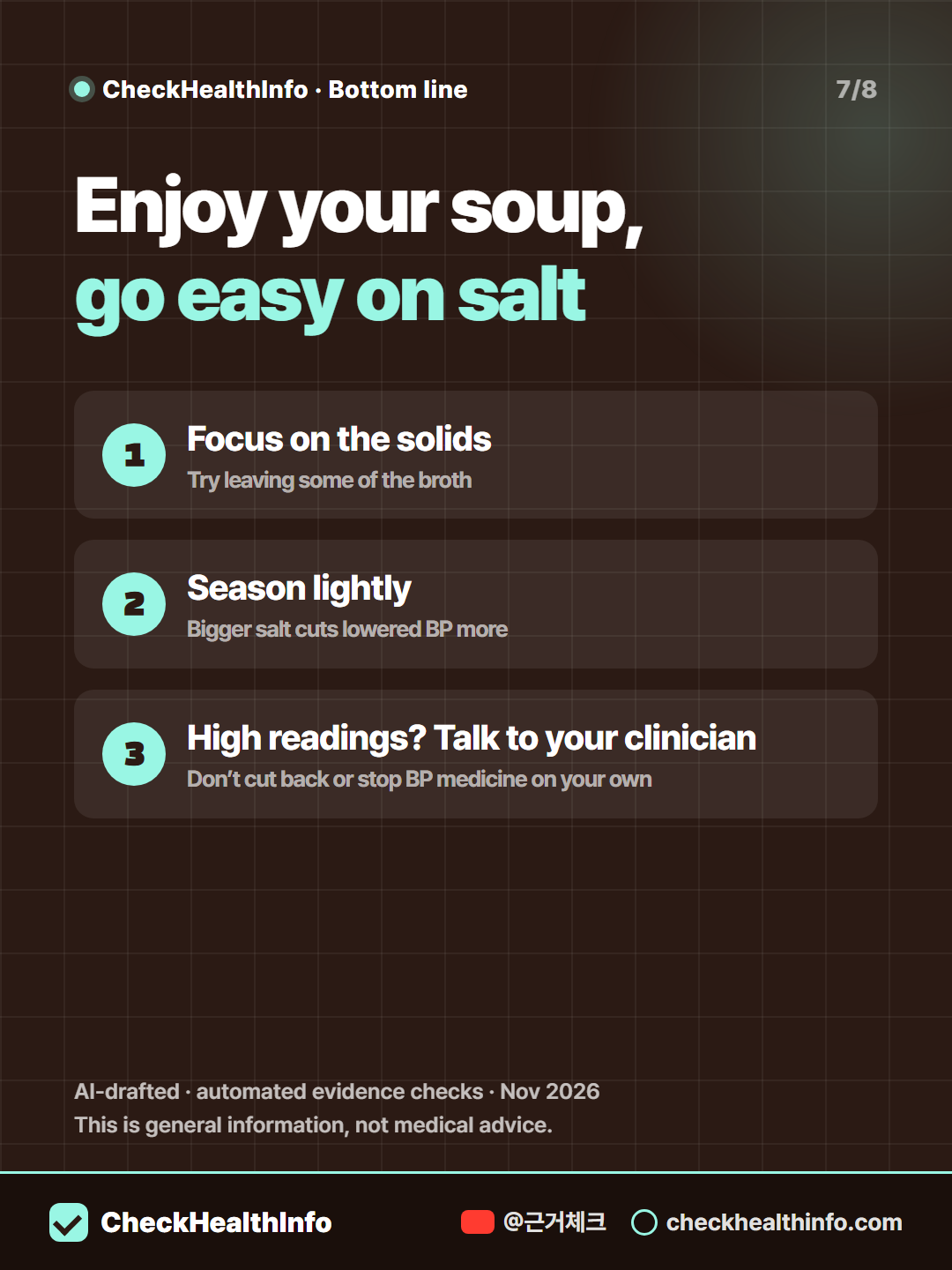
- Focus on the solids — Try leaving some of the broth. Finishing the broth was linked to eating more salt. [4]
- Season lightly — Larger salt reductions lowered blood pressure more. [2]
- High readings? Talk to your clinician first — If you take blood pressure medicine, do not cut back or stop it on your own, even if you are eating less salt; talk to your doctor.
Scope: This verdict covers only what happens to salt intake and blood pressure when adults often eat soups, stews and broths. It does not cover diets for people with conditions such as kidney disease, or treatment with blood pressure medicine.
Limitations of this verdict
- We found no randomized trial that tested cutting back on soup itself. The soup–salt link rests on two cross-sectional studies of Korean adults.
- The salt-reduction meta-analyses pooled trials from many countries; we did not include results looking only at Korean people.
- Grades follow section 1 of our rating method. We check new research in our monthly PubMed review, and if a verdict changes, we record it in our corrections log.
Card news
Video (in Korean)
References
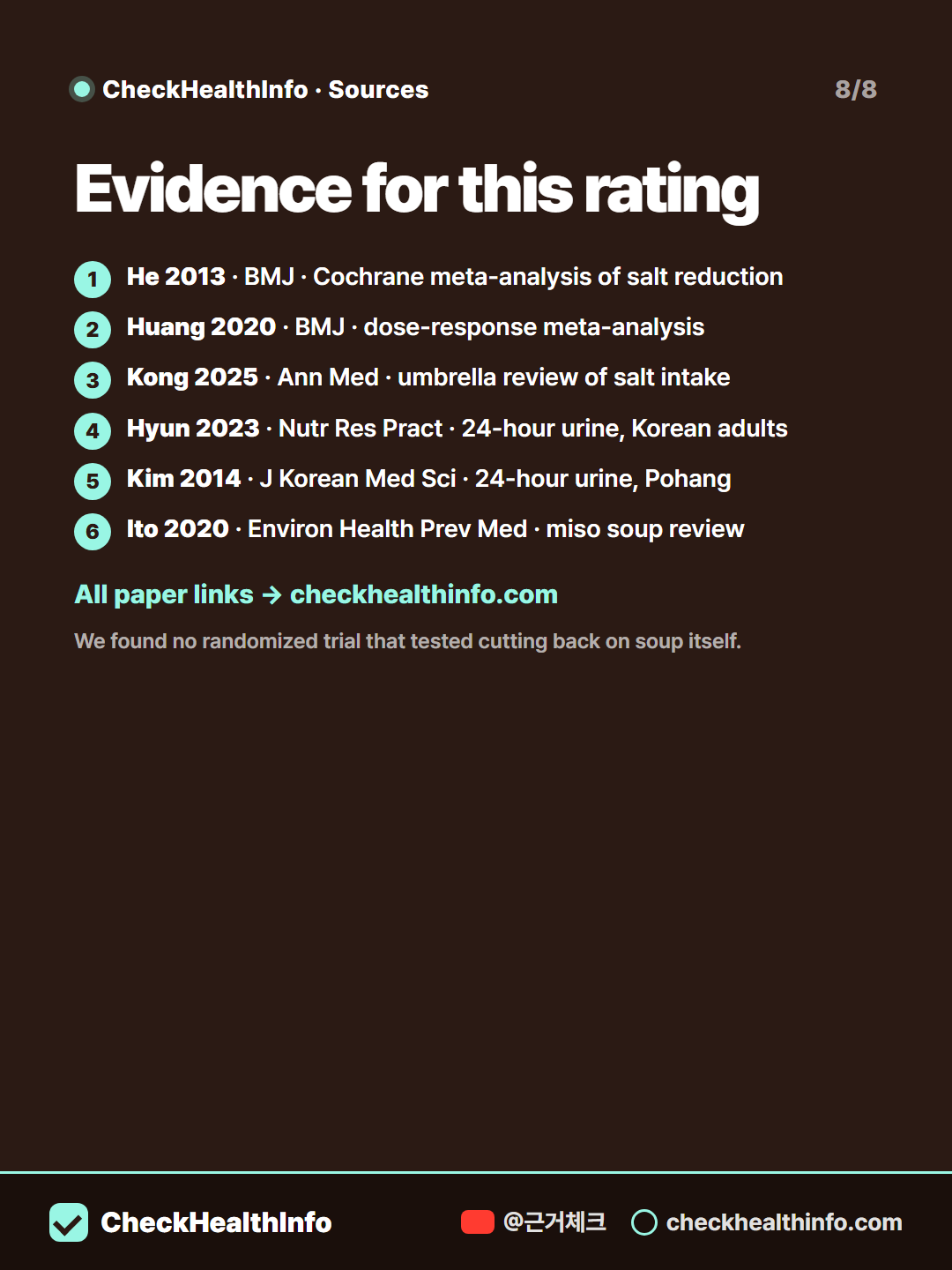
- He FJ, Li J, Macgregor GA. Effect of longer term modest salt reduction on blood pressure: Cochrane systematic review and meta-analysis of randomised trials. BMJ 2013;346:f1325. PMID 23558162. PubMed abstract · Full article
- Huang L, Trieu K, Yoshimura S, et al. Effect of dose and duration of reduction in dietary sodium on blood pressure levels: systematic review and meta-analysis of randomised trials. BMJ 2020;368:m315. PMID 32094151. PubMed abstract · Full article · Free full text
- Kong F, Liu Q, Zhou Q, et al. Dietary salt intake and cardiovascular outcomes: an umbrella review of meta-analyses and dose-response evidence. Ann Med 2025;57(1):2582065. PMID 41243115. PubMed abstract · Full article · Free full text
- Hyun T, Choi MK, Heo YR, et al. Comparison between 24-hour diet recall and 24-hour urine collection for estimating sodium and potassium intakes and their ratio among Korean adults. Nutr Res Pract 2023;17(2):284-296. PMID 37009144. PubMed abstract · Full article · Free full text
- Kim YC, Koo HS, Kim S, et al. Estimation of daily salt intake through a 24-hour urine collection in Pohang, Korea. J Korean Med Sci 2014;29 Suppl 2(Suppl 2):S87-90. PMID 25317022. PubMed abstract · Full article · Free full text
- Ito K. Review of the health benefits of habitual consumption of miso soup: focus on the effects on sympathetic nerve activity, blood pressure, and heart rate. Environ Health Prev Med 2020;25(1):45. PMID 32867671. PubMed abstract · Full article · Free full text
This is general information, not medical advice, and it does not replace diagnosis or treatment by your own clinician. If your blood pressure readings are high, talk to your doctor. If you take blood pressure medicine, do not cut back or stop it on your own, even if you are eating less salt.