Often squat or sit cross-legged on the floor? Is it hurting your knees?
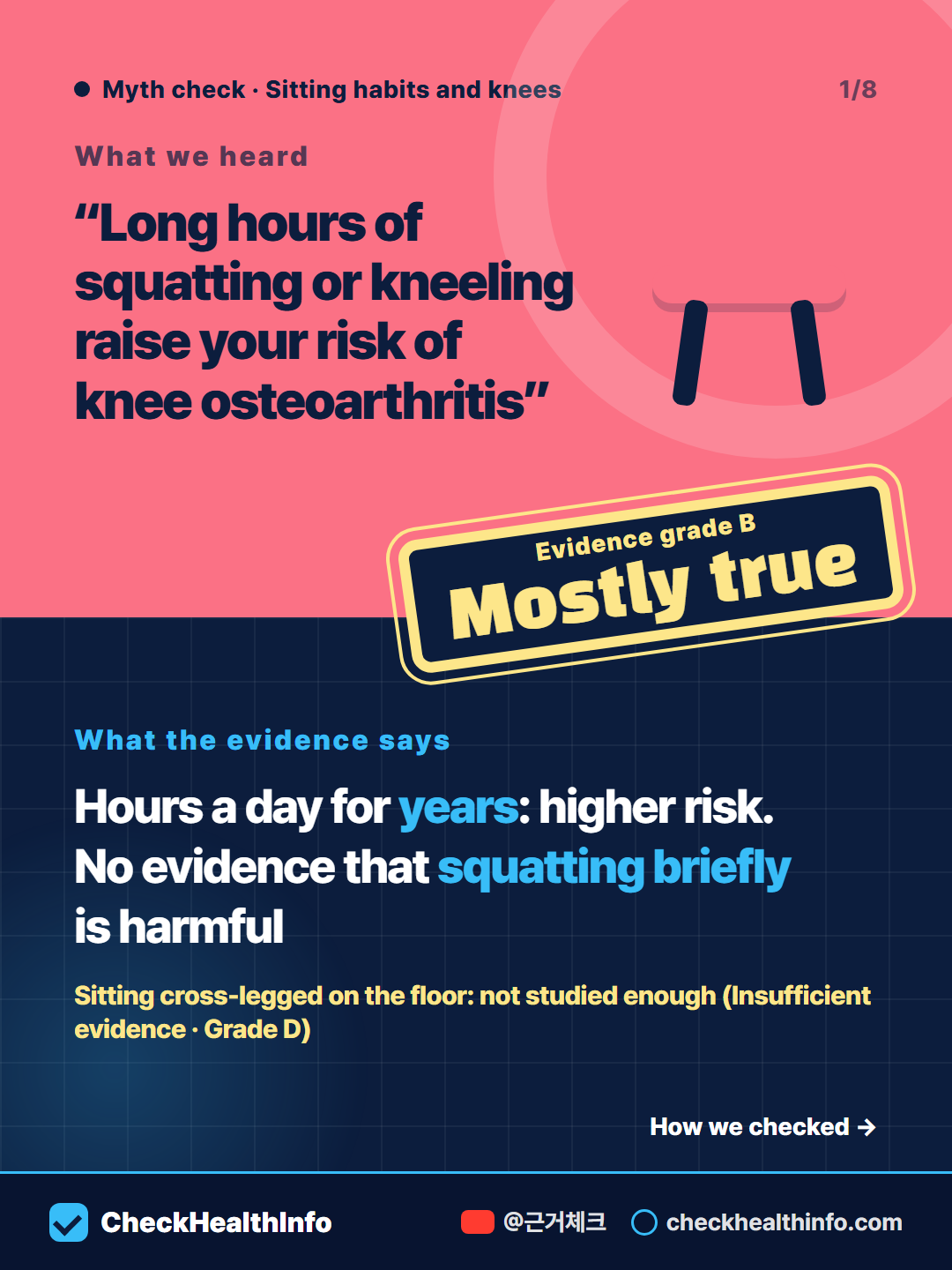
Does squatting or kneeling often or for long periods raise the risk of knee osteoarthritis? What about sitting cross-legged on the floor?

We checked this verdict against 13 sources, such as published studies and clinical guidelines. · How checked: AI-drafted · automated evidence checks
Verdicts at a glance
| Claim | Verdict |
|---|---|
| Squatting or kneeling often or for long periods raises the risk of knee osteoarthritis | Mostly true · Evidence grade B |
| Often sitting cross-legged on the floor raises the risk of knee osteoarthritis | Insufficient evidence · Evidence grade D |
Bottom line — Knee osteoarthritis was more common in people who squatted or knelt for hours a day over many years, at work or in daily life. So the claim that “squatting or kneeling often or for long periods raises the risk of knee osteoarthritis” is rated Mostly true. There is no evidence that squatting briefly is harmful. We found no study of cross-legged floor sitting on its own, so that claim is rated Insufficient evidence. And holding a deep squat for long periods is not the same as exercise — knee osteoarthritis guidelines recommend exercise as a core treatment.
Knee osteoarthritis — A condition in which the cartilage in the knee wears down and the joint changes, causing pain and stiffness. Often just called “knee arthritis.”
Odds ratio — A comparison of how likely a condition is in people with a habit versus people without it. A value of 1 means no difference; the further above 1, the stronger the link.
95% confidence interval — The range in which the true result is likely to lie. If the whole range is above 1, the link is considered statistically significant.
Observational study — A study that compares people’s existing habits without assigning them. It can show a link but cannot prove cause and effect.
Cross-legged sitting — Sitting on the floor with the knees bent out to the sides and the ankles crossed (sometimes called “criss-cross” sitting). It is common in Korea, where many people sit on the floor at home or in some restaurants. This is different from crossing your legs on a chair.
Verdict 1: “Squatting or kneeling often or for long periods raises the risk of knee osteoarthritis”
Mostly true · Evidence grade B
In plain terms The link showed up not with a quick squat now and then, but with hours a day, year after year.
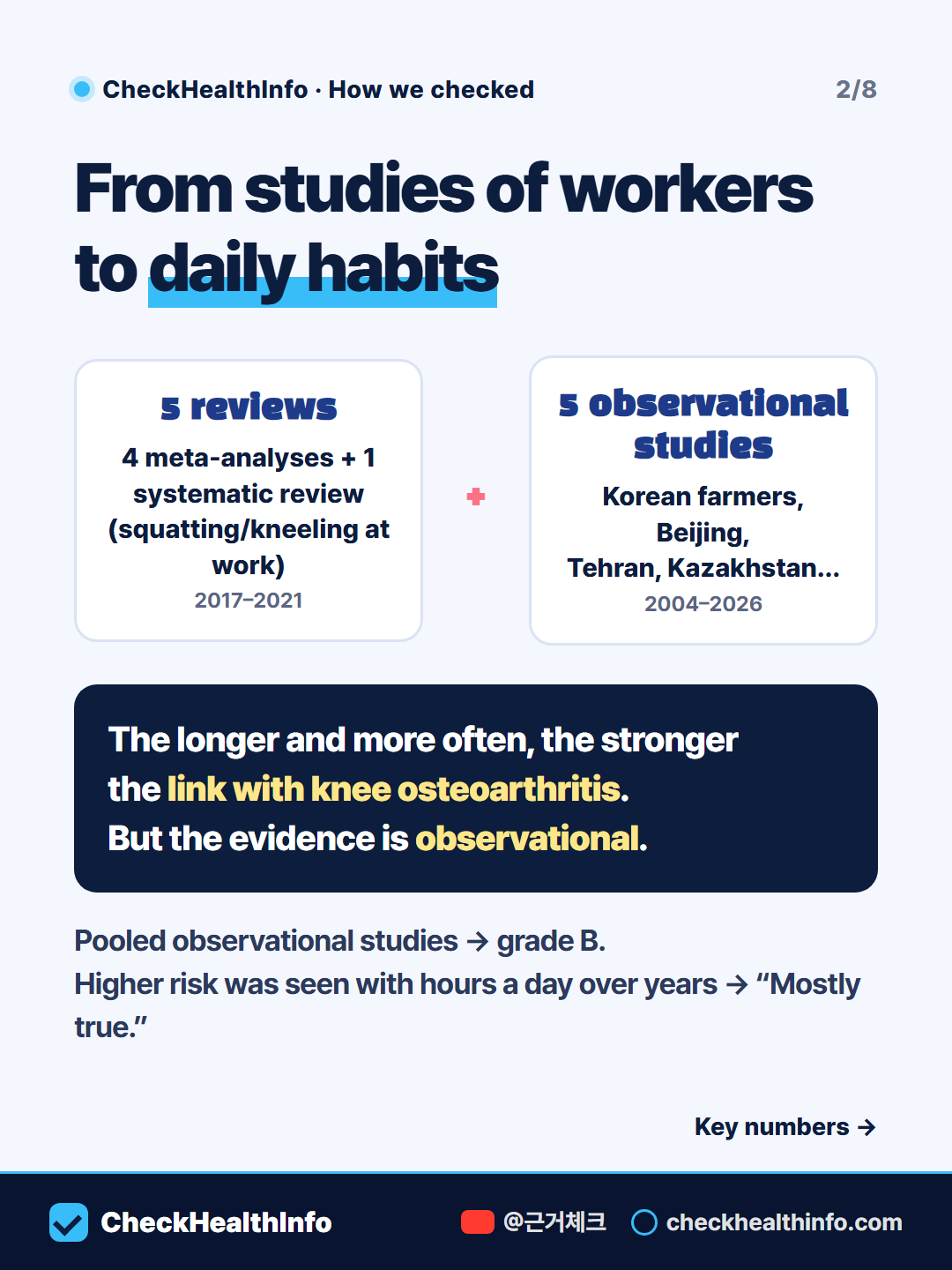
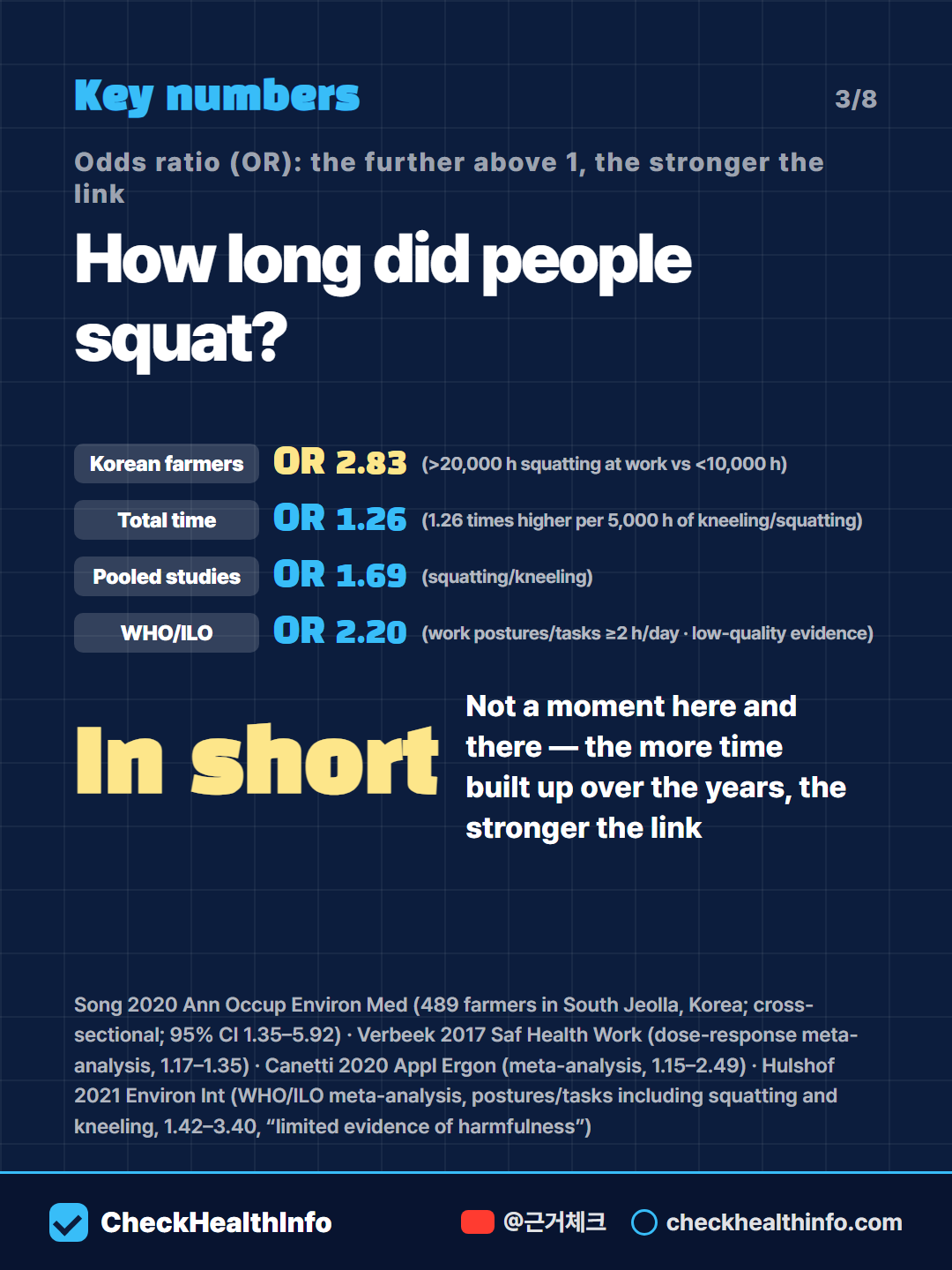
- Pooled studies of workers — In a meta-analysis of 80 observational studies, people in physically demanding jobs had higher odds of knee osteoarthritis than people in sedentary jobs (odds ratio 1.52; 95% confidence interval [CI] 1.37–1.69), and kneeling and squatting at work were each linked to knee osteoarthritis (moderate-quality evidence). [1] A meta-analysis that looked specifically at squatting and kneeling found an odds ratio of 1.69 (95% CI 1.15–2.49). [3] A systematic review of 69 studies from 23 countries found strong to moderate evidence that kneeling, squatting and bending increase the risk of osteoarthritis. [5]
- Accumulated time — For every 5,000 additional hours of kneeling or squatting at work, the odds of knee osteoarthritis were 1.26 times higher (odds ratio 1.26; 95% CI 1.17–1.35; moderate-quality evidence, though most studies were at high risk of bias). [2] In plain terms, the more time built up, the stronger the link.
- Farmers in Korea — In a cross-sectional study of 489 farmers in South Jeolla Province, those who had spent more than 20,000 hours in total working in a squatting posture had higher odds of symptomatic knee osteoarthritis than those with fewer than 10,000 hours (odds ratio 2.83; 95% CI 1.35–5.92). [7]
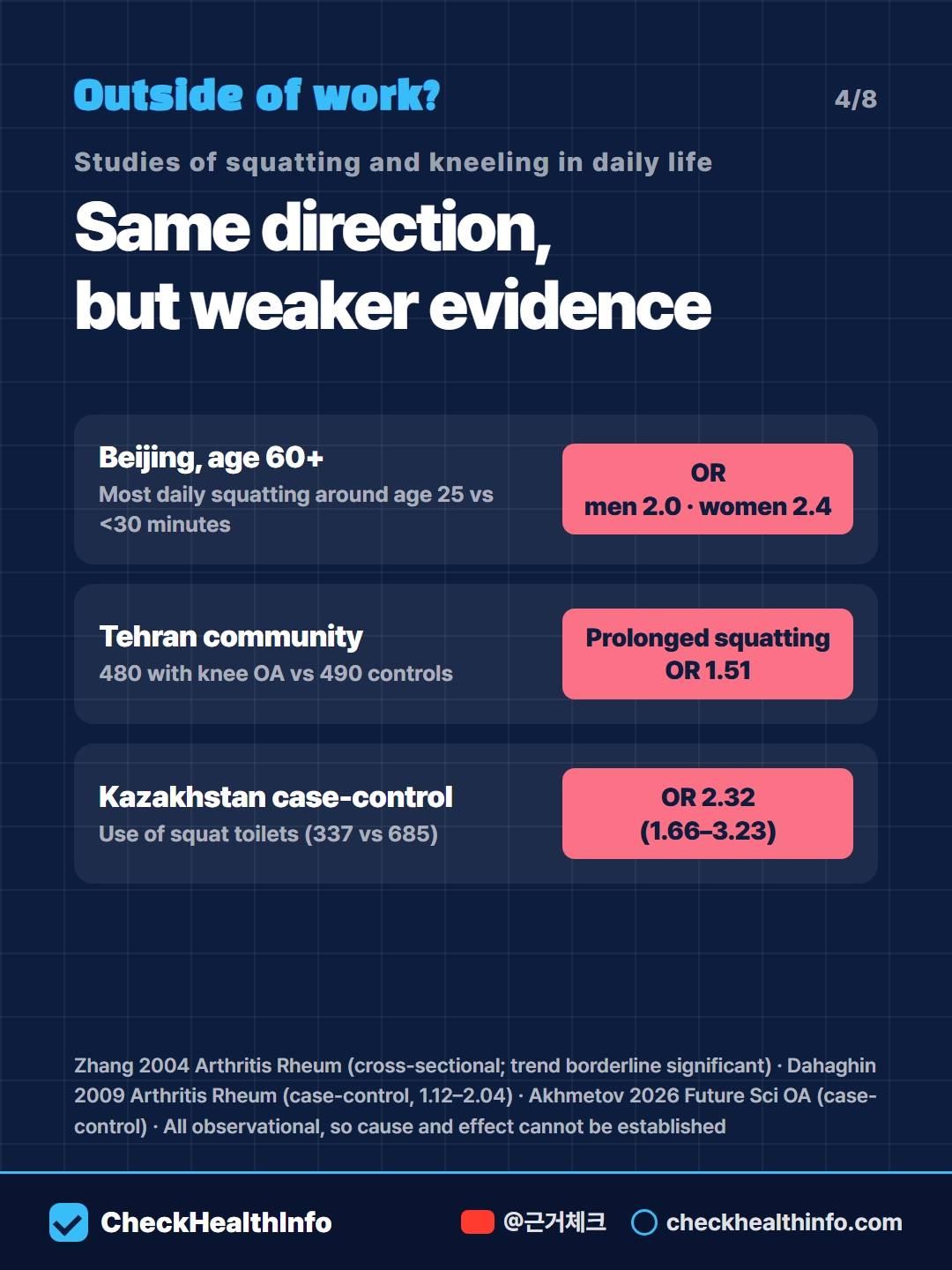
- Habits outside work — In a study of Beijing residents aged 60 and over, those who had squatted the longest each day around age 25 had higher odds of knee osteoarthritis than those who squatted less than 30 minutes a day (odds ratio 2.0 in men and 2.4 in women; the trend was borderline significant). [6] In a community-based case-control study in Tehran, prolonged squatting had an odds ratio of 1.51 (95% CI 1.12–2.04). [8]
- Kneeling and cartilage — Kneeling activities on 6 or more days a week were linked to worsening cartilage damage behind the kneecap, but the link weakened when the position of the kneecap was taken into account (an exploratory analysis). [9]
- Quality of the evidence — A meta-analysis commissioned by the World Health Organization (WHO) and the International Labour Organization (ILO) estimated an odds ratio of 2.20 (95% CI 1.42–3.40) for knee or hip osteoarthritis with 2 or more hours a day of strenuous postures and tasks at work, including squatting and kneeling, but rated the evidence as low quality and the evidence of harm as “limited.” [4]
Evidence grade: We started from meta-analyses of observational studies (A) and lowered the grade one level to B under reason 2 in our rating method (they pooled observational studies rather than randomized trials). Although the studies are observational, the odds rose as total time increased (a dose-response pattern), so we kept B. [2] Work exposure was mixed with heavy lifting, but studies of daily-life exposure pointed the same way, so we did not lower the grade further for indirectness. The higher risk applied to hours a day over years — narrower than the claim — so the rating is “Mostly true.”
Verdict 2: “Often sitting cross-legged on the floor raises the risk of knee osteoarthritis”
Insufficient evidence · Evidence grade D
In plain terms There is not yet enough evidence that sitting cross-legged on the floor damages the knees. This does not mean the claim is false — it means it has hardly been studied.
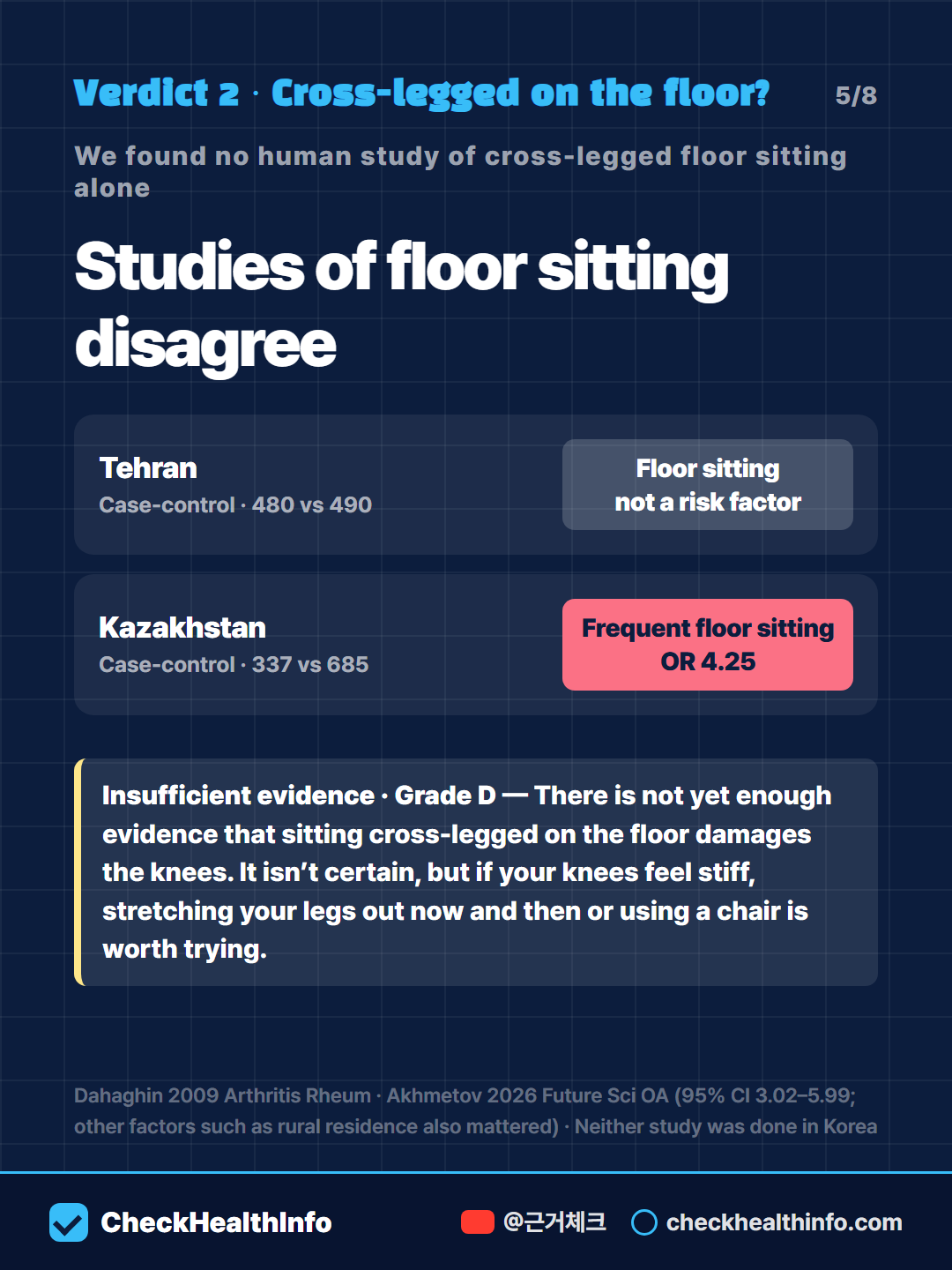
- We found no human study that looked at cross-legged floor sitting on its own and knee osteoarthritis. The closest evidence is two studies of “sitting on the floor,” and their results disagree.
- Tehran — In a study comparing 480 people with knee osteoarthritis and 490 controls, prolonged squatting was a risk factor, but sitting on the floor was not. [8]
- Kazakhstan — In a study comparing 337 cases and 685 controls, frequent floor sitting had an odds ratio of 4.25 (95% CI 3.02–5.99) and use of squat toilets (floor-level toilets used in a squatting position) 2.32 (95% CI 1.66–3.23). The researchers noted that longer-term follow-up studies are needed to establish cause and effect. [10]
- Both studies compared people who already had knee osteoarthritis with people who did not and asked about past habits, based on people’s own memory, so it is hard to rule out that knee pain changed people’s habits.
Evidence grade: We found no human study of cross-legged floor sitting on its own. The closest evidence is two case-control studies of floor sitting (questionnaire recall, about 1,000 people each), so the grade starts at C. It was lowered to D, the lowest grade, because the studies looked at floor sitting in general rather than cross-legged sitting (reason 1 in our rating method: indirect evidence) and their results conflict (reason 3).
But — sitting in a squat for hours ≠ exercise
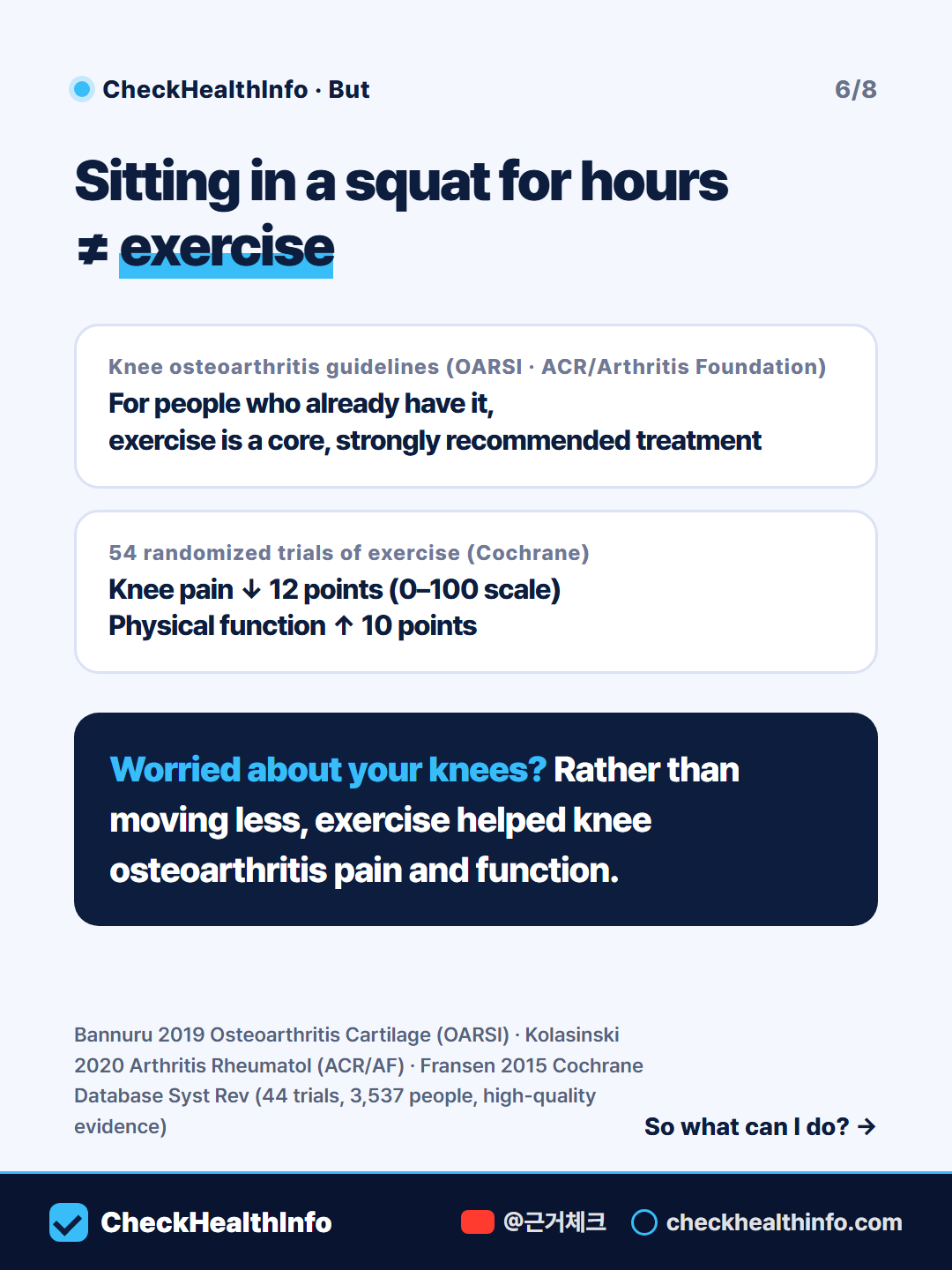
- Moving less because you are worried about your knees goes against the guidelines. The Osteoarthritis Research Society International (OARSI) guideline lists arthritis education and structured land-based (not in-water) exercise programs as core treatments for knee osteoarthritis. [11] The American College of Rheumatology/Arthritis Foundation guideline also strongly recommends exercise. [12] Both guidelines are for people who already have knee osteoarthritis.
- In a Cochrane review of 54 randomized trials, land-based therapeutic exercise reduced knee pain by 12 points on a 0–100 scale (44 trials, 3,537 people; high-quality evidence) and improved physical function by 10 points (moderate-quality evidence). Pain was still 6 points lower 2–6 months after the programs ended, and no serious adverse events were reported. [13]
- These sources do not address the claim that squatting is harmful, so we did not use them for grading; we used them only as supporting evidence for what to do instead.
If you often squat or kneel
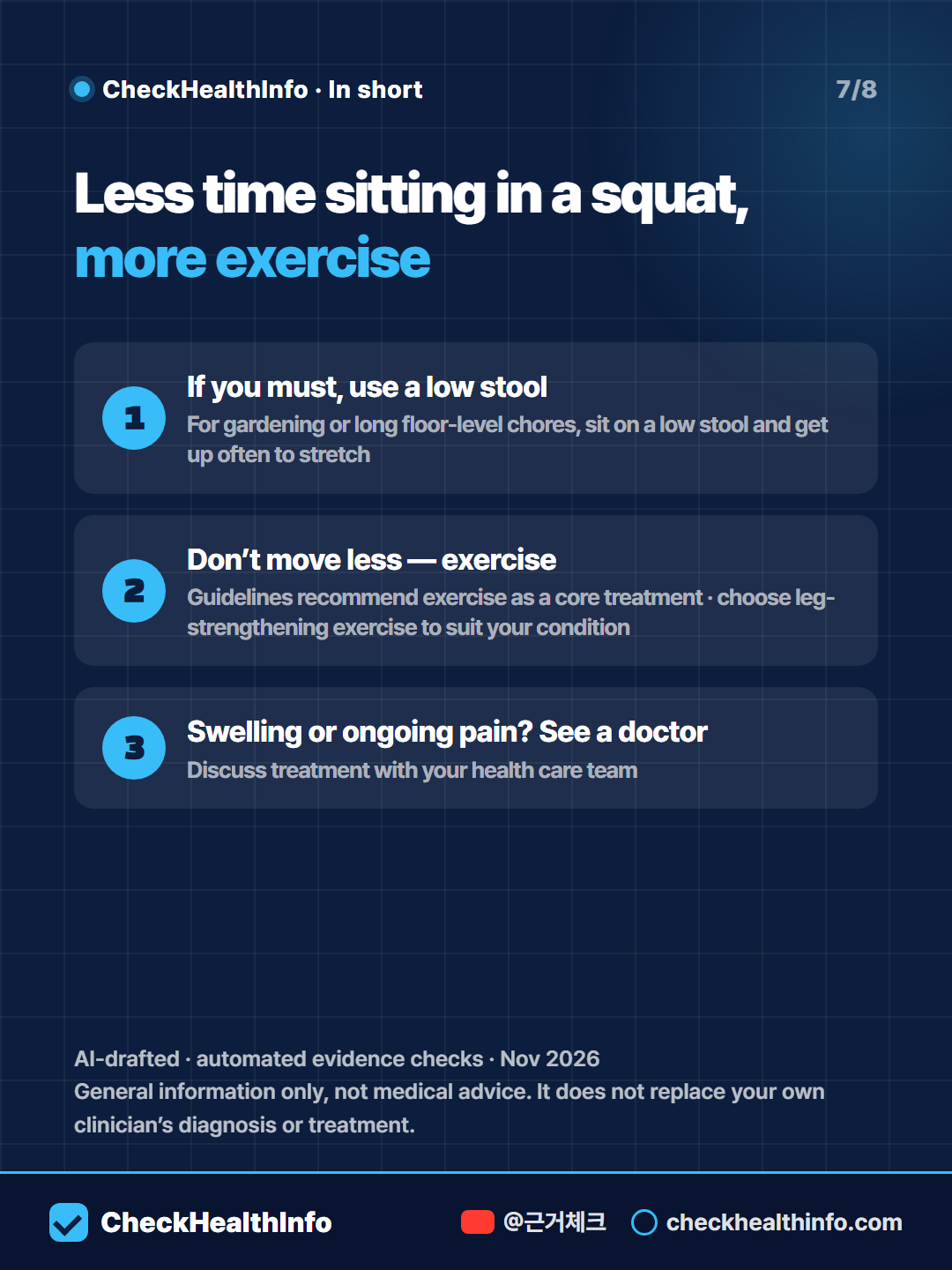
- If you must do it for a long time, use a low stool — For gardening, farm work or long floor-level chores such as hand-washing laundry, sit on a low stool and get up often to stretch. This was not directly tested in the studies, but it is a low-risk way to cut down time spent squatting.
- Don’t move less — exercise — Knee osteoarthritis guidelines recommend exercise as a core treatment. Choose leg-strengthening exercise, too, to suit your condition. [11] [13]
- Cross-legged floor sitting — It isn’t certain. But if your knees are stiff or sore, try not to stay in one position for a long time. Stretching your legs out now and then, or sitting in a chair, is low-risk and worth trying.
- If your knee is swollen or keeps hurting — See a doctor and discuss treatment options with your health care team.
Scope: This verdict covers sitting habits such as squatting, kneeling and cross-legged floor sitting in relation to knee osteoarthritis. It does not cover drug or injection treatments for knee osteoarthritis.
Limitations
- Most of the evidence comes from observational studies of workers, such as farmers and construction workers, exposed for hours a day, and exposure was usually based on people’s own memory of past work. Work exposure also included other strains such as heavy lifting. [1] [2]
- Because these are observational studies, cause and effect cannot be established, and people who already had knee pain may have recalled their posture differently. The Korean farmer study and the Beijing study were cross-sectional, so the order of events is unclear. [6] [7]
- The WHO/ILO meta-analysis rated the evidence as low quality. [4]
- This evidence is not about brief squatting in daily life or about squats done as exercise.
- Neither floor-sitting study was done in Korea, and in the Kazakhstan study other factors such as rural residence also had a large effect. [10]
- Grades follow section 1 of our rating method. We check for new studies in our monthly PubMed review, and any change in a verdict is recorded in our corrections log.
Card news

Video (in Korean)
References
- Wang X, Perry TA, Arden N, et al. Occupational Risk in Knee Osteoarthritis: A Systematic Review and Meta-Analysis of Observational Studies.. Arthritis Care Res (Hoboken) 2020;72(9):1213-1223. PMID 32638548. PubMed abstract · Full article
- Verbeek J, Mischke C, Robinson R, et al. Occupational Exposure to Knee Loading and the Risk of Osteoarthritis of the Knee: A Systematic Review and a Dose-Response Meta-Analysis.. Saf Health Work 2017;8(2):130-142. PMID 28593068. PubMed abstract · Full article
- Canetti EFD, Schram B, Orr RM, et al. Risk factors for development of lower limb osteoarthritis in physically demanding occupations: A systematic review and meta-analysis.. Appl Ergon 2020;86:103097. PMID 32342888. PubMed abstract · Full article
- Hulshof CTJ, Pega F, Neupane S, et al. The effect of occupational exposure to ergonomic risk factors on osteoarthritis of hip or knee and selected other musculoskeletal diseases: A systematic review and meta-analysis from the WHO/ILO Joint Estimates of the Work-related Burden of Disease and Injury.. Environ Int 2021;150:106349. PMID 33546919. PubMed abstract · Full article
- Gignac MAM, Irvin E, Cullen K, et al. Men and Women's Occupational Activities and the Risk of Developing Osteoarthritis of the Knee, Hip, or Hands: A Systematic Review and Recommendations for Future Research.. Arthritis Care Res (Hoboken) 2020;72(3):378-396. PMID 30762317. PubMed abstract · Full article
- Zhang Y, Hunter DJ, Nevitt MC, et al. Association of squatting with increased prevalence of radiographic tibiofemoral knee osteoarthritis: the Beijing Osteoarthritis Study.. Arthritis Rheum 2004;50(4):1187-92. PMID 15077301. PubMed abstract · Full article
- Song HS, Kim DH, Lee GC, et al. Work-related factors of knee osteoarthritis in Korean farmers: a cross-sectional study.. Ann Occup Environ Med 2020;32:e37. PMID 34754458. PubMed abstract · Full article
- Dahaghin S, Tehrani-Banihashemi SA, Faezi ST, et al. Squatting, sitting on the floor, or cycling: are life-long daily activities risk factors for clinical knee osteoarthritis? Stage III results of a community-based study.. Arthritis Rheum 2009;61(10):1337-42. PMID 19790110. PubMed abstract · Full article
- Haj-Mirzaian A, Mohajer B, Guermazi A, et al. Kneeling as a risk factor of patellofemoral joint cartilage damage worsening: an exploratory analysis on the Osteoarthritis Initiative.. Eur Radiol 2021;31(4):2601-2609. PMID 33009589. PubMed abstract · Full article
- Akhmetov A, Khaumet Y, Moldaliyev I, et al. Cultural practices and knee osteoarthritis in Central Asia: a case-control study on risk and protective factors.. Future Sci OA 2026;12(1):2602339. PMID 41403295. PubMed abstract · Full article
- Bannuru RR, Osani MC, Vaysbrot EE, et al. OARSI guidelines for the non-surgical management of knee, hip, and polyarticular osteoarthritis.. Osteoarthritis Cartilage 2019;27(11):1578-1589. PMID 31278997. PubMed abstract · Full article
- Kolasinski SL, Neogi T, Hochberg MC, et al. 2019 American College of Rheumatology/Arthritis Foundation Guideline for the Management of Osteoarthritis of the Hand, Hip, and Knee.. Arthritis Rheumatol 2020;72(2):220-233. PMID 31908163. PubMed abstract · Full article
- Fransen M, McConnell S, Harmer AR, et al. Exercise for osteoarthritis of the knee.. Cochrane Database Syst Rev 2015;1(1):CD004376. PMID 25569281. PubMed abstract · Full article
General information only, not medical advice. It does not replace your own clinician’s diagnosis or treatment. If your knee is swollen or keeps hurting, see a doctor and discuss treatment options with your health care team.