Palms turning yellow from tangerines — is that harmful?
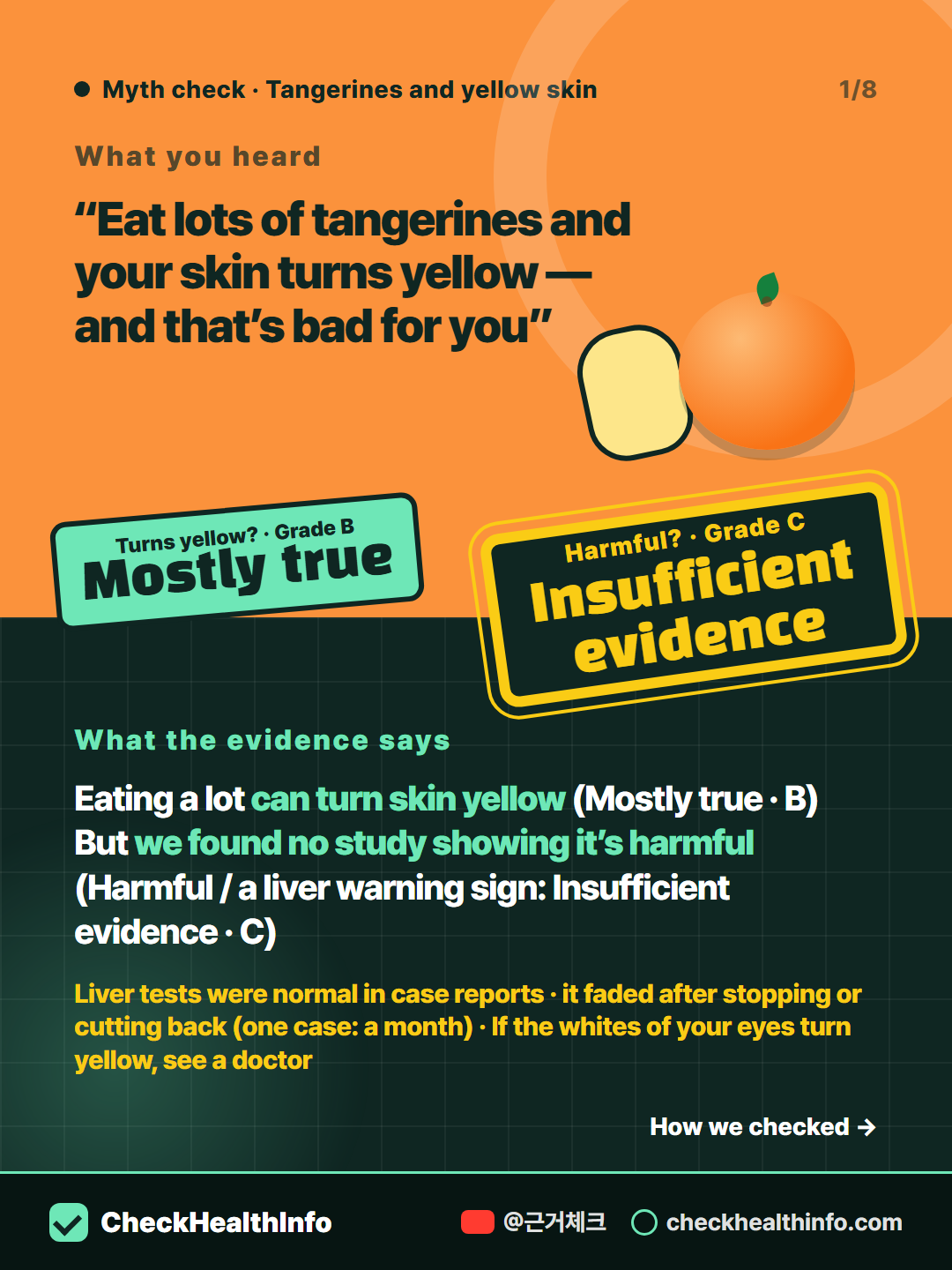
Can eating lots of tangerines and other carotenoid-rich fruits and vegetables really turn your skin yellow? And is skin that turns yellow this way harmful, or a sign of liver trouble?

We checked this verdict against 13 sources, such as published studies and clinical guidelines. · How checked: AI-drafted · automated evidence checks
Verdicts at a glance
| Claim | Verdict |
|---|---|
| Eating a lot of carotenoid-rich fruits and vegetables, such as tangerines, can turn your skin yellow | Mostly true · Evidence grade B |
| Skin that turns yellow from eating lots of tangerines is harmful — a sign of liver trouble | Insufficient evidence · Evidence grade C |
Bottom line — Eating a lot of fruits and vegetables rich in yellow-orange pigments called carotenoids, such as tangerines, can really make your skin more yellow. In randomized trials, skin became more yellow within 4 weeks on high-carotenoid fruits and vegetables than on low-carotenoid ones or water. So “eating a lot of carotenoid-rich fruits and vegetables can turn your skin yellow” is rated Mostly true (Evidence grade B). But “skin that turns yellow this way is harmful — a sign of liver trouble” is rated Insufficient evidence (Evidence grade C). In our search, we found no study showing harm; in case reports, liver tests were normal, and the color faded after people stopped eating or cut back on the food (in one adult case, after a month). The takeaway: if your palms turn yellow from eating tangerines, we found no evidence that it is harmful — but if the whites of your eyes turn yellow too, it may be jaundice, and you should see a doctor.
Carotenoids — Yellow-orange pigments in fruits and vegetables such as tangerines, carrots, and squash. Tangerines (Satsuma mandarins) contain a carotenoid called beta-cryptoxanthin.
Carotenemia — A buildup of carotenoids in the body that gives the skin, especially the palms, soles, and the creases beside the nose, a yellow-orange tint.
Jaundice — Yellowing of the skin and the whites of the eyes caused by a buildup of bilirubin, often from a problem with the liver, bile ducts, or blood. Unlike carotenemia, it turns the whites of the eyes yellow.
Case report — A description of what happened to one or a few patients. It shows what can happen, but it is weak evidence for how common something is or what causes it.
Randomized crossover trial — A trial in which each participant follows two diets, one after the other, in an order set by chance. Because each person is compared with themselves, differences in natural skin color between people matter less.
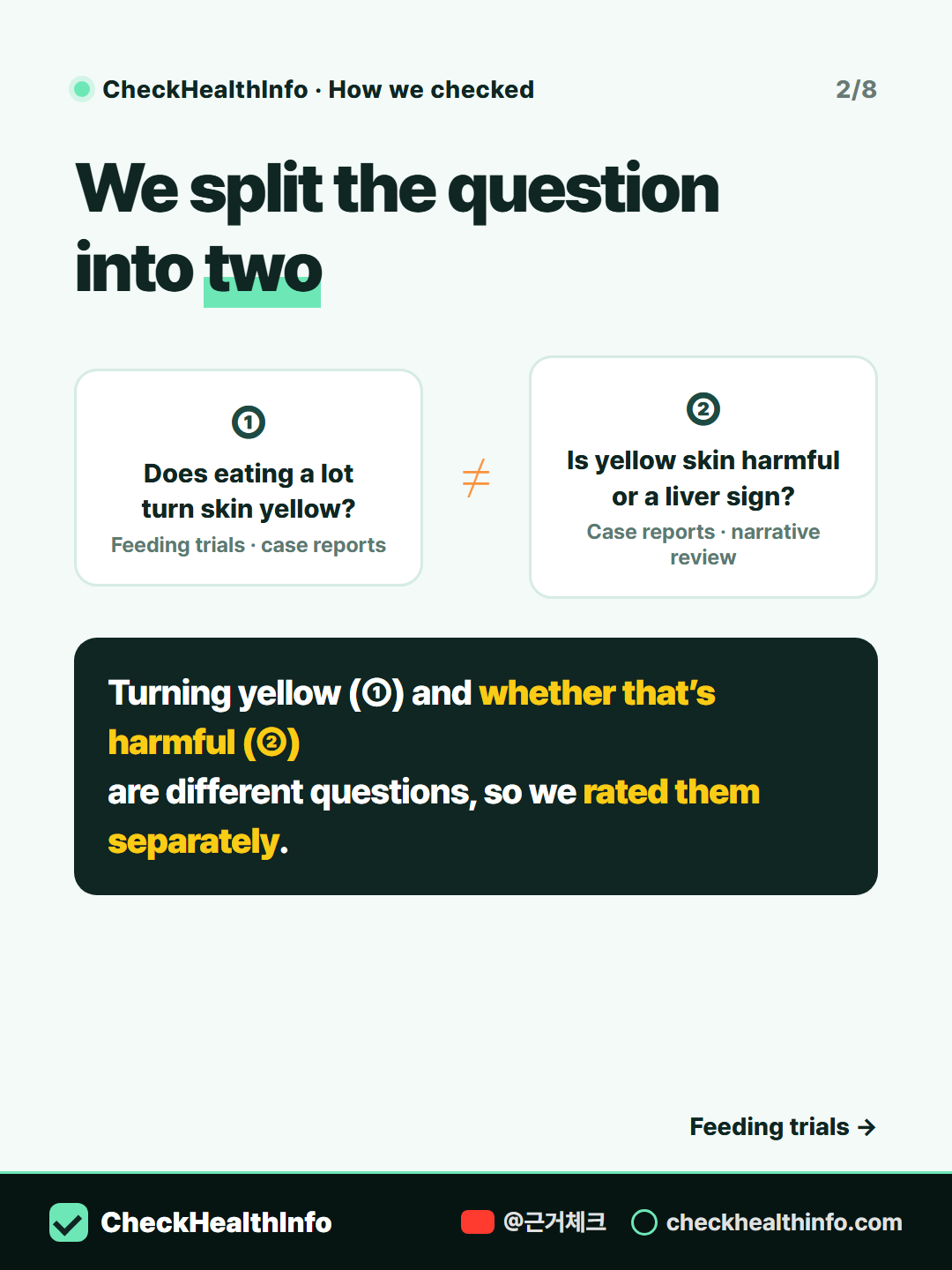
A recent news story, timed to tangerine season, asked whether eating lots of tangerines really turns your skin yellow. The popular claim mixes two ideas — “your skin turns yellow” and “that is bad for you (a sign of liver trouble)” — so we checked them as two separate questions.
Rating 1. “Eating a lot of carotenoid-rich fruits and vegetables, such as tangerines, can turn your skin yellow”
Mostly true · Evidence grade B
In plain terms Experiments have shown that eating a lot of brightly colored fruits and vegetables makes the skin slightly more yellow within weeks. But the cases with visibly yellow palms involved eating very large amounts for a long time.
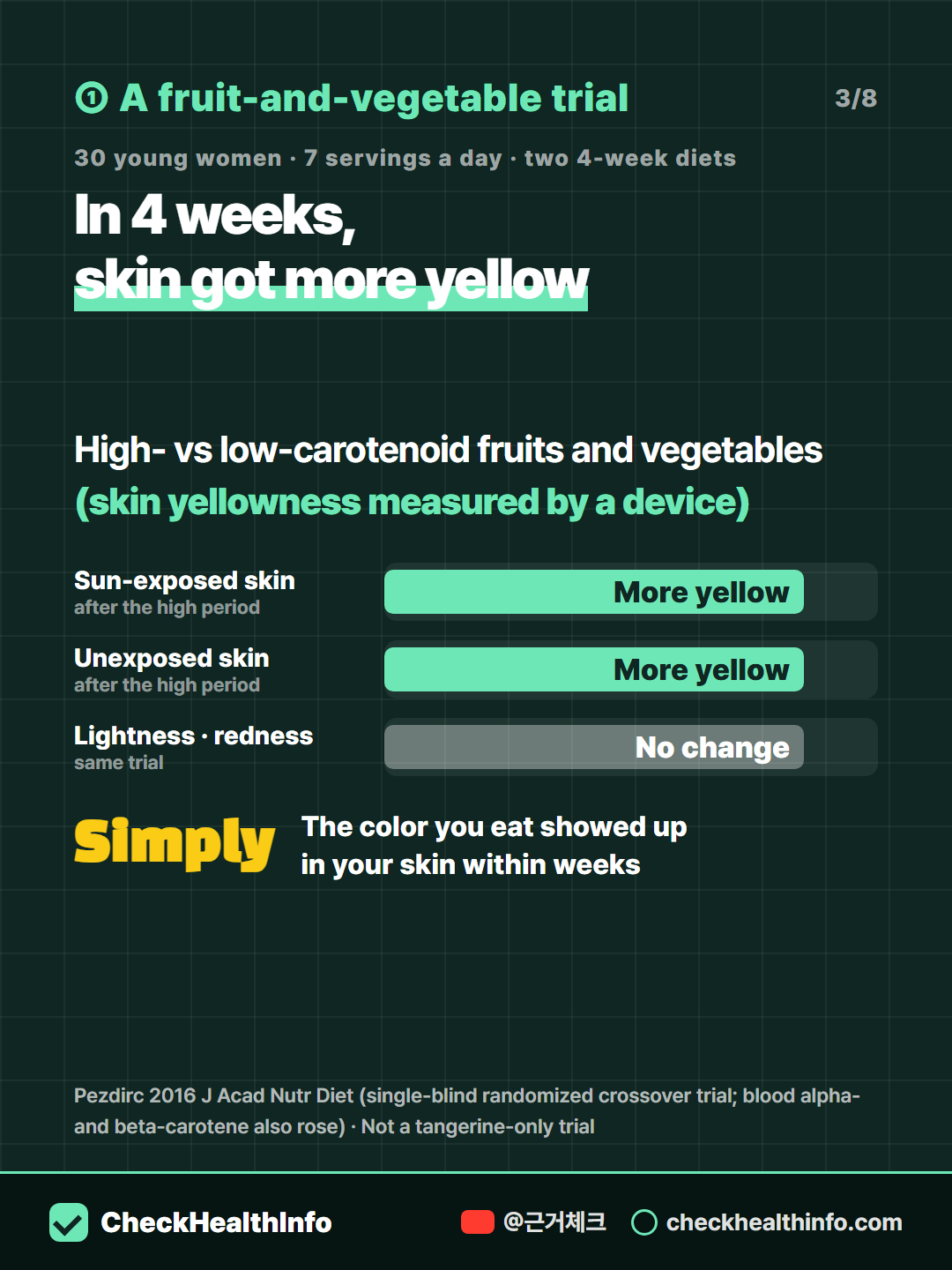
- In a crossover trial, 30 young women ate 7 servings a day of fruits and vegetables for two 4-week periods — one high in carotenoids and one low — in an order set by chance. Skin yellowness rose significantly more after the high-carotenoid period than after the low one, on both sun-exposed and unexposed skin. The amount of fruits and vegetables was the same in both periods; only the carotenoid content differed. Skin lightness and redness did not change, and blood alpha- and beta-carotene rose. [1]
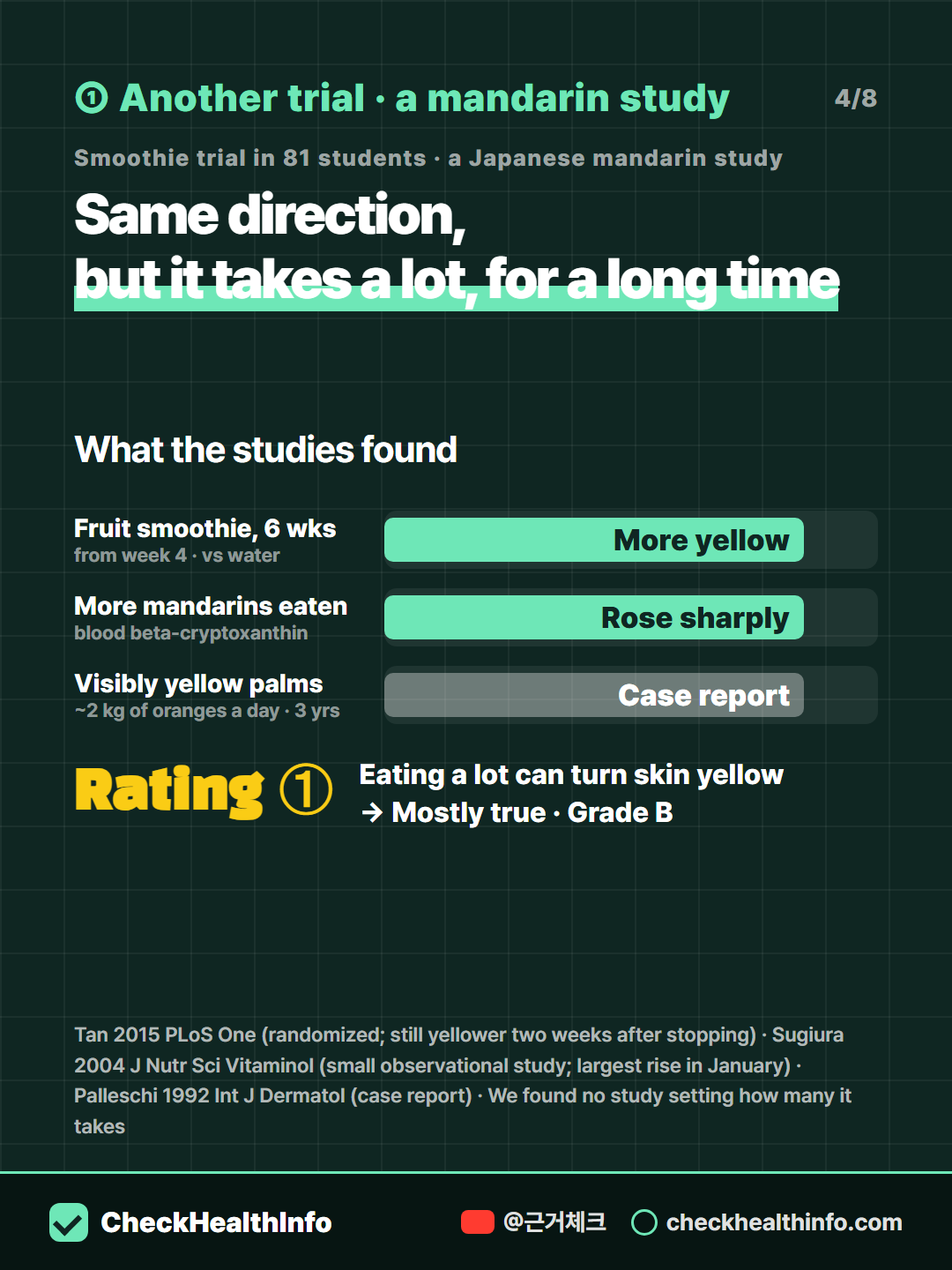
- In a trial that randomly assigned 81 college students to a fruit smoothie or mineral water, skin yellowness rose markedly after 4 weeks and was still higher two weeks after the smoothies stopped. [2]
- In plain terms, the color you eat shows up in your skin. A study that followed 35 people for 6 weeks estimated that for skin color to change enough to look “healthier,” fruit and vegetable intake would need to change by about 2.91 servings a day (an observational study in white participants). [3] A systematic review of 29 studies on skin carotenoid measurement found that all 29 reported a significant link between skin carotenoids and fruit and vegetable intake or blood carotenoids. [4]
- One study looked at mandarins themselves. In 15 men and 12 women in Japan who had blood drawn every two months for a year, blood beta-cryptoxanthin rose sharply as they ate more mandarins, with the largest rise in January. [5] In one case report, a 30-year-old woman who ate about 2 kg of oranges a day for 3 years developed visibly yellow-orange palms, soles, and creases beside the nose. [6]
Grade: The most direct evidence comes from two randomized trials that assigned fruit and vegetable intake and measured skin color, so we rated it B. The two trials pointed the same way and measured skin yellowness itself, so we did not grade it down. The systematic review of skin carotenoid measurement looked at how well a measuring method works, not at whether skin turns yellow, so we used it only as supporting evidence. It is “Mostly true” rather than “True” because the trials did not feed tangerines alone, they measured yellowness with a device, and the visibly yellow cases involved very large amounts over a long time — a narrower finding than the claim.
Evidence grades run in four levels, from A (high) to D (very low). Randomized trials are B; case reports are C. See our rating method for details.
Rating 2. “Skin that turns yellow from eating lots of tangerines is harmful — a sign of liver trouble”
Insufficient evidence · Evidence grade C
In plain terms We found no study showing that skin turned yellow by foods like tangerines is harmful. Here, “Insufficient evidence” means that harm has not been shown in people and that the evidence against harm is also only at the case-report level.
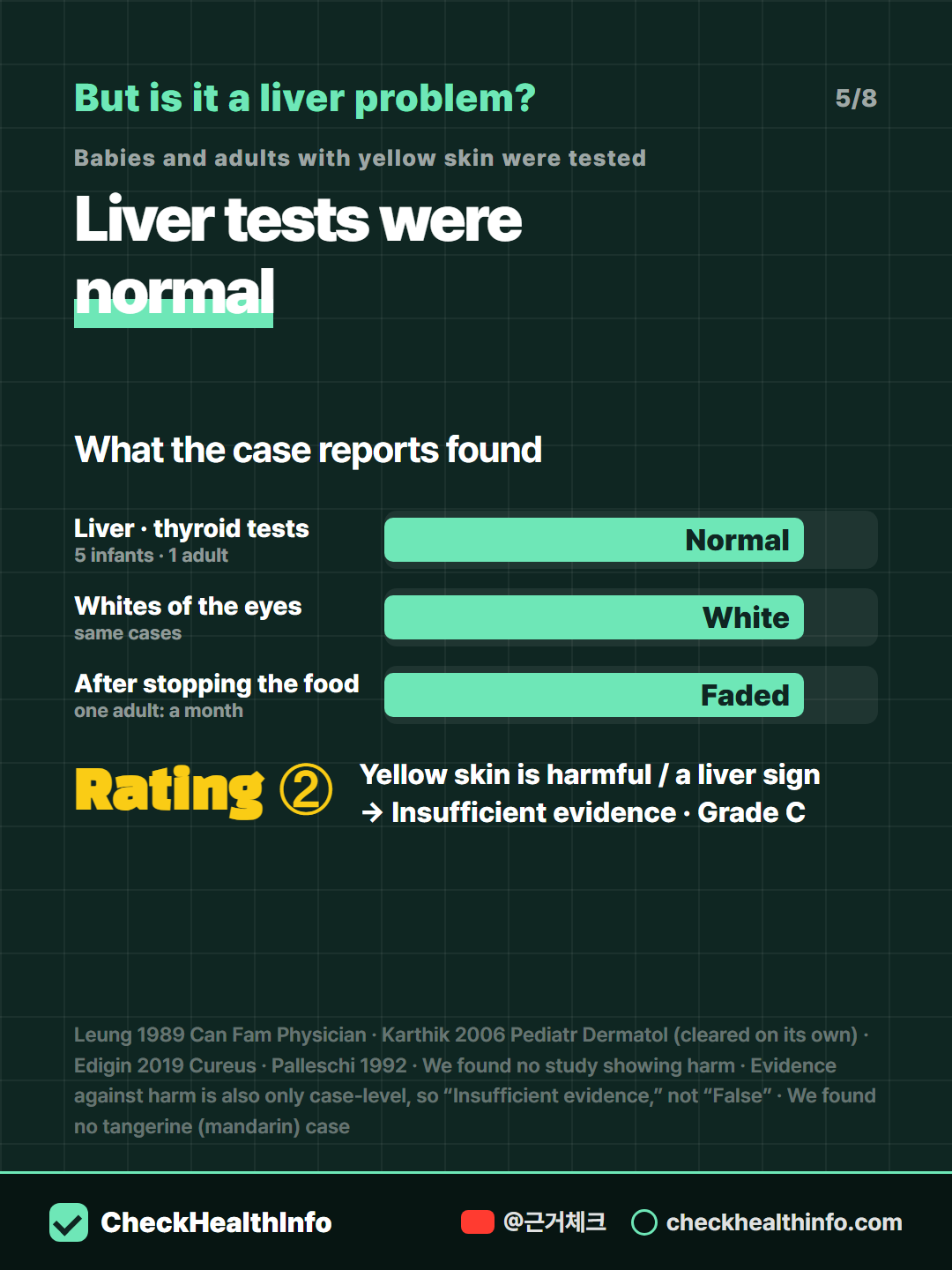
- Five infants (8 to 11 months old) with yellow skin but white eyes had normal vitamin A, white blood cell counts, blood sugar, blood fats, and liver and thyroid tests. When the carotene-rich foods were removed, the yellow color cleared and blood carotene returned to normal. The author stressed that the condition is benign. [7]
- In a case series from 3 years of records at one children’s hospital, infants with yellow palms, soles, and creases beside the nose got better on their own, without treatment, as their diets changed while they grew; the authors called it a benign condition that can be confused with jaundice. [8] The authors of a case report on an adult who ate a lot of papaya and mango also said it is a benign condition in which the whites of the eyes do not turn yellow, so, in the authors’ view, further diagnostic testing is not needed. [9]
- The woman who ate about 2 kg of oranges a day also had normal liver and thyroid tests (her vitamin A was slightly above normal), and a month after she stopped, her skin color, blood carotene, and vitamin A returned to normal. [6] In plain terms, case reports describe yellow skin from food — unlike jaundice from liver disease — as leaving the whites of the eyes white, and the color faded after people stopped eating or cut back on the food. Note that the cases we cite involved oranges, papaya, mango, carrots, squash, and similar foods; in our search, we found no case involving tangerines (mandarins).
- A study that followed 635 residents of one area of Japan found that people who ate 3 to 4 mandarins a day had a lower risk of stiffening arteries than those who ate fewer than 1. But it was an observational study, so it cannot show the mandarins were the reason, and it did not look at yellow skin or the liver, or set a “safe number.” [13]
Grade: The only evidence that directly addresses “harmful / a liver warning sign” consists of case reports and a narrative review, so we rated it C. The randomized trials in Rating 1 did not report harms in their abstracts, so we did not use them to grade this claim; the Japanese mandarin cohort looked at artery stiffness, which is indirect, so it is also C. We found no evidence of harm, but because the evidence against harm is also at the case-report level, we chose “Insufficient evidence” rather than “False,” which requires reliable studies (grade A or B) showing the opposite.
If you eat a lot of tangerines, here is what to check
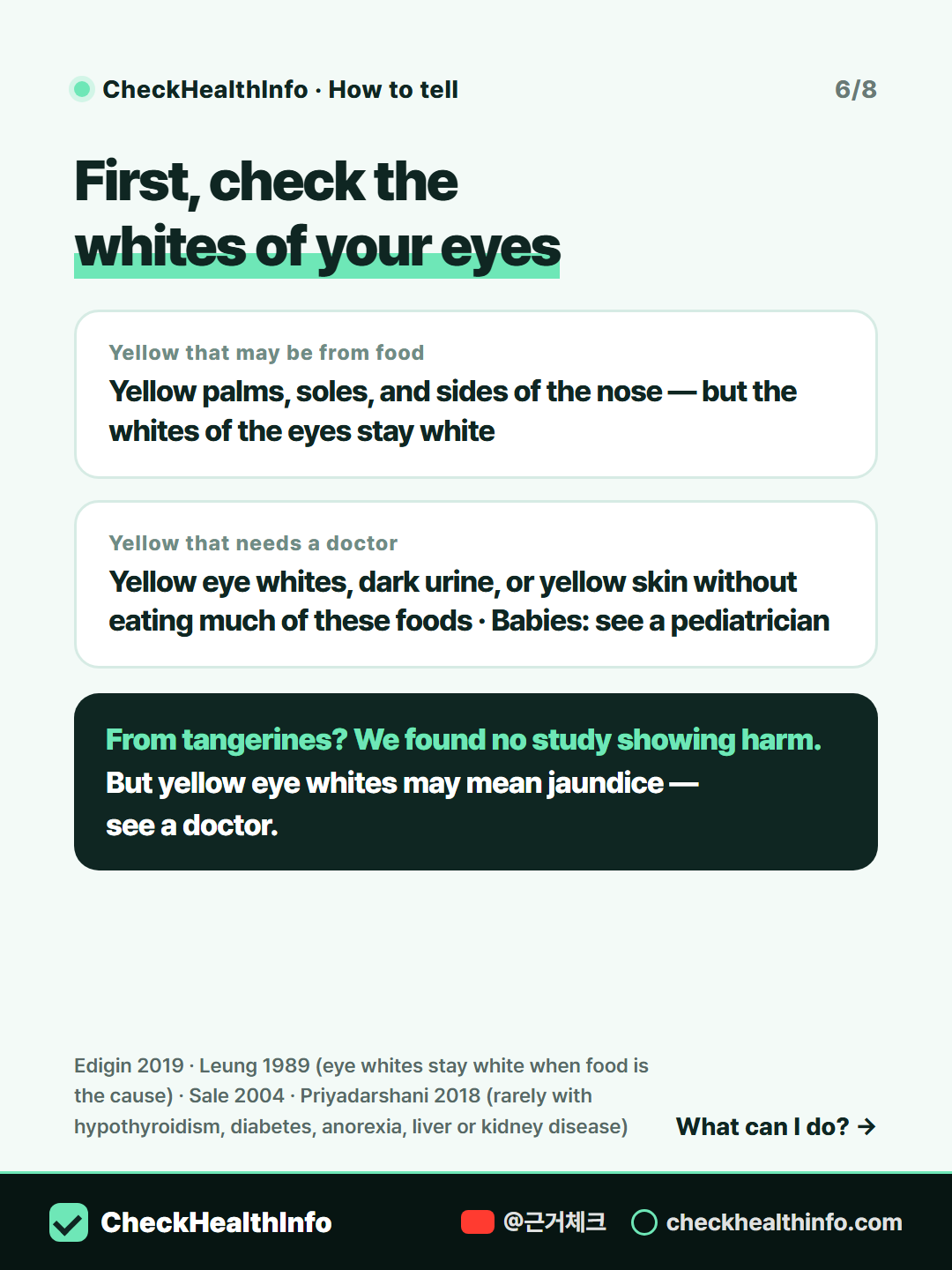
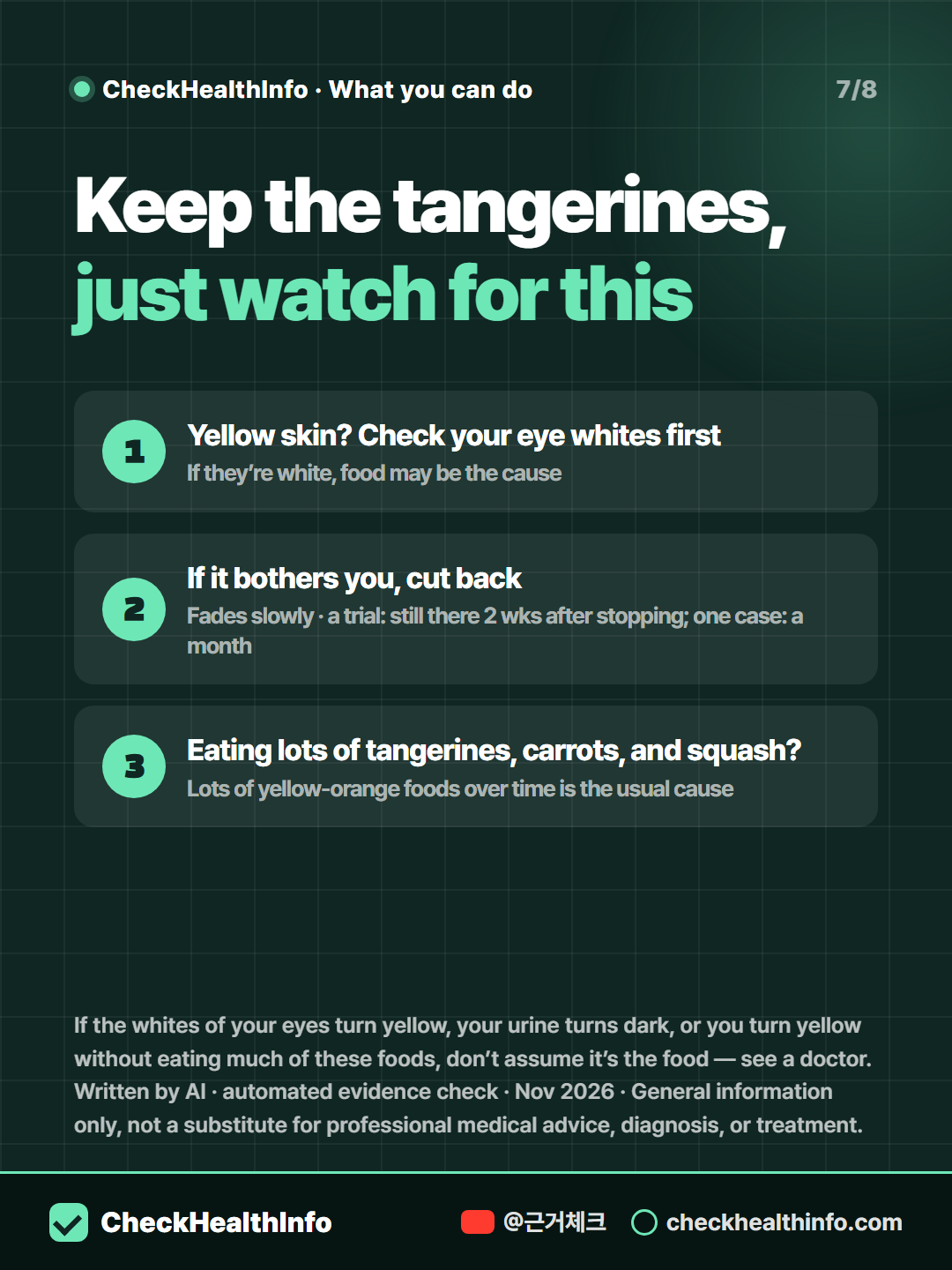
- If your skin turns yellow, check the whites of your eyes first — when food is the cause, the whites of the eyes have been reported to stay white. [7] [9]
- If it bothers you, cut back — but it will not fade right away. In the smoothie trial, skin was still yellower two weeks after stopping [2], and in the adult orange case, the color returned to normal a month after stopping. [6]
- Check whether you eat a lot of yellow-orange foods together, such as tangerines, carrots, and squash — eating large amounts of yellow-orange foods like carrots and winter squash over a long time has been reported as the most common cause. [10]
- If the whites of your eyes turn yellow, your urine turns dark, or you turn yellow without eating much of these foods, don’t assume it’s the food — see a doctor. Rarely, yellow skin can occur with an underactive thyroid, diabetes, anorexia nervosa, or liver or kidney disease. [10] [11] In babies, it can be confused with jaundice, so check with a pediatrician. [8]
Scope: This rating covers carotenoids from foods such as tangerines and skin color. It does not cover beta-carotene supplements (pills), vitamin A supplements, or a “safe number” of tangerines a day.
Limitations of this rating
- The randomized trials fed a mix of fruits and vegetables (or a fruit smoothie), not tangerines alone, and measured skin yellowness with a device. Participants were young women and college students, and the trials lasted only 4 to 6 weeks. Skin yellowness was linked to alpha- and beta-carotene; the abstracts do not separately report on skin color and beta-cryptoxanthin, the carotenoid found in tangerines. [1] [2]
- In our search, we found no study that set how many you need to eat before your skin turns yellow. The “one or two a day” amount mentioned in the news is not a figure we found in any study, so we did not use it here.
- The evidence for Rating 2 is case reports and a narrative review, so we cannot put a number on how common it is or how long it takes to fade (one adult case took a month; infant cases cleared as their diets changed while they grew).
- In a case report, a child on a diet that cut out many foods to avoid allergies (an exclusion diet) had carotenemia along with an enlarged liver, which got better once the diet was managed. The authors said carotenemia itself is benign, but preformed vitamin A in health supplements can be toxic. [12] Rarely, people who cannot break down carotenoids well for genetic reasons can turn yellow even on ordinary amounts. [11]
- This article was prompted by a news story. We do not evaluate any news outlet or person.
- Grades follow section 1 of our rating method. We check for new studies in our monthly PubMed review, and if a rating changes, we log it in our corrections log.
Card news
Video (in Korean)
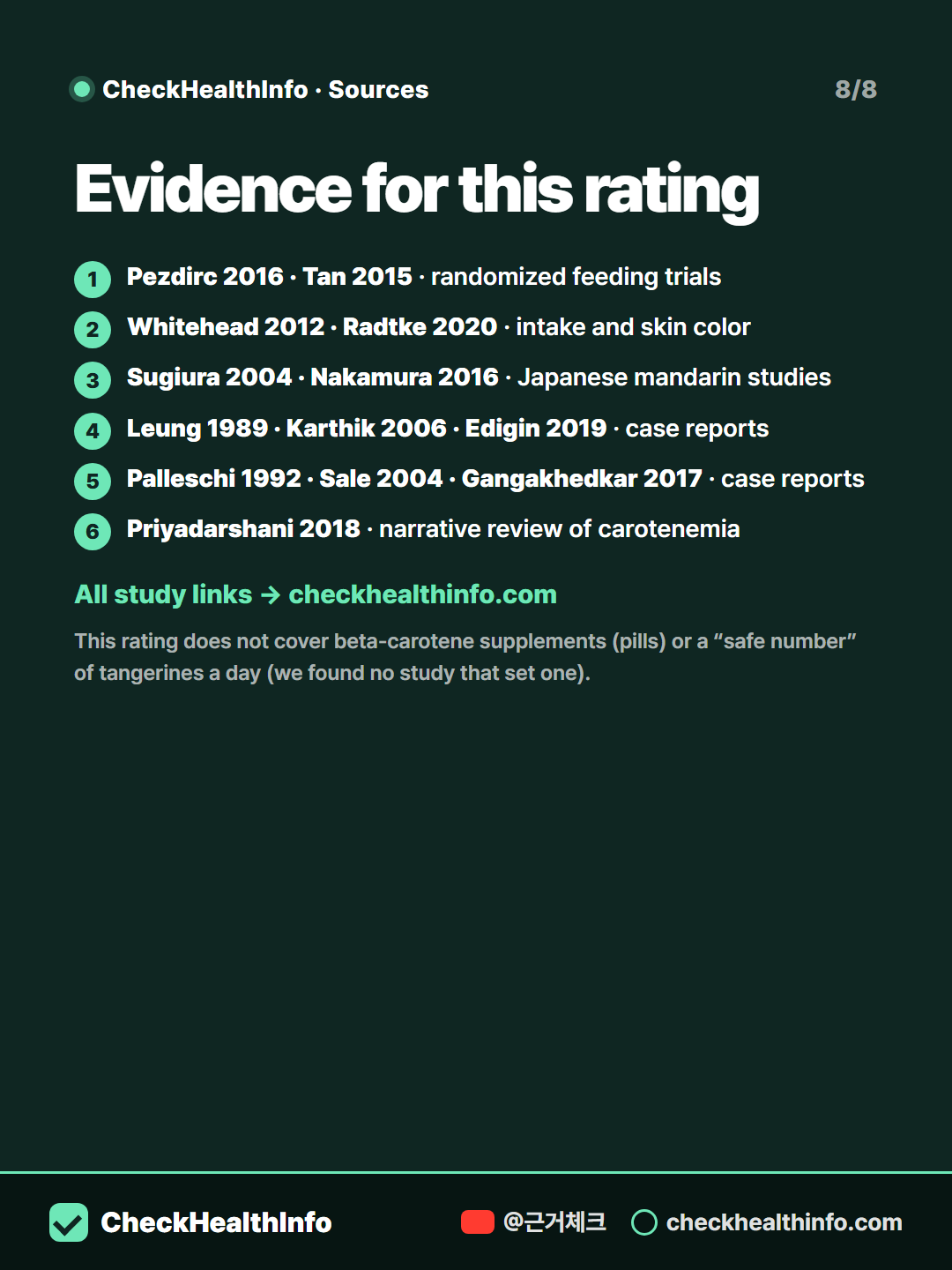
References
- Pezdirc K, Hutchesson MJ, Williams RL, et al. Consuming High-Carotenoid Fruit and Vegetables Influences Skin Yellowness and Plasma Carotenoids in Young Women: A Single-Blind Randomized Crossover Trial. J Acad Nutr Diet 2016;116(8):1257-65. PMID 27160341. PubMed abstract · Full article
- Tan KW, Graf BA, Mitra SR, et al. Daily Consumption of a Fruit and Vegetable Smoothie Alters Facial Skin Color. PLoS One 2015;10(7):e0133445. PMID 26186449. PubMed abstract · Full article · Free full text
- Whitehead RD, Re D, Xiao D, et al. You are what you eat: within-subject increases in fruit and vegetable consumption confer beneficial skin-color changes. PLoS One 2012;7(3):e32988. PMID 22412966. PubMed abstract · Full article · Free full text
- Radtke MD, Pitts SJ, Jahns L, et al. Criterion-Related Validity of Spectroscopy-Based Skin Carotenoid Measurements as a Proxy for Fruit and Vegetable Intake: A Systematic Review. Adv Nutr 2020;11(5):1282-1299. PMID 32407509. PubMed abstract · Full article · Free full text
- Sugiura M, Matsumoto H, Kato M, et al. Multiple linear regression analysis of the seasonal changes in the serum concentration of beta-cryptoxanthin. J Nutr Sci Vitaminol (Tokyo) 2004;50(3):196-202. PMID 15386932. PubMed abstract · Full article
- Palleschi GM, Knoepfel BR, Lotti T. Carotenoderma: a possible pit-fall in the immunopathologic diagnosis of pemphigus vulgaris. Int J Dermatol 1992;31(1):50-1. PMID 1737690. PubMed abstract · Full article
- Leung AK. Benign carotenemia in children. Can Fam Physician 1989;35:81-3. PMID 21253272. PubMed abstract · Free full text
- Karthik SV, Campbell-Davidson D, Isherwood D. Carotenemia in infancy and its association with prevalent feeding practices. Pediatr Dermatol 2006;23(6):571-3. PMID 17156001. PubMed abstract · Full article
- Edigin E, Asemota IR, Olisa E, et al. Carotenemia: A Case Report. Cureus 2019;11(7):e5218. PMID 31565621. PubMed abstract · Full article · Free full text
- Sale TA, Stratman E. Carotenemia associated with green bean ingestion. Pediatr Dermatol 2004;21(6):657-9. PMID 15575851. PubMed abstract · Full article
- Priyadarshani AMB. Insights of hypercarotenaemia: A brief review. Clin Nutr ESPEN 2018;23:19-24. PMID 29460797. PubMed abstract · Full article
- Gangakhedkar A, Somerville R, Jelleyman T. Carotenemia and hepatomegaly in an atopic child on an exclusion diet for a food allergy. Australas J Dermatol 2017;58(1):42-44. PMID 26490299. PubMed abstract · Full article
- Nakamura M, Sugiura M, Ogawa K, et al. Serum β-cryptoxanthin and β-carotene derived from Satsuma mandarin and brachial-ankle pulse wave velocity: The Mikkabi cohort study. Nutr Metab Cardiovasc Dis 2016;26(9):808-14. PMID 27212620. PubMed abstract · Full article
General information only, not a substitute for professional medical advice, diagnosis, or treatment. If the whites of your eyes also look yellow, your urine turns dark, or your skin turns yellow without eating much carotenoid-rich food, see a health care provider. For babies, check with a pediatrician.