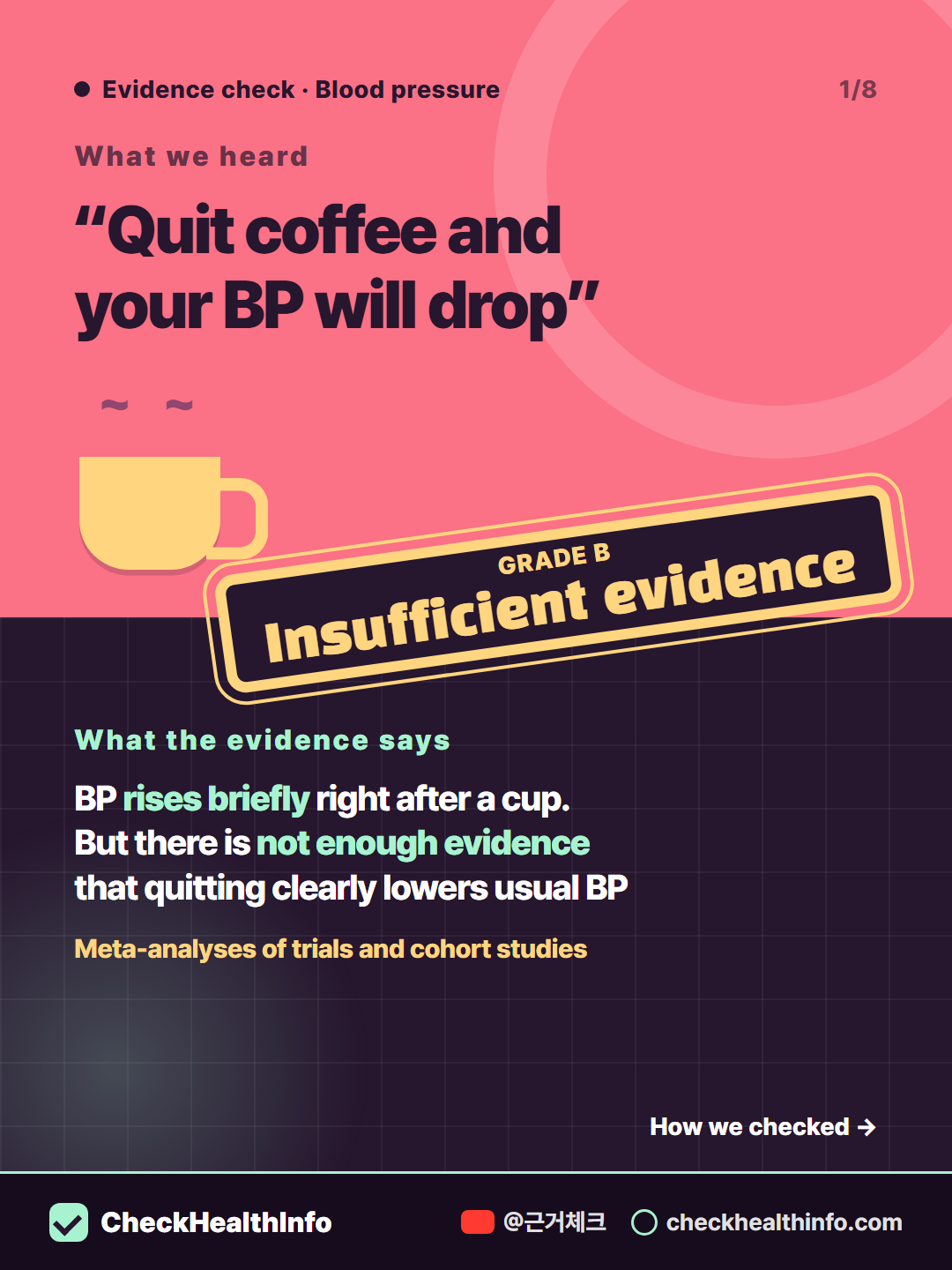
If you quit coffee, will your blood pressure drop?
Does quitting or cutting back on coffee (caffeine) lower blood pressure?

We checked this verdict against 10 sources, such as published studies and clinical guidelines. · How checked: AI-drafted · automated evidence checks
Verdicts at a glance
| Claim | Verdict |
|---|---|
| Drinking coffee (caffeine) raises blood pressure for a few hours afterward | Mostly true · Evidence grade B |
| Quitting or cutting back on your usual coffee lowers your usual blood pressure | Insufficient evidence · Evidence grade B |
Bottom line — The caffeine in coffee temporarily raises blood pressure for a few hours after you drink it. But there is not enough evidence that quitting the coffee you usually drink clearly lowers your usual blood pressure. In pooled analyses of randomized trials in which people drank coffee regularly, coffee showed no clear difference in usual blood pressure, or raised systolic pressure by just over 1 mmHg, and long-term studies found that coffee drinkers were not more likely to develop hypertension. So the claim that “quitting coffee lowers your blood pressure” is rated Insufficient evidence (this does not mean it is false).
Systolic and diastolic blood pressure — Blood pressure is given as two numbers. The first, larger number is systolic pressure (the top number); the second, smaller number is diastolic pressure (the bottom number). Both are measured in mmHg (millimeters of mercury).
Randomized trial — A study in which participants are assigned to groups by chance and then compared.
Crossover trial — A trial in which the same people try each drink in turn, on different days, so the drinks can be compared.
Meta-analysis — An analysis that pools the results of several studies into one estimate.
Cohort study — A study that follows many people over a long time and observes their habits and the illnesses they develop. It cannot show cause and effect for certain.
Relative risk — How many times higher one group’s risk is than another’s. A value of 1 means no difference.
95% confidence interval — The range in which the true value is likely to lie. If a difference crosses 0, or a relative risk crosses 1, we cannot be confident there is a real difference.
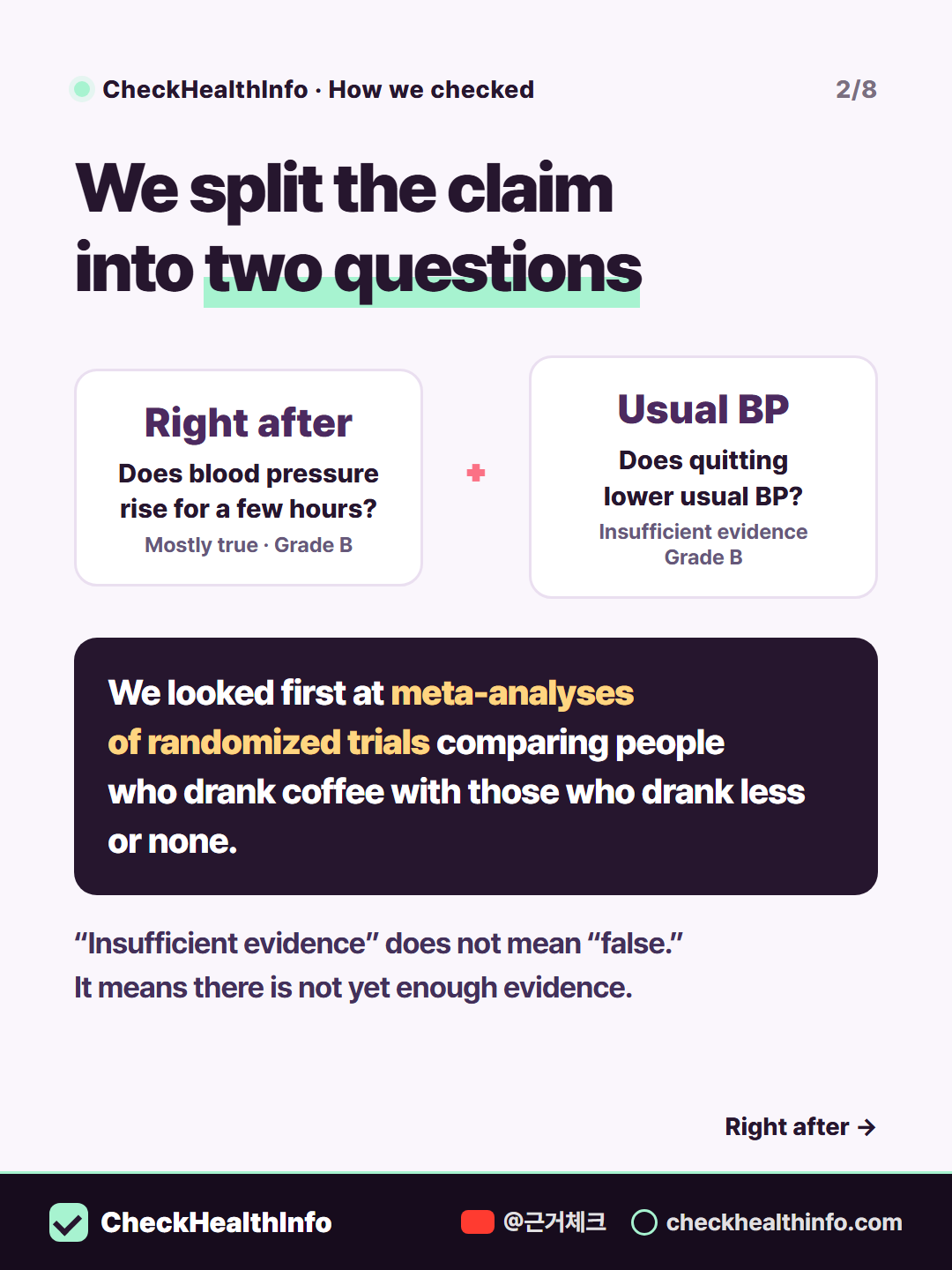
This claim mixes two different questions, so we gave two separate verdicts: (1) does blood pressure rise for a few hours right after drinking coffee, and (2) does quitting the coffee you usually drink lower your usual blood pressure?
Verdict 1. “Drinking coffee (caffeine) raises blood pressure for a few hours afterward”
Mostly true · Evidence grade B
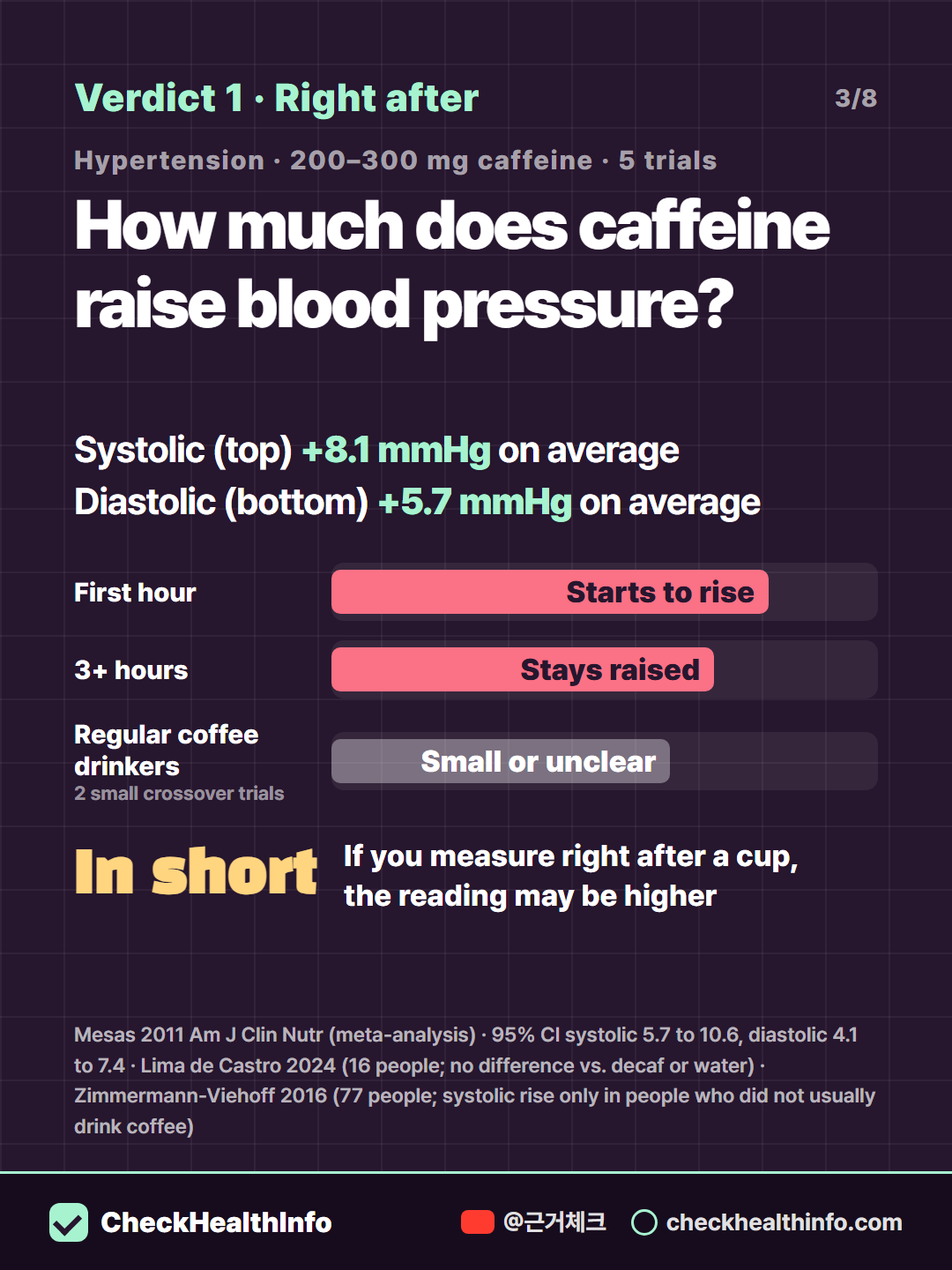
In plain terms Caffeine temporarily raises blood pressure for a few hours after you drink it. However, some trials found that in people who usually drink coffee the rise was small or unclear, so we rated it “Mostly true.”
- A meta-analysis of five trials that gave 200–300 mg of caffeine to people with hypertension found that systolic pressure rose by 8.1 mmHg on average (95% confidence interval 5.7 to 10.6) and diastolic pressure by 5.7 mmHg (4.1 to 7.4), compared with before caffeine. The rise appeared within the first hour and lasted 3 hours or more. In plain terms, for a few hours after caffeine, your blood pressure reading may be higher than usual. [1]
- However, in a crossover trial of 16 people with hypertension who were taking blood pressure medicines and usually drank coffee, blood pressure rose after caffeinated coffee but rose similarly after decaf, and there was no difference compared with decaf or water (with only 16 people, the trial may have been too small to detect a difference). [2]
- In a crossover trial of 77 healthy young adults, systolic pressure rose only in people who did not usually drink coffee. [3]
Grade: It starts at A (meta-analysis), but we lowered it one step to B because the trials gave 200–300 mg of caffeine to people with hypertension, so the results cannot be applied directly to typical adults who drink ordinary coffee (indirect evidence).
Verdict 2. “Quitting or cutting back on your usual coffee lowers your usual blood pressure”
Insufficient evidence · Evidence grade B
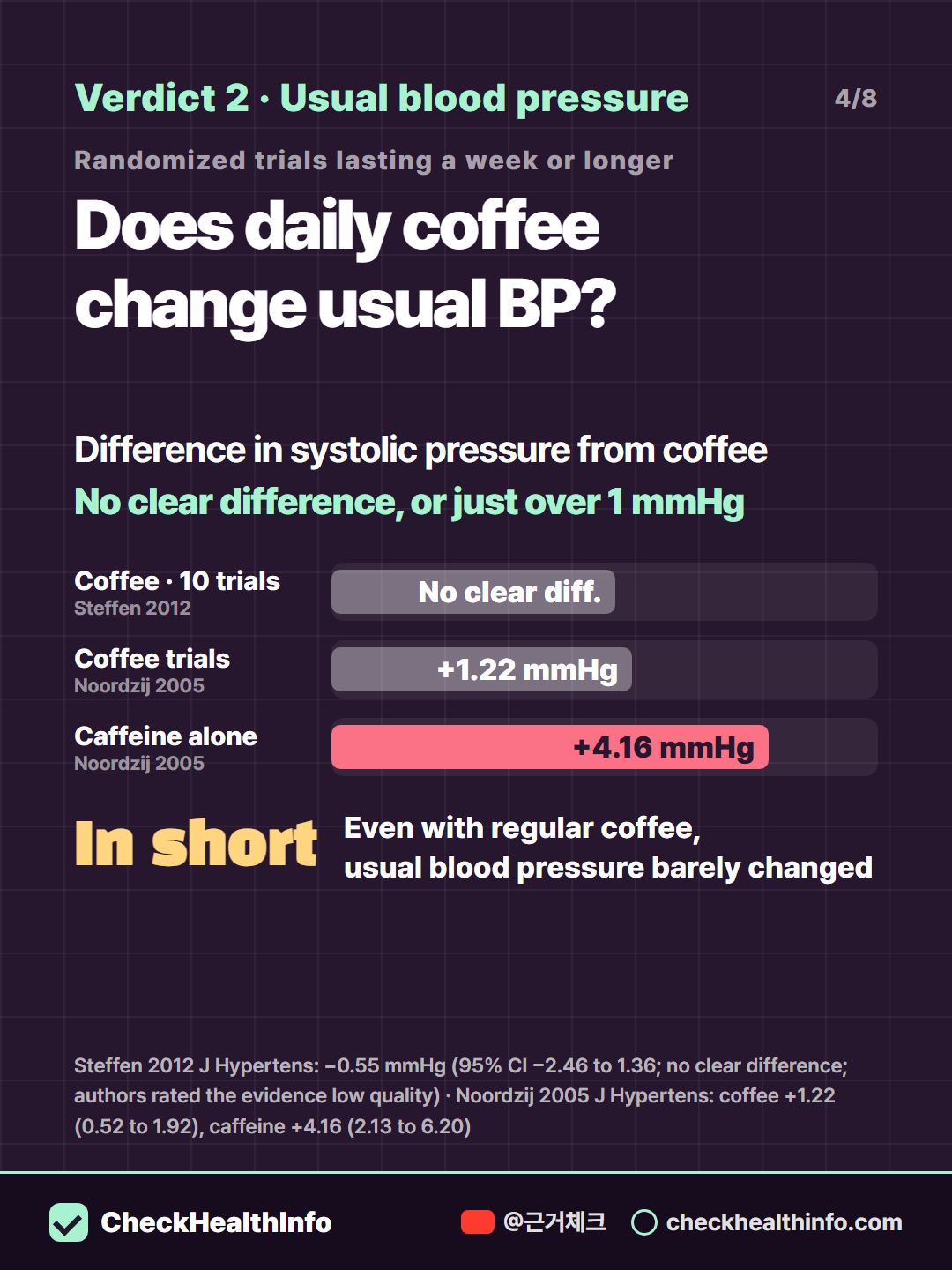
In plain terms In trials in which people drank coffee regularly, usual blood pressure barely changed, or rose by just over 1 mmHg. It has not been shown that quitting clearly lowers usual blood pressure, so we rated it “Insufficient evidence.”
- A meta-analysis of 10 randomized trials lasting a week or longer found no clear difference between people who drank coffee and those who drank less or none: systolic pressure differed by −0.55 mmHg (95% confidence interval −2.46 to 1.36) and diastolic pressure by −0.45 mmHg (−1.52 to 0.61). The authors rated the evidence as low quality. [4]
- A meta-analysis of 16 randomized trials lasting at least 7 days found that in the coffee trials (median 725 mL a day), systolic pressure rose by 1.22 mmHg (0.52 to 1.92), while the change in diastolic pressure, 0.49 mmHg (−0.06 to 1.04), was not clear. In plain terms, even with regular coffee, usual blood pressure barely changed, or rose by just over 1 mmHg. [5]
- In three trials of people with hypertension who drank coffee for 2 weeks, blood pressure did not rise compared with a caffeine-free diet or decaf. [1]
- However, in trials in which people took caffeine alone instead of coffee (median 410 mg a day), systolic pressure rose by 4.16 mmHg (2.13 to 6.20), which looked larger than in the coffee trials (this compares different trials that used different doses). [5]
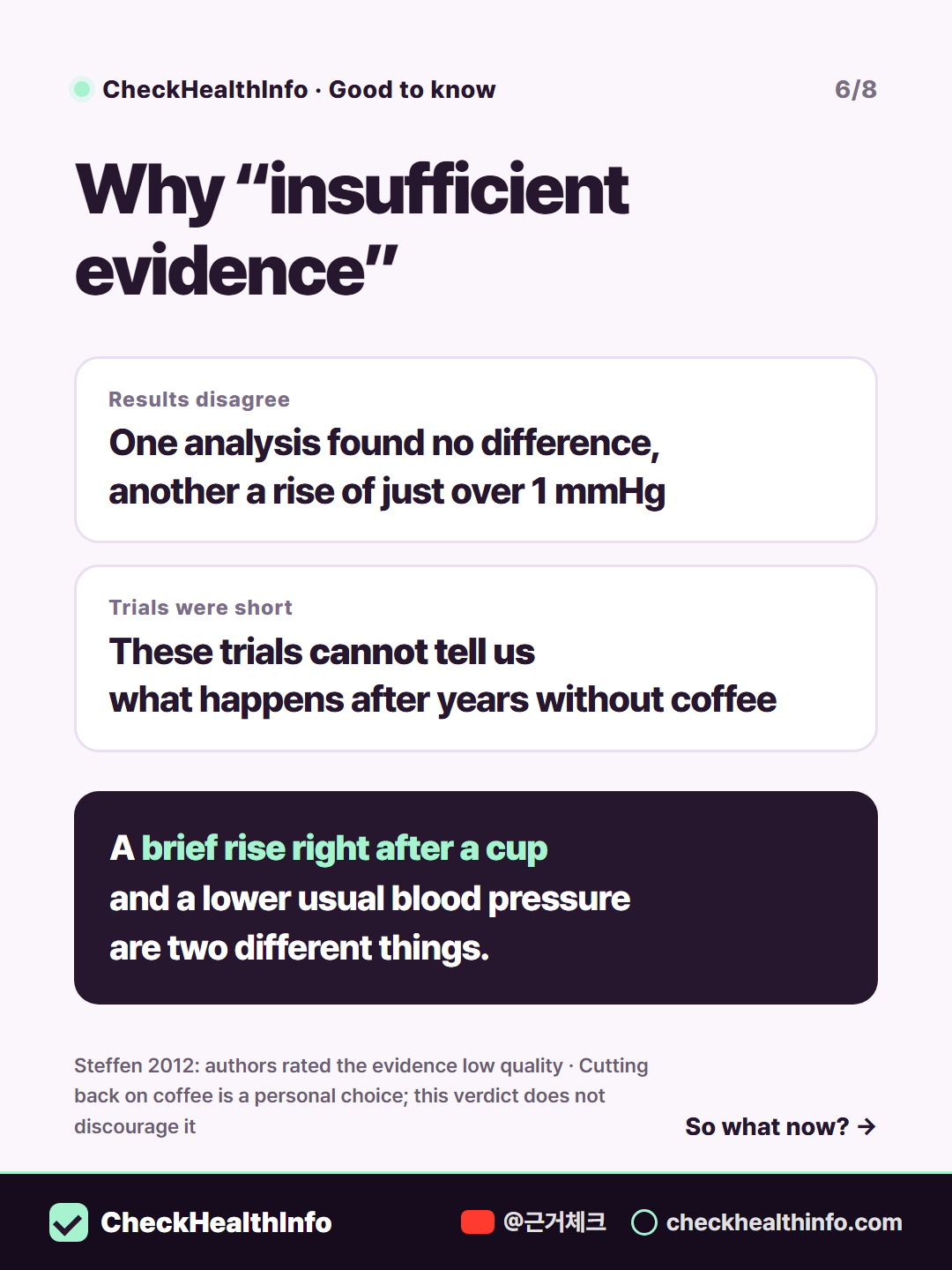
Grade: It starts at A (meta-analyses of randomized trials), but we lowered it one step to B because the results are uncertain: the confidence intervals are wide, the evidence was rated low quality, and the two meta-analyses reached different conclusions (no difference vs. a systolic rise of just over 1 mmHg).
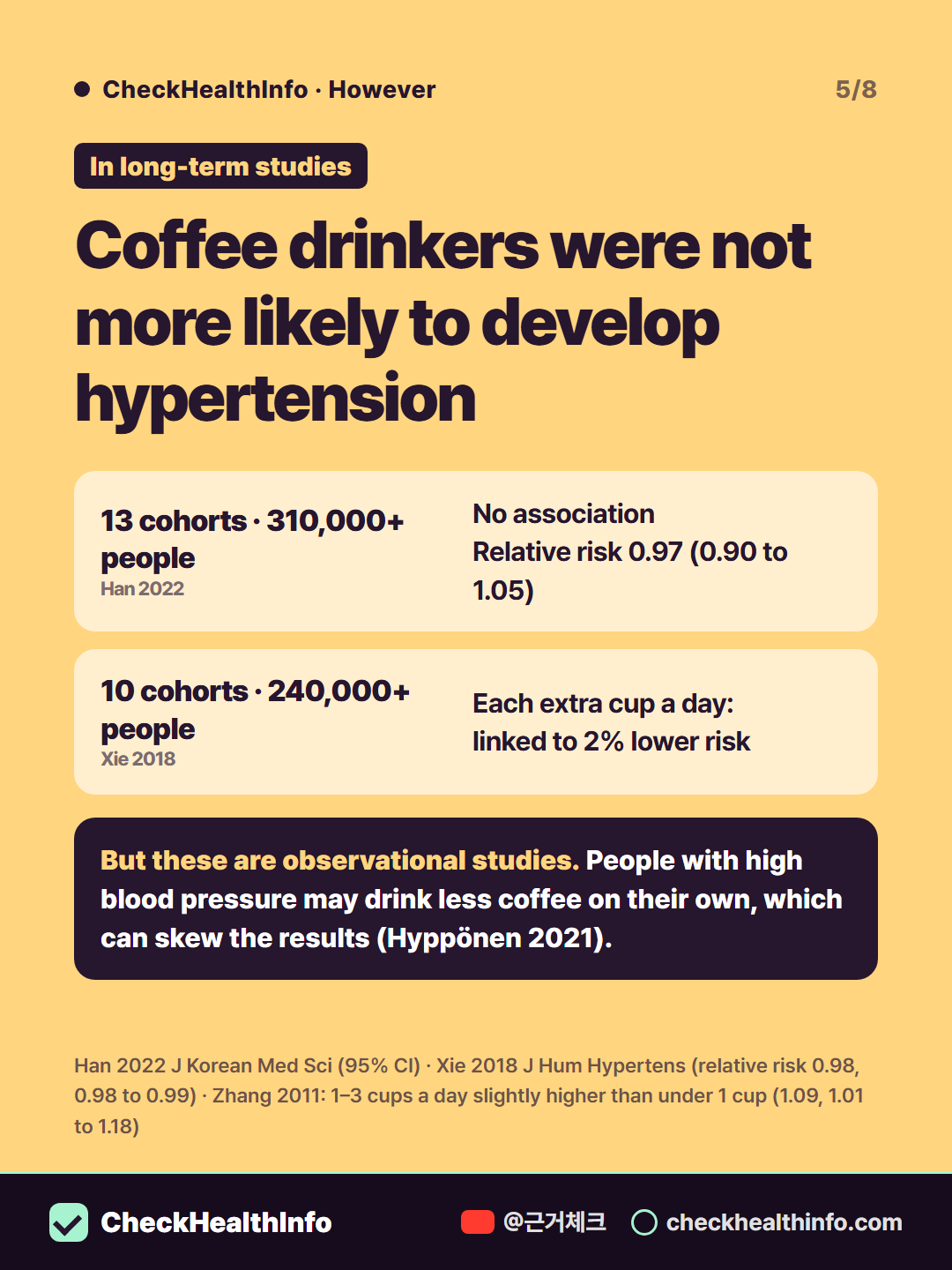
A meta-analysis of 13 cohort studies (314,827 people) found no association between coffee and the risk of hypertension (relative risk 0.97; 95% confidence interval 0.90 to 1.05). [6]
Another meta-analysis found that each additional cup a day was linked to a 2% lower risk of hypertension (relative risk 0.98; 0.98 to 0.99). [7]
In contrast, a meta-analysis of six cohort studies found that 1–3 cups a day was linked to a slightly higher risk of hypertension than less than 1 cup (relative risk 1.09; 1.01 to 1.18), but more than 3 cups was not. [8]
Observational studies like these can be skewed because people with high blood pressure tend to drink less coffee on their own (reverse causation). [9] An analysis using genetic data (Mendelian randomization) found that coffee intake was linked to slightly lower blood pressure, but this too is an observational analysis of genetic data, not a trial. [10]
If you drink coffee
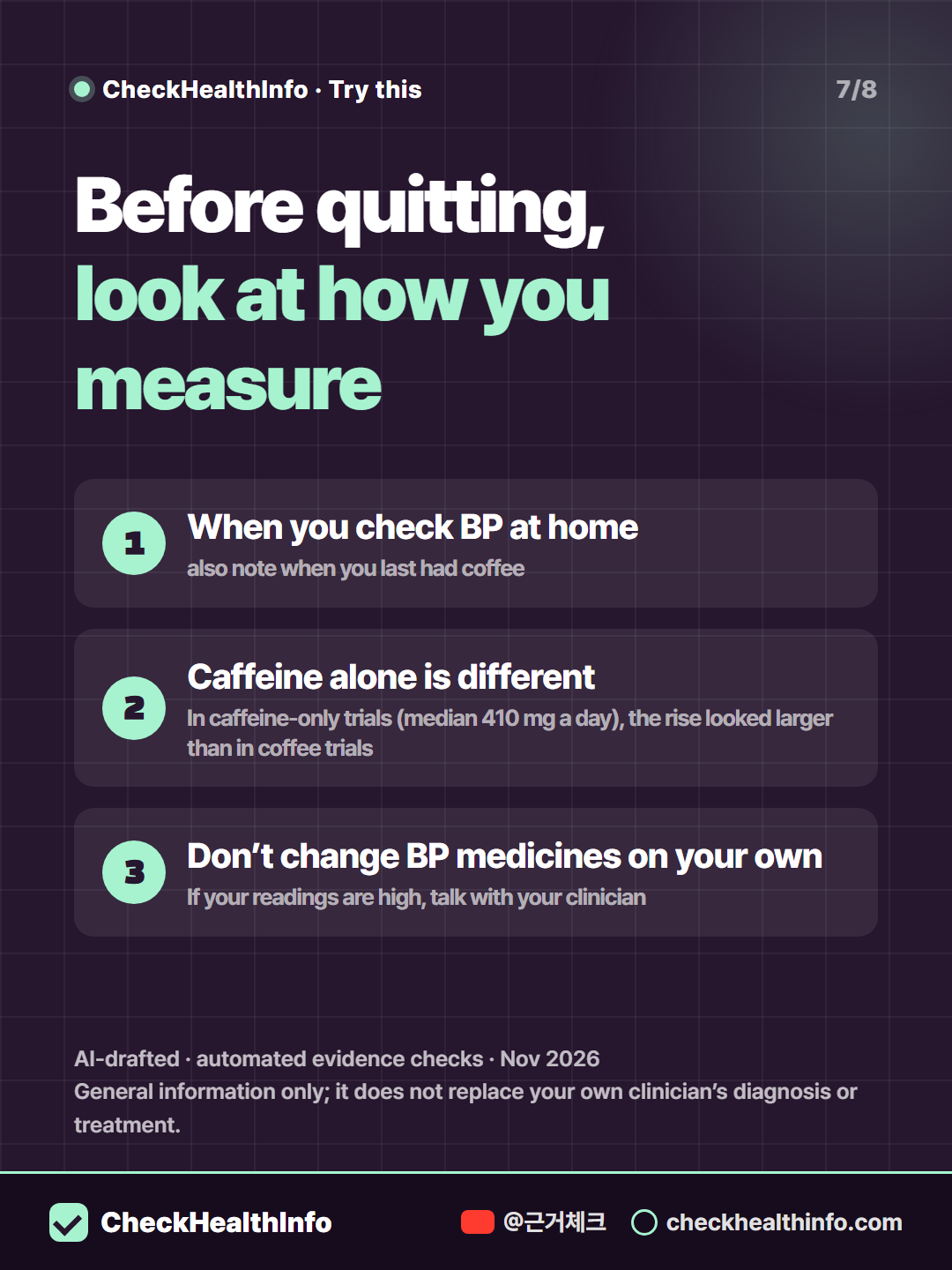
- When you check your blood pressure at home, note when you had coffee — In trials, blood pressure stayed raised for 3 hours or more after caffeine. Writing down when you drank it can help when you talk with your clinician. [1]
- Caffeine alone is different — In trials in which people took caffeine alone, the rise looked larger than in the coffee trials (a comparison between different trials). [5]
- If you take blood pressure medicines — Whether or not you drink coffee, do not change or stop your medicines on your own; talk with your clinician. The evidence that cutting salt lowers blood pressure is covered in our verdict on soup and blood pressure.
- Cutting back is a personal choice — If you cut back because coffee makes your heart race or disturbs your sleep, that is your choice, and this verdict does not discourage it.
Scope: This verdict covers the link between coffee or caffeine and blood pressure (right after drinking, usual blood pressure, and developing hypertension). It does not cover treatment or medicines for high blood pressure, or caffeine during pregnancy.
Limitations of this verdict
- The randomized coffee trials were short — at least a week, and usually a few weeks — so they cannot tell us the effect of quitting for years.
- The trials pooled for the rise right after drinking gave 200–300 mg of caffeine to people with hypertension. The two trials in which the rise was small in regular coffee drinkers were small (16 and 77 people) and measured blood pressure for a short time after a single drink.
- The authors of Steffen 2012 said they could neither recommend nor discourage coffee with regard to blood pressure. The abstracts of the two meta-analyses do not report participants’ blood pressure status, and most of the data come from Western countries. [4]
- The cohort meta-analyses are observational, so they cannot show cause and effect, and their results differed somewhat from one another.
- Grades follow section 1 of our rating method. We check PubMed for new studies every month, and if a verdict changes, we record it in our corrections log.
Card news
Video (in Korean)
References
- Mesas AE, Leon-Muñoz LM, Rodriguez-Artalejo F, et al. The effect of coffee on blood pressure and cardiovascular disease in hypertensive individuals: a systematic review and meta-analysis. Am J Clin Nutr 2011;94(4):1113-26. PMID 21880846. PubMed abstract · Full article
- Lima de Castro FBA, Castro FG, da Cunha MR, et al. Acute Effects of Coffee Consumption on Blood Pressure and Endothelial Function in Individuals with Hypertension on Antihypertensive Drug Treatment: A Randomized Crossover Trial. High Blood Press Cardiovasc Prev 2024;31(1):65-76. PMID 38308805. PubMed abstract · Full article
- Zimmermann-Viehoff F, Thayer J, Koenig J, et al. Short-term effects of espresso coffee on heart rate variability and blood pressure in habitual and non-habitual coffee consumers--a randomized crossover study. Nutr Neurosci 2016;19(4):169-75. PMID 25850440. PubMed abstract · Full article
- Steffen M, Kuhle C, Hensrud D, et al. The effect of coffee consumption on blood pressure and the development of hypertension: a systematic review and meta-analysis. J Hypertens 2012;30(12):2245-54. PMID 23032138. PubMed abstract · Full article
- Noordzij M, Uiterwaal CS, Arends LR, et al. Blood pressure response to chronic intake of coffee and caffeine: a meta-analysis of randomized controlled trials. J Hypertens 2005;23(5):921-8. PMID 15834273. PubMed abstract · Full article
- Han M, Oh Y, Myung SK. Coffee Intake and Risk of Hypertension: A Meta-Analysis of Cohort Studies. J Korean Med Sci 2022;37(45):e332. PMID 36413800. PubMed abstract · Full article · Free full text
- Xie C, Cui L, Zhu J, et al. Coffee consumption and risk of hypertension: a systematic review and dose-response meta-analysis of cohort studies. J Hum Hypertens 2018;32(2):83-93. PMID 29302055. PubMed abstract · Full article
- Zhang Z, Hu G, Caballero B, et al. Habitual coffee consumption and risk of hypertension: a systematic review and meta-analysis of prospective observational studies. Am J Clin Nutr 2011;93(6):1212-9. PMID 21450934. PubMed abstract · Full article
- Hyppönen E, Zhou A. Cardiovascular symptoms affect the patterns of habitual coffee consumption. Am J Clin Nutr 2021;114(1):214-219. PMID 33711095. PubMed abstract · Full article
- Zhong J, Huang S, Dong S, et al. Intake of coffee and blood pressure: A Mendelian randomized study. Nutr Metab Cardiovasc Dis 2026;36(1):104273. PMID 41087205. PubMed abstract · Full article
General information only, not medical advice. It does not replace your own clinician’s diagnosis or treatment. If your blood pressure readings are high, talk with your clinician. If you take blood pressure medicines, do not change or stop them on your own, whether or not you drink coffee.