If you shiver in the cold, do you really burn fat?
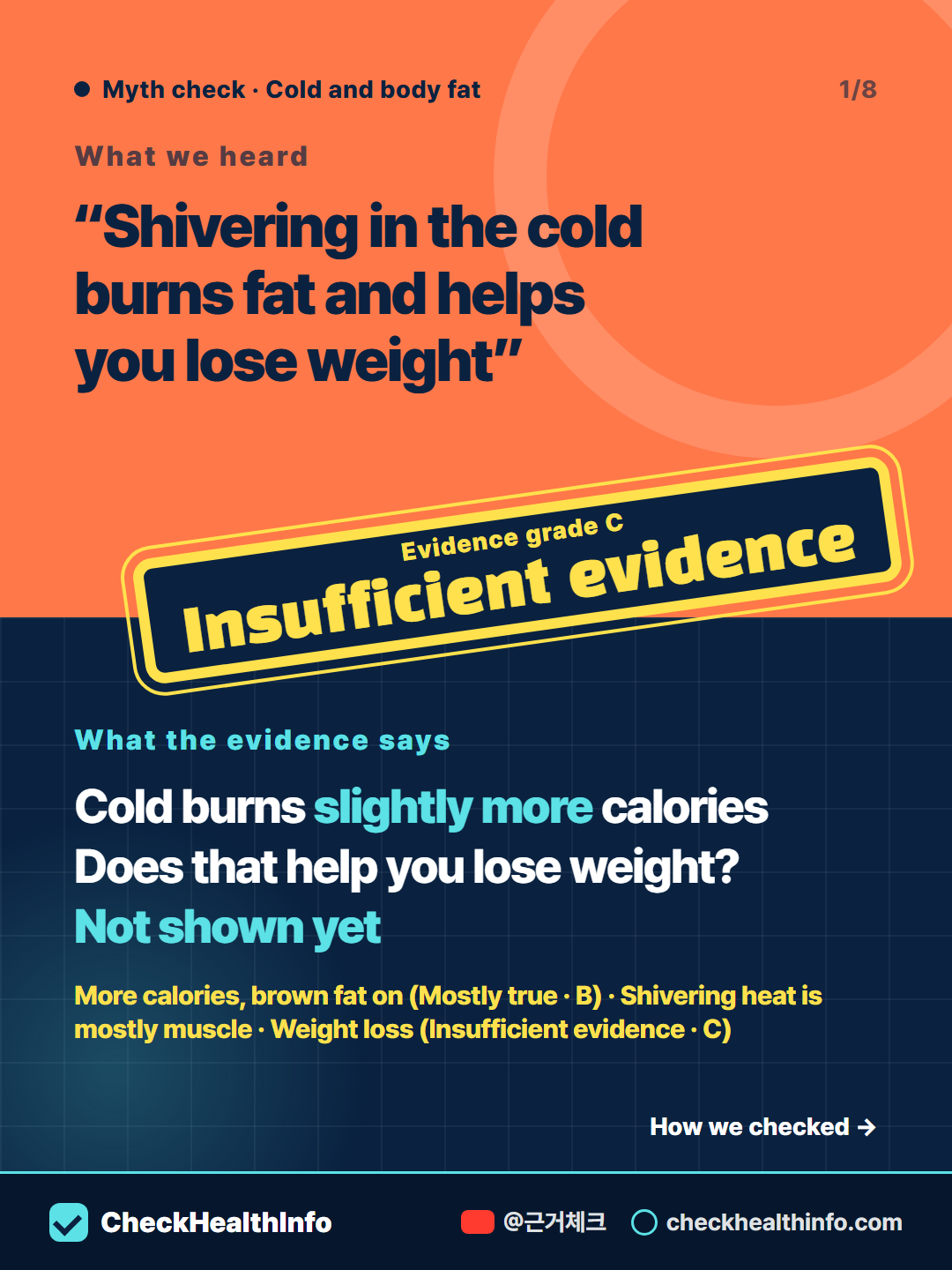
When you are exposed to cold and shiver, does brown fat become active and burn more fat (energy), and does that help you lose weight?

We checked this verdict against 14 sources, such as published studies and clinical guidelines. · How checked: AI-drafted · automated evidence checks
Verdicts at a glance
| Claim | Verdict |
|---|---|
| When you are exposed to cold and shiver, brown fat is activated and you burn more calories (energy) | Mostly true · Evidence grade B |
| So frequent cold exposure (shivering) helps you lose weight (body fat) | Insufficient evidence · Evidence grade C |
Bottom line — When you are exposed to cold, your body burns more calories to stay warm, and brown fat becomes more active. But when you shiver, most of the heat comes from your muscles, and brown fat accounted for only a small share of the extra calories. It has also not yet been shown that frequent cold exposure helps you lose weight. So the claim that “shivering in the cold burns fat and helps you lose weight” is rated Insufficient evidence (this does not mean it is false). There is no need to put up with the cold on purpose to lose weight.
Brown fat — Unlike ordinary (white) fat, which stores energy, brown fat burns fat and glucose to produce heat.
Energy expenditure — The number of calories your body uses. The studies in this article mostly measured it from the gases people breathed out.
Non-shivering thermogenesis — Heat the body produces without shivering. Brown fat and some muscles are responsible for it.
PET (positron emission tomography) — An imaging test that shows how much glucose, oxygen or other substances tissues in the body are using.
Randomized trial — A study in which participants are assigned to groups by chance and then compared.
Meta-analysis — An analysis that pools the results of several studies into one estimate.
95% confidence interval — The range in which the true value is likely to lie. The wider the range, the less certain the result.
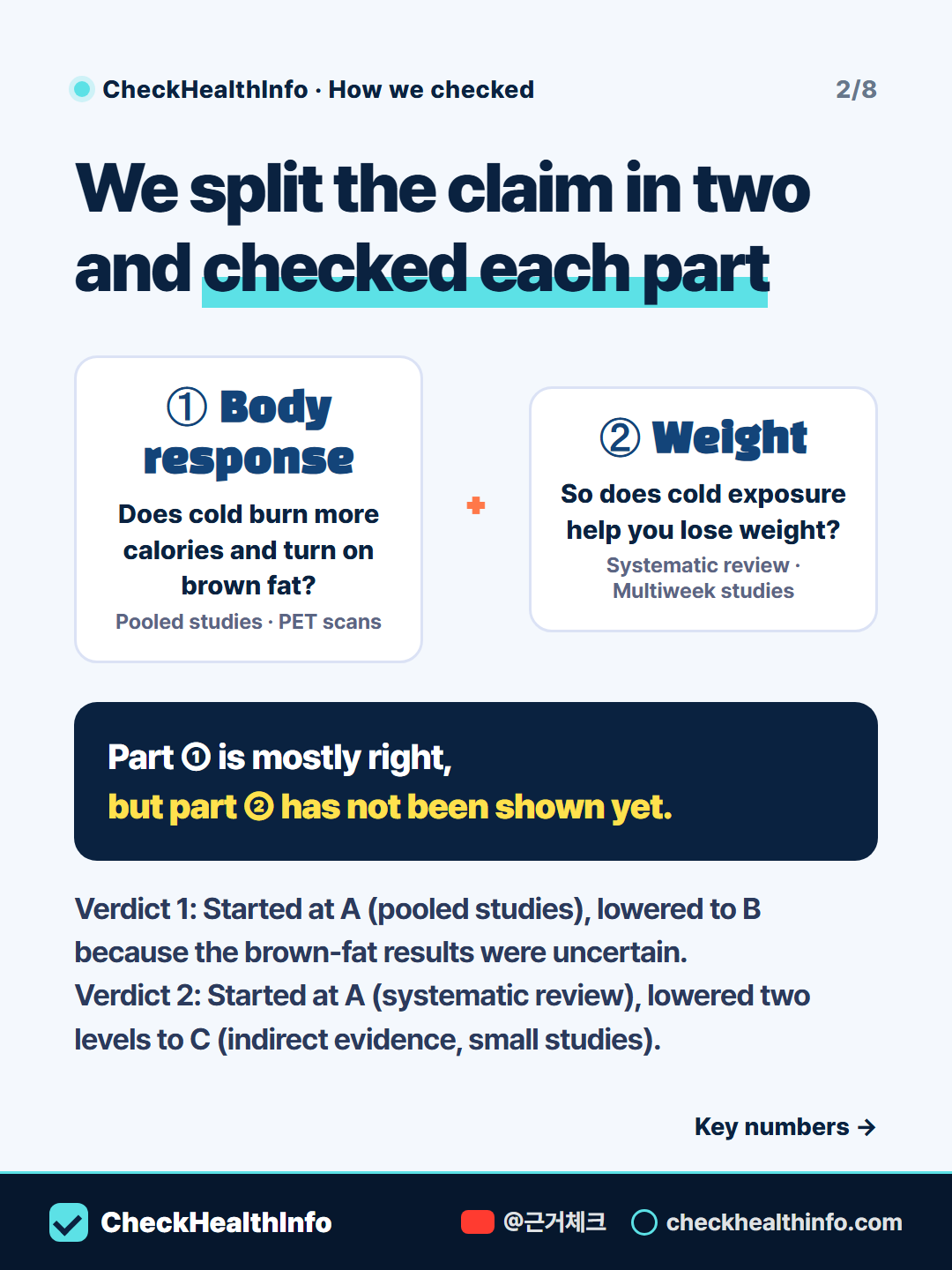
This claim mixes two different questions, so we gave two separate verdicts: (1) does shivering in the cold activate brown fat and make you burn more calories (the body’s response), and (2) does frequent cold exposure therefore help you lose weight (weight)? We covered the temperature of drinking water separately in “Does drinking cold water help you lose weight?”
Verdict 1. “When you are exposed to cold and shiver, brown fat is activated and you burn more calories (energy)”
Mostly true · Evidence grade B
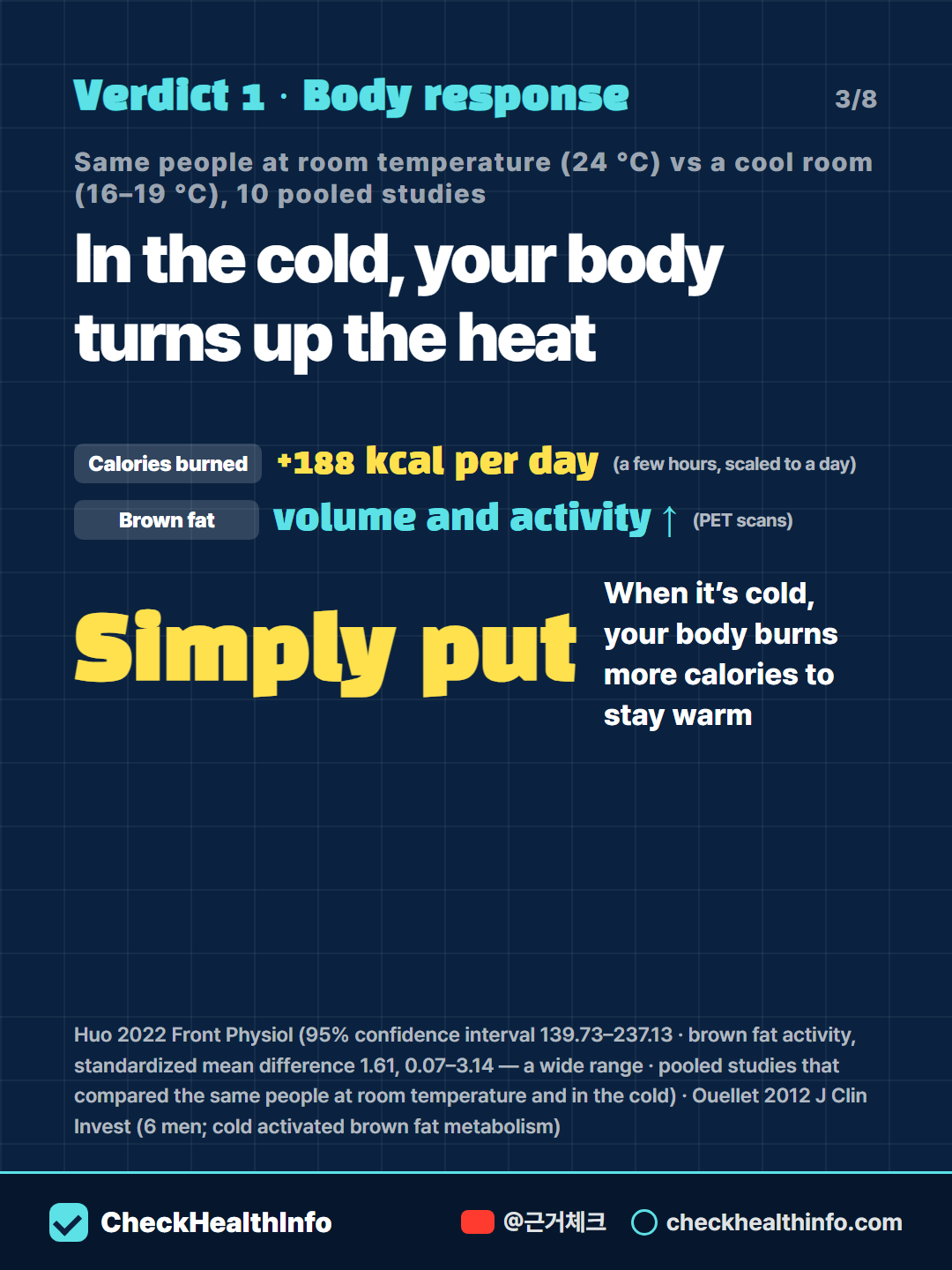
Simply put When it’s cold, your body turns up the heat and burns more calories, and brown fat goes to work too. But when you shiver, most of the heat comes from your muscles, and brown fat’s share is small. The main idea is right, but the idea that shivering is brown fat burning calories is not accurate, so we rated it Mostly true.
- A meta-analysis pooled 10 studies (classified by the authors as randomized trials) that compared people’s energy expenditure at room temperature (24 °C) with their energy expenditure during a short stay in a cool environment (16–19 °C). In the cool environment, energy expenditure was 188.43 kcal per day higher (95% confidence interval 139.73–237.13), and brown fat volume and activity also increased. This figure is a rate measured over a few hours of exposure and expressed per day; it is not the result of spending a whole day in the cold. [1]
- In a PET study of 6 healthy men, cold activated brown fat metabolism (but not that of nearby muscle or fat under the skin), and this occurred along with a rise in total energy expenditure. However, in the same study, the more active the brown fat, the less the men shivered. [2]
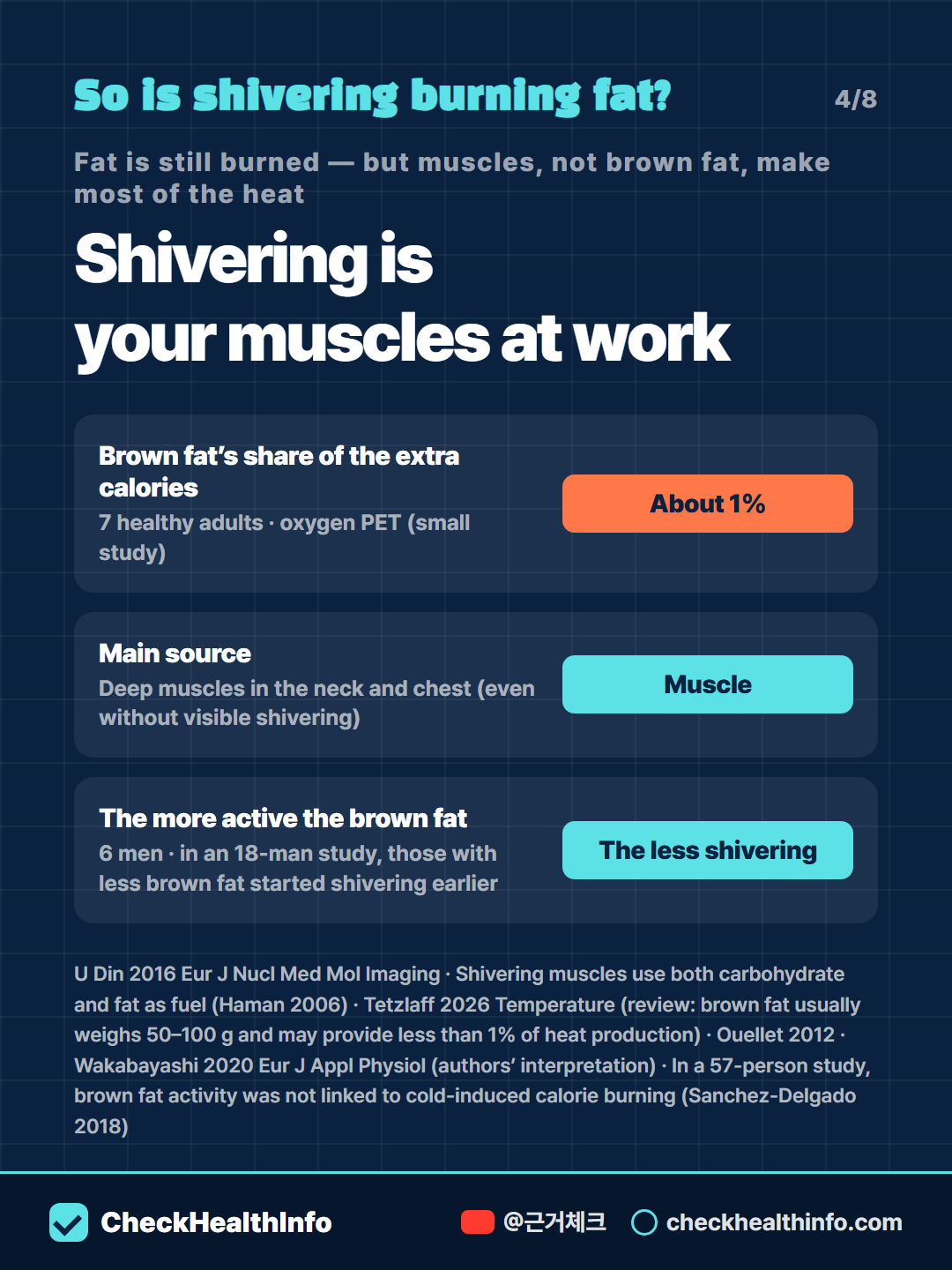
- In a study that gradually cooled 18 men, brown fat volume was also linked to non-shivering heat production, and the authors interpreted their findings to mean that men with less brown fat started shivering earlier to make up for the missing heat. [4] Shivering is a response in which muscles burn both carbohydrate and fat as fuel to produce heat; together with narrowing of blood vessels, it slows a large drop in body temperature. So this does not mean that no fat is burned when you shiver — it means the main source of heat is muscle, not brown fat. [5]
- In a study (7 people) that measured oxygen use directly, brown fat accounted for about 1% of the total increase in calories burned in the cold; most of the increase came from deep muscles in the neck and chest, which were working even without visible shivering. [3] A recent review likewise noted that brown fat usually weighs 50–100 g, may provide less than 1% of heat production, and that skeletal muscle plays a larger role. [6]
Grade: We started at A (a meta-analysis). The finding that calorie burning increases was consistent across studies, but the brown fat activity result pooled only two studies, so its 95% confidence interval was wide (0.07–3.14); each study was small; and the studies reached different conclusions about how much brown fat contributes to the extra calories (one found it contributes [2], another put it at about 1% [3], and a study of 57 people found no clear link [7]). We therefore lowered the grade one level, to B. In most of the meta-analysis studies, the cold was mild enough that people did not shiver; the fact that the idea that shivering is brown fat burning calories is not accurate is reflected in the Mostly true rating.
Verdict 2. “So frequent cold exposure (shivering) helps you lose weight (body fat)”
Insufficient evidence · Evidence grade C
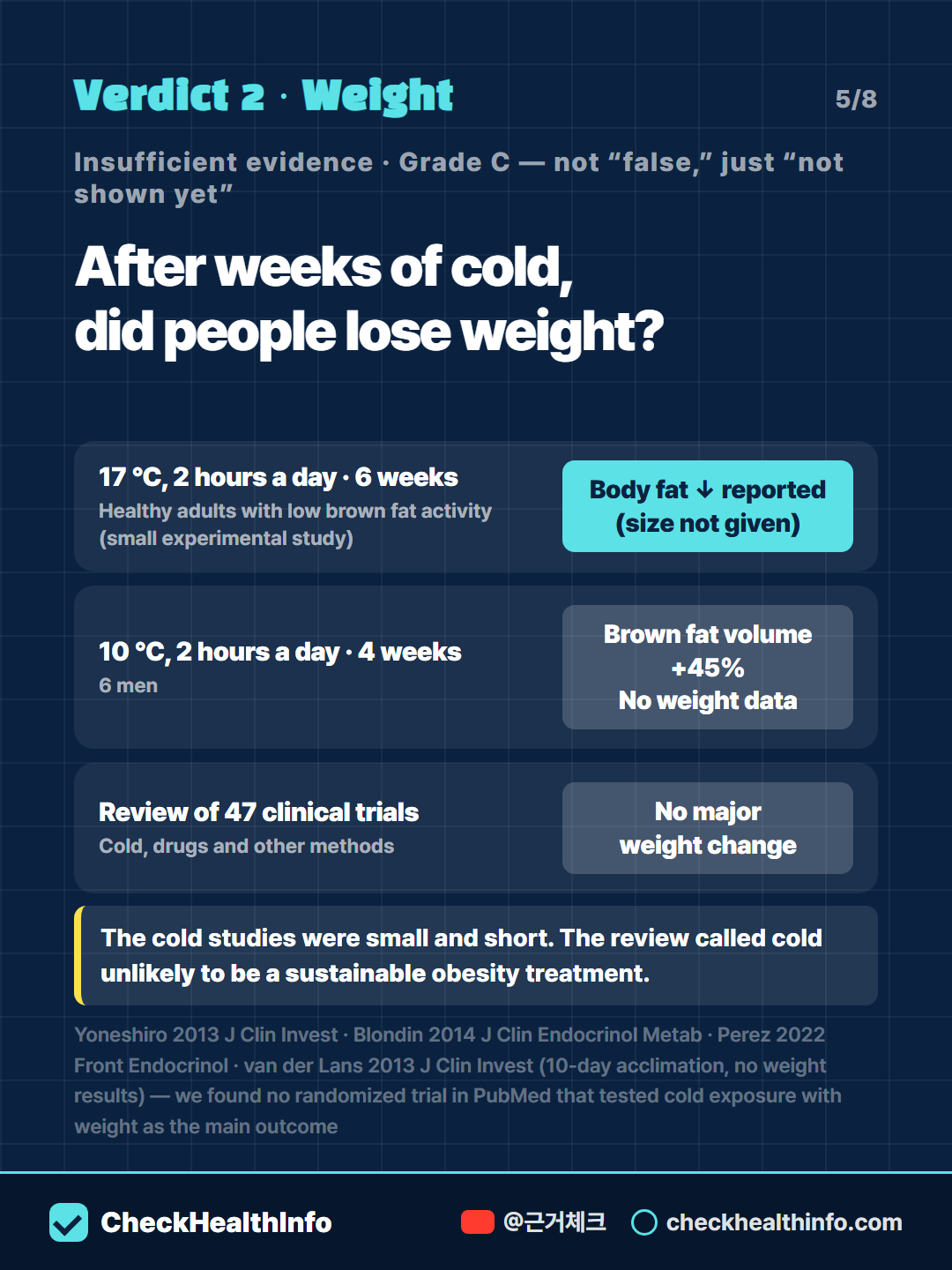
Simply put Cold makes you burn slightly more calories, but it has not yet been shown that this leads to weight loss. That is why we rated it Insufficient evidence — not because it is false, but because it has not yet been clearly shown.
- A systematic review of 47 clinical trials in adults that tested ways to activate brown fat — cold exposure as well as various drugs and other substances — concluded that cold exposure consistently activates brown fat and produces heat, but that the studies were small, changes in energy expenditure did not translate into major weight changes, and cold exposure appears unlikely to be a sustainable way to treat obesity. [8]
- A small experimental study in which healthy adults with low brown fat activity spent 2 hours a day at 17 °C for 6 weeks reported a decrease in body fat along with an increase in brown fat activity, but the abstract does not report how much body fat decreased. [9]
- In a study in which 6 men were exposed to 10 °C for 2 hours a day for 4 weeks, the volume of active brown fat increased by 45% (from 66 to 95 mL), but the abstract reports no weight results. [10] A study of 10 days of cold acclimation also found increases in brown fat activity and non-shivering heat production, but its abstract reports no weight results either. [11]
Grade: We started with a systematic review (A). However, (1) the evidence is indirect: the review pooled many substances along with cold, and the cold studies mostly measured calories and brown fat rather than weight (we found no randomized trial in PubMed that tested cold exposure with weight as the main outcome); and (2) the results are uncertain, because the studies were small (from 6 to a dozen or so people) and short (10 days to 6 weeks). Because these are two different reasons, we lowered the grade two levels, to C.
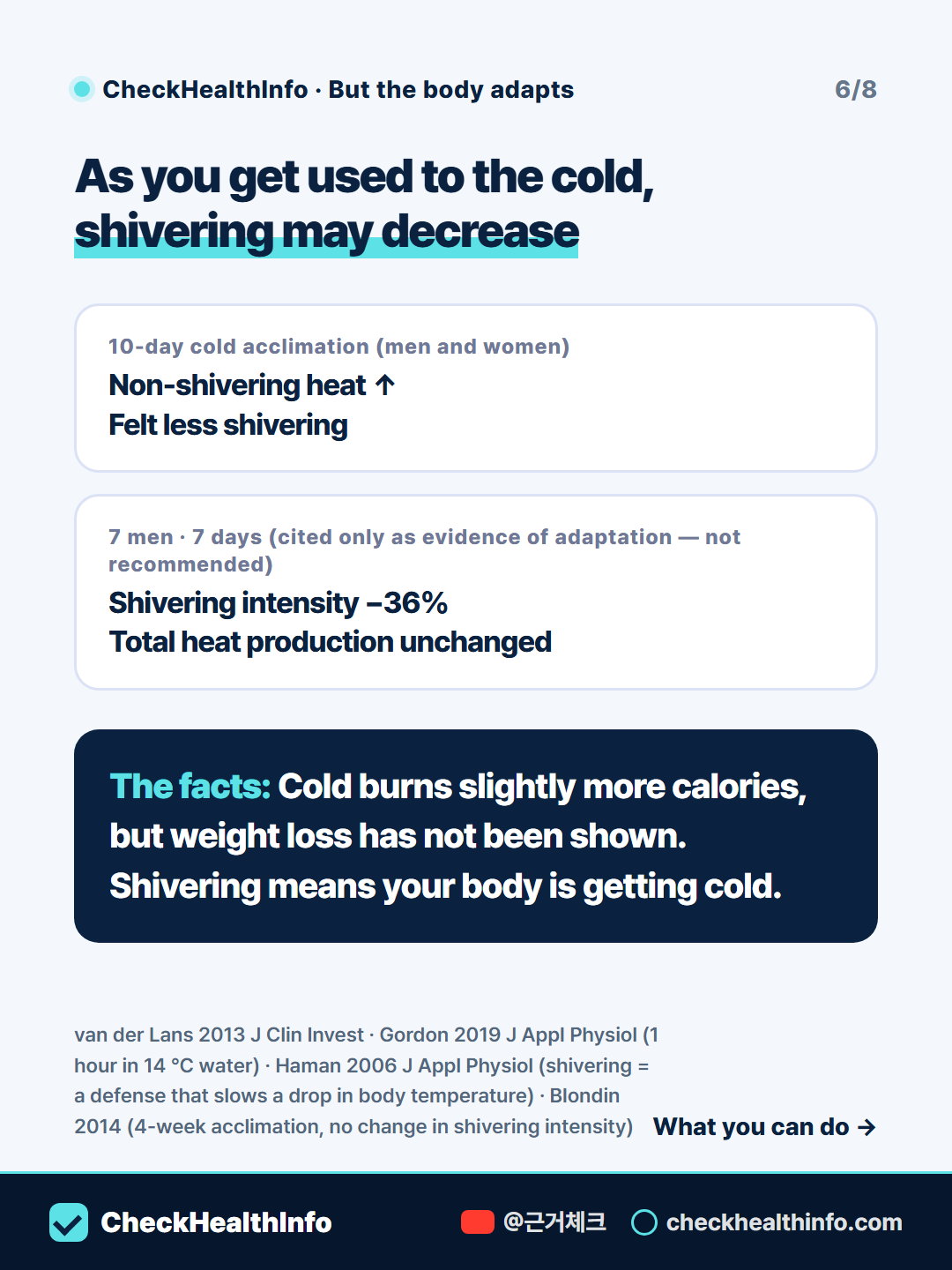
After 10 days of cold acclimation, participants felt less cold and reported less shivering. [11]
In a study in which 7 men were immersed in 14 °C water for 1 hour a day for 7 days, shivering intensity fell by 36%, but total heat production did not change, suggesting that non-shivering heat production increased to take the place of shivering. [12] However, in a study in which men were exposed to 10 °C every day for 4 weeks, shivering intensity did not change. [10] We cite the cold-water study only as evidence of how the body adapts; we do not recommend cold-water immersion.
If you get cold easily
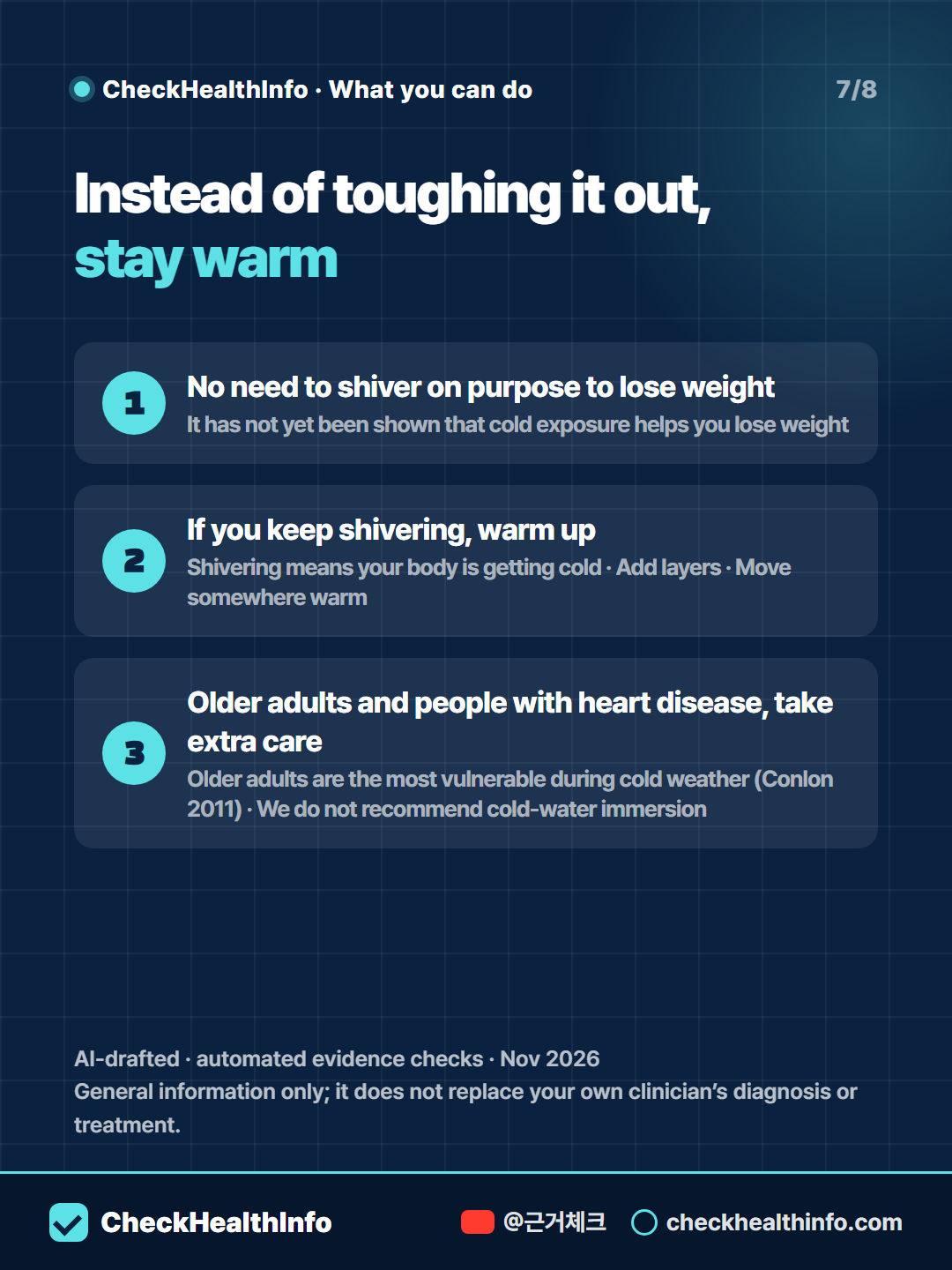
- There is no need to shiver on purpose to lose weight — It has not yet been shown that cold exposure helps you lose weight. [8]
- If you keep shivering, warm up — Shivering is your body’s way of defending against a drop in body temperature. Add layers and move somewhere warm. [5]
- Older adults and people with heart disease — Cold can put strain on the body. During cold weather, illness and death from heart and blood vessel disease and other conditions increase, and older adults are the most vulnerable [13]; even healthy older adults may have a weaker ability to narrow the blood vessels in their skin to hold in body heat. [14] This does not mean that staying in cool conditions is harmful, but there is no need to put up with the cold on purpose to lose weight. We do not recommend cold-water immersion.
Scope: This verdict covers how calorie burning and brown fat respond when the body is exposed to cold, and whether that affects weight. It does not cover the temperature of drinking water, the use of drugs or other substances to activate brown fat, or other health effects of cold.
Limitations of this verdict
- Most brown fat studies were small, with roughly 6 to 18 healthy young adults (mostly men), so the results may not apply directly to middle-aged or older adults.
- Brown fat activity measured by PET can vary with the method used. In a study of 57 young adults, neither brown fat nor muscle activity was linked to the increase in calorie burning in the cold, and the authors said this may reflect limits of the measurement methods. [7]
- The cold acclimation studies were short (10 days to 6 weeks), and we found no randomized trial in PubMed that assigned people to cold exposure with weight as the main outcome.
- Grades follow section 1 of our rating method. We check PubMed for new studies every month, and if a verdict changes, we record it in our corrections log.
Card news
Video (in Korean)
References
- Huo C, Song Z, Yin J, et al. Effect of Acute Cold Exposure on Energy Metabolism and Activity of Brown Adipose Tissue in Humans: A Systematic Review and Meta-Analysis. Front Physiol 2022;13:917084. PMID 35837014. PubMed abstract · Full article · Free full text
- Ouellet V, Labbé SM, Blondin DP, et al. Brown adipose tissue oxidative metabolism contributes to energy expenditure during acute cold exposure in humans. J Clin Invest 2012;122(2):545-52. PMID 22269323. PubMed abstract · Full article · Free full text
- U Din M, Raiko J, Saari T, et al. Human brown adipose tissue [(15)O]O2 PET imaging in the presence and absence of cold stimulus. Eur J Nucl Med Mol Imaging 2016;43(10):1878-86. PMID 26993316. PubMed abstract · Full article · Free full text
- Wakabayashi H, Matsumoto K, Kobori Y, et al. Multiorgan contribution to non-shivering and shivering thermogenesis and vascular responses during gradual cold exposure in humans. Eur J Appl Physiol 2020;120(12):2737-2747. PMID 32948898. PubMed abstract · Full article
- Haman F. Shivering in the cold: from mechanisms of fuel selection to survival. J Appl Physiol (1985) 2006;100(5):1702-8. PMID 16614367. PubMed abstract · Full article
- Tetzlaff EJ, Hancock C, Waddell L, et al. Cold exposure and human metabolism: A heterogeneous response across tissues and organs. Temperature (Austin) 2026;13(1):15-50. PMID 41797814. PubMed abstract · Full article · Free full text
- Sanchez-Delgado G, Martinez-Tellez B, Garcia-Rivero Y, et al. Brown Adipose Tissue and Skeletal Muscle 18F-FDG Activity After a Personalized Cold Exposure Is Not Associated With Cold-Induced Thermogenesis and Nutrient Oxidation Rates in Young Healthy Adults. Front Physiol 2018;9:1577. PMID 30505277. PubMed abstract · Full article · Free full text
- Perez LC, Perez LT, Nene Y, et al. Interventions associated with brown adipose tissue activation and the impact on energy expenditure and weight loss: A systematic review. Front Endocrinol (Lausanne) 2022;13:1037458. PMID 36568070. PubMed abstract · Full article · Free full text
- Yoneshiro T, Aita S, Matsushita M, et al. Recruited brown adipose tissue as an antiobesity agent in humans. J Clin Invest 2013;123(8):3404-8. PMID 23867622. PubMed abstract · Full article · Free full text
- Blondin DP, Labbé SM, Tingelstad HC, et al. Increased brown adipose tissue oxidative capacity in cold-acclimated humans. J Clin Endocrinol Metab 2014;99(3):E438-46. PMID 24423363. PubMed abstract · Full article · Free full text
- van der Lans AA, Hoeks J, Brans B, et al. Cold acclimation recruits human brown fat and increases nonshivering thermogenesis. J Clin Invest 2013;123(8):3395-403. PMID 23867626. PubMed abstract · Full article · Free full text
- Gordon K, Blondin DP, Friesen BJ, et al. Seven days of cold acclimation substantially reduces shivering intensity and increases nonshivering thermogenesis in adult humans. J Appl Physiol (1985) 2019;126(6):1598-1606. PMID 30896355. PubMed abstract · Full article · Free full text
- Conlon KC, Rajkovich NB, White-Newsome JL, et al. Preventing cold-related morbidity and mortality in a changing climate. Maturitas 2011;69(3):197-202. PMID 21592693. PubMed abstract · Full article · Free full text
- Alba BK, Castellani JW, Charkoudian N. Cold-induced cutaneous vasoconstriction in humans: Function, dysfunction and the distinctly counterproductive. Exp Physiol 2019;104(8):1202-1214. PMID 31045297. PubMed abstract · Full article
General information only, not medical advice. It does not replace your own clinician’s diagnosis or treatment. If you keep shivering, add layers and move somewhere warm. Cold can put extra strain on older adults and people with heart disease. We do not recommend cold-water immersion. If you have chest pain or severe shortness of breath, or you become confused, call 911 (119 in Korea) right away.