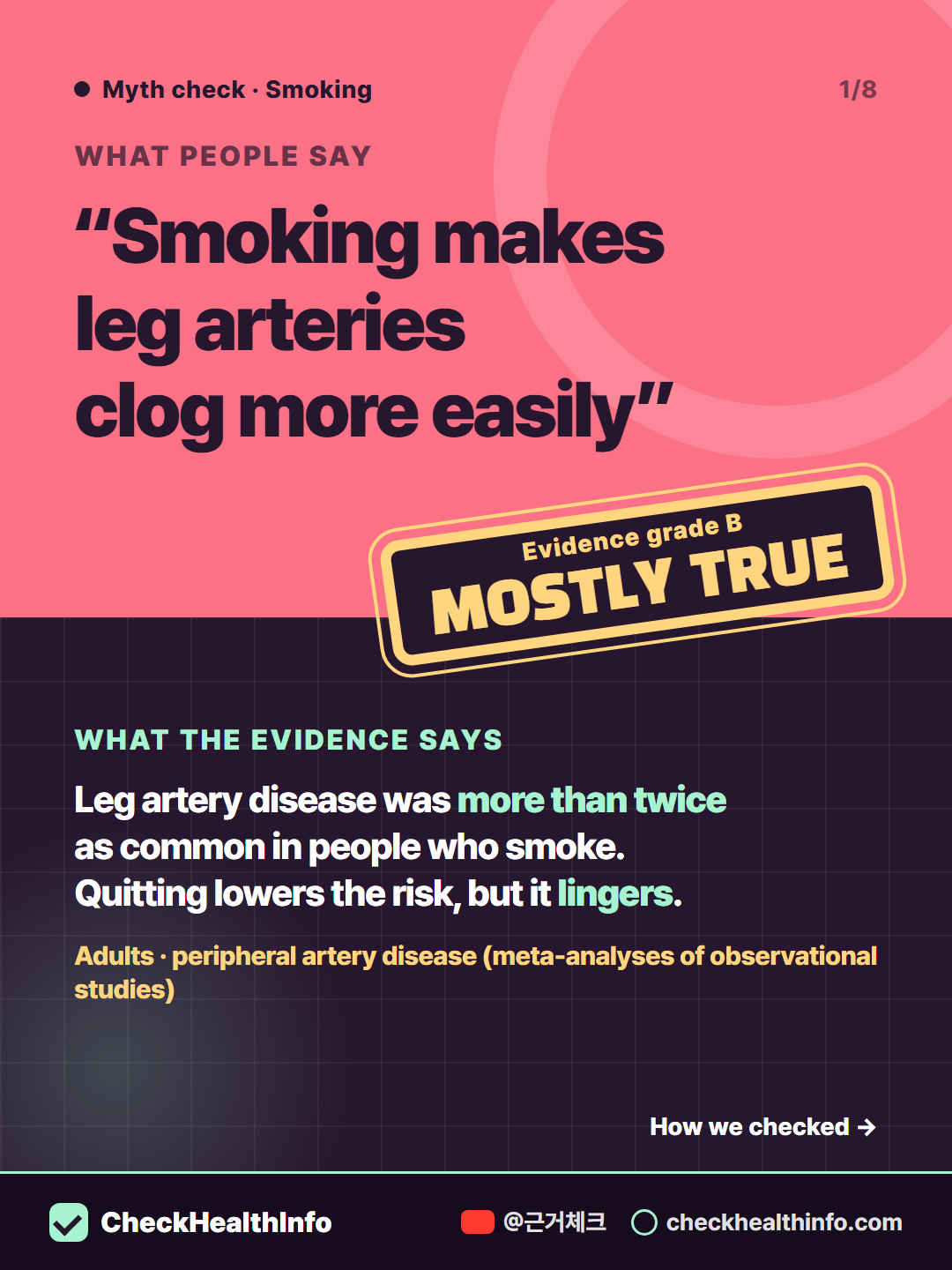
Can smoking clog your leg arteries, even to the point of amputation?
Does smoking really raise the risk of peripheral artery disease, which clogs the arteries in the legs? Does quitting help?

We checked this verdict against 5 sources, such as published studies and clinical guidelines. · How checked: AI-drafted · automated evidence checks
Verdicts at a glance
| Claim | Verdict |
|---|---|
| Smoking greatly raises the risk of peripheral artery disease, which clogs the arteries in the legs | Mostly true · Evidence grade B |
Bottom line — Across studies that looked at smoking and leg artery disease (peripheral artery disease), the disease was more than twice as common in people who smoke. So the claim that “smoking greatly raises the risk of peripheral artery disease, which clogs the arteries in the legs” is rated “Mostly true.” Here is what the evidence shows: leg artery disease was more than twice as common in smokers (odds ratio 2.71; 1.4 to 3.1 depending on the group studied). People who had quit had lower risk, but the risk lingered for a long time after quitting (up to 30 years), so the sooner you quit, the better.
Peripheral artery disease (PAD) — A disease in which the arteries that carry blood to the legs become narrowed or blocked. Leg pain while walking that eases with rest is a common sign, but many people have no symptoms.
Meta-analysis — An analysis that pools the results of several studies into a single estimate.
Odds ratio — Compares the odds of having a disease in two groups. A value of 1 means no difference; more than 1 means the disease is more common in that group. When a disease is not rare, the odds ratio makes the difference look a little larger than it really is.
Cohort study — An observational study that follows many people over a long time. It shows that two things go together, but it is less certain than a randomized trial about cause and effect.
95% confidence interval — The range in which the true value is likely to fall. If the range includes 1, we cannot say for sure that there is a difference.
Claim. “Smoking greatly raises the risk of peripheral artery disease, which clogs the arteries in the legs”
Mostly true · Evidence grade B
In plain terms Leg artery disease was more than twice as common in people who smoke, and smoking was linked with it even more strongly than with heart disease. But the size of the link depended on who was studied, so we rated the claim “Mostly true.”
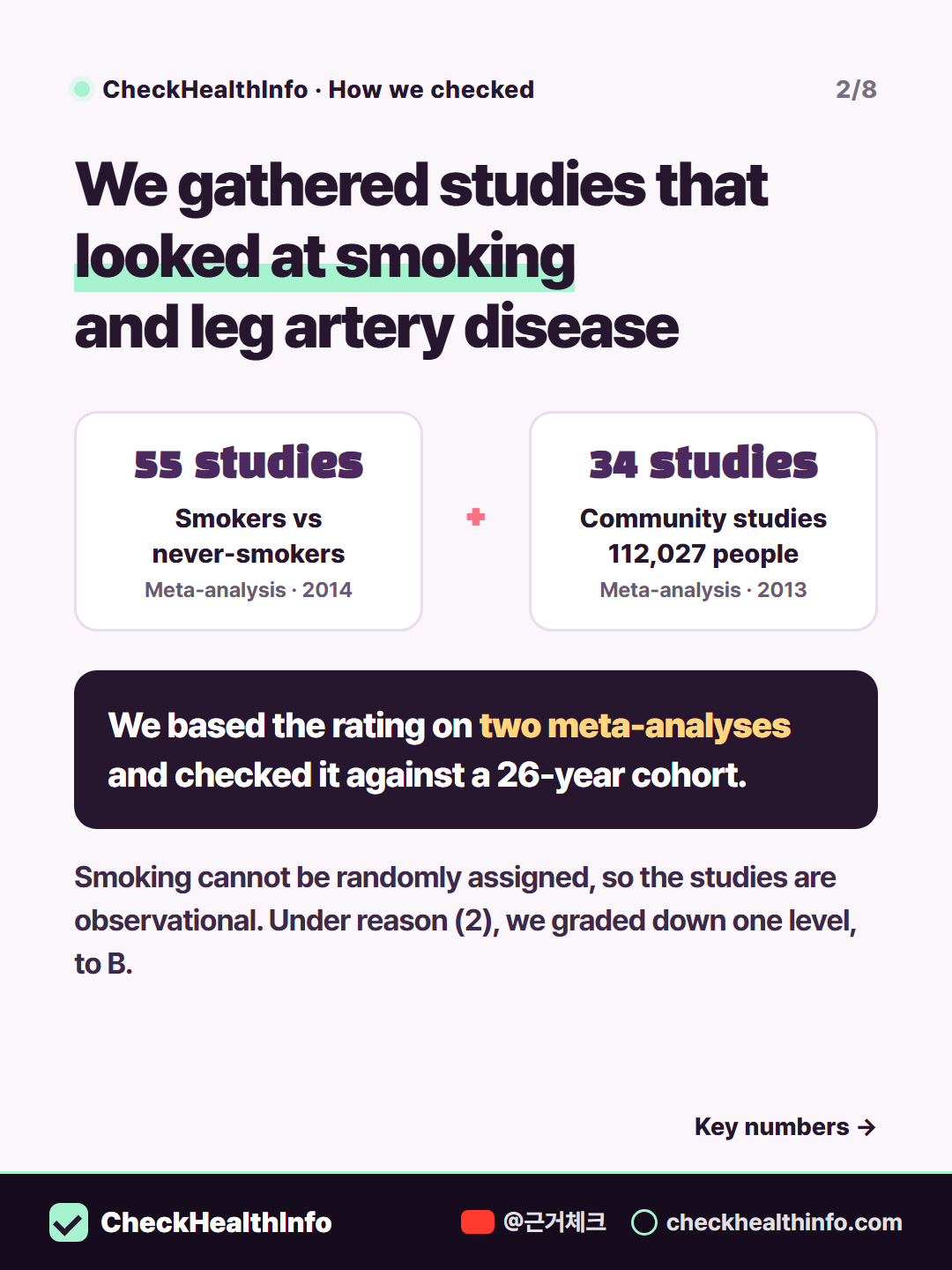
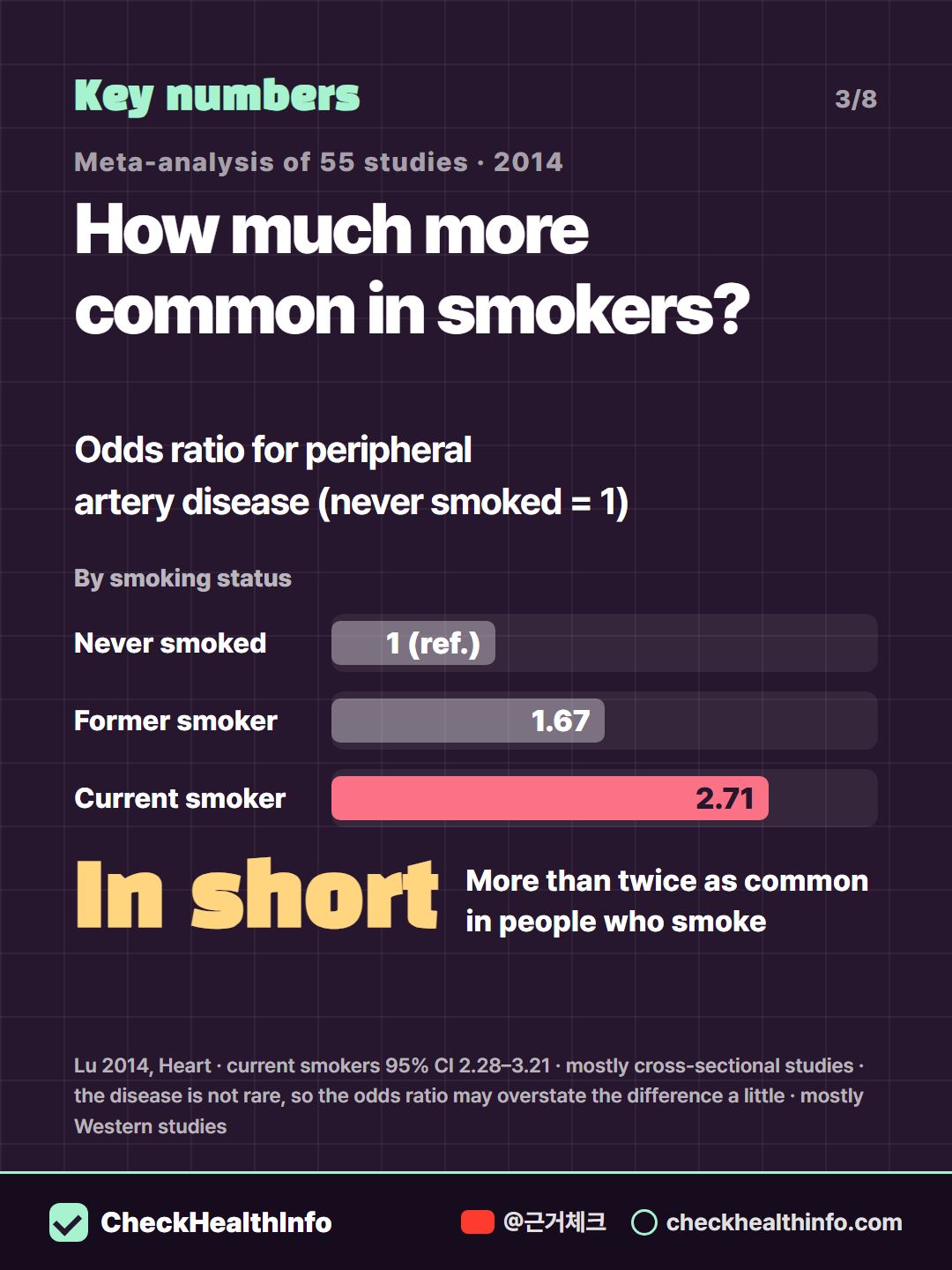
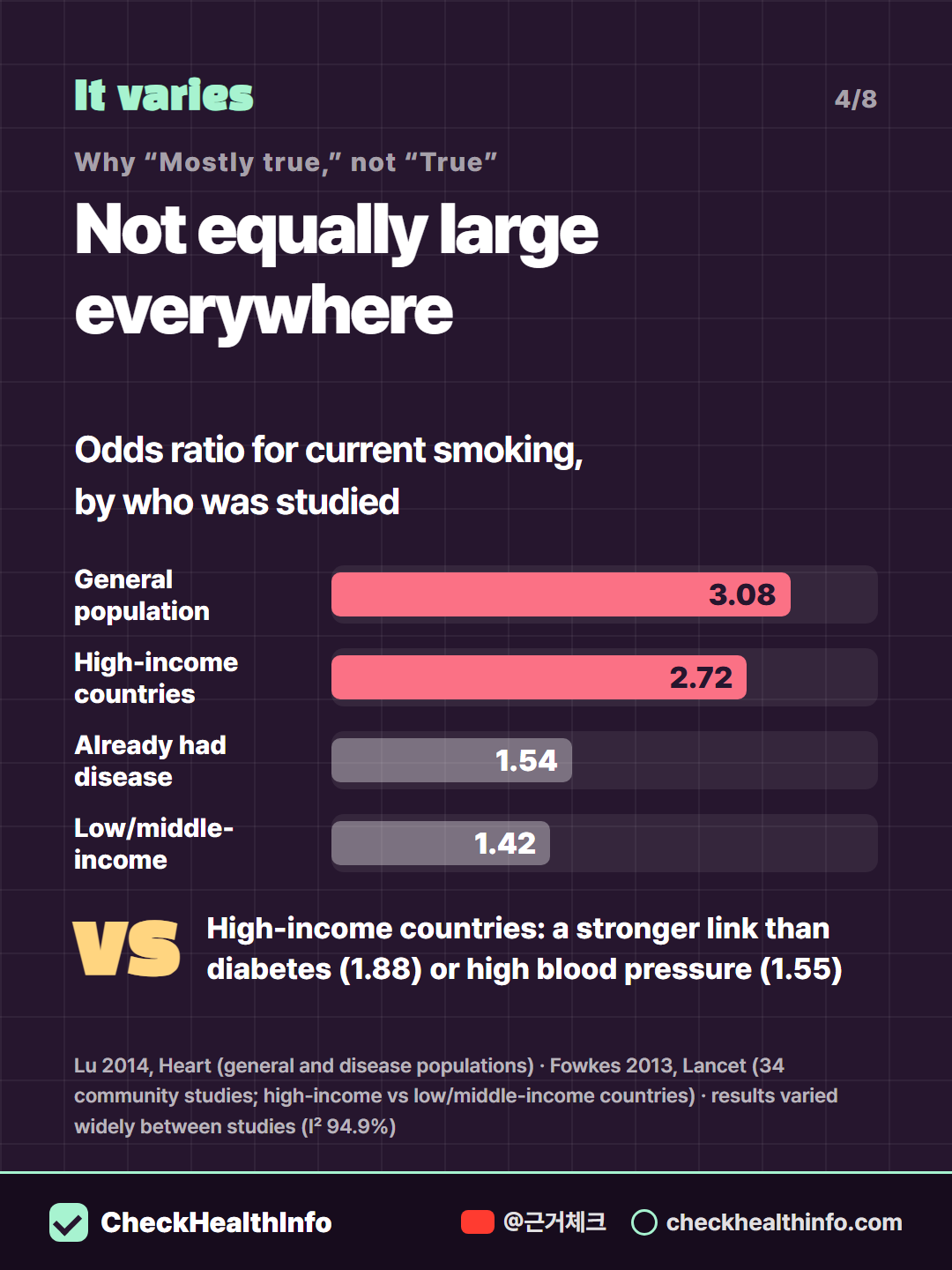
- A meta-analysis of 55 studies (43 cross-sectional, 10 cohort and 2 case-control) found an odds ratio for peripheral artery disease of 2.71 (95% confidence interval 2.28 to 3.21) in current smokers. It was 3.08 (2.56 to 3.69) in general populations and 1.54 (1.31 to 1.83) in groups who already had disease. The authors said the size of this link was greater than that previously reported for coronary heart disease. In plain terms, leg artery disease was more than twice as common in people who smoke. [1]
- A systematic review of 34 community studies (112,027 people) found odds ratios for current smoking of 2.72 (2.39 to 3.09) in high-income countries and 1.42 (1.25 to 1.62) in low- and middle-income countries. In high-income countries this was larger than for diabetes (1.88) or high blood pressure (1.55); in low- and middle-income countries it was similar to diabetes (1.47). [2]
- In a US cohort of 13,355 adults aged 45 to 64 followed for a median of 26 years, the more people had smoked (measured in pack-years), the more often peripheral artery disease developed. Of three diseases caused by hardening of the arteries (peripheral artery disease, coronary heart disease and stroke), the link was strongest for peripheral artery disease. [3]
- In a cohort of 44,985 US male health professionals, smoking, high blood pressure, high cholesterol and type 2 diabetes were each independently linked with peripheral artery disease, and 96% of the men who developed peripheral artery disease had at least one of them. Smoking is not the only cause. [4]
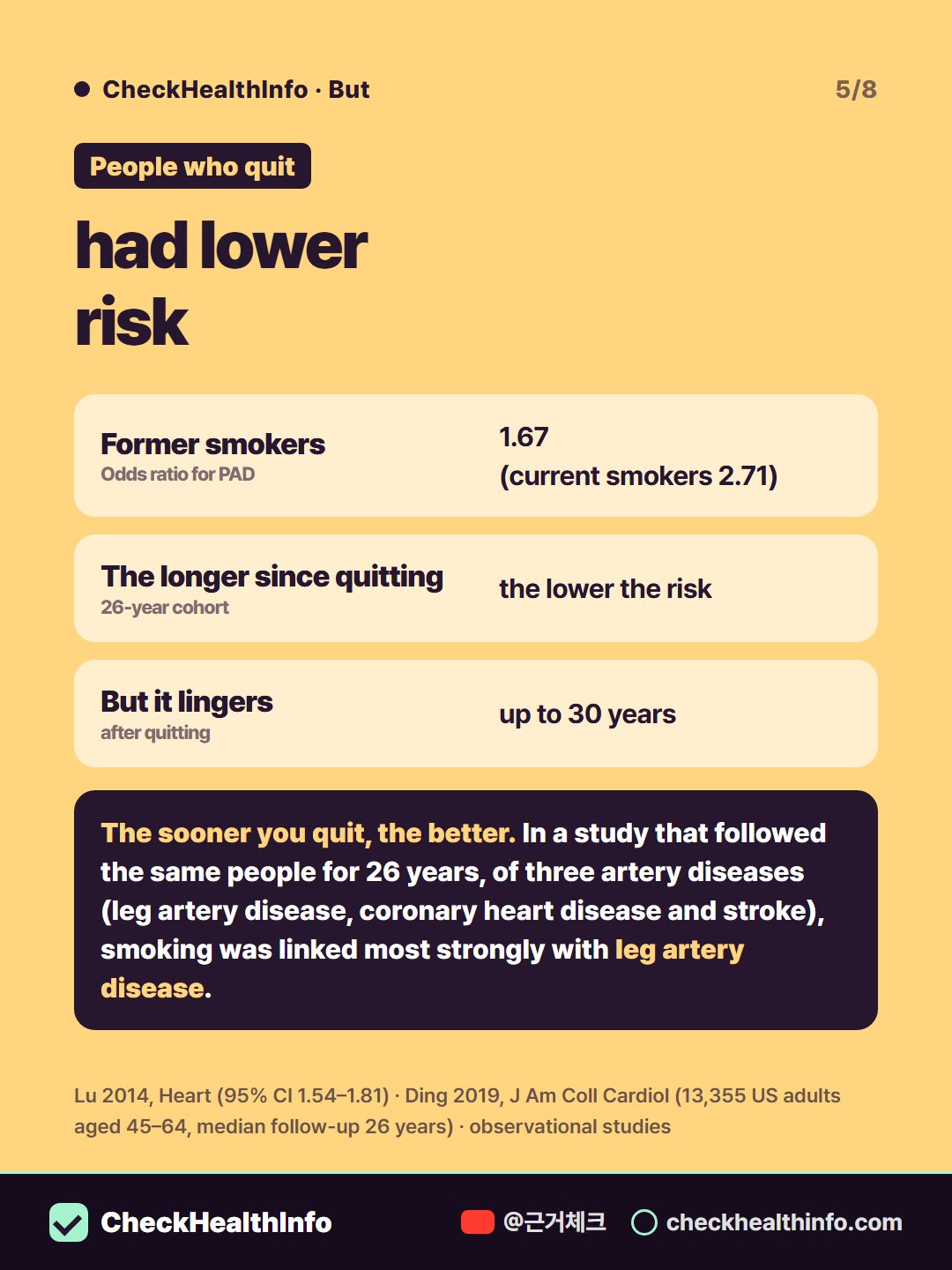
In the same meta-analysis, former smokers had an odds ratio of 1.67 (95% confidence interval 1.54 to 1.81), lower than current smokers (2.71) but still higher than people who had never smoked. [1] In the 26-year cohort, the longer people had been off cigarettes, the lower their risk, but the risk of peripheral artery disease stayed higher for up to 30 years after quitting (20 years for coronary heart disease). [3]
In plain terms, quitting lowers the risk, but the risk lingers, so the sooner you quit, the better.
Amputation can happen when peripheral artery disease becomes very severe. In our search, we found no meta-analysis that directly compared amputation risk in smokers and nonsmokers. In a cohort of 739 patients who already had symptoms of peripheral artery disease, among the 204 who smoked, those who quit within a year (61 people) had fewer deaths over 5 years than those who kept smoking (14% vs 31%; hazard ratio 0.40, 95% confidence interval 0.18 to 0.90), and more of them were alive without amputation (81% vs 60%; hazard ratio 0.43, 0.22 to 0.86). [5]
However, the difference came mostly from fewer deaths; it does not mean that amputations alone went down. Only 61 people quit, so the confidence intervals are wide, and because this was an observational study, other factors (for example, sicker patients being less able to quit) cannot be fully ruled out. Also, only people who quit within the first year and stayed quit were counted as quitters, so anyone who died during that year could not be in the quit group, which may have favored the quitters.
To protect the arteries in your legs
- Quit early — The longer people had been off cigarettes, the lower their risk, and the risk lingered for years. Ask your health care team or a stop-smoking program (such as a quitline) about ways to quit.
- See a clinician if your legs keep hurting when you walk — If your legs hurt while walking and the pain eases with rest, talk to a clinician. Many people have no symptoms, so if you smoke, ask about your leg arteries at your checkups.
- Also check blood pressure, blood sugar and cholesterol — Most patients had at least one of smoking, high blood pressure, high cholesterol or diabetes.
Scope: This verdict covers only the link between smoking and leg artery disease (lower-extremity peripheral artery disease) in adults, and what changes after quitting. It does not cover medicines to help people quit, artery procedures or e-cigarettes.
Limitations of this verdict
- Smoking cannot be randomly assigned, so all of these are observational studies, and most studies in the meta-analysis were cross-sectional (measured at one point in time), so they cannot directly show which came first.
- Results varied widely between studies (I² 94.9%), and there were signs that small studies may have skewed the results (Egger test p=0.023).
- When a disease is not rare, the odds ratio makes the difference look a little larger than it really is. That is why we wrote “more than twice as common.”
- The data come mostly from Western studies, and the link with smoking was smaller in low- and middle-income countries. We did not separately check Korean data.
- The grade follows section 1 of our rating method. We check for new studies in a monthly PubMed review, and if the verdict changes, we log it in our corrections.
Card news



Video (in Korean)
References
- Lu L, Mackay DF, Pell JP. Meta-analysis of the association between cigarette smoking and peripheral arterial disease. Heart 2014;100(5):414-23. PMID 23922053. PubMed abstract · Full article
- Fowkes FG, Rudan D, Rudan I, et al. Comparison of global estimates of prevalence and risk factors for peripheral artery disease in 2000 and 2010: a systematic review and analysis. Lancet 2013;382(9901):1329-40. PMID 23915883. PubMed abstract · Full article
- Ding N, Sang Y, Chen J, et al. Cigarette Smoking, Smoking Cessation, and Long-Term Risk of 3 Major Atherosclerotic Diseases. J Am Coll Cardiol 2019;74(4):498-507. PMID 31345423. PubMed abstract · Full article · Free full text
- Joosten MM, Pai JK, Bertoia ML, et al. Associations between conventional cardiovascular risk factors and risk of peripheral artery disease in men. JAMA 2012;308(16):1660-7. PMID 23093164. PubMed abstract · Full article · Free full text
- Armstrong EJ, Wu J, Singh GD, et al. Smoking cessation is associated with decreased mortality and improved amputation-free survival among patients with symptomatic peripheral artery disease. J Vasc Surg 2014;60(6):1565-71. PMID 25282696. PubMed abstract · Full article
General information only, not medical advice. It does not replace your own clinician’s diagnosis or treatment. If your legs keep hurting when you walk, talk to a clinician. Ask your health care team or a stop-smoking program (such as a quitline) about ways to quit.